
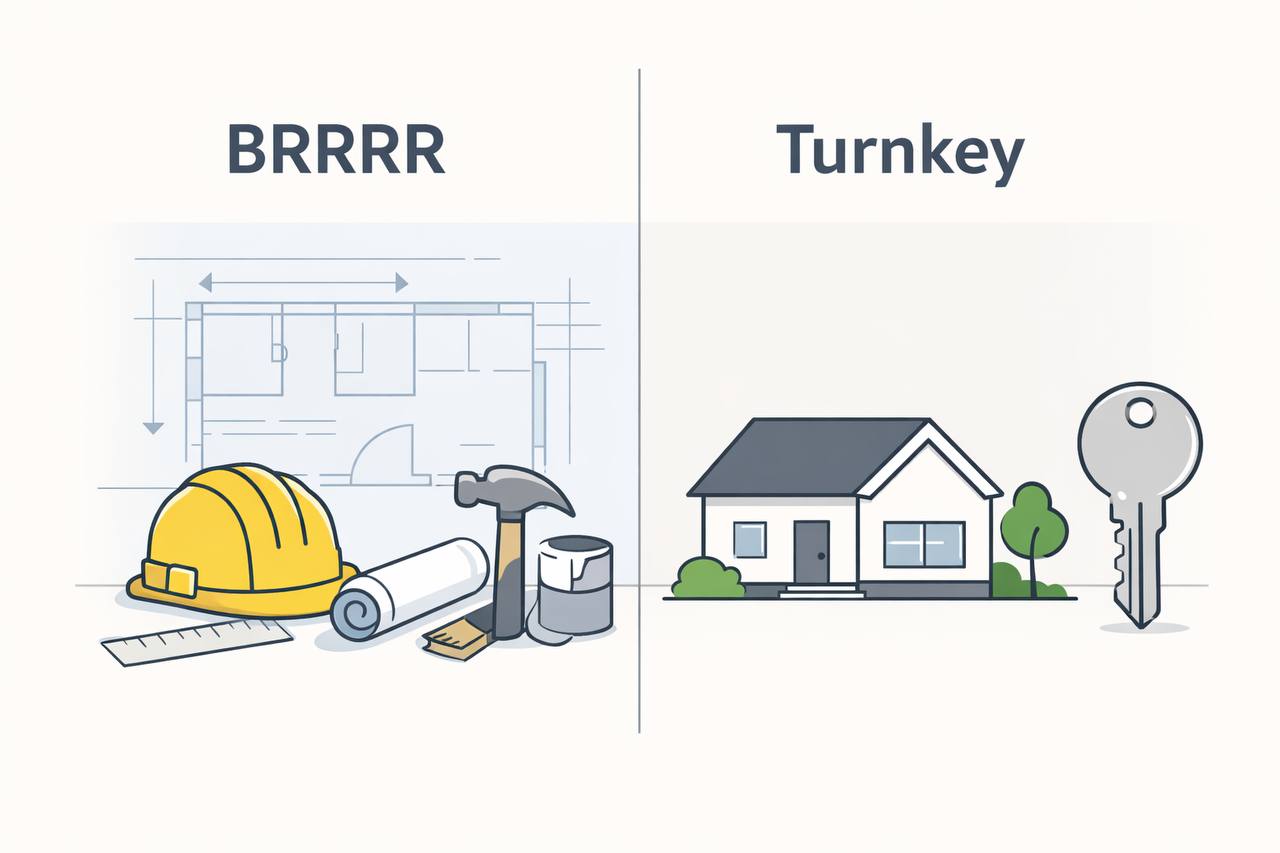
BRRRR vs. Turnkey: Control, Simplicity, and the Cost of Complexity
On this page
- BRRRR: Control & Complexity
- Turnkey: Speed & Simplicity
- Hidden Costs to Watch
- BRRRR hidden costs
- BRRRR example
- Turnkey hidden costs
- Turnkey example
- A quick way to frame the choice
- Which strategy wins on cash flow?
- Who BRRRR Fits
- Who Turnkey Fits
- Decision Framework
- 1. How much time do I actually have?
- 2. How much execution risk can I tolerate?
- 3. What am I optimizing for?
- 4. What does my portfolio need right now?
- 5. Which path would I still like on a bad day?
- What most investors get wrong
- The simplest way to think about it
- Final thought
- Where to go next
If you are trying to build a rental portfolio, the real question is usually not whether real estate can work.
The real question is how much operating complexity you want to buy along with the asset.
That is where the BRRRR vs. turnkey comparison matters.
On paper, both strategies can produce a good deal. In practice, they solve different problems.
BRRRR is built for control, forced appreciation, and capital recycling. Turnkey is built for speed, simplicity, and a cleaner path into ownership.
The wrong choice is not necessarily the one with the lower theoretical return. The wrong choice is the one that does not match your time, capital, skill stack, and tolerance for friction.
BRRRR: Control & Complexity
BRRRR stands for buy, rehab, rent, refinance, repeat.
That sequence is not just a strategy. It is an operating model.
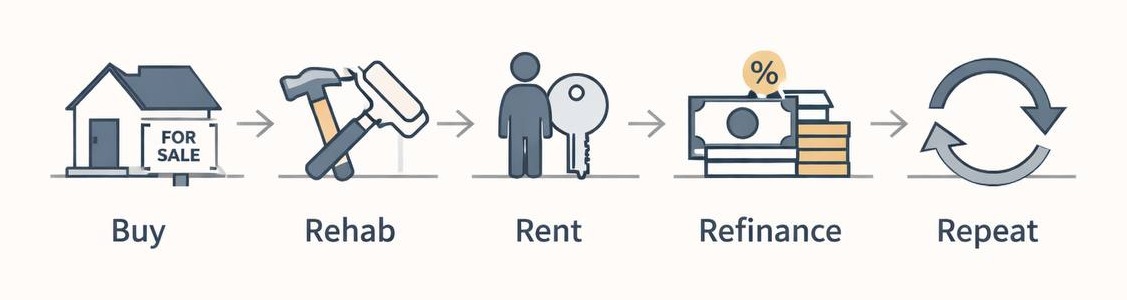
The goal is to buy an underperforming property, improve it, stabilize it with a tenant, and then refinance based on the new value so you can pull capital back out and move to the next deal.
That has a few advantages:
- you can create value instead of only buying it
- you may recycle capital faster than a straight buy-and-hold deal
- you can sometimes force equity through renovation rather than waiting for the market
- you keep more control over the final asset than a passive fund or managed pool
That is why BRRRR appeals to investors who like systems, execution, and optionality.
But the hidden assumption is simple: you are also buying a lot of complexity.
A BRRRR deal often requires:
- finding the right property
- estimating renovation scope correctly
- managing contractors
- controlling timelines
- handling vacancy during the transition
- qualifying for a refinance later
- absorbing some execution risk if the rehab or appraisal does not go as planned
That means BRRRR is not just a real estate strategy. It is a project-management strategy.
Turnkey: Speed & Simplicity
Turnkey is the opposite tradeoff.
Instead of buying a rougher asset and creating value through rehab, you buy a property that is already closer to rent-ready or already stabilized.
That usually means less renovation work, less management burden, and a faster path to holding an income-producing asset.

Turnkey tends to appeal to investors who want:
- quicker deployment
- fewer moving parts
- less active oversight
- a cleaner entry into rental ownership
- less time spent coordinating the deal
In other words, turnkey is often the better fit if your real constraint is not capital efficiency but bandwidth.
That matters more than most investors admit.
A strategy that looks less exciting can still be the better one if your goal is to keep your life simple and your process repeatable.
Hidden Costs to Watch
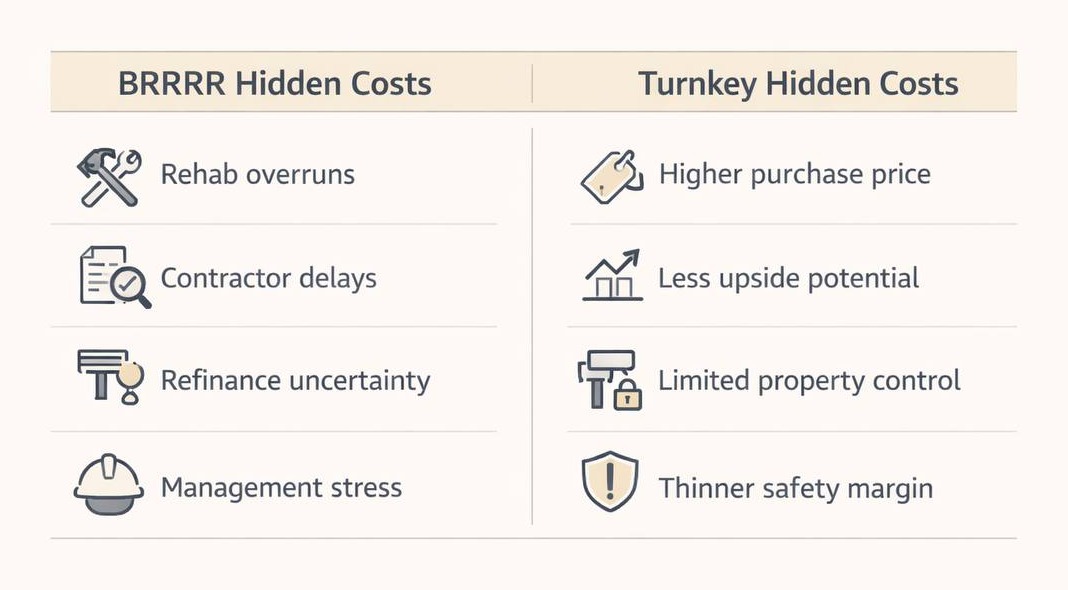
This is where people usually oversimplify the comparison.
They compare purchase price, projected rent, and maybe a rough cash-on-cash return.
That is not enough.
You also need to account for the costs that do not show up cleanly in the headline math.
BRRRR hidden costs
BRRRR can look powerful because it creates equity. But the operational costs can be real:
- rehab overruns
- contractor delays
- carrying costs during renovation
- refinance uncertainty
- appraisal risk
- management stress
- more time spent on the front end
If your renovation timeline slips, the deal can quietly become much less attractive.
BRRRR example
Investor A buys a $150k duplex, spends $40k on rehab, and refinances at $250k after stabilization. The upside is clear: equity creation and capital recycling. The tradeoff is equally clear: more moving parts, more timeline risk, and more coordination before the deal turns into a stable asset.
Turnkey hidden costs
Turnkey can look easier because it is cleaner. But the tradeoffs are still there:
- you may pay more for convenience
- there may be less upside from value creation
- you may have less control over the exact property improvements
- you may get a smaller margin of safety if you buy too close to retail pricing
So turnkey does not eliminate risk. It changes the shape of the risk.
Turnkey example
Investor B buys a $220k single-family home with a tenant already in place. Cash flow may start sooner, the process is simpler, and the operating burden is lower. The tradeoff is less upside from forced appreciation and less control over the value-creation process.
A quick way to frame the choice
The cleanest comparison is not “Which one makes more money?” It is “Which strategy asks for the kind of work I can actually do well?”
- BRRRR asks for execution. You need acquisition discipline, rehab judgment, contractor control, and refinance timing.
- Turnkey asks for underwriting discipline. You need to avoid overpaying for convenience and verify the operator, tenant quality, expenses, and market assumptions.
Both can work. Both can fail. The difference is where the failure points live.
Which strategy wins on cash flow?
This is the wrong first question, but it is still worth answering.
If you are only comparing monthly cash flow, BRRRR often looks stronger on paper because it can produce equity creation in addition to rental income.
But cash flow alone is not the whole picture.
You also need to ask:
- how much work did it take to get there?
- how much capital was tied up during the process?
- how long until the asset actually became stable?
- how much uncertainty did you absorb to get the result?
A more conservative turnkey deal may produce a lower headline return but a better real-life return if you value simplicity, faster execution, and lower stress.
That is why the better strategy depends on the investor.
Who BRRRR Fits
BRRRR tends to fit investors who:
- are comfortable managing projects
- can estimate rehab scope with some accuracy
- have reliable contractor access
- want to create equity instead of only buying it
- can tolerate delays and imperfect outcomes
- want to recycle capital into the next deal
If you are the type of investor who likes to build systems and optimize process, BRRRR can be a strong fit.
But it works best when the execution layer is real.
If you are not actually ready to manage a project, BRRRR can become a stress multiplier instead of a wealth multiplier.
Who Turnkey Fits
Turnkey tends to fit investors who:
- want to get started faster
- have less bandwidth for renovations
- prefer fewer moving parts
- want a simpler entry point into real estate
- value predictability over maximum upside
- want to own rentals without turning their life into a construction schedule
That does not make turnkey passive. It just makes it more operationally manageable.
For many readers, that is the actual win.
Decision Framework
If you are choosing between BRRRR and turnkey, ask these questions instead of starting with returns:
1. How much time do I actually have?
If you have the time and energy to manage a rehab, BRRRR may be worth the extra complexity.
If your schedule is already full, turnkey may be the better fit.
2. How much execution risk can I tolerate?
BRRRR rewards execution. Turnkey reduces the amount of execution required.
If execution risk keeps you from acting, that matters more than a slightly better projected return.
3. What am I optimizing for?
- If you want equity creation and capital recycling, BRRRR is usually more attractive.
- If you want simplicity and speed, turnkey is usually cleaner.
4. What does my portfolio need right now?
If your broader portfolio already has enough complexity, a simpler rental strategy may be more appropriate.
If your portfolio needs more active upside and you can handle the burden, BRRRR may be the more strategic move.
5. Which path would I still like on a bad day?
That question matters.
A strategy can look great in a spreadsheet and still be the wrong fit if you would resent the work required to make it function.
What most investors get wrong
The most common mistake is treating BRRRR as obviously superior because it sounds more sophisticated.
It is not automatically superior.
It is just more active.
And the more active a strategy is, the more likely it is to fail when the execution layer is weak.
The other mistake is assuming turnkey is boring and therefore inferior.
It is not.
If turnkey helps you move faster, stay consistent, and avoid the friction that would otherwise keep you on the sidelines, it can be the better wealth-building decision.
The simplest way to think about it
BRRRR is for investors who want to trade effort for control and upside.
Turnkey is for investors who want to trade some upside for simplicity and speed.
That is the real tradeoff.
Neither is universally better.
The better strategy is the one that matches the way you actually want to invest.
Final thought
The strongest rental strategy is not the one with the biggest mythology around it.
It is the one you can execute cleanly, repeat consistently, and hold through real-world friction.
If BRRRR fits your capacity, it can be powerful. If turnkey fits your life, it can be smarter.
The winning move is to choose the strategy that matches your constraints instead of chasing the one that sounds most impressive.
Where to go next
If you want to compare assumptions side by side — purchase price, rent, financing, expenses, and risk — run the numbers in DealAnalyzer. It is built to make these tradeoffs visible before you commit to a strategy.
Related NJL resources: