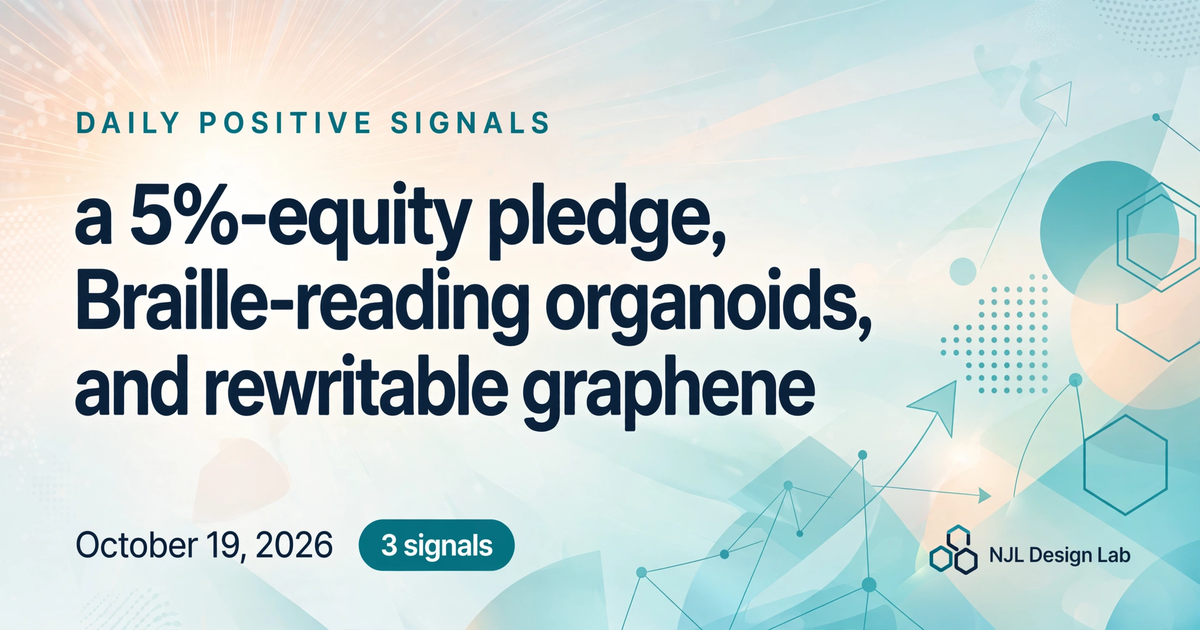
Daily Positive Signals: a 5%-equity pledge, organoids that read Braille, and rewritable graphene
On this page
Listen to this brief · about 4 min, story text only
This edition: an AI lab directing 5% of its shares to the public good, living brain tissue that can tell Braille letters apart, and graphene whose magnetism you can switch with voltage. The thread is rearrangement: new structure from old stuff.
In this edition · 3 signals
- An AI lab commits 5% of itself to the public good — AI governance
- Lab-grown brain tissue tells Braille letters apart — Biocomputing
- Graphene that flips magnetic with a nudge of voltage — Materials science
Signal 1 of 3 · AI governance
An AI lab commits 5% of itself to the public good
Anthropic has committed 5% of its shares to a new Anthropic Public Benefit Fund, set up as a wholly-owned LLC rather than a charity, with the board able to add 2% more for every 50% increase in the company’s value above a set baseline (Anthropic, 2026). The commitment is subject to stockholder approval, and none of the fund’s equity may be used for lobbying or political giving, in the US or abroad (Anthropic, 2026). Combined with the co-founders’ pledge of 80% of their equity and an employee equity-donation match program, roughly 20% of Anthropic’s shares are now dedicated to the public good (Anthropic, 2026; Reuters, 2026).
Why it matters. This turns a frontier lab’s windfall into a durable public resource rather than a one-off gift. Where yesterday’s edition covered outside examiners moving into Anthropic, this is the financial companion: opening the equity, not just the offices.
Evidence status: Company announcement (Oct 18) corroborated by Reuters and TechCrunch; the 5% commitment is subject to stockholder approval, and the fund’s governance details are still to come.
Signal 2 of 3 · Biocomputing
Lab-grown brain tissue tells Braille letters apart
Researchers at the University of Bristol placed human forebrain organoids — clusters of about 10,000 neurons, each under a millimeter across — on multielectrode arrays and fed them electrical patterns converted from a tactile sensor’s readings of the 26 Braille letters (Frontiers, 2026). A simple machine-learning decoder identified the letter from the organoids’ neural activity 61% of the time with one organoid and 83% with three working together (Frontiers, 2026). The trio also beat the decoder working directly on deliberately noisy signals, suggesting the living networks genuinely processed the information rather than passing it through (Frontiers, 2026; 404 Media, 2026). The team is explicit about the limit: the organoids relayed the signals but showed no learning or adaptation (Frontiers, 2026).
Why it matters. It’s the clearest demonstration yet of the missing interface for biohybrid computers: artificial sensors in, meaningful neural signals out.
Evidence status: Peer-reviewed paper in Frontiers in Artificial Intelligence (Oct 16) with publisher and independent summaries; the organoids relayed signals — no learning or long-term change was demonstrated.
Signal 3 of 3 · Materials science
Graphene that flips magnetic with a nudge of voltage
A Cornell team applied voltage to a stack of four graphene layers and watched the layers physically slide into a different atomic stacking, flipping the material between nonmagnetic and magnetic states (Cornell Chronicle, 2026). The new arrangement persists after the voltage is removed, making the switch nonvolatile — a state change the material holds on its own (Cornell Chronicle, 2026). The study, published in Nature Nanotechnology, shows stacking can be rewritten electrically on demand, where changing a material’s structure normally takes high heat or pressure (Brandon et al., 2026; phys.org, 2026). The honest limit: the magnetic phase survives only at a few kelvin, so this is a laboratory proof of concept, not a device (ScienMag, 2026).
Why it matters. It proves quantum properties can be rewritten with a gate voltage instead of rebuilt with chemistry. If the trick generalizes to other layered materials, device behaviors become switchable rather than fixed.
Evidence status: Peer-reviewed paper in Nature Nanotechnology (Oct 14) with Cornell institutional summary and independent coverage; the ferromagnetic phase is cryogenic — room-temperature behavior is unproven.
Editor’s note
Today’s thread is rearrangement. The same carbon atoms, stacked differently, are magnetic or not. The same neural tissue, working as a trio, filters noise better than one alone. None of today’s items invent a new substance or a new fortune — they find better arrangements of what was already there, and that may be the most reliable form of progress there is.
That’s the edition — three signals, every claim verified against its sources. Browse past briefs · tomorrow’s lands at 07:15.
The Progress Brief, by email
Useful progress, without the hype
The daily Positive Signals brief and the weekly deep dive, by email. Evidence-checked, concise, no doom.
Free. One daily email, one weekly email. Unsubscribe anytime.
References
- Anthropic. (2026, October 18). Investing in the public benefit. Anthropic Newsroom. https://www.anthropic.com/news/public-benefit-fund
- Brandon, D., Tan, T., Ai, Y., Nadel, K., Golemis, P., Gandhi, A., Min, L., Zheng, W., Watanabe, K., Taniguchi, T., Liu, M., Devakul, T., & Yasuda, K. (2026). Gate-induced layer sliding drives non-volatile switching of magnetism in tetralayer graphene. Nature Nanotechnology. https://doi.org/10.1038/s41565-026-02306-x
- Cornell Chronicle. (2026, October 14). Electrical sliding switches graphene between magnetic states. https://news.cornell.edu/stories/2026/10/electrical-sliding-switches-graphene-between-magnetic-states
- Frontiers. (2026, October 16). Mini brain organoids ‘reading’ Braille marks key step towards biohybrid computing. https://www.frontiersin.org/news/2026/10/electrical-sliding-switches-graphene-between-magnetic-states”>https://news.cornell.edu/stories/2026/10/electrical-sliding-switches-graphene-between-magnetic-states
- phys.org. (2026, October 17). Electrical sliding switches graphene between magnetic states. https://phys.org/news/2026-10-electrical-graphene-magnetic-states.html
- Reuters. (2026, October 18). Anthropic to commit 5% stake to new public benefit fund. https://www.reuters.com/business/anthropic-commit-5-stake-new-public-benefit-fund-2026-10-18/
- ScienMag. (2026, October 17). Voltage-driven atomic sliding flips magnetism on and off in tetralayer graphene. https://scienmag.com/voltage-driven-atomic-sliding-flips-magnetism-on-and-off-in-tetralayer-graphene/
- TechCrunch. (2026, October 18). Anthropic says it’s committing 5% of its shares to a ‘public benefit fund’. https://techcrunch.com/2026/10/18/anthropic-says-its-committing-5-of-its-shares-to-a-public-benefit-fund/
- 404 Media. (2026, October 16). Computers made of human brain tissue identify Braille letters in breakthrough. https://www.404media.co/computers-made-of-human-brain-tissue-identify-braille-letters-in-breakthrough/