
AGI and Household Resilience
Preparing a household for more than one future.
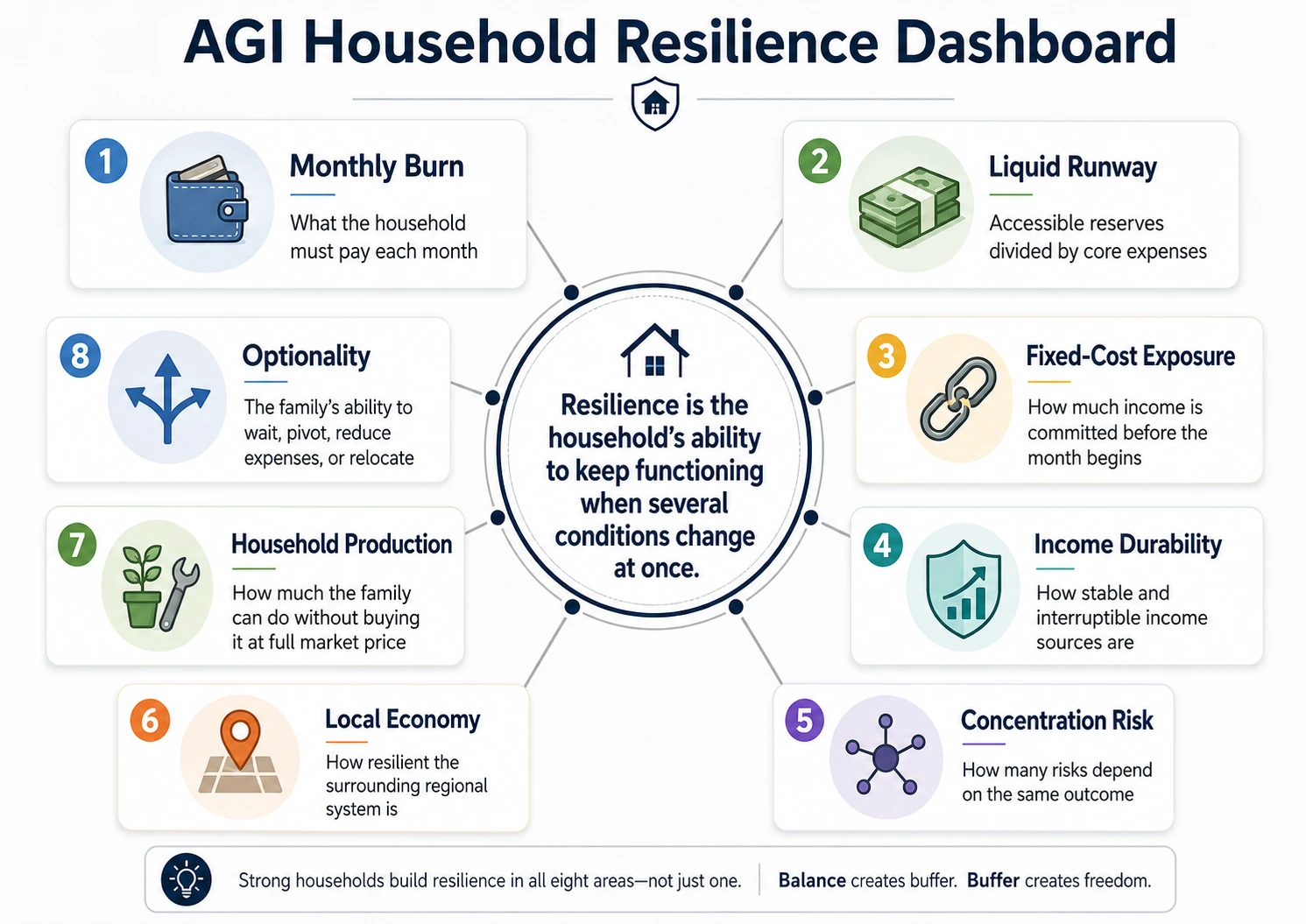
AI capability, work, money, housing, children, community, robotics, and government policy are connected. This reading path keeps the evidence, the uncertainty, and the household decisions in the same frame.
Editorial position
Prepare for the range, not one prediction.
No one knows exactly when AGI will arrive or which definition will matter most. The series separates technical capability from deployment, physical transformation, institutional response, and the actions that remain useful if the forecast is wrong.
It is research and planning material, not a promise that one scenario will come true.
Reading path
Ten connected questions.
Read in order for the full arc, or start with the question closest to your household.
What Is AGI?
A practical definition, progress markers, and the difference between capability and impact.
Preparing for Different AGI Timelines
How to prepare for rapid, gradual, delayed, and uneven transitions.
Raising Children in the Age of AGI
Skills, education, agency, and judgment when tools change quickly.
Building Local Community Resilience
Why household preparation cannot stop at the front door.
Robotics and the Physical Economy
What changes when intelligence reaches machines, infrastructure, and physical work.
AI, Government, and the Social Contract
UBI, services, ownership, agency, and the policy choices ahead.
AGI and Financial Independence
How AI changes the assumptions behind income, investing, and independence.
Household Self-Sufficiency in the Age of AGI
Cost, resilience, optionality, and practical household capacity.
The AGI Mortgage Trap
Housing decisions when work and location may change faster than a loan.
The AGI Career Transition Playbook
Protect income by mapping tasks, building optionality, and watching evidence.
Continue beyond the articles
Turn the questions into working decisions.
Projects, tools, and household systems are where the ideas get tested against real constraints.