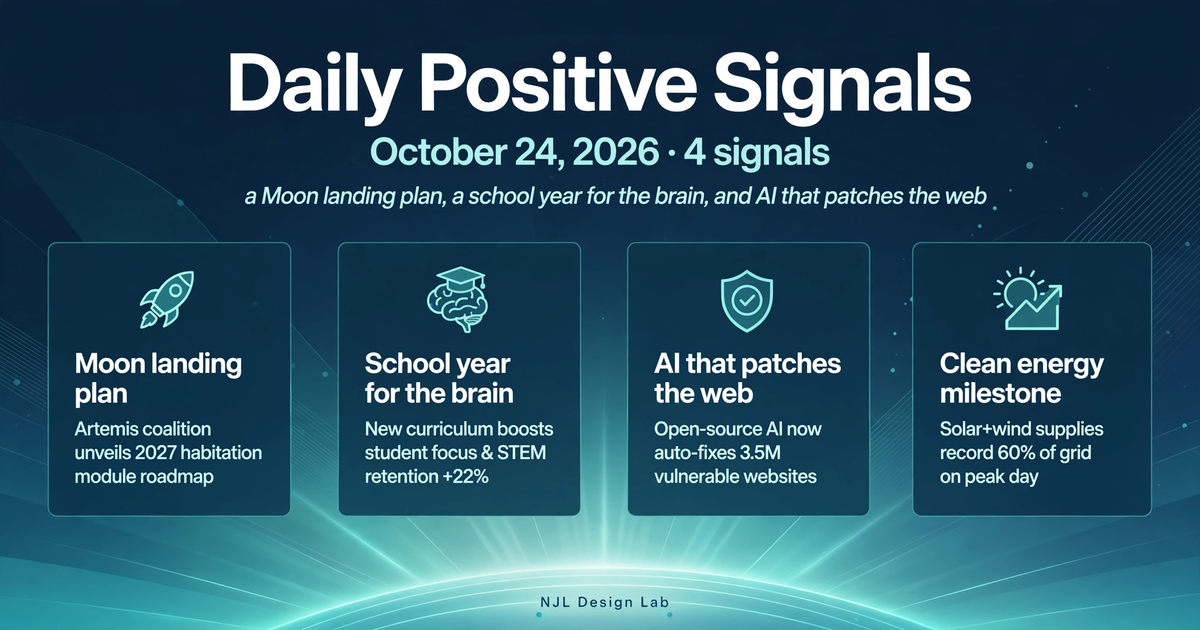
Daily Positive Signals: a 2028 Moon landing, an extra school year, and AI that patches the web
On this page
- NASA rehearses the Moon landing in Earth orbit first
- One extra year of school still protects brains 50 years later
- A precision T-cell therapy that stalls treatment-resistant tumors
- AI found two critical flaws in the web — before attackers did
- Useful progress, without the hype
- Know someone this would help?
- References
Listen to this brief · about 5 min, story text only
This edition: NASA’s Moon return gets a two-step plan — a full rehearsal in Earth orbit in 2027, then astronauts back on the surface in 2028; a 1972 school reform that is still cutting dementia diagnoses 50 years later; an experimental T-cell therapy that stalled tumors other immunotherapies couldn’t touch; and AI models that found — and helped patch — two critical flaws in the code behind roughly 70% of the web. The thread: this week’s best wins came from preparing before the crisis.
In this edition · 4 signals
Signal 1 of 4 · Space
NASA rehearses the Moon landing in Earth orbit first
NASA has restructured Artemis III into a full-dress rehearsal: in 2027, four astronauts aboard Orion will rendezvous and dock in low Earth orbit with test versions of the lunar landers from SpaceX and Blue Origin — three spacecraft launched on three different heavy-lift rockets (NASA, 2026a). The 14-day mission, crewed by Randy Bresnik, Frank Rubio, Andre Douglas, and ESA astronaut Luca Parmitano, tests the rendezvous, docking, and habitation procedures the landings will need, with astronauts boarding the Blue Origin test article for two days of evaluation (NASA, 2026a). In parallel, both companies have streamlined their lander designs and operations: Starship will fuel at an orbital depot and dock with Orion in Earth orbit, while Blue Origin’s Blue Moon uses three transfer stages to reach an elliptical polar orbit (NASA, 2026b; AP, 2026). Whichever company proves ready first will fly the Artemis IV surface mission in 2028 (NASA, 2026b).
Why it matters. The biggest risk in the Moon program isn’t the rockets — it’s two companies’ landers meeting Orion for the first time. Flying that encounter in Earth orbit, where help is hours away rather than days, is the cheapest way to retire it.
Evidence status: Agency announcements plus independent press reporting (AP). The 2028 landing is a target, not an achieved milestone — both lander programs face known schedule risks flagged by NASA’s own auditors, and no crewed landing has been assigned yet.
Signal 2 of 4 · Medicine
One extra year of school still protects brains 50 years later
A 1972 British law that raised the minimum school-leaving age from 15 to 16 — for students born after September 1, 1957 — boosted the share staying in school to 16 by 14%, giving researchers a natural experiment on whether education actually causes lower dementia risk (NIH, 2026). In a study of more than 100,000 UK Biobank participants, published October 23 in the Proceedings of the National Academy of Sciences, the reform reduced Alzheimer’s disease and related dementia diagnoses up to 50 years later — believed to be the first causal evidence for that link (NIH, 2026; USC Schaeffer, 2026). The effect was strongest in participants with genetic variants linked to higher Alzheimer’s risk, suggesting schooling can partly offset inherited vulnerability (NIH, 2026).
Why it matters. Dementia prevention has almost no proven levers, and genetic risk has felt like a fixed sentence. This says a school year is a hedge against even high inherited risk — and policy made decades ago is still paying out.
Evidence status: NIH-funded, peer-reviewed study in PNAS. Limit: participant ages were capped at 65, so the group differences could change as the cohort ages. Education likely bundles socioeconomic benefits too, which the study did not fully separate.
Signal 3 of 4 · Biotech
A precision T-cell therapy that stalls treatment-resistant tumors
The experimental drug invikafusp alfa (invika), developed by Marengo Therapeutics, selectively activates a narrow subset of tumor-fighting T cells — avoiding the indiscriminate activation that makes many T-cell therapies brutally toxic (NIH, 2026). In the phase 1/2 START-001 trial, led by the NIH, Mass General Brigham, and Memorial Sloan Kettering and published October 23 in Nature Medicine, the drug was well tolerated and stopped progression in 16 of 27 patients treated at the optimal dose — most with solid tumors that had resisted standard immunotherapy (NIH, 2026; MedicalXpress, 2026). Four patients (14.8%) had tumors shrink by over 30%, including two with notoriously treatment-resistant metastatic colorectal cancer receiving it as a seventh-line therapy (MedicalXpress, 2026). The FDA has granted the drug Fast Track designation for metastatic colorectal cancer (MedicalXpress, 2026).
Why it matters. For patients whose tumors shrug off checkpoint immunotherapy, options run out fast. A drug that rallies T cells precisely — and tolerably — could give them one more move.
Evidence status: Peer-reviewed phase 1/2 trial in Nature Medicine, but early: 27 patients at the optimal dose, preliminary efficacy signal, side effects manageable (flu-like symptoms) at optimal doses. Larger trials will decide whether this becomes a therapy.
Signal 4 of 4 · AI + Security
AI found two critical flaws in the web — before attackers did
Two critical vulnerabilities in PHP, tracked as CVE-2026-109618 and CVE-2026-109619 and collectively dubbed PHP2Shell, allowed attackers to run code on a web server without any authentication (OpenAI, 2026; The Week, 2026). Security firm Calif discovered a flaw using OpenAI’s GPT-5.6 Sol under OpenAI’s “Patch the Planet” initiative, while Google-owned Wiz independently found both using Gemini 4 Argon (OpenAI, 2026; The Week, 2026). OpenAI then spent two months coordinating with PHP’s maintainers, Cloudflare, and U.S. cyber agencies before the October 21 disclosure, and PHP has shipped emergency patches (versions 8.2.35 through 8.5.12) (OpenAI, 2026). Alongside the disclosure, OpenAI committed $1 billion in subsidized access to its Daybreak security program for organizations defending essential services (OpenAI, 2026).
Why it matters. AI can now hunt vulnerabilities at a scale human auditors can’t match — this time it was used to find-and-fix before exploits, with two months of coordinated patching. That’s the defensive playbook the internet needs as the same capabilities reach attackers.
Evidence status: Company announcement corroborated by multiple independent outlets (The Week, Oossa, Confirmed Security) and confirmed by PHP Foundation emergency releases plus NSA/CISA advisories. “One of the most impactful security issues in recent memory” is OpenAI’s own framing; the two-month “before attackers did” claim is to OpenAI’s knowledge, not independently proven.
Editor’s note
The pattern across today’s signals is preparation over reaction. NASA will fly the whole mission in Earth orbit before trusting it at the Moon, retiring the riskiest maneuver where help is hours away. A 1972 education law is paying out as dementia protection half a century later — an unglamorous policy decision, still compounding. The invika trial moved carefully from dose-finding to an optimal dose, and still called its results preliminary. And the PHP flaws were hunted down and patched before attackers ever saw them. None of these were accidents. They were the payoff of doing the quiet work first.
That’s the edition — four signals, every claim verified against its sources. Browse past briefs · tomorrow’s lands at 07:15.
The Progress Brief, by email
Useful progress, without the hype
The daily Positive Signals brief and the weekly deep dive, by email. Evidence-checked, concise, no doom.
Free. One daily email, one weekly email. Unsubscribe anytime.
References
- AP. (2026, October 24). NASA adopting Apollo’s urgency to build a Moon base and land astronauts within two years. https://www.etvbharat.com/en/technology/nasa-adopting-apollos-urgency-to-build-a-moon-base-and-land-astronauts-within-two-years-enn26102400508
- MedicalXpress. (2026, October 23). A precision T-cell therapy stalls treatment-resistant cancers in clinical trial. https://medicalxpress.com/news/2026-10-precision-cell-therapy-stalls-treatment.html
- NASA. (2026a, October 23). NASA’s Artemis III mission to test future Moon lander operations. https://www.nasa.gov/missions/artemis/nasas-artemis-iii-mission-to-test-future-moon-lander-operations/
- NASA. (2026b, October 23). NASA, partners accelerate lander development for 2028 Moon missions. https://www.nasa.gov/missions/artemis/nasa-partners-accelerate-lander-development-for-2028-moon-missions/
- NIH. (2026, October 23). An extra year of secondary school lowered dementia diagnoses later in life. NIH, 2026
- NIH. (2026, October 23). A precision T-cell therapy stalls treatment-resistant cancers in clinical trial. https://www.nih.gov/news-events/news-releases/precision-t-cell-therapy-stalls-treatment.html
- OpenAI. (2026, October 21). Patch the Planet: Global response coordination as agents uncover critical vulnerabilities. https://openai.com/index/coordinated-disclosure-of-critical-vulnerabilities
- The Week. (2026, October 22). PHP vulnerabilities patched: Did you update your website server?. https://www.theweek.in/news/sci-tech/2026/10/22/update-php-server-security.amp.html
- USC Schaeffer. (2026, October 23). More education reduces dementia risk decades later. https://schaeffer.usc.edu/research/more-education-reduces-dementia-risk-decades-later/