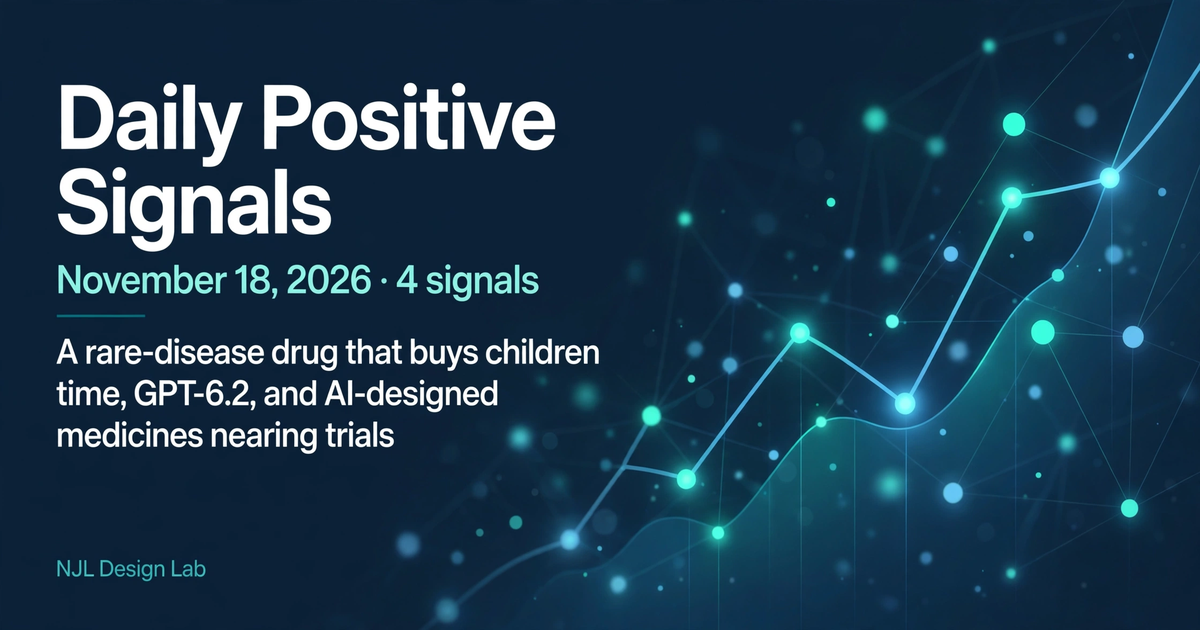
Daily Positive Signals: a rare-disease drug that buys children time, GPT-6.2, and AI-designed medicines nearing trials
On this page
Listen to this brief · about 5 min, story text only
This edition: the first drug shown to extend survival in infantile-onset Niemann-Pick disease; OpenAI’s GPT-6.2 pair, scoring higher on independent benchmarks at lower cost; a record $5 billion to push AI-designed medicines toward human trials; and a detector that keeps up as AI writing evolves. The thread: every claim tested against something real.
In this edition · 4 signals
Signal 1 of 4 · Medicine
The first drug shown to help children with a rare disease live longer
The U.S. Food and Drug Administration has approved Lembaz (adrabetadex), the first treatment shown to help people with infantile-onset Niemann-Pick disease type C live longer (FDA, 2026). The approval covers adults and children weighing at least 7 kilograms whose neurological symptoms began before age 6, the most serious form of the disease (FDA, 2026). In the FDA’s review, 36 treated patients across three clinical studies and an expanded access program lived longer than matched external controls, with a 55% lower risk of death and median survival of 8.5 years against 4.9 (FDA, 2026; Pharmacy Times, 2026). Beren Therapeutics expects Lembaz at treatment sites nationwide in early December (Pharmacy Times, 2026).
Why it matters. Niemann-Pick type C affects about 1 in 150,000 people, and the two previously approved therapies were never shown to reduce the risk of death. This is the first option that changes the survival outlook for the youngest, hardest-hit patients.
Evidence status: FDA approval announcement (November 17, 2026), independently covered by Pharmacy Times. Limits: the survival comparison used matched external controls, not a randomized trial; Lembaz carries a boxed warning for hearing impairment, including permanent hearing loss, and is given by injection into the spinal canal every two weeks.
Signal 2 of 4 · AI
GPT-6.2 arrives: stronger models, cheaper to run
OpenAI has released GPT-6.2 Astra, its new frontier model for demanding work, and GPT-6.2 Sol, its efficient everyday model, in ChatGPT Work, Codex, and the API (OpenAI, 2026). On OpenAI’s Agents’ Last Exam, which tests long professional workflows, Astra scored 5.2 points above GPT-6 Astra at less than a third of the cost, and 5.5 points above Claude Fable 5.2 at 5% of the cost (OpenAI, 2026). Sol came within half a point of Astra on Cognition’s FrontierCode 2.0 coding benchmark at about one-fifth the cost, and Astra’s API prices fell 20% to $8 per million input tokens (OpenAI, 2026). Independent evaluator Artificial Analysis scored Astra at 62 on its Intelligence Index, up from 57 for GPT-6 Astra, and Sol at 57, up from 55 (WinBuzzer, 2026).
Why it matters. The cheaper model now nearly matches the flagship on real coding work, which puts frontier capability within reach of smaller teams. Astra also set a new high on a benchmark for scientific work — the November 8 deep dive asked whether AI can do science yet, and this is one more data point.
Evidence status: Company announcement (November 17, 2026), independently covered by WinBuzzer with Artificial Analysis scores. Limits: most benchmark figures are OpenAI’s own; Astra is OpenAI’s first externally released model rated High for AI self-improvement risk, and both models ship with tighter safeguards for higher-risk cybersecurity help.
Signal 3 of 4 · Biotech
$5 billion to take AI-designed medicines into human trials
Isomorphic Labs, the AI drug-discovery company spun out of Google DeepMind, has raised $5 billion in a Series C round to move its first AI-designed drug candidates toward clinical trials (TechCrunch, 2026). The round was co-led by Greenoaks and Sequoia Capital, with Andreessen Horowitz joining, and follows a $2.1 billion Series B in May (TechCrunch, 2026; Reuters, 2026). The money will mature IsoDDE, the company’s drug-design engine, and build the clinical development infrastructure needed to run human studies (Reuters, 2026). Isomorphic reports positive preclinical results in oncology and immunology programs, and lists Novartis, Eli Lilly, and Johnson & Johnson as partners (Reuters, 2026).
Why it matters. No AI-designed drug has yet reached patients, so the test now moves from the lab to the clinic. The raise — the largest venture round in biotech history, according to BioSpace — funds the expensive part: proving the molecules work in people. DeepMind’s AlphaGenome 2, covered in the November 12 brief, reads DNA variants cell by cell; the same family of tools is now pointing at drug design.
Evidence status: Company announcement (November 17, 2026), independently covered by TechCrunch and Reuters. Limits: Isomorphic has disclosed no human trial, named candidate, or trial date; its results so far are preclinical, and the founder’s goal of first trials by the end of 2026 remains unconfirmed.
Signal 4 of 4 · AI research
AI text detectors that learn as the writing changes
Researchers at MIT and Cornell Tech have shown that AI text detectors can keep working as writing styles change, by letting the detector adapt after deployment instead of freezing it at release (Zewe, 2026). Their method, test-time adaptation, lets a deployed detector learn from new, unlabeled text as it arrives, adjusting itself on the fly (Ren et al., 2026). In experiments, a commercial detector caught only 27% of AI-generated text disguised to look human, while the adapted detector caught more than 93% (Zewe, 2026; Ren et al., 2026). On text that mimicked natural shifts in human writing over time, the adapted detector reached 85% accuracy against 73% for standard methods (Zewe, 2026).
Why it matters. Detectors are used by teachers, editors, and publishers, but they go stale the moment new models appear or writers change habits. A detector that updates itself closes the gap between the tool and the text it has to judge.
Evidence status: Peer-reviewed conference paper to be presented at NeurIPS, plus MIT News summary (November 18, 2026). Limits: the researchers caution the method may not always work as future models write more naturally and verifiable human text gets harder to find; the results are experimental, not a deployed product.
Editor’s note
Every signal today is a claim put to a test. Lembaz was approved on survival data, not a surrogate measure. GPT-6.2 was scored by an independent evaluator as well as its maker. Isomorphic’s $5 billion buys the clinical trials that will prove or disprove its drug-design engine. And the MIT detector was measured against text designed to defeat it. Progress you can check is the only kind worth reporting.
That’s the edition — four signals, every claim verified against its sources. Browse past briefs · tomorrow’s lands at 07:15.
The Progress Brief, by email
Useful progress, without the hype
The daily Positive Signals brief and the weekly deep dive, by email. Evidence-checked, concise, no doom.
Free. One daily email, one weekly email. Unsubscribe anytime.
References
- FDA. (2026, November 17). FDA approves first drug shown to help patients with infantile-onset Niemann-Pick disease type C live longer. https://www.fda.gov/news-events/press-announcements/fda-approves-first-drug-shown-help-patients-infantile-onset-niemann-pick-disease-type-c-live-longer
- OpenAI. (2026, November 17). Introducing GPT-6.2 Astra and Sol. https://openai.com/index/introducing-gpt-6-2-astra-sol
- Pharmacy Times. (2026, November 17). Adrabetadex becomes first therapy shown to extend survival in infantile-onset Niemann-Pick disease type C. https://www.pharmacytimes.com/view/adrabetadex-becomes-first-therapy-shown-to-extend-survival-in-infantile-onset-niemann-pick-disease-type-c
- Ren, K., Raghavan, M., & Garg, N. (2026). Hitting a moving target: Test-time adaptation for AI text detection under continual distribution shift. arXiv. https://arxiv.org/abs/2606.25152
- Reuters. (2026, November 17). AI drug developer Isomorphic raises $5 billion in Series C round. https://www.reuters.com/legal/litigation/ai-drug-developer-isomorphic-raises-5-billion-series-c-round-2026-11-17/
- TechCrunch. (2026, November 17). Isomorphic Labs raises $5B as it looks to take drug candidates to clinical trials. https://techcrunch.com/2026/11/17/isomorphic-labs-raises-5b-as-it-looks-to-take-drug-candidates-to-clinical-trials/
- WinBuzzer. (2026, November 17). OpenAI releases GPT-6.2 with higher performance and speed at lower cost. https://winbuzzer.com/2026/11/17/gpt-6-2-scores-higher-at-lower-cost-in-ai-tests-xcxwbn/
- Zewe, A. (2026, November 18). Helping AI text detectors keep up with changing conditions. MIT News. https://news.mit.edu/2026/helping-ai-text-detectors-keep-up-with-changing-conditions-1118