Daily Positive Signals: a geothermal first, AI hearing glasses, and repairable 3D prints
On this page
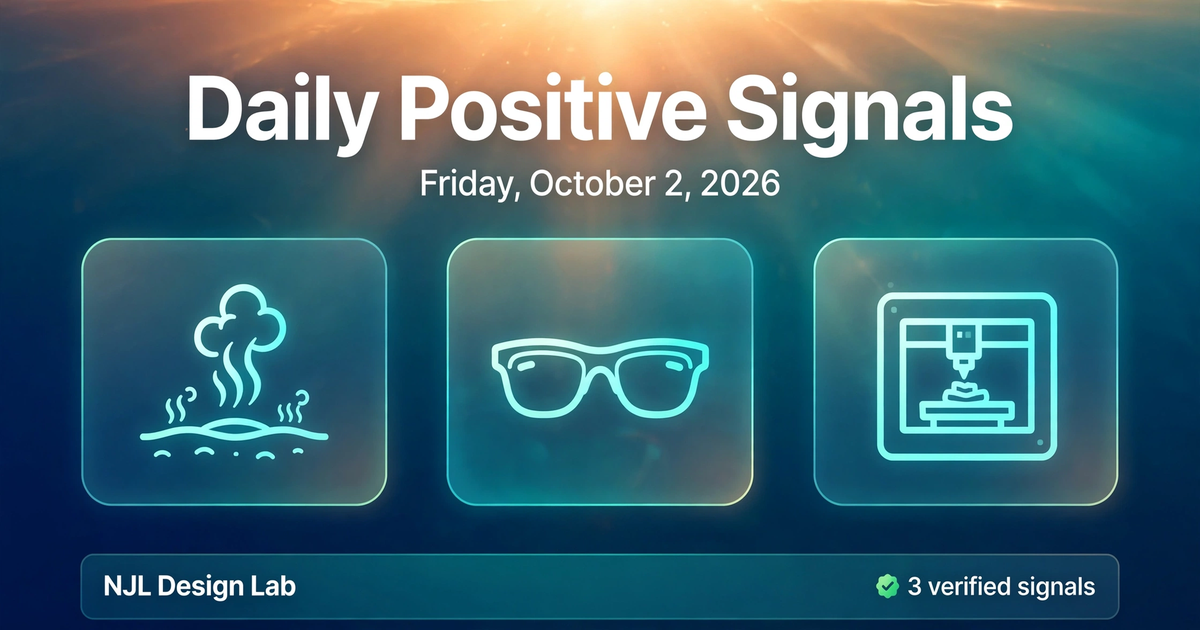
Fervo Energy brought the first commercial enhanced-geothermal plant online ahead of schedule, a startup launched AI-powered hearing glasses at $999 to take on the hearing-aid stigma problem, and MIT researchers gave novices a way to fix AI-generated 3D designs before printing. The thread: this week’s wins all moved from prototype to something you can buy, sell, or use.
In this edition · 3 signals
Signal 1 of 3 · Energy
The world’s first enhanced-geothermal plant starts selling power
Fervo Energy announced October 1 that its first power plant at Cape Station in Beaver County, Utah, reached commercial operation on September 30, one day ahead of its contractual date, and is now generating revenue under a power purchase agreement (Fervo Energy, 2026). The first GeoBlock produces 33 megawatts of net power, which Fervo says makes it the first greenfield enhanced geothermal development in the world to reach commercial operations. The plant synchronized with the grid on September 24, and Fervo built and commissioned the first block in 23 months, with future blocks targeted at 18 months (TechCrunch, 2026).
Why it matters. Enhanced geothermal drills into deeper, hotter rock, so it can deliver around-the-clock carbon-free power in places conventional geothermal cannot reach. Google and Southern California Edison have already signed on as buyers, and data-center operators are watching closely (TechCrunch, 2026).
Evidence status: Company announcement plus independent press coverage; two of the three Phase 1 GeoBlocks are still being commissioned, and the “world’s first” claim is the company’s.
Signal 2 of 3 · Medtech
AI hearing glasses launch, aiming past the hearing-aid stigma
Hearing tech startup Legato announced October 1 that its Legato Frames are available in the United States, combining AI-powered hearing assistance and prescription lenses in one pair of glasses for adults with up to moderate hearing loss (Legato, 2026). The AI separates voices from background noise while an open-ear dual-speaker system directs sound toward the wearer, and all processing happens on the glasses with no cameras or recording (Malik, 2026). The startup recently emerged from stealth with $12 million in funding from Neotribe Ventures, Listen, and Village Global, and plans to sell through eye-care providers where purchases may qualify for vision insurance (Malik, 2026).
Why it matters. An estimated 50 million US adults have recognized hearing loss, and the company says 80% of those who could benefit from hearing aids do not use them, often over cost, comfort, or stigma (Legato, 2026). Selling hearing help through the eye doctor, in a product that does not look medical, attacks exactly those barriers.
Evidence status: Company announcement plus independent press coverage; no published independent hearing-performance data yet; designed for adults with up to moderate hearing loss.
Signal 3 of 3 · AI research
A repair kit for AI-generated 3D models that works in novices’ hands
Researchers at MIT’s Computer Science and Artificial Intelligence Laboratory (CSAIL), with Google and Northeastern University, built InstructMesh, a tool that repairs AI-generated 3D models before fabrication (Shipps, 2026). It pairs Microsoft’s TRELLIS generator with the GPT-4 language model: users highlight a flawed region, describe the problem in plain language or use sliders, and the tool applies the fix in the model’s latent representation. To test it, the team had TRELLIS recreate popular Thingiverse models and found nearly 80% were structurally flawed; novices using InstructMesh identified and repaired the flaws about 90% of the time, as judged by an expert (Shipps, 2026; Faruqi et al., 2026).
Why it matters. Generative 3D tools know what objects should look like, not how they should work, which is why a printed mug can come out unable to hold coffee. Giving beginners a way to fix that gap turns AI design from decoration into fabrication.
Evidence status: MIT News report on an arXiv preprint, with independent coverage; user studies run by the research team; conference presentation planned for November.
Editor’s note
Today’s three signals share one shape: a prototype becoming a product. Fervo took enhanced geothermal from a first-of-its-kind demonstration to a plant selling power to the grid; Legato took hearing technology from stealth to store shelves; and InstructMesh took generative 3D design from broken prints to objects a beginner can repair. All three are still early, and the companies’ headline claims deserve the independent confirmation each edition demands, but none of them is “someday” anymore.
That’s the edition — three signals, every claim verified against its sources. Browse past briefs · tomorrow’s lands at 07:15.
References
- 3DPrinting.com. (2026). MIT researchers let users repair AI-generated 3D models before printing. https://3dprinting.com/news/mit-researchers-let-users-repair-ai-generated-3d-models-before-printing/
- Faruqi, F., Katary, A., Tas, D., Hradilak, T., Zhang, N., Li, J., Manhardt, F., Nisser, M., Phadnis, V., Du, R., Tombari, F., Hofmann, M., & Mueller, S. (2026). InstructMesh: Selective refinement of generative 3D models for fabrication. arXiv. https://arxiv.org/abs/2608.28534
- Fervo Energy. (2026, October 1). Fervo Energy declares commercial operation at Cape Station ahead of schedule, leading the race for next-generation geothermal energy. GlobeNewswire. https://business.am-news.com/am-news/article/gnwcq-2026-10-1-fervo-energy-declares-commercial-operation-at-cape-station-ahead-of-schedule-leading-the-race-for-next-generation-geothermal-energy
- Legato. (2026, October 1). Legato Frames, the world’s first AI-based hearing glasses, are now available in the U.S. GlobeNewswire. https://www.globenewswire.com/news-release/2026/10/01/3372968/0/en/legato-frames-the-world-s-first-ai-based-hearing-glasses-are-now-available-in-the-u-s.html
- Malik, A. (2026, October 1). Hearing tech startup Legato launches its AI hearing glasses. TechCrunch. https://techcrunch.com/2026/10/01/hearing-tech-startup-legato-launches-its-ai-hearing-glasses/
- Shipps, A. (2026, October 1). New software tool lets users repair AI-generated 3D models, then fabricate them just the way they want. MIT News. https://news.mit.edu/2026/instructmesh-tool-lets-users-repair-ai-3d-models-then-fabricate-them-1001
- TechCrunch. (2026, October 1). World’s first enhanced geothermal power plant completed in just 23 months. https://techcrunch.com/2026/10/01/worlds-first-enhanced-geothermal-power-plant-completed-in-just-23-months/
The Progress Brief, by email
Useful progress, without the hype
The daily Positive Signals brief and the weekly deep dive, by email. Evidence-checked, concise, no doom.
Free. One daily email, one weekly email. Unsubscribe anytime.