Daily Positive Signals: an MS pill’s deepest data yet, a full-duration moon-engine burn, and a first-of-its-kind kidney approval
On this page
Listen to this brief · about 6 min, story text only
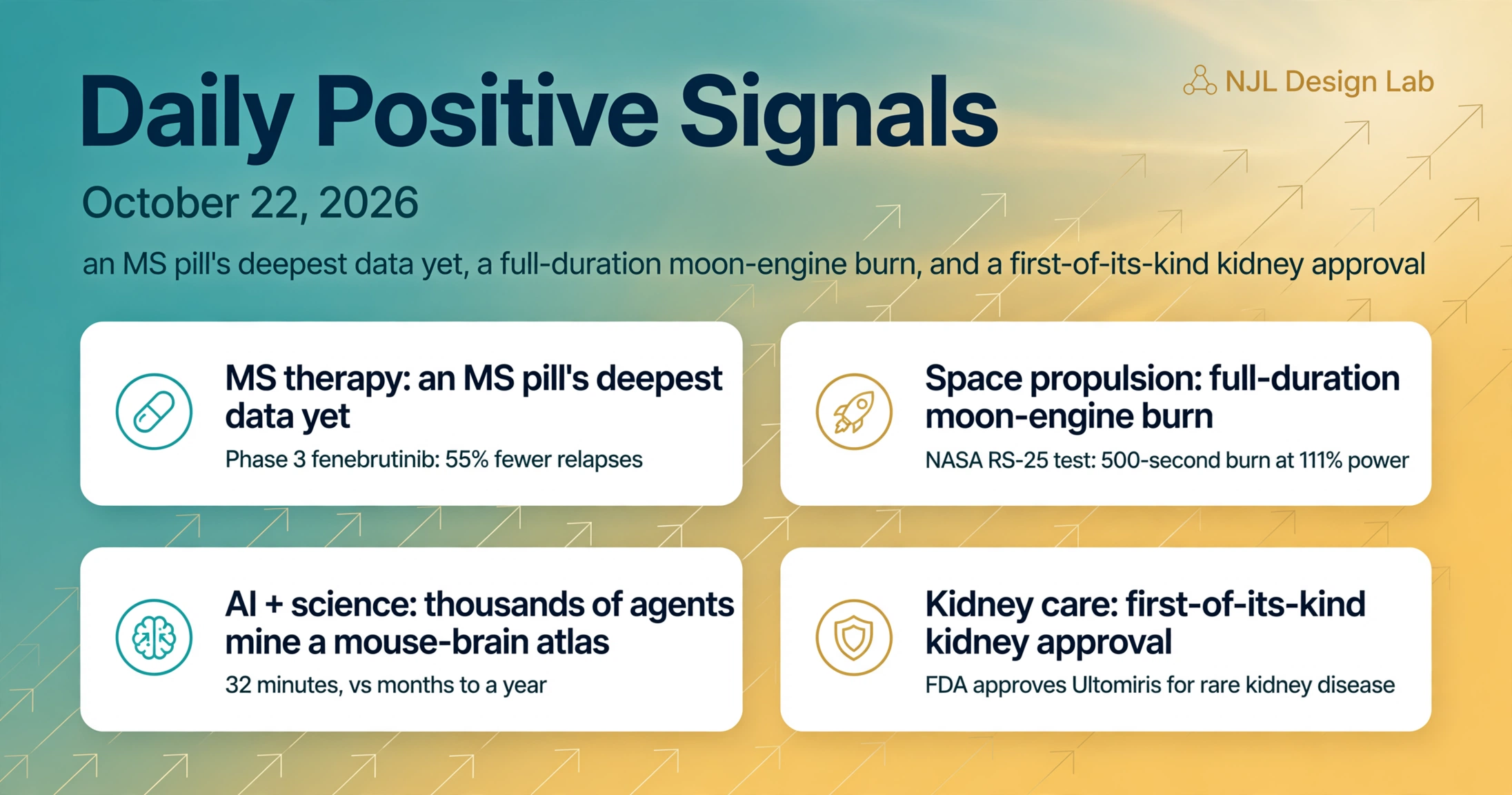
This edition: an experimental MS pill that cut relapses and quieted the brain’s slow-burning inflammation, a full-duration hot-fire test of the engines that will carry Artemis back to the Moon, thousands of AI agents turning a mouse-brain atlas into leads for Alzheimer’s and Parkinson’s research, and a first-of-its-kind FDA approval for a rare kidney disease. The thread is going deeper — beneath the symptom, beneath the data, beneath the surface.
In this edition · 4 signals
Signal 1 of 4 · Medicine
An MS pill that attacks relapses and the brain’s slow burn
Roche has reported new Phase III data for fenebrutinib, an experimental oral drug for multiple sclerosis, presented at the MSToronto2026 conference in Toronto (Genentech, 2026). In pooled data from the FENhance 1 and 2 trials, the drug cut the annualized relapse rate by 55% versus the active comparator teriflunomide over 96 weeks (Genentech, 2026; Reuters, 2026b). It also reduced the volume of slowly expanding brain lesions, a marker of chronic inflammation, by up to 30%, and the accumulation of paramagnetic rim lesions by 62% (Genentech, 2026; Europe Pharma Today, 2026). Three-quarters of treated patients showed no evidence of disease activity — no relapses, no MRI activity, no worsening disability — after nearly two years (Reuters, 2026b).
Why it matters. Most MS drugs suppress relapses; this one also targets the smoldering inflammation inside the brain that drives long-term disability. If the data hold, it would be the first high-efficacy oral medicine covering both relapsing and primary progressive MS.
Evidence status: Company announcement with data presented at MSToronto2026 (conference abstracts; peer review pending), reported independently by Reuters. Fenebrutinib is investigational — the FDA accepted it for priority review.
Signal 2 of 4 · Space
A full-duration roar for the Moon engines
NASA fired developmental RS-25 engine No. 10001 for a full 500 seconds on October 21 at the Fred Haise Test Stand at Stennis Space Center in Mississippi (NASA, 2026). Operators pushed the engine to 111% of its rated power, the thrust level required of new production engines for the Space Launch System rocket (NASA, 2026). The test acceptance-checked flight components for future Artemis missions and validated a new thermal protection system for the engine nozzle (The Gazebo Gazette, 2026). Four RS-25 engines together produce up to 2 million pounds of thrust for each SLS launch (NASA, 2026).
Why it matters. Later Artemis missions need newly built engines, not refurbished shuttle hardware. Every component that survives a full-duration burn is one less risk on the road back to the Moon.
Evidence status: NASA release with independent local coverage; the tested engine is developmental and will not fly.
Signal 3 of 4 · AI + Science
Thousands of AI agents mine a mouse-brain atlas in 32 minutes
OpenAI, PerturbAI, and Scripps Research used thousands of AI agents powered by the GPT-Rosalind model to analyze a whole-brain CRISPR atlas of mouse brain cells, finishing in 32 minutes — work the team estimates would take human researchers months to a year (OpenAI, 2026). Each agent took one of nearly 2,000 gene disruptions, analyzed how brain cells responded, searched the scientific literature, and proposed explanations; the reports were merged into a public reasoning atlas of 3,397 findings (OpenAI, 2026; Unite.AI, 2026). In blinded comparisons, human experts preferred the distributed agents’ reports 75% of the time, and their novelty assessments matched expert judgment (Unite.AI, 2026). One lead connects DCTN1 — a gene whose mutations cause the Parkinson’s-like Perry syndrome — to cholesterol regulation in neurons, a testable new hypothesis (OpenAI, 2026).
Why it matters. Modern experiments generate more data than scientists can ever read. Agents that convert raw results into ranked, literature-linked hypotheses turn a bottleneck into a head start for the lab.
Evidence status: Company announcements with a bioRxiv preprint (posted October 16) that is not yet peer-reviewed; the proposed mechanisms still need laboratory testing.
Signal 4 of 4 · Medicine
A first-of-its-kind approval for a rare kidney disease
The FDA has granted accelerated approval to AstraZeneca’s Ultomiris for adults with immunoglobulin A nephropathy, a rare kidney disease that can lead to kidney failure (Reuters, 2026a). In a late-stage trial, the drug cut proteinuria — excess protein in the urine — by 43.4% versus placebo after 34 weeks (Reuters, 2026a; AstraZeneca, 2026). Ultomiris is the first approved C5 complement inhibitor for the disease, targeting an immune pathway linked to kidney inflammation (AstraZeneca, 2026). The trial will continue through 106 weeks to measure whether the drug slows loss of kidney function, which would support full approval (Reuters, 2026a).
Why it matters. Accelerated approval means patients get access now on the strength of a surrogate measure, while the definitive kidney-function data accumulate. For a progressive disease with few options, that head start counts.
Evidence status: Company-announced regulatory approval reported by Reuters; accelerated approval rests on a surrogate endpoint, with confirmatory data still to come.
Editor’s note
Today’s thread is going deeper. An MS pill aimed at the smoldering inflammation behind long-term disability, not just the relapses on the surface. AI agents that finished reading the experiments scientists never had time to, a moon-engine test that certifies the parts you never see in flight, and a kidney drug targeting the immune pathway that drives the damage. The visible wins keep coming because someone went one layer down.
That’s the edition — four signals, every claim verified against its sources. Browse past briefs · tomorrow’s lands at 07:15.
The Progress Brief, by email
Useful progress, without the hype
The daily Positive Signals brief and the weekly deep dive, by email. Evidence-checked, concise, no doom.
Free. One daily email, one weekly email. Unsubscribe anytime.
References
- AstraZeneca. (2026, June 15). Ultomiris granted Priority Review in the US as treatment for adults with immunoglobulin A nephropathy. https://news.cision.com/se/astrazeneca/r/ultomiris-granted-priority-review-in-the-us-as-treatment-for-adults-with-immunoglobulin-a-nephropath,c4363531
- Europe Pharma Today. (2026, October 21). Roche fenebrutinib phase 3 MS data at MSToronto. https://europepharmatoday.com/news/roche-fenebrutinib-mstoronto-october-2026
- The Gazebo Gazette. (2026, October 21). NASA conducts RS-25 engine test for future Artemis missions. https://thegazebogazette.com/2026/10/nasa-conducts-rs-25-engine-test-for-future-artemis-missions/
- Genentech. (2026, October 21). Genentech presents new pivotal trial data across broad neuroimmunology portfolio at MSToronto2026 [Press release]. https://ivpressonline.marketminute.com/article/bizwire-2026-10-21-genentech-presents-new-pivotal-trial-data-across-broad-neuroimmunology-portfolio-at-mstoronto2026
- NASA. (2026, October 21). NASA conducts RS-25 engine test in support of future Artemis missions. https://www.nasa.gov/image-article/rs-25-engine-test-in-support-of-future-artemis-missions/
- OpenAI. (2026, October 21). Using thousands of AI agents to uncover new leads in biological data. https://openai.com/index/scaling-ai-research-for-complex-biological-data
- Reuters. (2026a, October 21). AstraZeneca says FDA approves drug for rare kidney disease in adults. https://www.reuters.com/business/healthcare-pharmaceuticals/astrazeneca-says-fda-approves-drug-rare-kidney-disease-adults-2026-10-21/
- Reuters. (2026b, October 21). Roche says experimental MS pill cuts relapses by 55% in late-stage trials. Reuters, 2026b
- Unite.AI. (2026, October 21). OpenAI unveils mouse brain reasoning atlas from GPT-Rosalind agents. https://www.unite.ai/openai-unveils-mouse-brain-reasoning-atlas-from-gpt-rosalind-agents/