Daily Positive Signals: a potency rule for cell therapies, a grid-friendly AI campus, and a Mars slingshot
On this page
Listen to this brief · about 4 min, story text only
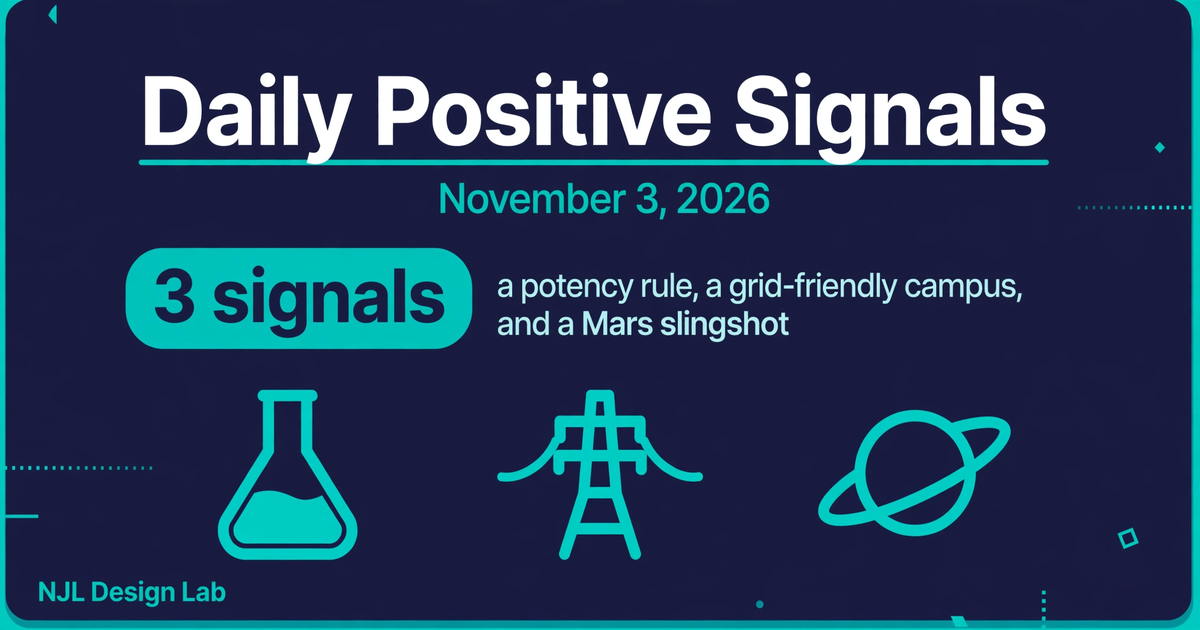
This edition: a potency rule for cell and gene therapies, a pledge to make AI campuses flex for the grid, and a first-of-its-kind slingshot toward Mars. The thread: build the safeguard into the design, whether the design is a therapy, a campus, or a route to another planet.
In this edition · 3 signals
Signal 1 of 3 · Biotech
A potency rule for every batch of cell and gene therapy
The U.S. Food and Drug Administration (FDA) has issued final guidance telling makers of cellular and gene therapy (CGT) products to build a Potency Assurance Strategy into every stage of a therapy’s life, from early development through approval and post-market checks (U.S. Food and Drug Administration, 2026). The strategy must show, before a product reaches a patient, that every batch meets a defined standard of potency: the ability to do what the therapy is supposed to do (U.S. Food and Drug Administration, 2026). The guidance replaces the agency’s 2011 potency testing guidance, finalizes a draft from December 2023, and covers products for serious and often life-threatening conditions, including therapies made individually for one patient (Regulatory Affairs Professionals Society, 2026).
Why it matters. Cell and gene therapies are among the hardest products to make consistently, so a clear, lifecycle-wide potency rule protects patients and gives manufacturers a predictable path to approval. Clear rules are what let a promising therapy become a reliable one.
Evidence status: FDA final guidance and press release, with independent trade coverage from the Regulatory Affairs Professionals Society. Limits: guidance states the FDA’s current thinking, not a binding regulation; faster patient access is the agency’s stated aim, not a measured outcome.
Signal 2 of 3 · Energy
AI campuses that give power back when the grid strains
OpenAI has launched a Grid Protectors Program under which its future compute campuses will cut their electricity use when the local grid is under strain, with terms to be agreed with utilities, regulators, and policymakers for each site (OpenAI, 2026). The pilot is a planned campus in Effingham County, Georgia, where OpenAI will pay the full infrastructure and electric-service costs and where its agreement with Georgia Power already includes up to 1,000 megawatts of flexible demand response (OpenAI, 2026). OpenAI puts that flexibility at roughly the average electricity demand of 700,000 households, and notes that the Georgia campus is still in development, so the relief lies ahead rather than on the grid today (Unite.AI, 2026).
Why it matters. Data centres are becoming large enough to move local power prices, so designing campuses that shed load on request turns a new burden into a grid resource. The test now is whether other sites sign terms as concrete as Georgia’s.
Evidence status: Company announcement, corroborated by independent coverage and the underlying Georgia Power agreement (a 25-year contract approved in August 2026). Limits: only Georgia has agreed terms so far; the $950 million annual customer savings Georgia Power projects from 2029 cover its whole large-load portfolio, not this campus alone; flexibility cannot replace new energy supply and transmission, as OpenAI itself notes.
Signal 3 of 3 · Space
Two spacecraft, one powered slingshot to Mars
NASA’s twin ESCAPADE spacecraft (Escape and Plasma Acceleration and Dynamics Explorers) will each perform a powered flyby of Earth, combining the planet’s gravity with an engine burn to slingshot toward Mars (National Aeronautics and Space Administration, 2026). The first spacecraft flies by around 5 a.m. Eastern time on Saturday, November 7, and the second around 6 a.m. on Monday, November 9, each firing its engine for about 9 minutes at closest approach to gain more than 1,000 miles per hour (National Aeronautics and Space Administration, 2026). No Mars-bound spacecraft has successfully flown a powered flyby, also called an Oberth maneuver, before, and the pair launched in November 2025 when Earth and Mars were on opposite sides of the Sun, so they looped around the Earth-Sun Lagrange point 2 and came back to Earth for this push (Primetimer, 2026).
Why it matters. If both burns succeed, Mars missions will no longer be tied to the 26-month alignment window in the same way, opening more flexible routes to the Red Planet. At Mars, the pair will be the first mission to fly in formation around the planet, studying how the solar wind strips its atmosphere.
Evidence status: NASA mission blog and star-chart notice, with independent coverage confirming the dates and maneuver. Limits: the flybys have not happened yet; success will only be known days later, once trajectory tracking confirms the aim, and a missed burn would cost about two years until the next window.
Editor’s note
Today’s thread is safeguards designed in, not bolted on. A potency strategy that follows a therapy from its first trial batch to every lot after approval. A campus built to step back when neighbours need power most. A Mars route that uses Earth itself as part of the engine. Each one is still a promise with a test ahead: a webinar, a pilot campus, two engine burns. But the pattern is the same in all three, and it is a hopeful one: the most durable progress is the kind planned before it is needed.
That’s the edition — three signals, every claim verified against its sources. Browse past briefs · tomorrow’s lands at 07:15.
The Progress Brief, by email
Useful progress, without the hype
The daily Positive Signals brief and the weekly deep dive, by email. Evidence-checked, concise, no doom.
Free. One daily email, one weekly email. Unsubscribe anytime.
References
- National Aeronautics and Space Administration. (2026, November 2). NASA’s twin ESCAPADE spacecraft to slingshot past Earth on way to Mars. https://science.nasa.gov/blogs/escapade/2026/11/02/nasas-twin-escapade-spacecraft-to-slingshot-past-earth-on-way-to-mars/
- OpenAI. (2026, November 2). Introducing the Grid Protectors Program. https://openai.com/index/grid-protectors-program
- Primetimer. (2026, November 2). NASA’s ESCAPADE mission will use Earth’s gravity to help send two spacecraft towards Mars. https://www.primetimer.com/features/nasa-s-escapade-mission-will-use-earth-s-gravity-to-help-send-two-spacecraft-towards-mars
- Regulatory Affairs Professionals Society. (2026, November 2). FDA finalizes cell and gene therapy potency guidance. https://www.raps.org/resource/fda-finalizes-cell-and-gene-therapy-potency-guidance.html
- Unite.AI. (2026, November 2). OpenAI launches Grid Protectors Program for compute campuses. https://www.unite.ai/openai-launches-grid-protectors-program-for-compute-campuses/
- U.S. Food and Drug Administration. (2026, November 2). FDA provides clarity to support cell and gene therapy development and quality. https://www.fda.gov/news-events/press-announcements/fda-provides-clarity-support-cell-and-gene-therapy-development-and-quality