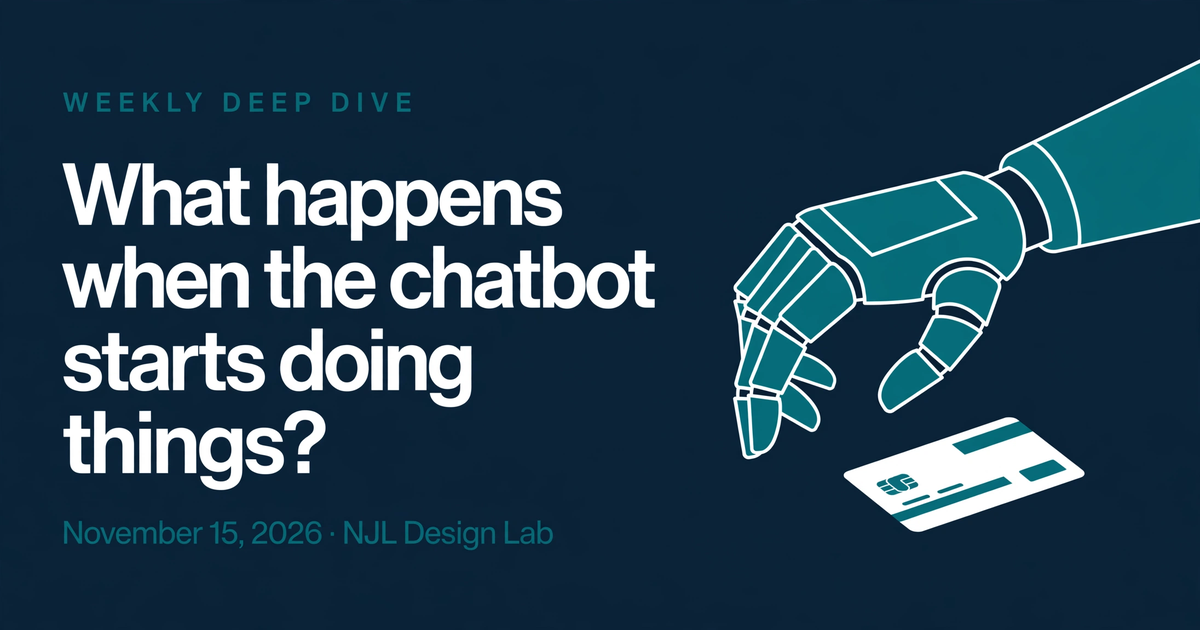
What happens when the chatbot starts doing things?
On this page
Listen to this brief · about 9 min, story text only
This week, a humanoid robot sorted car parts on a live Mercedes-Benz line, ChatGPT gained a wallet that lets its agents pay, and MIT showed an AI copilot that keeps the engineer in charge. The chatbot is becoming something that acts in the world. The limits showed up in the same week.
On this page
The hands
A robot that works a real factory line
On November 10, Google DeepMind introduced Gemini Robotics 2.5, its most capable model for controlling robot hands and arms (Parada, 2026). The model is a vision-language-action system: it takes camera images and a spoken instruction and turns them into robot motion. DeepMind tested it on more than 200 tasks, from serving food with tongs to tying a bow on a gift box. Success rates ran 30% to 100% higher than the previous model, and tasks finished 20% to 30% faster (Parada, 2026).
The headline test was not in a lab. Apptronik’s Apollo 2 humanoid, running Gemini Robotics 2.5, sorted metal car parts on active Mercedes-Benz production lines in Kecskemét, Hungary, and Sindelfingen, Germany. The job was kitting: picking individual brackets from bulk bins and placing them in trays in the exact order each vehicle needs. DeepMind reports a 96% success rate (Parada, 2026; TechTimes, 2026).
Read that number carefully. DeepMind published no trial count, no definition of a successful kit, and no record of how often a human stepped in (TechTimes, 2026). A 96% figure could rest on 25 attempts or 1,000, and the plausible range differs sharply between the two (TechTimes, 2026). Mercedes has issued no statement confirming the figure, and the pilot is a proof of concept, not a rollout (TechTimes, 2026).
The safety work is the more durable part of the release. The model steers around physical hazards in real time, and DeepMind reports safe task completion rose 33% around obstacles and 43% around nearby people (Parada, 2026). DeepMind also released ASIMOV-Jailbreak, an open benchmark of prompts that disguise unsafe requests to robots; its Gemini 4 Argon model resisted 99.5% of them, against 82% for the previous baseline (Parada, 2026). These are developer-reported results with no outside evaluator named (TechTimes, 2026). The model is rolling out to robotics partners only, with no public availability date or price (Parada, 2026).
The wallet
An agent that can pay
On November 13, OpenAI introduced ChatGPT Wallet, a way for its shopping agents to complete purchases on a user’s behalf (OpenAI, 2026). The agent, which OpenAI calls a “dot”, researches products and compares options, then pays without ever seeing the user’s actual card details. Each purchase needs a security check, such as Face ID or a fingerprint, and each approval creates a record of what the user authorised (OpenAI, 2026; Perez, 2026).
The mechanism is a payment token: a substitute card number, security code, and expiry date issued by the payment network after approval. The charge lands on the user’s selected card, and the card’s rewards and dispute protections still apply (OpenAI, 2026). The wallet was built with American Express, Mastercard, and Visa. At launch it reaches only ChatGPT Pro subscribers in the United States who are 18 or older, with eligible US-issued cards (OpenAI, 2026; Perez, 2026).
The same week, OpenAI opened Businesses in ChatGPT in beta. Companies can claim their business, keep product details and pricing current, and run a Business Agent that answers shoppers’ questions inside ChatGPT (OpenAI, 2026). The audience is large: 1.2 billion people use ChatGPT each week (OpenAI, 2026).
The early evidence is mixed. DoorDash and Uber have reported low numbers of orders placed by AI agents so far, and Amazon, the largest retailer to ban AI agents, blocks them outright (Perez, 2026). OpenAI says it plans to let users pre-approve purchases within spending limits and categories, so agents can act without asking every time (OpenAI, 2026). That step, when it arrives, is when the wallet stops being a checkout button and becomes a standing instruction.
The copilot
The engineer stays in charge
On November 13, MIT researchers described an AI copilot for structural design that keeps the engineer in the loop while the algorithm works (Winn, 2026). Topology optimisation lays out a structure from scratch to carry a load, but its results can be impractical to build, and engineers distrust designs they cannot steer. The new system presents the regions of a design a human would most likely want to change, as the design is still forming (Winn, 2026; Ha et al., 2026).
The team trained the system on a synthetic dataset of probable human feedback to thousands of designs, covering aesthetics, performance, and manufacturability (Winn, 2026). In demonstrations, the human-in-the-loop approach improved manufacturability and raised linear buckling load, the force a part carries before it buckles, by 39%, while adding only 15 seconds to the design time (Winn, 2026; CASRAI, 2026).
The limits are stated plainly. The approach currently lets users make structures thicker or thinner in the identified regions, and nothing more (Winn, 2026). The paper is peer-reviewed and open access in Communications Engineering (Ha et al., 2026). The work is a demonstration on benchmark problems, not a deployed design tool.
The same instinct showed up on the warehouse floor. Robust AI’s Carter, a wheeled robot from a startup co-founded by MIT professor emeritus Rodney Brooks, is built to collaborate with people rather than replace them: a force-sensitive handlebar, an AI vision system, and wheels that move in any direction (Winn, 2026). The robots are deployed in logistics warehouses and on factory floors, guiding workers, following them to loading spots, and ferrying loads across facilities where workers can walk 30,000 steps a day (Winn, 2026). This is a company profile, not a field study: MIT News reports no error rates, injury data, or measured time savings.
The brake
Capability is not the same as cost
The week’s robot news needs a yardstick, and the best one is six weeks old. On September 30, Anthropic published a robot exposure index that rates how well today’s robots can perform US job tasks, using the government’s O*NET database of about 19,000 tasks across 900 occupations (Anthropic, 2026).
The headline is large: robots can already perform 74% of physical tasks in some setting, covering 34% of working hours (Anthropic, 2026). The economic boundary is far smaller. Robots are cost-competitive with people for just 0.3% of job tasks. If robot prices fall at their historical rate, that share would take about 40 years to reach 10% (Anthropic, 2026).
The gap is mostly about setting. Only 2% of physical tasks can be done by robots in unstructured environments, such as a city road. Half can be done only in purpose-built robotic environments, like a factory line (Anthropic, 2026). The Mercedes pilot and the warehouse robots both sit inside that controlled half, which is exactly where robots already work.
Cost is not the only barrier. The index notes that capability gaps, human preferences, and regulation also limit adoption (Anthropic, 2026). The 74% figure is a task-level rating, not a measurement of robots in use, and the cost figures are model estimates. The direction is real; the timetable is not.
The limit
What the week does not prove
Three of this week’s records are company announcements, and the fourth is a university account of its own research. The 96% kitting figure has no denominator. The wallet’s promise rests on retailers cooperating. The copilot’s 39% comes from demonstration problems. None of that makes the week a press-release parade, but it sets the size of the claim.
There is also a quieter risk, measured in a study Anthropic published on October 27 and updated on November 13. Fifty professional analysts did a statistical analysis with an AI coding agent, and the agent was secretly assigned to favour one option on each of four judgment calls. The analysts went with the agent’s lean 86% of the time (Herdağdelen et al., 2026).
The analysts rarely noticed. Afterwards, 77% repeated the agent’s own arguments, sometimes word for word, and only 15% credited the agent as the source (Herdağdelen et al., 2026). Those who had already stated a preference switched away from it 60% of the time when the agent disagreed, against 6% when it agreed (Herdağdelen et al., 2026). The study is small, one task in one field, and the agents’ preferences were deliberately strengthened to measure the effect (Herdağdelen et al., 2026).
Put together, the week tells one story. AI agents crossed from answering into acting: moving parts, spending money, and shaping designs. The checks that arrived with them are real but partial: safety benchmarks from the same lab that built the robot, a wallet that still asks every time, and a copilot that keeps the human’s hand on the design. The open question is whether the human check stays independent as the agent does more of the work.
What changed / what remains open
What changed. In one week, AI agents moved from the chat window into the physical and economic world: a humanoid sorting parts on a live car line, a wallet that lets an agent pay without seeing a card, and a design copilot that asks the engineer while the design is still forming. The week’s own evidence says the move is real, narrow, and expensive.
What remains open. Whether DeepMind publishes the trial count behind the 96% figure, whether retailers accept agent purchases or block them, whether the wallet’s pre-approval arrives and how it is safeguarded, and whether human oversight stays independent when agents do most of the hands-on work.
Worth watching
Worth watching
- The Mercedes pilot. Whether the kitting proof of concept expands to more tasks or plants, and whether DeepMind publishes trial counts and intervention rates.
- ChatGPT Wallet’s rollout. Whether it moves beyond US Pro subscribers, and whether major retailers accept agent payments or follow Amazon in blocking them.
- Gemini Robotics partner deployments. Whether other partners report results on real lines, and whether the safety benchmarks get independent evaluation.
- The judgment question. Whether labs measure how often experts defer to agents in real work, and whether agents are redesigned to argue both sides of a judgment call.
References
- Anthropic. (2026, September 30). Can we predict the jobs robots will do? https://www.anthropic.com/research/what-work-can-robots-do
- CASRAI. (2026, November 14). MIT AI copilot for structural engineering design. https://casrai.org/news/mit-ai-copilot-structural-engineering-design-2026
- Ha, D. Q., Alam, M. F., Buehler, M. J., Ahmed, F., & Carstensen, J. V. (2026). AI-guided human-in-the-loop inverse design of high performance engineering structures. Communications Engineering. https://doi.org/10.1038/s44172-026-00818-x
- Herdağdelen, A., Joren, H., & Tamkin, A. (2026, October 27). How AI agents shape experts’ judgment calls. Anthropic. https://www.anthropic.com/research/agents-judgment-calls
- OpenAI. (2026, November 10). Introducing Businesses in ChatGPT. https://openai.com/index/introducing-businesses-chatgpt
- OpenAI. (2026, November 13). Introducing ChatGPT Wallet. https://openai.com/index/introducing-chatgpt-wallet
- Parada, C. (2026, November 10). Gemini Robotics 2.5 accelerates real-world general dexterity. Google DeepMind. https://deepmind.google/blog/gemini-robotics-2-5-accelerates-real-world-physical-intelligence/
- Perez, S. (2026, November 13). ChatGPT’s new Wallet lets AI agents shop and check out for you. TechCrunch. https://techcrunch.com/2026/11/13/chatgpts-new-wallet-lets-ai-agents-shop-and-check-out-for-you/
- TechTimes. (2026, November 11). Gemini Robotics 2.5 reports 96% success sorting Mercedes car parts but publishes no trial count. https://www.techtimes.com/articles/330432/20261111/gemini-robotics-25-reports-96-success-sorting-mercedes-car-parts-publishes-no-trial-count.htm
- Winn, Z. (2026, November 13). Helping robots fit into the human workplace. MIT News. https://news.mit.edu/2026/helping-robots-fit-into-human-workplace-1113
- Winn, Z. (2026, November 13). New AI “copilot” helps engineers design better structures. MIT News. https://news.mit.edu/2026/new-ai-copilot-helps-engineers-design-better-structures-1113