The Post-FI Reset: Identity, Routines, and Community After Work Stops Running the Calendar
On this page
- FI solves the money problem. It creates a structure problem.
- Three things need to be replaced after FI
- 1. The schedule
- 2. The identity
- 3. The community
- The best post-FI lives usually have some rhythm
- Routines are not the same as the old grind
- Identity usually changes in stages
- Community matters more after FI, not less
- Flexibility is a gift, but it can also create friction
- A simple post-FI reset checklist
- The real goal is not to do nothing
- Next Steps
- If you are still on the journey toward FI
- If you want to build better systems for this phase
- If you want to know whether the number is actually there
- The reset does not happen by default. It happens by design.
Most FI conversations stop at the number.
How much do you need?
When can you stop?
How do you know it is enough?
That part matters. But it is not the whole transition.
For many people, the harder shift comes after the money question is mostly solved. Work no longer runs the calendar. The old schedule disappears. The default identity changes. And suddenly the real problem is not just what you can afford. It is how to live in a way that feels calm, steady, and intentional without rebuilding the exact pressure system you just left.
That is the post-FI reset.
It is not a crisis.
It is not a failure.
It is a design problem.
FI solves the money problem. It creates a structure problem.
Before FI, work does a lot of hidden jobs:
- a schedule
- a reason to be somewhere every weekday
- a built-in social layer
- a public identity
- a sense of momentum
When that disappears, the calendar opens up. That sounds great until you realize open time is not automatically meaningful time.
A lot of people expect retirement or FI to feel like permanent relief. In practice, the first stretch can feel strangely flat. Not bad. Just unstructured. The days are lighter, but they can also feel less defined. The old pressure is gone, but so is the old scaffolding.
That is why the post-FI reset matters. You are not just replacing income. You are replacing structure.
Three things need to be replaced after FI
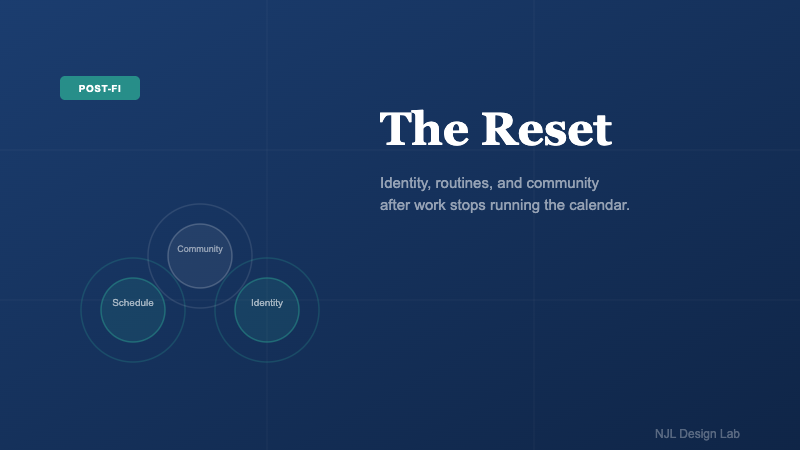
There are three core systems that often need rebuilding.
1. The schedule
Work used to tell you when the week started, when it ended, and what counted as productive.
After FI, you need a new rhythm.
Not a rigid one. Just enough structure to keep the week from dissolving into vague intention.
2. The identity
For a long time, your title may have been part of how you introduced yourself. After FI, that label can feel less useful — sometimes even awkward.
You do not need to invent a dramatic new persona. You just need a better answer to the question: what kind of life are you building now?
3. The community
Work gives you repeat exposure to people, even when you do not actively seek it.
Once that disappears, you have to be more deliberate.
If you do nothing, isolation can creep in quietly.
If you do too much, the calendar fills back up with noise.
The goal is a middle path: real connection without constant coordination.
The best post-FI lives usually have some rhythm
The mistake is thinking FI means no structure. That is rarely what people actually want — what they usually want is better structure.
A calmer week often has a few anchor points:
- a morning routine that does not require willpower
- a weekly planning session that is short and repeatable
- one or two recurring social touchpoints
- time carved out for movement, rest, and learning
- enough flexibility to take advantage of good opportunities
The point is not to fill the calendar — it is to make the calendar feel trustworthy. When the week has anchors, the rest of the time becomes easier to enjoy.
Routines are not the same as the old grind
A lot of people resist routines because they think routines equal restriction — but that is only true when the routine is imposed from the outside.
A self-chosen routine is different — lighter, lower-friction, and designed to reduce decision fatigue rather than add to it.
A good post-FI routine does not feel like a job.
It feels like support.
That can be simple:
- wake up at a consistent time
- get outside early
- move your body before the day gets noisy
- make one small planning pass for the day
- leave room for spontaneity
You are not optimizing your life to death — you are making it easier to repeat the parts that actually matter.
Identity usually changes in stages
One of the most common surprises after FI is that identity does not update instantly.
Even when the financial decision is finished, the inner shift can lag behind.
You may still feel a pull toward old credentials.
You may still want to explain yourself in work terms.
You may still reach for the old answer when someone asks what you do.
That is normal.
Identity usually changes in stages:
- You stop doing the old thing.
- You start noticing the old identity is still active.
- You experiment with a new way of describing yourself.
- Eventually it stops feeling forced.
The mistake is expecting the new identity to arrive overnight.
It usually does not — it forms through repetition.
How Identity Actually Changes After FI
Stop
You leave the old role behind.
Notice
The old identity is still active in your head.
Experiment
You try new ways of describing who you are.
Settle
It stops feeling forced. A new identity forms through repetition.
Most people expect Step 4 to happen right after Step 1. It rarely does.
The best version is not performative.
It is calm.
It is something like: I spend my time on the things that matter to me now.
That answer is quiet, but it is strong.
Community matters more after FI, not less
When people leave work, they often assume the main challenge will be money.
Often it is not — it is connection.
The people who seem to do best after FI are usually the ones who keep building real relationships.
Not huge networks.
Not performative social lives.
Just honest, recurring contact with people who make life feel more alive.
That can come from:
- neighbors
- hobby groups
- travel friendships
- family rhythms
- local community involvement
- regular meetups with people who share the same stage of life
Community does not happen automatically anymore — but it does not have to be complicated. You just have to keep showing up.
Flexibility is a gift, but it can also create friction
FI gives you freedom — that is the point. But freedom creates new decisions.
When everything is possible, nothing is automatically chosen — and that can create a different kind of pressure.
Should you travel now or later?
Should you plan ahead or stay open?
Should you spend more on comfort or keep things simple?
Should you fill the week or leave space?
There is no perfect answer — the best one fits your actual energy, not your imagined ideal self.
Some people need more structure.
Some people need more spontaneity.
Most people need a little of both.
The goal is not to recreate work — it is to create a life you do not need to recover from.
A simple post-FI reset checklist
If you are newly FI or approaching it, this is a useful place to start.
- Write down what work used to provide besides money.
- Identify what you want to replace first: schedule, identity, or community.
- Build one repeatable weekly anchor.
- Decide how you want to introduce yourself now.
- Put one social commitment on the calendar that is not work-related.
- Choose one hobby, class, or learning track that gives you direction.
- Leave room for flexibility so the week does not become another job.
That is enough to begin.
You do not need to solve the whole rest of your life in one sitting.
You just need a better operating system than the one you left behind.
The real goal is not to do nothing
A lot of people fear FI because they imagine it as emptiness.
But the best post-FI life is not empty — it is chosen.
It still has structure.
It still has effort.
It still has responsibility.
But it is built around your values instead of your employer’s calendar.
That is the reset.
Not escape.
Not idleness.
Not reinvention for its own sake.
Just a calmer life, designed on purpose.
Next Steps
The post-FI reset is a design problem, not a personal failing. These are the most useful reads from here, depending on where you are in the transition:
If you are still on the journey toward FI
The identity work does not start at FI. It starts in the middle — the phase where the math is mostly solved but the life design question is just beginning. The Boring Middle covers exactly this.
If you want to build better systems for this phase
The Life & Systems section of The Lab covers routines, decision-making, and the daily structures that compound over time — exactly the kind of work the post-FI reset requires.
If you want to know whether the number is actually there
Before the reset comes the readiness question. FI Architect is the free planning tool that shows exactly where you stand — your FI number, your timeline, and how your current trajectory projects forward.
Design it on purpose
The reset does not happen by default. It happens by design.
FI Architect helps you track the financial side of the transition. The Lab covers the rest — routines, identity, decisions, and the systems that make the next chapter feel like yours.