Daily Positive Signals: a hepatitis B milestone, a map of every forest type, and touch-sensing 3D prints
On this page
Listen to this brief · about 5 min, story text only
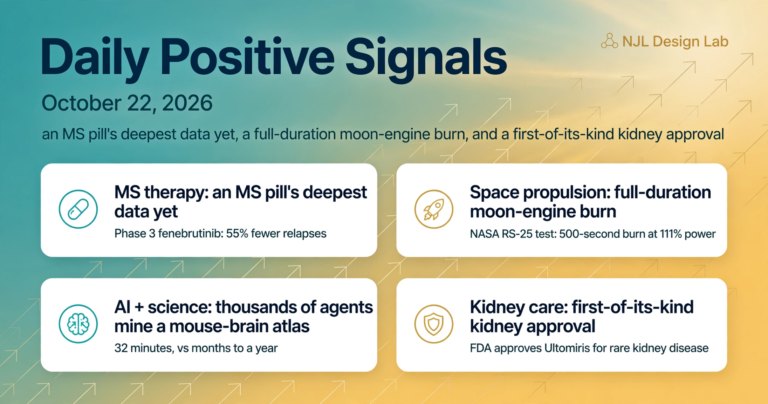
This edition: the first antisense treatment for chronic hepatitis B, approved after 19% of trial patients held the virus in check months after stopping all treatment; a 10-meter map that classifies every forest on Earth for deforestation-free supply chains; AI agents that turned a mouse-brain atlas into testable disease leads in 32 minutes; and 3D-printed objects that sense touch. The thread: knowing precisely what’s there is most of the battle.
In this edition · 4 signals
- A first-of-its-kind hepatitis B treatment — and an off-ramp from lifelong pills — Medicine
- A 10-meter map of every forest on Earth — Environment
- Thousands of AI agents decode a mouse brain in 32 minutes — AI + Science
- 3D-printed objects that feel touch — Engineering
Signal 1 of 4 · Medicine
A first-of-its-kind hepatitis B treatment — and an off-ramp from lifelong pills
The FDA has approved Hibsago (bepirovirsen), the first antisense oligonucleotide treatment for chronic hepatitis B, for certain adults without cirrhosis (FDA, 2026). The drug silences the genetic instructions the virus uses to copy itself and produce viral proteins. In two Phase III trials, 24% of patients met the requirements to stop their existing antivirals, versus none on placebo; 24 weeks after stopping all treatment, 19% still had the virus under control with no detectable surface antigen (FDA, 2026; Reuters, 2026). The approval came with Fast Track, Breakthrough Therapy, and Priority Review designations, and the drug has already been approved in Japan (Reuters, 2026).
Why it matters. For most of the 250 million people living with chronic hepatitis B, treatment is a lifelong suppressant. This is the first approved option that gives some patients a real chance to stop taking medicines at all.
Evidence status: FDA approval based on two placebo-controlled Phase III trials (B-Well 1 and 2). The drug carries a boxed warning for serious liver reactions and low platelet counts, and the 19% functional-cure rate applies only to the eligible population (no cirrhosis, suppressed virus, surface antigen at or below 3,000 IU/mL).
Signal 2 of 4 · Environment
A 10-meter map of every forest on Earth
Google DeepMind, Google Research, the World Resources Institute, and IIASA have released Forest Typology (ForTy) 2020, a global map sorting every 10-by-10-meter patch of land into six forest and land-use types (Google DeepMind, 2026). Trained on about 1.7 million labeled locations, the model separates primary forest from plantation and tree crops — distinctions ordinary tree-cover maps miss (Google DeepMind, 2026; Oossa, 2026). Validated against more than 9,000 expert-checked sites, it got the forest type right 90% of the time and forest versus non-forest right 95% (Oossa, 2026). An open time series covers 2017–2025, showing not just where forest was lost but what replaced it, on Google Earth Engine under an open license (Google DeepMind, 2026).
Why it matters. The EU’s deforestation-free products rule requires proof that coffee, cocoa, or palm oil didn’t come from land cleared after 2020. This map makes that proof possible at product-relevant scale.
Evidence status: Research announcement with validation methodology described in a Scientific Data paper; dataset and time series released openly on Google Earth Engine.
Signal 3 of 4 · AI + Science
Thousands of AI agents decode a mouse brain in 32 minutes
OpenAI, PerturbAI, and Scripps Research divided a whole-brain mouse CRISPR atlas among thousands of agents powered by the GPT-Rosalind model, each investigating one of nearly 2,000 gene disruptions, analyzing cellular responses, and searching the scientific literature (OpenAI, 2026). In 32 minutes the agents produced a public reasoning atlas linking genes, cellular effects, and publications; the team estimates humans would need months to a year for the same work (OpenAI, 2026; The Decoder, 2026). In blinded reviews, human experts preferred the distributed agents’ reports 75% of the time (The Decoder, 2026). One lead ties DCTN1 — a gene mutated in the Parkinson’s-like Perry syndrome — to cholesterol regulation in neurons, a new hypothesis to test in the lab (OpenAI, 2026).
Why it matters. Modern experiments generate more data than any team can read. Agents that turn raw results into ranked, literature-backed hypotheses give researchers a head start on the next experiment.
Evidence status: Company and academic announcement with a bioRxiv preprint (posted October 16) that is not yet peer-reviewed; the proposed mechanisms are hypotheses awaiting laboratory testing. The months-to-a-year figure is the research team’s estimate.
Signal 4 of 4 · Engineering
3D-printed objects that feel touch
Researchers at MIT’s CSAIL laboratory and Tianjin University have built X-Hinges, software that designs an object and automatically embeds touch sensors where it bends — using one conductive filament for sensing and another for the signal-carrying traces to cut interference (MIT News, 2026). Previous approaches used the same material for both, making it hard to separate movement from noise (Superpower Daily, 2026). Demos include a glove that relays finger bends to a humanoid hand, a pinch-controlled lamp, a shark-shaped joystick, and a surface that recognizes objects like bananas by touch (MIT News, 2026; Superpower Daily, 2026). The paper has been accepted at the ACM UIST 2026 conference, with a presentation planned for early November (Superpower Daily, 2026).
Why it matters. It collapses assembly into fabrication: a custom object comes off the printer already able to feel how it’s handled. That’s a stepping stone toward interfaces and robots that adapt on the fly.
Evidence status: University-announced research accepted at ACM UIST 2026 and reported by two independent outlets; the demos are prototypes, not products, and a sensor-recalibration bottleneck remains unsolved.
Editor’s note
Today’s thread is sharper perception. The hepatitis B drug works because it silences the right genetic instructions, in the right patients — the trials sorted that out. The forest map matters because it tells you which forest, not just where trees are. The AI agents and the 3D prints both win by sensing what’s already there rather than guessing: the agents read the experiments scientists never had time to, and the prints feel the hands that hold them. The biggest gains this week didn’t come from pushing harder. They came from seeing more clearly.
That’s the edition — four signals, every claim verified against its sources. Browse past briefs · tomorrow’s lands at 07:15.
The Progress Brief, by email
Useful progress, without the hype
The daily Positive Signals brief and the weekly deep dive, by email. Evidence-checked, concise, no doom.
Free. One daily email, one weekly email. Unsubscribe anytime.
References
- FDA. (2026, October 20). FDA approves first-of-its-kind chronic hepatitis B treatment. https://www.fda.gov/news-events/press-announcements/fda-approves-first-its-kind-chronic-hepatitis-b-treatment
- Google DeepMind. (2026, October 22). Not all forests are equal: Mapping the world’s forests. https://deepmind.google/blog/beyond-tree-cover-mapping-the-worlds-forest-types/
- MIT News. (2026, October 22). This design software reimagines everyday objects as self-aware devices. https://news.mit.edu/2026/design-software-reimagines-everyday-objects-as-self-aware-devices-1022
- Oossa. (2026, October 22). Google DeepMind releases detailed global forest type map. https://oossa.com/en/google-deepmind-releases-detailed-global-forest-type-map
- OpenAI. (2026, October 21). Using thousands of AI agents to uncover new leads in biological data. https://openai.com/index/scaling-ai-research-for-complex-biological-data
- Reuters. (2026, October 20). US FDA approves GSK’s hepatitis B drug, offering patients chance to stop long-term treatment. https://979weve.com/2026/10/20/us-fda-approves-gsks-hepatitis-b-drug-offering-patients-chance-to-stop-long-term-treatment/
- Superpower Daily. (2026, October 22). MIT researchers build sensing into 3D-printed objects, from robot gloves to lamps. https://superpowerdaily.com/posts/mit-researchers-build-sensing-into-3d-printed-objects-from-robot-gloves-to-lamps
- The Decoder. (2026, October 22). OpenAI agents analyze mouse brain data in 32 minutes, a job that would take humans months. https://the-decoder.com/openai-agents-analyze-mouse-brain-data-in-32-minutes-a-job-that-would-take-humans-months/