Daily Positive Signals: crows that think twice as fast, a voice AI that learned from sound alone, and passwords agents never touch
On this page
Listen to this brief · about 5 min, story text only
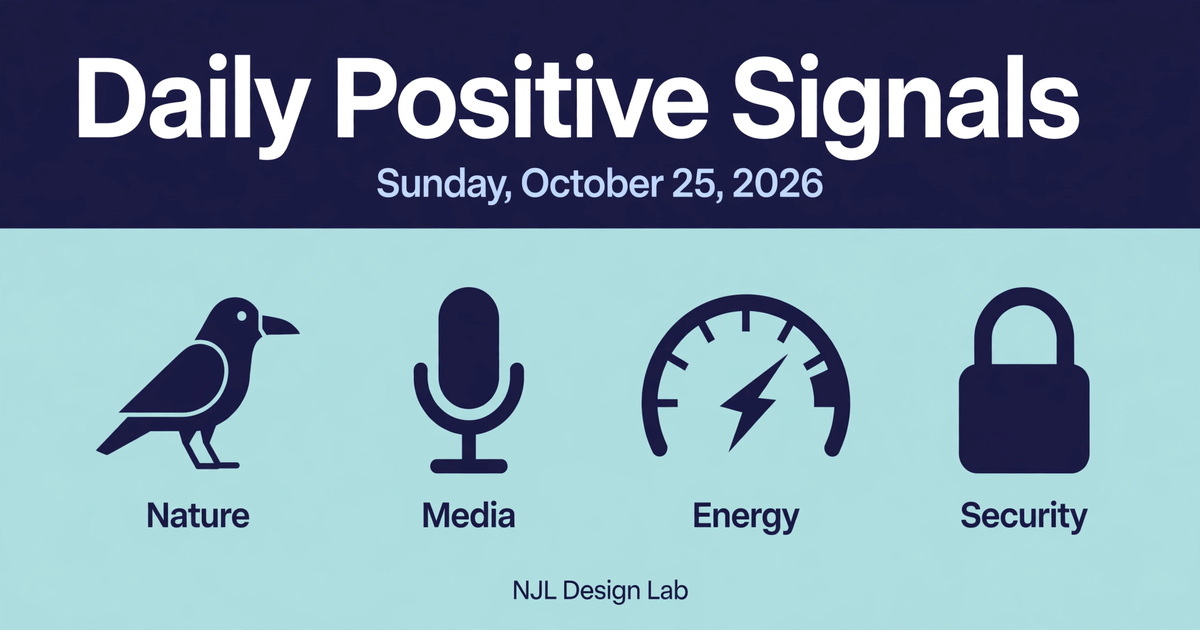
This edition: two crows that make visual decisions about twice as fast as primates, a voice AI that learned to talk from human speech alone, a faster way for apps to make small decisions, and a sign-in layer that lets agents log in without ever seeing your password. The thread: AI is moving into everyday tasks, and the guardrails are arriving with it.
In this edition · 4 signals
- Two crows decide twice as fast as primates — Science
- A voice AI that learned to talk from sound alone — AI
- Small app decisions, answered up to ten times faster — AI + Developers
- Agents can now log in without ever seeing your password — AI + Security
Signal 1 of 4 · Science
Two crows decide twice as fast as primates
Two carrion crows, Iggy and Lemmy, learned a classic visual test used with monkeys for three decades: dots drift across a screen, and the bird pecks the side most dots are moving toward (NPR, 2026). After thousands of trials, the crows averaged 235 milliseconds per decision, roughly twice as fast as humans and monkeys in earlier versions of the task, with comparable accuracy (NPR, 2026; The Transmitter, 2026). The study, published October 22 in Science, also recorded 248 neurons in the crows’ nidopallium caudolaterale — the avian counterpart of the prefrontal cortex — and found their activity predicted the birds’ choices as early as 70 milliseconds after the dots appeared (The Transmitter, 2026).
Why it matters. Bird brains are built nothing like ours — dense clusters instead of layered cortex — yet they ran the same decision faster. That is a concrete hint that intelligence has more than one workable architecture.
Evidence status: Peer-reviewed study in Science, reported by NPR, The Transmitter, and Ars Technica. Limits: two crows only, and the speed comparison is against earlier primate studies, not a head-to-head test in the same lab.
Signal 2 of 4 · AI
A voice AI that learned to talk from sound alone
Block’s small research lab has unveiled Dessa, a full-duplex speech model — it listens and talks at the same time — trained from scratch on nothing but recorded human conversation (Block, 2026). Because no text sits in the pipeline, Dessa keeps the timing, laughter, pauses, and tone that text-based voice assistants throw away, and it learned language from hundreds of times fewer words than a text model needs (Block, 2026; TechCrunch, 2026). Block says the model runs locally on a consumer laptop and is opening early access to a small group of AI safety researchers first, to probe risks like voice-based deception before wider release (Block, 2026).
Why it matters. Today’s voice assistants flatten speech into text and lose how something was said. A model that learns from sound alone points to voice AI that hears emotion and timing — and runs on your own machine, not a server farm.
Evidence status: Company announcement and demo recordings, corroborated by TechCrunch and CoinDesk. Limits: research preview behind a waitlist, with no published paper, weights, benchmarks, or independent evaluation yet — the demos are Block’s own.
Signal 3 of 4 · AI + Developers
Small app decisions, answered up to ten times faster
OpenAI has made its Decisions API generally available: built on GPT-6 Luna, it answers bounded questions — a probability, a choice, or a score — from text, images, or structured data, for the small judgments apps and agents make constantly, like classifying an input or routing a request (OpenAI, 2026). The API now integrates natively with GPT-Live for real-time voice, supports prompt caching and US/EU processing residency, and costs $0.10 per million input tokens with no output-token charges (OpenAI, 2026; TechCrunch, 2026). Early users apply it to jobs like categorizing transactions and making language lessons more interactive.
Why it matters. Most of what agents do is not grand reasoning — it is thousands of tiny calls. Making those cheap and near-instant is what turns demos into responsive products.
Evidence status: Company announcement with pricing and technical details, corroborated by TechCrunch. The 10x speed figure is OpenAI’s own comparison against its Responses API, not an independent benchmark.
Signal 4 of 4 · AI + Security
Agents can now log in without ever seeing your password
1Password has launched 1Password for Agents, a platform that lets personal AI agents sign into your accounts while the credentials stay in your vault (1Password, 2026). When an agent reaches a sign-in form, it identifies itself with a unique digital key; you see which login it wants and why, approve on your own device, and 1Password fills the credential directly into the form (1Password, 2026; TechCrunch, 2026). The launch partners span Meta’s Muse, Anthropic’s Claude Duet, OpenAI’s ChatGPT Work and dots, SpaceXSI’s Grok Bot, and Town’s Townie, with more integrations in the works.
Why it matters. The risky habit so far has been pasting passwords into an agent’s chat, where a copy lives on in logs and memory. This keeps the agent useful and the password unshared — the trust layer agents need before people hand them real errands.
Evidence status: Company announcement corroborated by TechCrunch and SiliconANGLE. Note: integrations are rolling out in stages — several agents are listed as coming soon rather than live today — and the design has not yet had independent security testing.
Editor’s note
The thread across today’s signals is agents growing up. The crows are a reminder that a very different brain can outpace ours at a well-defined job — useful humility for the age of machine minds. Dessa shows voice AI learning the way babies do, from sound alone, instead of through text. And the two launches that matter most for daily life are the unglamorous ones: faster small decisions and logins that never leak a password. The frontier is not only getting smarter. It is getting safer to hand things to.
That’s the edition — four signals, every claim verified against its sources. Browse past briefs · tomorrow’s lands at 07:15.
The Progress Brief, by email
Useful progress, without the hype
The daily Positive Signals brief and the weekly deep dive, by email. Evidence-checked, concise, no doom.
Free. One daily email, one weekly email. Unsubscribe anytime.
References
- Ars Technica. (2026, October 23). Crows can evaluate visual info twice as fast as mammals. https://arstechnica.com/science/2026/10/crows-can-evaluate-visual-info-twice-as-fast-as-mammals/
- Block. (2026, October 23). Dessa: The conversation model trained only on speech. https://block.xyz/dessa
- NPR. (2026, October 22). Should ‘bird brain’ be a compliment? Here’s how crows think fast. https://www.krvs.org/2026-10-22/should-bird-brain-be-a-compliment-heres-how-crows-think-fast
- 1Password. (2026, October 22). 1Password for Agents launches as the trust layer for personal AI agents. https://1password.com/press/2026/october/1password-for-agents-trust-layer-personal-ai-agents
- OpenAI. (2026, October 22). Build more responsive apps with the Decisions API. https://openai.com/index/decisions-api
- TechCrunch. (2026, October 22). 1Password launches a way for AI agents to log in on your behalf without seeing your password. https://techcrunch.com/2026/10/22/1password-launches-a-way-for-ai-agents-to-log-in-on-your-behalf-without-seeing-your-password/
- TechCrunch. (2026, October 22). OpenAI makes its Jev competitor widely available as decision model competition heats up. https://techcrunch.com/2026/10/22/openai-makes-its-jev-competitor-widely-available-as-decision-model-competition-heats-up/
- TechCrunch. (2026, October 24). Block’s new voice model sounds eerily human. https://techcrunch.com/2026/10/24/blocks-new-voice-model-sounds-eerily-human/
- The Transmitter. (2026, October 22). Crows have brains in the fast lane. https://www.thetransmitter.org/behavior/crows-have-brains-in-the-fast-lane/