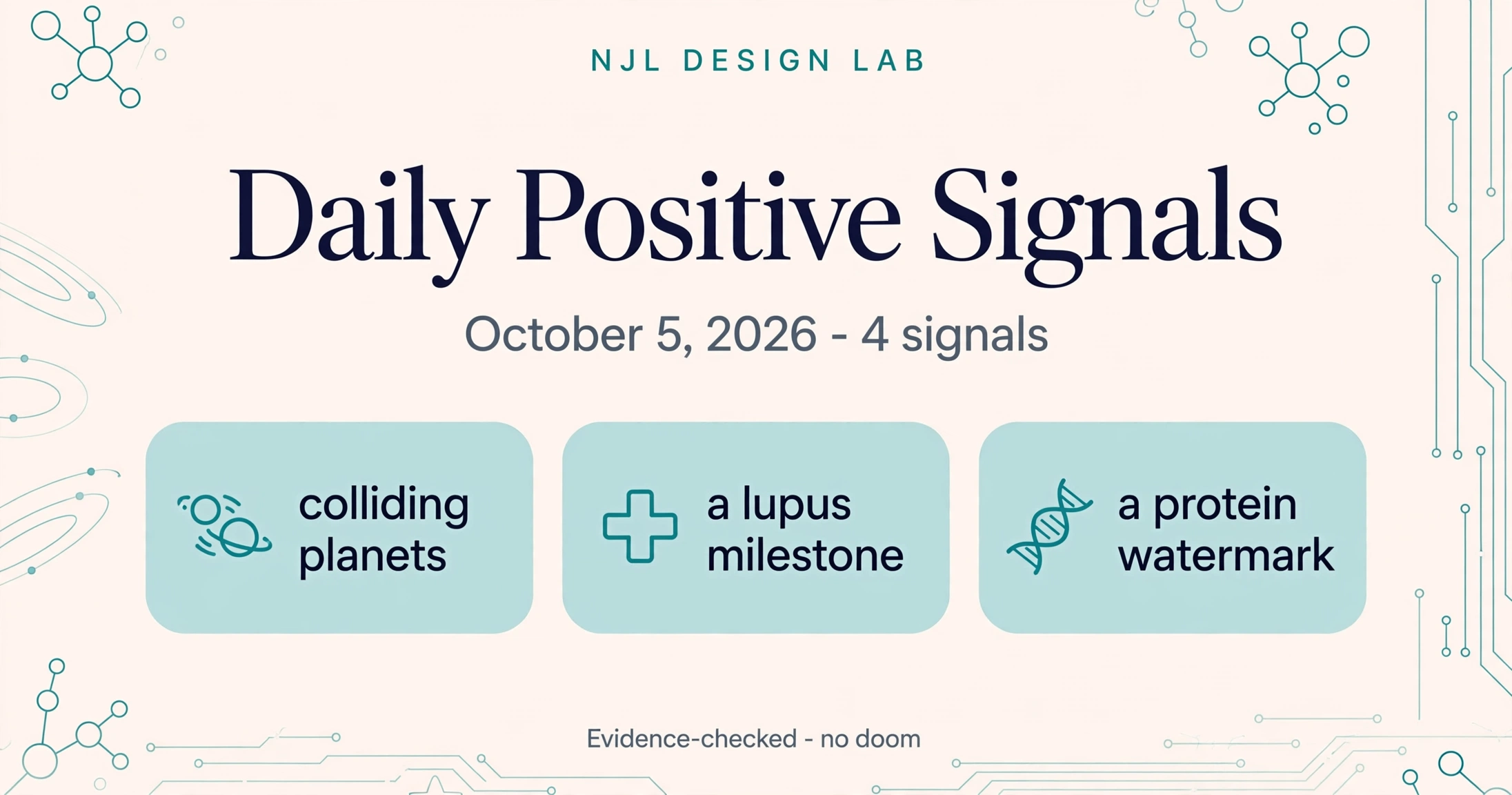
Daily Positive Signals — October 5, 2026
On this page
Webb decoded the chemistry of planet-shattering collisions, a lupus drug held its gains through week 52, DeepMind watermarked AI-designed proteins without breaking their function, and an MIT algorithm models double-digit emissions cuts from smarter driving. The thread: every win in this edition comes with a measurement attached.
In this edition · 4 signals
- Webb reads the chemistry of planet-shattering collisions · Extreme debris disks
- A lupus drug keeps working at week 52 · Litifilimab
- DeepMind watermarks AI-designed proteins without breaking their function · SynthID Bio
- Smarter speed control could cut traffic emissions by up to 22% · Eco-driving
Signal 1 of 4 · Space
Webb reads the chemistry of planet-shattering collisions
A team led by Kate Su of the Space Science Institute used the James Webb Space Telescope to analyze 21 extreme debris disks: warm, dusty rings around young stars first flagged by NASA’s retired Spitzer telescope (NASA, 2026). The dust splits into two chemical families: silica-rich disks, produced when high-energy impacts vaporize rock between Mars-sized bodies, and silica-poor disks from gentler, grazing collisions between Moon-sized bodies (Su et al., 2026). The silica-rich disks appear only around stars younger than about 300 million years, which suggests the era of Moon-forming-scale impacts is brief and ends early (NASA, 2026).
Why it matters. Rocky planets grow through collisions, and this is the first time there are enough systems to sort those collisions by energy and age. It turns debris disks into a fossil record of how terrestrial planets assemble, including our own.
Evidence status: Peer-reviewed study in the Astrophysical Journal; NASA institutional summary; independent science-press coverage.
Signal 2 of 4 · Medical research
A lupus drug keeps working at week 52
Biogen reported 52-week results from the Phase 2 part of the AMETHYST study of litifilimab in cutaneous lupus erythematosus (CLE), presented at the European Academy of Dermatology and Venereology 2026 congress in Vienna (Biogen, 2026). Among 93 adults whose disease had not responded to standard antimalarial treatments, 27.2% reached clear or almost clear skin at week 52, up from 19.0% at week 24, and 28.8% achieved at least a 70% reduction in disease activity (Pharmacally, 2026). Participants who switched from placebo to the drug at week 24 improved within four weeks, and no new safety signals appeared (Biogen, 2026).
Why it matters. CLE causes permanent scarring and disfigurement, and the FDA granted litifilimab Breakthrough Therapy Designation in January. Durability through a full year is what turns a promising drug into a real treatment option.
Evidence status: Company announcement of Phase 2 data at a medical congress; independent trade-press reporting; Phase 3 results expected in the first half of 2027; the drug is not yet approved.
Signal 3 of 4 · AI research
DeepMind watermarks AI-designed proteins without breaking their function
DeepMind has published a proof of concept for watermarking AI-generated proteins: an imperceptible signature embedded in the biological code, readable on the synthesized physical protein. Two routes work: guiding amino-acid choice during design, and fine-tuning part of AlphaFold 3’s diffusion network so predicted coordinates carry the signature. In wet-lab tests on three protein binders, the watermarked designs matched unwatermarked ones on hit rate, binding affinity, and sequence diversity, and the work is open-sourced with a peer-reviewed paper, code, and lab data (DeepMind, 2026; Tech Times, 2026; Ground Truth, 2026). The October 4 edition of this brief covered an open-source pipeline for checkable AI science; watermarking is the provenance half of that same trust infrastructure.
Why it matters. Provenance for AI-designed biology is a genuine biosecurity need: knowing a protein came from an AI pipeline lets regulators and synthesis labs trace it. This is a first demonstration, not a deployed screen, and the watermark can be stripped by known routes, so it must be read as provenance tooling, not a safety guarantee (Ground Truth, 2026).
Evidence status: Peer-reviewed paper in Nature plus the DeepMind blog; open code and wet-lab data. Proof of concept only, with documented removal routes and no operational deployment.
Signal 4 of 4 · AI research
Smarter speed control could cut traffic emissions by up to 22%
MIT profiled associate professor Cathy Wu’s program applying reinforcement learning to transportation, including a city-scale study that found intelligently controlling vehicle speeds at intersections could cut intersection emissions by 11 to 22 percent without hurting throughput or safety (MIT News, 2026). The study simulated over a million traffic scenarios across three U.S. cities, and found that even 10% adoption would capture 25 to 50% of the total benefit (AI4OPT, 2026). Separately, Wu’s team addressed reinforcement learning’s notorious brittleness, devising a contextual-RL approach that improves training efficiency up to 30 times (MIT News, 2026).
Why it matters. Transportation policy debates usually run on opinions; this gives city planners a quantified, evidence-based lever. Smoother speeds at intersections pay off big even at modest adoption.
Evidence status: MIT News profile of a peer-reviewed research program; the eco-driving study was published in 2025 in Transportation Research Part C; contextual-RL results from 2023.
Editor’s note
Four signals, one habit: measure the thing. Webb sorted planetary collisions by chemistry instead of guessing at them. A drug trial reported durability through a full year, not just a week-16 endpoint. A protein watermark was validated in wet labs, with its removal routes disclosed. And traffic researchers quantified the emissions prize before asking any city to act. Progress you can inspect is the kind that compounds.
That’s the edition: four signals, every claim verified against its sources. Browse past briefs · tomorrow’s lands at 07:15.
The Progress Brief, by email
Useful progress, without the hype
The daily Positive Signals brief and the weekly deep dive, by email. Evidence-checked, concise, no doom.
Free. One daily email, one weekly email. Unsubscribe anytime.
References
- AI4OPT. (n.d.). Seminar: Cathy Wu — Towards AI-assisted optimization for transportation system design. AI Institute for Advances in Optimization. https://www.ai4opt.org/news-events/seminar-cathy-wu
- Biogen. (2026, October 2). Biogen’s litifilimab demonstrates rapid and durable efficacy in new 52-week Phase 2 data from ongoing Phase 2/3 AMETHYST study. GlobeNewswire. https://www.globenewswire.com/news-release/2026/10/02/3373899/0/en/biogen-s-litifilimab-demonstrates-rapid-and-durable-efficacy-in-new-52-week-phase-2-data-from-ongoing-phase-2-3-amethyst-study-reinforcing-its-potential-as-a-first-in-class-therapy.html
- DeepMind. (2026, September 30). Introducing SynthID Bio. https://deepmind.google/blog/introducing-synthid-bio/
- Ground Truth. (2026, October 2). DeepMind publishes protein watermarks with documented removal routes. Ground Truth, 2026
- MIT News. (2026, October 2). Computational tools for society’s most complex challenges. Massachusetts Institute of Technology. https://news.mit.edu/2026/computational-tools-for-societys-most-complex-challenges-cathy-wu-1002/
- NASA. (2026, October 1). NASA’s Webb provides crash course on planet-shattering collisions. https://science.nasa.gov/missions/webb/nasas-webb-provides-crash-course-on-planet-shattering-collisions/
- Pharmacally. (2026, October 3). Biogen reports encouraging 52-week results for litifilimab in cutaneous lupus. https://pharmacally.com/biogen-litifilimab-amethyst-phase-2-cutaneous-lupus-week-52/
- sci.news. (2026, October 2). Strange dusty disks around young stars may be wreckage of Moon- and Mars-sized collisions. https://www.sci.news/astronomy/extreme-debris-disks-15105.html
- Su, K. Y. L., et al. (2026). Extreme debris disks: Insights into violent collisions in planet formation and destruction. The Astrophysical Journal, 1010, 1. https://doi.org/10.3847/1538-4357/ae88fe
- Tech Times. (2026, October 2). SynthID Bio watermarks AI-designed proteins without breaking their function. Tech Times, 2026