Daily Positive Signals: a Martian meteorite, a trillion-parameter model, and a whole-body cell map
On this page
Listen to this brief · about 5 min, story text only
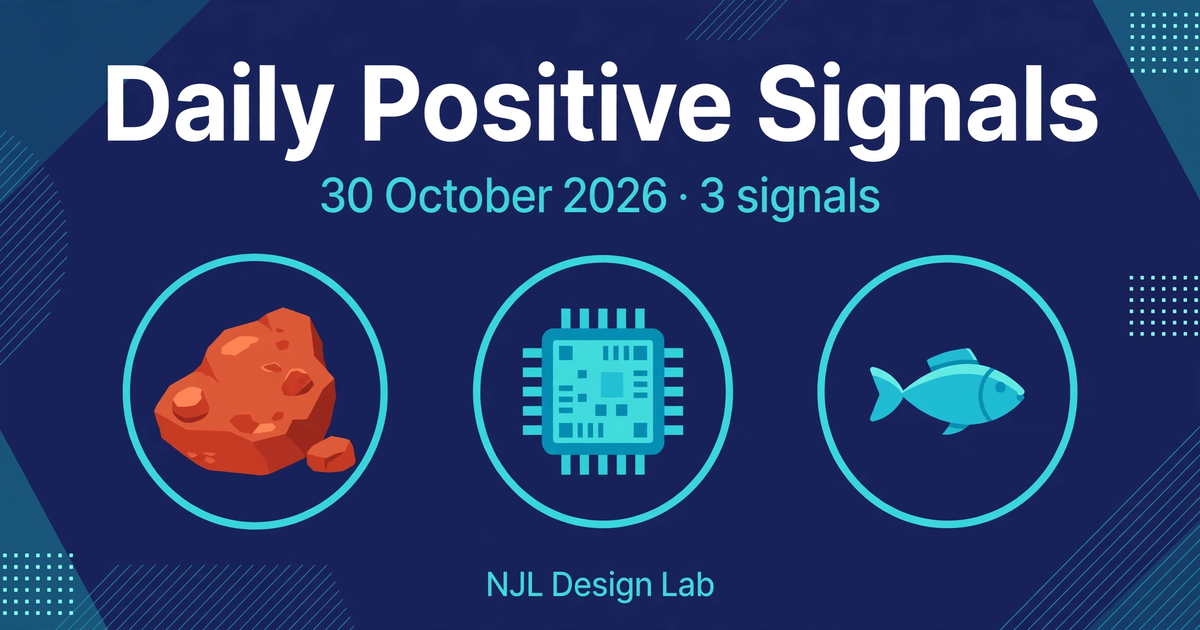
This edition: a Martian meteorite older than Earth’s oldest rocks, a trillion-parameter model anyone can download and run, and the first whole-body cell map of an adult vertebrate. The thread: each one is a new reference map — of ancient Mars, of frontier AI in your own hands, of a whole body cell by cell.
In this edition · 3 signals
Signal 1 of 3 · Space
A 4.1-billion-year-old piece of Mars, characterised at last
A rose-coloured meteorite found in the Sahara Desert in 2022 has turned out to be one of the oldest pieces of Mars ever found on Earth. NASA-funded researchers age-dated Teghaza 001, a rock of just under 800 grams named after the salt plain in Mali where it was found, and showed it formed more than 4.1 billion years ago (NASA, 2026). A paper in Science offers the first full characterisation of the rock: a mix of volcanic minerals that records how Mars’s crust formed from cooling magma and was later altered by water beneath the surface (NASA, 2026; Scientific American, 2026). Its mineralogy matches terrain NASA’s Mars Reconnaissance Orbiter has mapped in the cratered southern highlands, and the paper names 13 candidate sites with matching chemistry, though the exact origin will never be known for certain (NASA, 2026). Dating it took a new in-situ method that analysed single mineral grains on a fragment smaller than a fingernail, preserving the rare sample for future study (NASA, 2026).
Why it matters. Most Martian meteorites are hundreds of millions of years old, so a sample from the planet’s first chapter fills a gap no rover has sampled in place. It also gives researchers a reference point for how water moved through early Mars, and a method for dating other ancient samples without destroying them.
Evidence status: Peer-reviewed paper in Science, plus a NASA release and independent Scientific American coverage. Limits: an initial characterisation only; the exact site on Mars is unknown, with 13 candidate regions; and the water history is inferred from mineral alteration, not observed directly.
Signal 2 of 3 · AI
A trillion-parameter model, free to download and run yourself
Mistral has released the full weights of Mistral Large 4, nicknamed Le Chonk, so any business or government can download the trillion-parameter model and run it on its own servers (Mistral AI, 2026; TechCrunch, 2026). The model is natively multimodal, with a one-million-token context window, and Mistral pitches it first at cyber defence: it scores 51% on the Artificial Analysis Cyber Index and refuses 96.6% of malicious cyber requests in company tests (Mistral AI, 2026). On coding it leads open models on FrontierCode 2.0 at 19.7% while using 47% fewer tokens per task than its closest open rival (Mistral AI, 2026). The weights carry a modified MIT licence that allows free use and commercialisation, except that businesses offering the model as a service need a separate commercial licence (TechCrunch, 2026).
Why it matters. Security teams handle code and incident data they cannot send to someone else’s cloud, so a frontier model they can run inside their own firewall changes what they can defend in-house. Open weights also mean access cannot be cut off by a provider’s decision, which matters as much for governments as for companies.
Evidence status: Company announcement with independent TechCrunch reporting. Limits: benchmark figures are company-reported and not yet independently reproduced; Mistral itself notes attack-uplift risk, and its specialised penetration-testing variant stays restricted to vetted partners.
Signal 3 of 3 · Biology
A whole-body cell map, built from a one-centimetre fish
Whitehead Institute researchers have built the first whole-body single-cell atlas of an adult vertebrate, using a tiny transparent fish barely one centimetre long (Whitehead Institute, 2026). The team profiled more than 600,000 cells from Danionella cerebrum, recording which genes are active in each cell and where those cells sit in the body (Whitehead Institute, 2026; Atabay et al., 2026). Pairing single-cell RNA sequencing with spatial mapping, they captured even rare cell populations and found that adult cells keep a molecular memory of where they belong in the body (Atabay et al., 2026). They then used the atlas to trace brain regeneration after injury, from wound and immune response through stem-cell activity to new neurons, and have published the whole atlas openly through DigiFish (Whitehead Institute, 2026).
Why it matters. Studying tissues one at a time hides how the body coordinates across them. A whole-animal reference lets researchers ask whole-body questions, about injury, ageing or drugs, and follow a single cell type from gene to location to function.
Evidence status: Peer-reviewed study in Science, plus a Whitehead Institute release and independent coverage. Limits: the findings describe one fish species, not a treatment, and whether the same organising patterns hold in mammals is still to be tested.
Editor’s note
Today’s thread is reference maps. A meteorite that maps Mars’s earliest crust. A model that any team can download and run behind its own firewall. A cell-by-cell map of a whole vertebrate body. Each one hands researchers something they can build on directly — a sample, a tool, a baseline — rather than a promise about what comes next. That is the quiet shape of progress: not a breakthrough announced, but a map published, so the next discovery starts further along.
That’s the edition — three signals, every claim verified against its sources. Browse past briefs · tomorrow’s lands at 07:15.
The Progress Brief, by email
Useful progress, without the hype
The daily Positive Signals brief and the weekly deep dive, by email. Evidence-checked, concise, no doom.
Free. One daily email, one weekly email. Unsubscribe anytime.
References
- Atabay, K. D., et al. (2026, October 29). Whole-body single-cell atlas of an adult vertebrate in homeostasis and regeneration. Science. https://phys.org/news/2026-10-body-cell-atlas-adult-vertebrate.html
- Mistral AI. (2026, October 29). Mistral Large 4 (Le Chonk) is now open weight. https://mistral.ai/news/mistral-large-4-oss/
- NASA. (2026, October 29). NASA-funded study details one of oldest Mars meteorites ever found. https://www.nasa.gov/solar-system/planets/mars/nasa-funded-study-details-one-of-oldest-mars-meteorites-ever-found/
- Scientific American. (2026, October 29). Oldest known Mars rock is a ‘Rosetta stone’ for the Red Planet’s watery past. https://www.scientificamerican.com/article/oldest-known-mars-rock-is-a-rosetta-stone-for-the-red-planets-watery-past/
- TechCrunch. (2026, October 29). Mistral releases weights for its trillion-parameter AI model, targeting cybersecurity. TechCrunch, 2026
- Whitehead Institute. (2026, October 29). A tiny fish provides big answers: the first full-body map of gene activity in an adult vertebrate [Press release]. https://www.prnewswire.com/news-releases/a-tiny-fish-provides-big-answers-the-first-full-body-map-of-gene-activity-in-an-adult-vertebrate-302924053.html