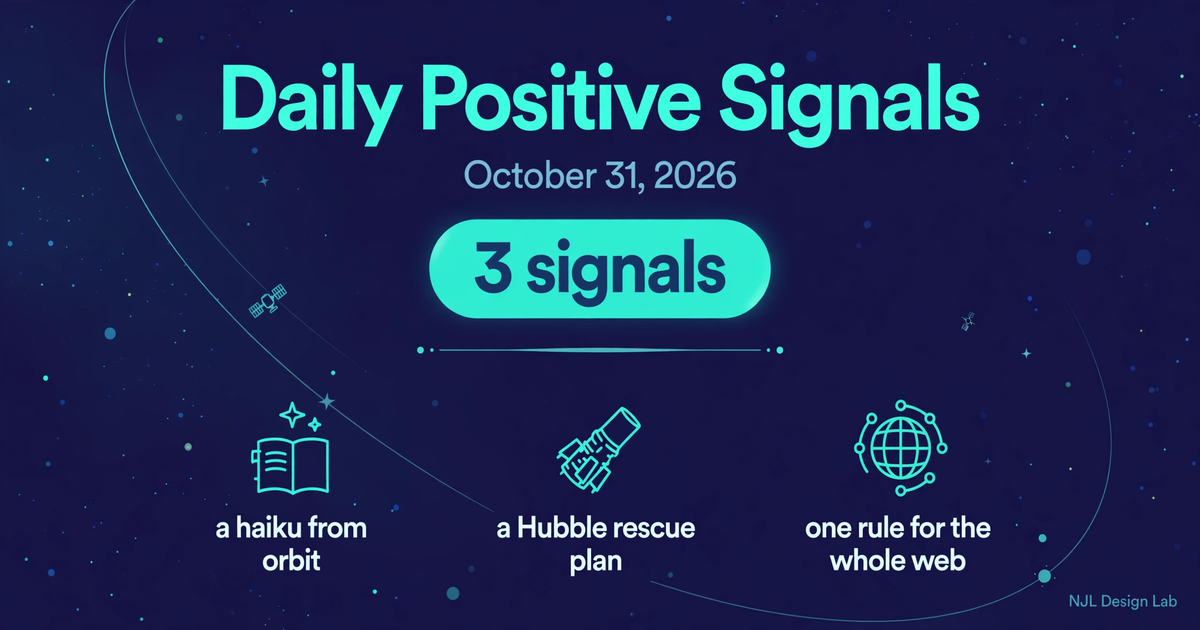
Daily Positive Signals: a haiku from orbit, a Hubble rescue plan, and one rule for the whole web
On this page
Listen to this brief · about 4 min, story text only
This edition: the first AI answer generated aboard a satellite in orbit, a commercial route to keep Hubble flying, and one shared robots.txt signal for AI training. The thread: existing things given a new job — a chip built for data centres goes to orbit, a 35-year-old telescope gets a commercial second act, and a web convention from the 1990s gains a shared AI vocabulary.
In this edition · 3 signals
Signal 1 of 3 · Space
An AI haiku beamed down from orbit
Google’s prototype satellite for Project Suncatcher has sent back its first AI-generated answer from orbit. After launching on 1 October aboard a SpaceX Falcon 9 rocket, the satellite spent about three weeks in commissioning before engineers uplinked a first prompt to its onboard Gemma 4 model (Google, 2026; TechCrunch, 2026). Asked to write a haiku about being in space, it replied as it passed over a ground station in Svalbard, Norway: “Blue marble below / Data streams in silent grace / Starlight feeds my core” (Google, 2026). The satellite carries four of Google’s Tensor Processing Units, though power limits mean only one runs at a time, for about 20 minutes per stretch (TechCrunch, 2026).
Why it matters. The poem is trivial; the proof is not. A data-centre-class chip has now received a prompt, run a model, and sent an answer home from orbit, which is the first step toward testing whether AI hardware survives radiation and thermal stress in space.
Evidence status: Google announcement with independent TechCrunch reporting. Limits: an early demonstration only; the next tests on radiation and heat are still to come, and commercial orbital data centres remain years away.
Signal 2 of 3 · Space
A commercial rescue plan for Hubble
NASA has asked commercial companies how they would keep the Hubble Space Telescope flying — or bring it down safely. The agency issued a Request for Information on 29 October seeking concepts in three areas: boosting Hubble to a higher orbit, servicing it to improve its performance and resilience, or performing a controlled re-entry (NASA, 2026). For a boost, the notice specifies raising the telescope to at least 600 kilometres, with any mission expected by 2032 (EconoTimes, 2026). Hubble has no propulsion of its own, and NASA’s analysis puts uncontrolled re-entry in the 2033 to 2034 timeframe if nothing is done (NASA, 2026).
Why it matters. Hubble has delivered science for more than 35 years and still has work ahead of it, so a commercial boost could buy years of observations without a new flagship. Even the third option matters: a planned ending beats an uncontrolled fall.
Evidence status: NASA release plus independent reporting of the notice. Limits: an information request only — no contract, funding, or selected provider, and NASA may never issue a formal solicitation.
Signal 3 of 3 · AI
One shared signal for AI training preferences
OpenAI has committed to honour a single shared signal in robots.txt that lets websites state whether their content may be used to train generative AI models. Until now, site operators had to identify each provider’s crawlers and maintain separate rules for each one; the shared signal lets them communicate one preference to multiple participating providers at once (OpenAI, 2026). The signal uses the policy token __usage_ai-training, developed through the Internet Engineering Task Force’s AI Preferences working group (Unite.ai, 2026). OpenAI says it aims to implement the signal in the coming months, and that its existing crawler controls will continue to apply alongside it (OpenAI, 2026).
Why it matters. For small publishers, the current system is a maintenance burden that favours large sites with legal teams. One shared vocabulary lowers that cost and gives every site owner the same simple way to say yes or no.
Evidence status: OpenAI announcement with independent reporting. Limits: voluntary and not yet implemented — no firm date, and adoption by other providers is still to be confirmed.
Editor’s note
Today’s thread is old things given a new job. A chip designed for warehouse-scale data centres earns its wings in orbit. A telescope launched in 1990 gets a commercial path to keep working instead of a date with the atmosphere. A file websites have used since the early web to talk to crawlers gains one shared word for AI training. None of these is a brand-new invention, and that is the point: progress often looks like existing infrastructure, pointed somewhere it has never been pointed before.
That’s the edition — three signals, every claim verified against its sources. Browse past briefs · tomorrow’s lands at 07:15.
The Progress Brief, by email
Useful progress, without the hype
The daily Positive Signals brief and the weekly deep dive, by email. Evidence-checked, concise, no doom.
Free. One daily email, one weekly email. Unsubscribe anytime.
References
- EconoTimes. (2026, October 30). NASA seeks commercial plans to extend Hubble or manage its disposal. https://econotimes.com/NASA-Seeks-Commercial-Plans-to-Extend-Hubble-or-Manage-Its-Disposal-1767164
- Google. (2026, October 30). Google receives response from Project Suncatcher prototype satellite in space. https://blog.google/innovation-and-ai/models-and-research/google-research/project-suncatcher-satellite-response/
- NASA. (2026, October 30). NASA explores potential commercial servicing for Hubble Telescope. https://science.nasa.gov/missions/hubble/nasa-explores-potential-commercial-servicing-for-hubble-telescope/
- OpenAI. (2026, October 30). Making it easier for websites to express AI training preferences. https://openai.com/index/helping-websites-express-ai-training-preferences
- TechCrunch. (2026, October 30). Google’s first data center satellite is online and writing poetry. https://techcrunch.com/2026/10/30/googles-first-data-center-satellite-is-online-and-writing-poetry/
- Unite.ai. (2026, October 30). OpenAI to honor shared robots.txt signal for AI training preferences. https://www.unite.ai/openai-to-honor-shared-robots-txt-signal-for-ai-training-preferences/