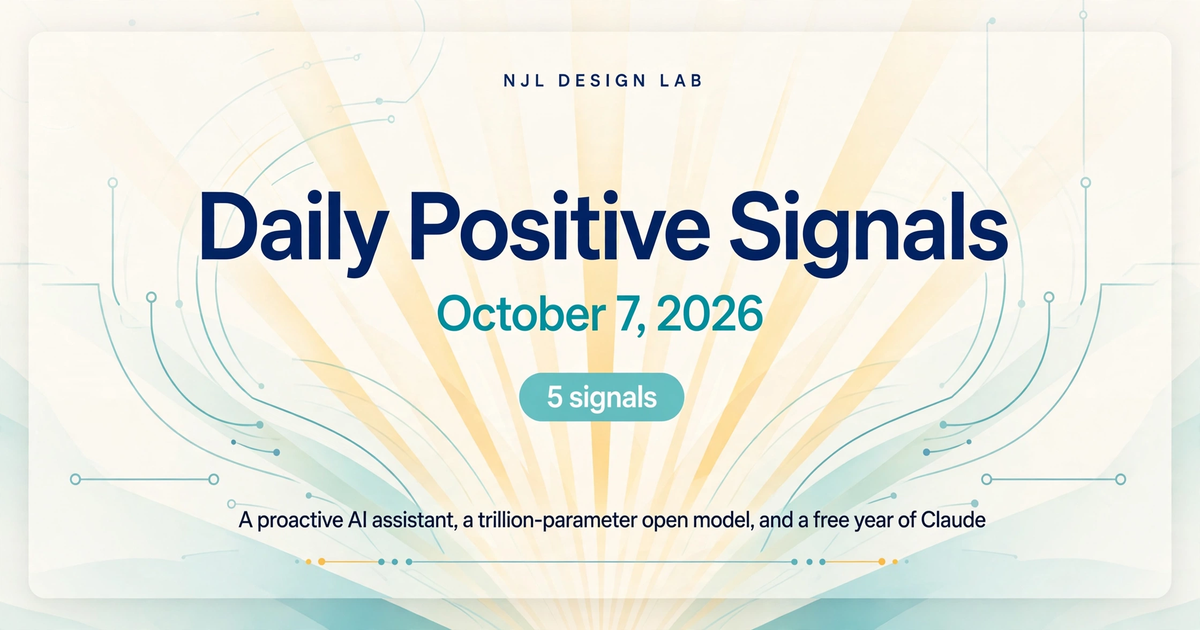
Daily Positive Signals: a proactive AI assistant, a trillion-parameter open model, and a free year of Claude
On this page
- Hark Pro: an AI assistant that uses your computer for you
- Mistral’s “Le Chonk”: a trillion parameters, open weights by month’s end
- Anthropic hands startups a free year of Claude Team and $1,000 in credits
- EmbeddingGemma 2: multimodal search that runs entirely on your device
- OpenAI will watermark ChatGPT text for EU users
- Useful progress, without the hype
- References
- Know someone this would help?
Listen to this brief · about 7 min, story text only
Hark Pro turns an AI assistant into a proactive operator that uses your computer for you, Mistral ships a trillion-parameter model with European open weights on the way, and Anthropic hands startups a free year of Claude Team. The thread: the frontier is moving toward assistants you can hand real work to — and toward openness at both ends of the size spectrum.
In this edition · 5 signals
- Hark Pro: an AI assistant that uses your computer for you — Hark Pro launch
- Mistral’s “Le Chonk”: a trillion parameters, open weights by month’s end — Mistral Large 4
- Anthropic hands startups a free year of Claude Team and $1,000 in credits — Claude for Startups
- EmbeddingGemma 2: multimodal search that runs entirely on your device — On-device embeddings
- OpenAI will watermark ChatGPT text for EU users — Text provenance
Signal 1 of 5 · AI assistants
Hark Pro: an AI assistant that uses your computer for you
Hark, the AI startup founded by Figure AI chief executive Brett Adcock, launched Hark Pro on October 6, 2026 — a proactive personal assistant built around a computer-use model rather than a chat window (TechCrunch, 2026). The product’s centerpiece is Handoff, an agent that opens cloud computers and operates websites the way a person would — clicking buttons, filling forms, completing purchases — so the assistant can finish tasks end to end instead of just suggesting them (TestingCatalog, 2026). The home screen surfaces proactive prompts (expenses to approve, emails to answer, flights to book) alongside small dashboards the company calls panels, and the service is free to use with a paid tier for heavy users (TechCrunch, 2026).
Why it matters. Most assistants still wait to be asked; Hark bets the winning interface is one that notices what you need and acts. With three frontier labs now shipping proactive assistants within weeks of each other, computer-use is becoming the field where the personal-AI race is decided.
Evidence status: Company launch announcement; independent hands-on coverage from TechCrunch and Gizmodo. Benchmark claims about Handoff are company-reported and unverified. Giving an assistant access to email, calendar, files, and payment details raises real security questions — Hark says it does not sell user data and lets users delete it, but that is a promise, not an audit.
Signal 2 of 5 · AI industry
Mistral’s “Le Chonk”: a trillion parameters, open weights by month’s end
Mistral AI released a public preview of Mistral Large 4 on October 6, 2026 — a natively multimodal mixture-of-experts model with about one trillion total parameters and 49 billion active per request, available through its API now, with the downloadable weights promised by the end of October (TechCrunch, 2026; Unite.AI, 2026). Trained on roughly 3,800 NVIDIA Grace Blackwell GPUs in the company’s own European data centers, it covers more than 160 languages and targets enterprise workloads: cybersecurity, finance, law, coding, and manufacturing (Oossa, 2026). Mistral reports it leads open-weight rivals on cyber-defense tasks — 82% on one vulnerability-reproduction-and-patching test where closed competitors’ safety filters refuse to act — though these are company-selected benchmarks, not independent verification (TechDefused, 2026).
Why it matters. Yesterday’s edition covered Reflection’s efficiency play; this is the other direction — scale. A trillion-parameter European open-weight model means organizations that cannot or will not send data to U.S. clouds get a frontier-class option they can run themselves. The cyber-defense angle also shows safety-tuned refusals are becoming a competitive differentiator, not just a compliance feature.
Evidence status: Company launch announcement with company-reported benchmarks; broad independent press coverage. The weights and their license are not published yet — the “open” part is a promise until the release lands.
Signal 3 of 5 · AI industry
Anthropic hands startups a free year of Claude Team and $1,000 in credits
Anthropic expanded its Claude for Startups program on October 6, 2026, adding a free year of Claude Team (up to five premium seats), $1,000 in API credits, and virtual office hours with its Applied AI team — plus a new Claude Startup Stack of partner discounts and credits worth up to $45,000 (TechCrunch, 2026; Inc., 2026). Any startup founded in the last five years, or funded in the last two, can apply; venture-backed founders in Anthropic’s partner network can claim up to $100,000 more in API credits through their investors (AI Weekly, 2026). The company’s rationale: the benefits of AI reach most people through companies that build on the models, so backing early-stage builders is central to its strategy (TechCrunch, 2026).
Why it matters. Frontier AI access was an enterprise budget line; subsidizing it for early startups puts frontier capabilities in the hands of teams building the next layer of useful tools. It is also honest strategy: whoever onboards a startup first often keeps its API bill for years.
Evidence status: Company program announcement corroborated by TechCrunch, CNBC, and Inc. coverage. Terms and eligibility confirmed on Anthropic’s program page.
Signal 4 of 5 · AI research
EmbeddingGemma 2: multimodal search that runs entirely on your device
Google DeepMind launched EmbeddingGemma 2 on October 6, 2026 — a compact open-weight model that maps text, code, images, video, and audio into one shared vector space, so local files can be searched with natural language without sending anything to a server (DeepMind, 2026; The Decoder, 2026). The text-only configuration needs about 191 MB of active RAM; the full multimodal build uses around 567 MB on a Pixel phone, and the code-search score (MTEB Code) jumped nearly 10 points over its predecessor (Google Developers Blog, 2026). Released under the Apache 2.0 license with weights on Hugging Face and Kaggle, it can power offline retrieval for apps like local codebase search and photo libraries (The Decoder, 2026).
Why it matters. The counterweight to today’s trillion-parameter release: serious multimodal AI is also getting small enough to live on your phone. Privacy-first, offline search for your own photos, documents, and code is the kind of capability that quietly becomes infrastructure.
Evidence status: Company research announcement; developer documentation and independent press coverage. Benchmark figures are company-reported; independent reproduction pending.
Signal 5 of 5 · AI transparency
OpenAI will watermark ChatGPT text for EU users
OpenAI announced on October 5, 2026 that it will add an invisible watermark to text generated by ChatGPT and Codex in the European Union, complying with the EU AI Act’s transparency rules (OpenAI, 2026; TechCrunch, 2026). The watermark subtly shapes word choices into a pattern a detector can spot: it is invisible to readers, travels with copied text, does not identify the user, and OpenAI says it caused no meaningful change in model performance. The rollout starts over the coming weeks for EU ChatGPT and Codex users on all plans, while API developers anywhere can switch it on today — off by default, not a global default (TechCrunch, 2026). Alongside the announcement, OpenAI published a technical report on its method, textGrain, co-written with researchers from the University of Pennsylvania and Yale. Anthropic made a similar move for Claude two months ago, applied worldwide (TechCrunch, 2026).
Why it matters. Machine-generated text is getting harder to distinguish from human writing, and an invisible, copy-resistant marker is the most practical provenance tool available. OpenAI is unusually honest about the limits — editing defeats the watermark, and its absence proves nothing — which makes this a credible start rather than a promise of solved detection.
Evidence status: Company announcement with a published technical report; independent reporting by TechCrunch. OpenAI’s own tests show the watermark degrades under paraphrasing, and detector access is initially limited to approved researchers and expert organizations.
Editor’s note
The five signals today pull in two directions that are starting to look like one: AI is getting bigger and more autonomous at the top end, and smaller and more private at the edge. Hark and Mistral both want to be the layer that actually does things for you — one through an assistant that clicks, one through a model you can run yourself. And as the output gets more capable, the provenance question (OpenAI’s watermarking) and the privacy question (on-device embeddings) are finally being treated as product features rather than afterthoughts.
That’s the edition — five signals, every claim verified against its sources. Browse past briefs · tomorrow’s lands at 07:15.
The Progress Brief, by email
Useful progress, without the hype
The daily Positive Signals brief and the weekly deep dive, by email. Evidence-checked, concise, no doom.
Free. One daily email, one weekly email. Unsubscribe anytime.
References
- AI Weekly. (2026, October 6). Anthropic expands Claude Startups with $45k partner stack. https://aiweekly.co/alerts/anthropic-expands-claude-startups-with-45k-partner-stack
- DeepMind. (2026, October 6). EmbeddingGemma 2: An open, lightweight multimodal embedding model. Google DeepMind. https://deepmind.google/blog/embeddinggemma-2-an-open-lightweight-multimodal-embedding-model/
- Gizmodo. (2026, October 6). This startup led by an ex-Apple designer thinks a GUI for AI could change everything. https://gizmodo.com/hark-pro-ai-ui-2000822253
- Google Developers Blog. (2026, October 6). Bring multimodal semantic search to the edge with EmbeddingGemma 2. https://developers.googleblog.com/google-ai-edge-with-embeddinggemma-2/
- Inc. (2026, October 6). Anthropic is offering more than $50,000 in Claude perks for entrepreneurs. Here’s how to get them. https://www.inc.com/aaron-mok/anthropic-is-offering-more-than-50000-in-claude-perks-for-entrepreneurs-heres-how-to-get-them/91415278
- Oossa. (2026, October 6). Mistral launches public preview of Mistral Large 4 model. https://oossa.com/en/mistral-launches-public-preview-of-mistral-large-4-model
- OpenAI. (2026, October 5). Our approach to EU text provenance rules. https://openai.com/index/eu-text-provenance
- SecNews. (2026, October 6). Hark Pro: Brett Adcock’s new AI assistant, what it does and how much it costs. https://www.secnews.gr/en/738462/hark-pro-voithos-ai-brett-adcock/
- TechCrunch. (2026, October 5). OpenAI will start watermarking ChatGPT’s text in the EU. https://techcrunch.com/2026/10/05/openai-will-start-watermarking-chatgpts-text-in-the-eu/
- TechCrunch. (2026, October 6). Anthropic is giving startups a free year of Claude Team and $1,000 in credits. https://techcrunch.com/2026/10/06/anthropic-gives-startups-a-free-year-of-enterprise-service-and-1000-in-token-credits/
- TechCrunch. (2026, October 6). Hark releases an AI personal assistant with a focus on privacy. https://techcrunch.com/2026/10/06/hark-releases-an-ai-personal-assistant-with-a-focus-on-privacy/
- TechCrunch. (2026, October 6). Mistral’s new 1T model aims to leapfrog closed and open rivals. https://techcrunch.com/2026/10/06/mistrals-new-1t-model-aims-to-leapfrog-closed-and-open-rivals/
- TechDefused. (2026, October 6). Mistral launches its largest model yet with a sharp focus on cybersecurity. TechDefused, 2026
- TestingCatalog. (2026, October 4). Figure plans to release Hark this week. https://www.testingcatalog.com/figure-plans-to-release-hark-ai-assistant-this-week/
- The Decoder. (2026, October 6). Google claims EmbeddingGemma 2 outperforms rival embedding models twice its size. https://the-decoder.com/google-claims-embeddinggemma-2-outperforms-rival-embedding-models-twice-its-size/
- Unite.AI. (2026, October 6). Mistral unveils 1.05T-parameter ‘Le Chonk’ MoE model in public preview. https://www.unite.ai/mistral-unveils-1-05t-parameter-le-chonk-moe-model-in-public-preview/