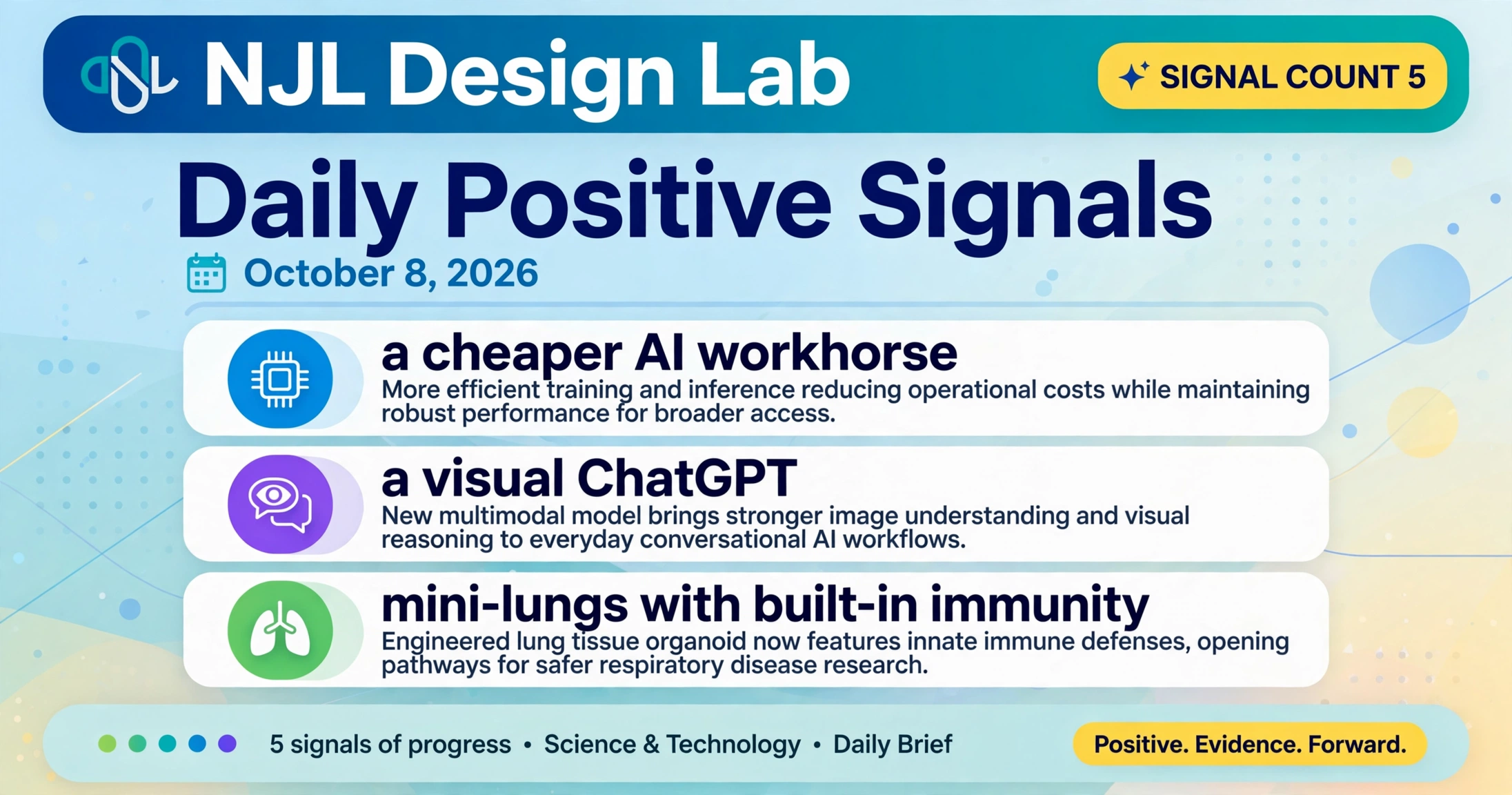
Daily Positive Signals: a cheaper AI workhorse, a visual ChatGPT, and mini-lungs with built-in immunity
On this page
- Claude Haiku 5.5: frontier-lite AI at roughly a quarter of the old cost
- ChatGPT gets a visual interface that builds calculators, charts, and diagrams
- Google’s SynthID Detector is now open to everyone
- $1.8 billion pledged to build the datasets for predictive biology
- Mini-lungs with a built-in immune system fight off a virus
- Useful progress, without the hype
- References
- Know someone this would help?
Listen to this brief · about 7 min, story text only
Anthropic released its cheapest, fastest small model yet; OpenAI gave ChatGPT a visual interface; Google opened its AI-media detector to everyone; a $1.8 billion coalition pledged to build the datasets for predictive biology; and lab-grown mini-lungs mounted immune responses to a virus. The thread: the tools for trusting, using, and understanding AI — and biology — are arriving as public infrastructure.
In this edition · 5 signals
- Claude Haiku 5.5: frontier-lite AI at roughly a quarter of the old cost — Small models
- ChatGPT gets a visual interface that builds calculators, charts, and diagrams — GPT-6 + Intelligent UI
- Google’s SynthID Detector is now open to everyone — Media provenance
- $1.8 billion pledged to build the datasets for predictive biology — Virtual cell
- Mini-lungs with a built-in immune system fight off a virus — Organoids
Signal 1 of 5 · AI industry
Claude Haiku 5.5: frontier-lite AI at roughly a quarter of the old cost
Anthropic launched Claude Haiku 5.5 on October 7, 2026, describing it as the cheapest, fastest, and most capable small model it has released (Anthropic, 2026; Unite.AI, 2026). For prompts up to 100,000 tokens — about 90% of Haiku requests — it costs $0.10 per million input tokens and $0.50 per million output tokens, a tenth of Haiku 4.5’s rates, and Anthropic says average running costs land around 75% below the predecessor (TestingCatalog, 2026). The model adds an adjustable effort setting — a first for the Haiku line — so developers can trade thinking depth against cost, and its context window grew to one million tokens (Anthropic, 2026).
Why it matters. The price of useful AI keeps falling faster than the price of anything else in computing. When a capable small model costs a tenth of last year’s small model, automated busywork — classification, summarization, document processing — becomes affordable at scales where it was previously just theory.
Evidence status: Company launch announcement corroborated by independent reporting (TestingCatalog, Unite.AI). Pricing and benchmark figures are company-reported; independent verification pending. Haiku is aimed at high-volume, narrow work — Anthropic still positions Sonnet 5.5 and Opus 5.5 for complex agentic coding.
Signal 2 of 5 · AI product
ChatGPT gets a visual interface that builds calculators, charts, and diagrams
OpenAI announced on October 7, 2026 that GPT-6 is rolling out globally in ChatGPT with a new capability called Intelligent UI, which composes interactive, visual answers — tappable buttons, task-specific calculators, interactive charts, editable graphs — directly inside the conversation (OpenAI, 2026; TechCrunch, 2026). In a journalist briefing, the company demonstrated a chatbot that spins up diagrams on request — for example, showing a college student how an airplane wing generates lift — with recipe visuals, bicycle-mechanics diagrams, hiking maps, and a personal savings calculator among the other examples (TechCrunch, 2026). The visuals are customizable: users who prefer plainer answers can dial them back.
Why it matters. Chat interfaces have been text-first for four years; the stated goal here is making complex topics easier to learn. If the interface finally catches up to the model’s capabilities, the practical consequence is a chatbot that teaches visually — the way most people actually learn — instead of dumping paragraphs.
Evidence status: Company announcement with a live journalist demonstration, reported independently by TechCrunch. Usage claims (e.g., that visuals improve learning) are the company’s rationale, not measured outcomes.
Signal 3 of 5 · AI transparency
Google’s SynthID Detector is now open to everyone
Google opened its SynthID Detector to everyone globally on October 7, 2026, a website where anyone can upload an image, video, or audio file to check for the invisible watermarks Google embeds in AI-generated media (Google, 2026; TechCrunch, 2026). The detector had been limited to journalists, media professionals, and researchers since a pilot at Google I/O last year; it now works worldwide in English for media from Google’s Gemini, Veo, and Lyria models plus partners OpenAI, NVIDIA, and Kakao, with Apple support said to be coming soon (Unite.AI, 2026; The Decoder, 2026). The site is explicit about scope: it is not a general AI detector and can only flag content carrying a SynthID watermark.
Why it matters. Proving a photo or clip came from an AI model is one of the few concrete defenses against synthetic-media fraud. A watermark checker anyone can use moves provenance from a lab capability to public infrastructure — though it only catches media from companies that adopted the standard.
Evidence status: Company announcement corroborated by multiple independent reports (TechCrunch, Unite.AI, The Decoder, MacRumors). Scale figures (180 billion watermarked, 1 million daily requests) are Google’s. A clean result does not prove a file is real — it only means no SynthID watermark was found — and signing in is required to use the site.
Signal 4 of 5 · Biotechnology
$1.8 billion pledged to build the datasets for predictive biology
Biohub, the U.S. Department of Energy, the National Institutes of Health, Google DeepMind, Isomorphic Labs, and Meta announced a $1.8 billion expansion of the Virtual Biology Initiative on October 7, 2026 — the largest coordinated commitment yet to generating the open datasets needed to train predictive AI models of biology (Biohub, 2026; Reuters, 2026). The Department of Energy will invest more than $500 million over five years in lab measurement, modeling, and computation; NIH will coordinate datasets built on more than $500 million of earlier federal funding; and Google DeepMind, Isomorphic Labs, and Meta jointly contribute $300 million, on top of Biohub’s founding $500 million commitment from April (Biohub, 2026). The goal: measure how cells respond to far more conditions than science has studied so far, and turn that data into predictive “virtual cell” models.
Why it matters. AI in biology is currently data-starved: there is far less structured biological data than the text and images behind today’s AI. A coordinated, standardized, open data commons is the prerequisite for models that could compress drug-development timelines — currently years long — into digital experiments.
Evidence status: Coalition announcement (Biohub) corroborated by Reuters reporting. The five-year “accurate predictive models” target is a stated ambition, not a commitment; commercial funders get an embargo period before datasets become public.
Signal 5 of 5 · Medical research
Mini-lungs with a built-in immune system fight off a virus
Researchers at the Stanford University School of Medicine built human lung organoids that keep the tissue’s resident immune cells alive for months — and when infected with SARS-CoV-2, the mini-lungs mounted not just generic inflammation but adaptive immune responses, with T cells reacting to the virus specifically (NIH, 2026; MedicalXpress, 2026). The study, published in Nature, used lung fragments from more than 220 patient volunteers in a 3D air-liquid interface culture simulating the lung’s gas exchange (Rathkey et al., 2026). Pre-stimulating the organoids with virus fragments — essentially simulating a vaccination — weakened subsequent infections, suggesting the lung’s local immune system alone can provide significant protection.
Why it matters. Most lab models of infection lack immune cells entirely. A model that keeps human lung immunity functional for months gives researchers a way to study local vaccines — the kind that train the body’s frontline defenses — and could eventually replace some animal testing.
Evidence status: Peer-reviewed study in Nature (Rathkey et al., 2026), reported by NIH and MedicalXpress. Animal-model replacement is a potential application, not yet demonstrated; clinical relevance for vaccines is still downstream of more research.
Editor’s note
Today’s edition is unusually coherent: every signal is about making powerful technology legible, affordable, or grounded. Haiku 5.5 makes capable AI cheap enough to run at scale; Intelligent UI makes AI’s answers readable at a glance; the SynthID Detector makes AI’s outputs checkable; the Virtual Biology Initiative and the lung organoids both feed the same long game — better models of human disease: one through data at scale, the other through living human tissue that fights back. The frontier is no longer just advancing. It is being documented, priced, and opened up.
That’s the edition — five signals, every claim verified against its sources. Browse past briefs · tomorrow’s lands at 07:15.
The Progress Brief, by email
Useful progress, without the hype
The daily Positive Signals brief and the weekly deep dive, by email. Evidence-checked, concise, no doom.
Free. One daily email, one weekly email. Unsubscribe anytime.
References
- Anthropic. (2026, October 7). Claude Haiku 5.5: The cheapest, fastest, and most capable small model we’ve ever released. https://www.anthropic.com/claude/haiku
- Biohub. (2026, October 7). AI-ready biological data: $1.8 billion global commitment. https://biohub.org/news/virtual-biology-initiative-expansion/
- Google. (2026, October 7). SynthID Detector, now available to everyone. https://synthid.com
- MedicalXpress. (2026, October 7). Human lung organoids with a built-in immune system could transform respiratory disease research. https://medicalxpress.com/news/2026-10-human-lung-organoids-built-immune.html
- NIH. (2026, October 7). Human lung organoids with a built-in immune system could transform respiratory disease research. NIH News Releases. https://www.nih.gov/news-events/news-releases
- OpenAI. (2026, October 7). GPT-6 and Intelligent UI for everyone. https://openai.com/index/gpt-6-for-everyone
- Rathkey, J. K., et al. (2026). Human lung organoid modelling of tissue-resident antiviral T cell responses. Nature. https://dx.doi.org/10.1038/s41586-026-11114-1
- Reuters. (2026, October 7). US government, Google join Zuckerberg-backed Biohub in $1.8 billion push for AI biology data. https://www.channelnewsasia.com/business/us-government-google-join-zuckerberg-backed-biohub-in-18-billion-push-ai-biology-data-6439731
- TechCrunch. (2026, October 7). ChatGPT is getting a lot more visual, with the launch of a new interface. https://techcrunch.com/2026/10/07/chatgpt-is-getting-a-lot-more-visual-with-the-launch-of-a-new-interface/
- TechCrunch. (2026, October 7). Google’s new SynthID website can identify AI-generated media. https://techcrunch.com/2026/10/07/googles-new-synthid-website-can-identify-ai-generated-media/
- TestingCatalog. (2026, October 7). Anthropic launches Claude Haiku 5.5 at lower API prices. https://www.testingcatalog.com/anthropic-launches-claude-haiku-5-5-at-lower-api-prices/
- The Decoder. (2026, October 7). Google says 180 billion images and videos now carry SynthID watermarks as detector goes public. https://the-decoder.com/google-says-180-billion-images-and-videos-now-carry-synthid-watermarks-as-detector-goes-public/
- Unite.AI. (2026, October 7). Anthropic releases Claude Haiku 5.5, cutting small-model API prices. https://www.unite.ai/anthropic-releases-claude-haiku-5-5-cutting-small-model-api-prices/
- Unite.AI. (2026, October 7). Google opens SynthID Detector globally with partner AI content checks. https://www.unite.ai/google-opens-synthid-detector-globally-with-partner-ai-content-checks/