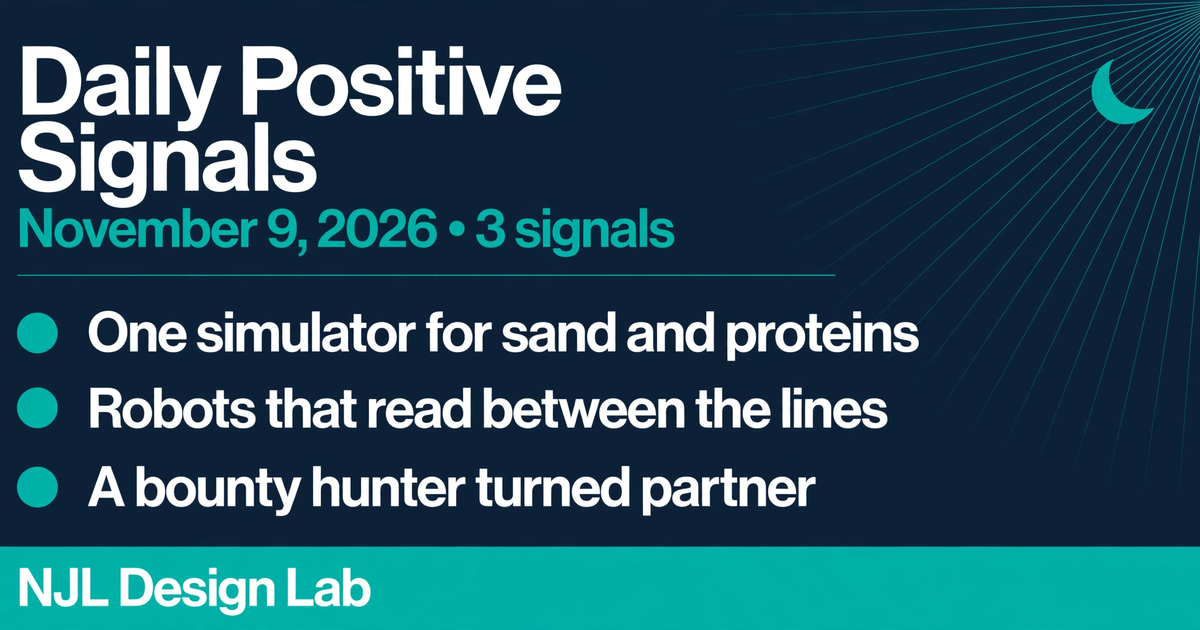
Daily Positive Signals: a universal physics simulator, robots that read between the lines, and a bounty hunter turned partner
On this page
Listen to this brief · about 4 min, story text only
This edition: one AI model simulates sand, cloth, and folding proteins; MIT robots learn what a command really means; and OpenAI turns a bug-bounty hacker into a security partner. The thread: reading the intent behind the surface.
In this edition · 3 signals
Signal 1 of 3 · AI
One AI model simulates sand, cloth, fluids, and folding proteins
Researchers at MIT, the University of British Columbia, and partner institutions have built WorldParticle, a single transformer-based system that simulates six kinds of physical behaviour where each used to need its own dedicated solver (Wang et al., 2026). It treats everything as particles and predicts how they move one step at a time, learning the dynamics from data instead of being programmed with each governing equation (Zewe, 2026). The same architecture outperformed existing neural simulators on accuracy across all six categories, and modelled protein motion about 100 times faster than numerical simulators (Zewe, 2026). The work will be presented at SIGGRAPH Asia, and the paper is published in ACM Transactions on Graphics (Wang et al., 2026).
Why it matters. Simulation is the bottleneck for designing everything from soft robots to new drugs. One model that covers many materials means engineers can test ideas without building a new simulator for each one.
Evidence status: Peer-reviewed paper in ACM Transactions on Graphics, announced by MIT News on November 9, 2026. Limits: the model trades some per-phenomenon accuracy against specialist solvers, and one parameter set is trained per category — a single shared model is still future work.
Signal 2 of 3 · Robotics
Robots that read what you meant, not just what you said
Researchers at MIT and New York University have built FLEX, a system that lets a robot infer the intent behind a spoken correction instead of taking it literally (Chu, 2026). Tell a robot carrying coffee “Don’t spill on the laptop,” and FLEX adds the laptop as something to avoid, then generalizes the rule to all electronics, so the arm steers around a nearby phone too — without being told (Lee et al., 2026). The three-step process — add, generalize, mask — takes about five seconds, and in simulated arm tasks FLEX learned the intended behaviour after one or two corrections (Chu, 2026). In a study with 12 volunteers, people rated its intent understanding 6.3 out of 7, against 5.0 and 4.5 for two comparison methods (Lee et al., 2026).
Why it matters. Household robots will only work if ordinary people can correct them in ordinary words. FLEX turns a single sentence into a rule the robot can reuse, instead of a rule for one object.
Evidence status: Paper on arXiv (Lee et al., 2026), announced by MIT News on November 9, 2026, ahead of the Conference on Robot Learning; independently covered by Unite.AI. Limits: tested in simulation; the human study watched simulated trajectories rather than a robot acting live, and the method covers slow manipulation of rigid objects only.
Signal 3 of 3 · AI
OpenAI turns the hackers who broke in into security partners
OpenAI announced on November 6 that it is partnering with Hacktron, the security firm whose researchers found flaws in its systems through its public bug-bounty programme (OpenAI, 2026). The two teams will jointly choose what to test, starting with how OpenAI’s systems connect to third-party services, and Hacktron gets wider access to OpenAI’s frontier models through its restricted Daybreak Red programme (OpenAI, 2026). The relationship began in July, when Hacktron researchers chained two previously unknown flaws — one in forum software, one in staff verification — to reach employee ChatGPT accounts in under 72 hours; OpenAI patched both and paid a $6,500 bounty (SECNEWS, 2026). The firm builds AI agents for code review, penetration testing, and red teaming (OpenAI, 2026).
Why it matters. As AI agents plug services together, the seams between them are the new attack surface. Paying the people who found the holes to keep probing them, with the strongest tools, is defence that learns from the offence.
Evidence status: OpenAI announcement (November 6, 2026), confirmed by Hacktron and independently reported by SECNEWS. Limits: a company announcement — the partnership’s value will show in flaws found and fixed, not in the press release; the July incident caused no damage, per NBC News.
Editor’s note
Today’s thread is inference. WorldParticle learns how matter moves instead of being handed each equation, FLEX infers the preference behind a sentence instead of obeying it literally, and OpenAI’s new partnership probes the seams between systems instead of the systems alone. Each item treats the surface — the equation, the words, the product — as a clue to something underneath. That is a useful habit for a field that keeps mistaking the interface for the thing itself.
That’s the edition — three signals, every claim verified against its sources. Browse past briefs · tomorrow’s lands at 07:15.
The Progress Brief, by email
Useful progress, without the hype
The daily Positive Signals brief and the weekly deep dive, by email. Evidence-checked, concise, no doom.
Free. One daily email, one weekly email. Unsubscribe anytime.
References
- Chu, J. (2026, November 9). AI-assisted learning platform helps robots reason beyond literal commands. MIT News. https://news.mit.edu/2026/ai-assisted-learning-platform-helps-robots-reason-beyond-literal-commands-1109
- Lee, A., Dennler, N., Sucholutsky, I., & Bobu, A. (2026). Flexible language-guided representation editing for adaptive robot behavior. arXiv. https://arxiv.org/pdf/2610.28893
- OpenAI. (2026, November 6). Partnering with Hacktron to find vulnerabilities in OpenAI’s systems. https://openai.com/index/partnering-with-hacktron
- Sato, O. (2026, November 9). FLEX teaches robots to generalize from human corrections. Unite.AI. https://www.unite.ai/flex-teaches-robots-to-generalize-from-human-corrections/
- SECNEWS. (2026, November 7). OpenAI turns Hacktron from bounty hunter into security partner. https://secnews.co.uk/2026/11/openai-hacktron-bug-bounty-partnership/
- Wang, C., Guo, M., Chen, S., Zhang, H., Wang, M., Ni, X., Sun, H., Wang, K., Pan, Z., Wu, K., Liu, L., Yang, Y., Jiang, C., Komura, T., Matusik, W., & Chen, P. Y. (2026). WorldParticle: Unified world simulation of Lagrangian particle dynamics via transformer. ACM Transactions on Graphics. https://arxiv.org/pdf/2605.15305
- Zewe, A. (2026, November 9). A single AI model simulates the behavior of many substances, from sliding sand to folding proteins. MIT News. https://news.mit.edu/2026/single-ai-model-simulates-many-substances-behavior-1109