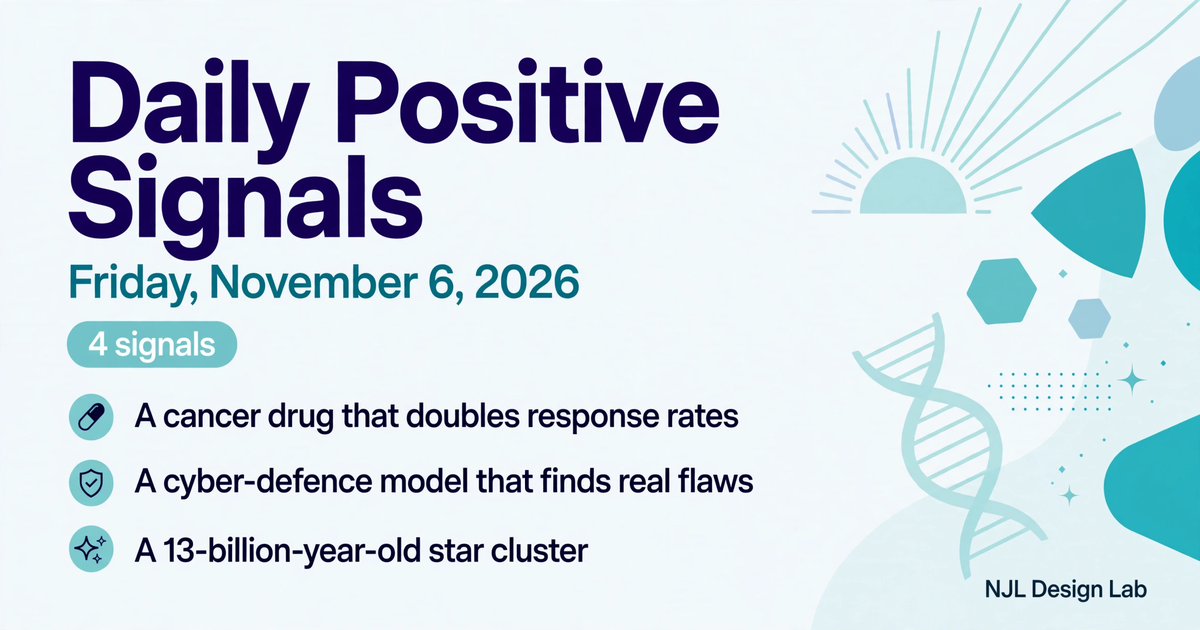
Daily Positive Signals: a head-and-neck cancer drug, a cyber-defence model, and a 13-billion-year-old star cluster
On this page
- A new head-and-neck cancer drug that more than doubles response rates
- A cyber-defence model that finds real flaws in Firefox and Linux
- Hubble reads our galaxy’s history in a 13-billion-year-old star cluster
- A robot memory that catches its own mistakes
- Useful progress, without the hype
- Know someone this would help?
- References
Listen to this brief · about 5 min, story text only
This edition: the FDA approves the first new drug in a decade for advanced head-and-neck cancer, an AI security model finds 81 flaws in Firefox and hundreds in the Linux kernel, and Hubble reads our galaxy’s history from a 13-billion-year-old star cluster. The thread: finding what humans miss, then proving it.
In this edition · 4 signals
Signal 1 of 4 · Medicine
A new head-and-neck cancer drug that more than doubles response rates
The U.S. Food and Drug Administration has granted accelerated approval to Rybrevant Faspro (amivantamab and hyaluronidase-lpuj) for adults with recurrent or metastatic head and neck squamous cell carcinoma whose disease has progressed after platinum-based chemotherapy and immunotherapy (U.S. Food and Drug Administration, 2026). In the OrigAMI-4 trial of 102 patients, 42% saw their tumors shrink or disappear, including complete responses in 15% of patients, and 56% of those who responded were still responding after six months (U.S. Food and Drug Administration, 2026). It is the first therapy to target two proteins at once in this setting, EGFR and MET, and it is given as a subcutaneous injection rather than an infusion (Johnson & Johnson, 2026).
Why it matters. Head-and-neck cancer that returns after chemotherapy and immunotherapy has had almost no good options. A treatment that more than doubles the response rate gives these patients and their doctors a real new choice.
Evidence status: FDA approval based on the phase 1b/2 OrigAMI-4 trial, with a Johnson & Johnson release and independent trade coverage. Limits: accelerated approval rests on response rate, not yet on longer survival; confirmatory phase 3 results are still pending, and the drug is not indicated for HPV-associated oropharyngeal cancer.
Signal 2 of 4 · AI
A cyber-defence model that finds real flaws in Firefox and Linux
OpenAI has introduced GPT-6 Cyber, a model built to find and fix software vulnerabilities while staying inside the boundaries researchers set (OpenAI, 2026). In a research campaign it produced evidence for 81 novel high-severity vulnerabilities in Firefox, and developed working exploits for 948 vulnerabilities in the Linux kernel, disclosing 304 critical findings to maintainers with candidate patches (OpenAI, 2026). It also stayed within its authorized scope in 99.93% of alignment tests without a safety prompt, and 100% with one, up from 94.49% for the previous model (Fernholz, 2026).
Why it matters. The software the world runs on is full of flaws nobody has found yet. A model that finds them, proves they are real, and hands over a patch turns AI from a hacking risk into a repair crew for the open-source code everyone depends on.
Evidence status: OpenAI announcement and benchmark results, corroborated by independent TechCrunch coverage. Limits: the benchmark scores are OpenAI’s own; the model is powerful enough to be classified Critical, so access is restricted to approved Daybreak Red customers, and independent security researchers question whether that reach is wide enough.
Signal 3 of 4 · Space
Hubble reads our galaxy’s history in a 13-billion-year-old star cluster
A new image from the NASA/ESA Hubble Space Telescope shows Messier 30, a dense ball of ancient stars 27,500 light-years away, in ultraviolet, visible, and near-infrared light (NASA, 2026). The image combines data from three Hubble observing programs spanning 15 years, letting astronomers track how different populations of stars inside the cluster have moved (NASA, 2026). Messier 30 and many other globular clusters orbit in the opposite direction to the Milky Way’s spin, which suggests our galaxy captured them from elsewhere rather than forming them itself (Phys.org, 2026).
Why it matters. Globular clusters are time capsules from the young universe. Reading their orbits and ages tells us how the Milky Way was assembled, piece by piece, over billions of years.
Evidence status: NASA release with text credit to ESA/Hubble, with independent coverage from Phys.org. Limits: the capture scenario is a hypothesis drawn from orbital direction, not a proven fact; precise age dating still needs ground-based follow-up.
Signal 4 of 4 · Robotics
A robot memory that catches its own mistakes
MIT researchers have built UQ-DAAAM, a system that lets a robot notice when its memory of an object might be wrong and fix it (Zewe, 2026). The robot compares descriptions of the same object from different viewpoints, combines the vision model’s confidence with how much the captions agree, and pulls in extra views to resolve the doubt, fusing them into a corrected description (Zewe, 2026). In tests it resolved ambiguities for about 92% of objects with only two additional captions each, and improved description accuracy by 5% over the state of the art (TechXplore, 2026). The work will be presented at the Conference on Neural Information Processing Systems (Zhang et al., 2026).
Why it matters. A robot that mistakes a defibrillator for a fire extinguisher is a robot that cannot be trusted with real tasks. Teaching machines to doubt their own memories is a step toward robots that can work safely alongside people.
Evidence status: MIT News report of peer-reviewed conference research, with the arXiv preprint and independent TechXplore coverage. Limits: results come from lab evaluations, not deployment on working robots; the method was tested on the team’s own memory system.
Editor’s note
Today’s thread is second looks. The cancer drug is a second chance for patients whose first treatments stopped working. The cyber model takes a second look at code that experts already combed through and finds flaws they missed. Hubble’s image is a third look at a cluster first photographed years ago, now sharp enough to read motion across fifteen years. And the robot system is built on the idea that a first impression should never be final. None of these is a finished answer: a confirmatory trial is still running, the model’s reach is still limited, the capture story is still a hypothesis, and the robot has yet to leave the lab. But each one shows what changes when you check again instead of moving on.
That’s the edition — four signals, every claim verified against its sources. Browse past briefs · tomorrow’s lands at 07:15.
The Progress Brief, by email
Useful progress, without the hype
The daily Positive Signals brief and the weekly deep dive, by email. Evidence-checked, concise, no doom.
Free. One daily email, one weekly email. Unsubscribe anytime.
References
- Fernholz, T. (2026, November 5). OpenAI released a new cybersecurity model. Is that enough? TechCrunch. https://techcrunch.com/2026/11/05/openai-released-a-new-cybersecurity-model-is-that-enough/
- Johnson & Johnson. (2026, November 5). Johnson & Johnson announces U.S. FDA approval of RYBREVANT FASPRO™ (amivantamab and hyaluronidase-lpuj) as first and only dual-targeted therapy for advanced head and neck cancer. https://www.jnj.com/media-center/press-releases/johnson-johnson-announces-u-s-fda-approval-of-rybrevant-faspro-amivantamab-and-hyaluronidase-lpuj-as-first-and-only-dual-targeted-therapy-for-advanced-head-and-neck-cancer
- NASA. (2026, November 5). Hubble learns galactic history from stars. https://science.nasa.gov/missions/hubble/hubble-learns-galactic-history-from-stars/
- OpenAI. (2026, November 5). GPT-6 Cyber: Advancing the frontier of aligned cybersecurity agents. https://openai.com/index/introducing-gpt-6-cyber
- Phys.org. (2026, November 5). Hubble learns galactic history from stars. https://phys.org/news/2026-11-hubble-galactic-history-stars.html
- TechXplore. (2026, November 5). Chimney or squirrel? Clearing up a robot’s fuzzy memory by comparing images from different angles. https://techxplore.com/news/2026-11-chimney-squirrel-robot-fuzzy-memory.html
- U.S. Food and Drug Administration. (2026, November 5). FDA grants accelerated approval to a new treatment for head and neck squamous cell carcinoma. https://www.fda.gov/news-events/press-announcements/fda-grants-accelerated-approval-new-treatment-head-and-neck-squamous-cell-carcinoma
- Zewe, A. (2026, November 5). Clearing up a robot’s fuzzy memory. MIT News. https://news.mit.edu/2026/clearing-up-robot-fuzzy-memory-1105
- Zhang, H., Gorlo, N., & Carlone, L. (2026). Remember with confidence: Uncertainty quantification for spatio-temporal memory with probabilistic guarantees. arXiv. https://arxiv.org/abs/2606.08277