Daily Positive Signals: a cell-by-cell brain atlas, a faster Gemini for everyone, and mangroves on the rebound
On this page
Listen to this brief · about 6 min, story text only
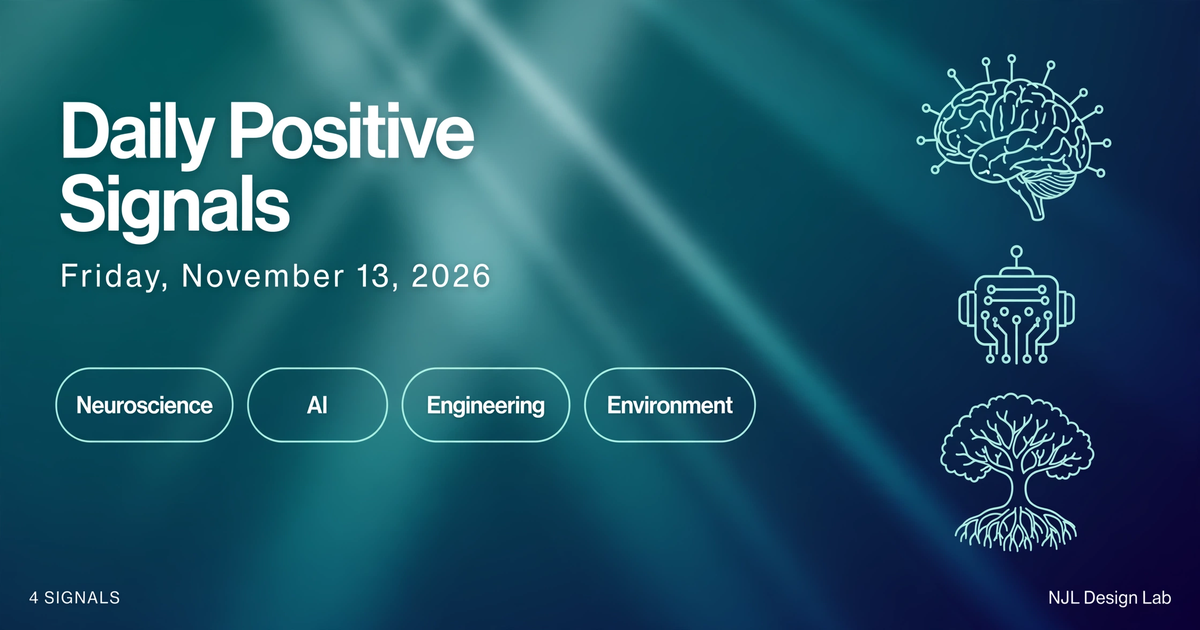
This edition: scientists map the brain’s movement center cell by cell; Google ships a faster Gemini to everyone; MIT gives engineers a say while algorithms design; and the world’s mangroves turn a corner. The thread: power you can check.
In this edition · 4 signals
- The brain’s movement center, mapped cell by cell — Neuroscience
- Gemini 4 Hydrogen brings the fast model to everyone — AI
- An AI copilot that lets engineers steer the algorithm — Engineering
- The world’s mangroves are growing again — Environment
- References
Signal 1 of 4 · Neuroscience
The brain’s movement center, mapped cell by cell
Scientists have produced the first comprehensive cellular atlas of the basal ganglia, the brain region that turns thoughts into movement and shapes habits, decisions, and emotions (National Institutes of Health, 2026). The NIH BRAIN Initiative Cell Atlas Network profiled 25.5 million individual cells — 21.0 million from humans, 3.0 million from macaques, and 1.5 million from marmosets — and published the work in 27 papers across Cell and its sister journals on November 12 (National Geographic, 2026; National Institutes of Health, 2026). The atlas catalogues each cell’s identity, gene activity, and three-dimensional location, and all of the data is openly available for other researchers to use (National Institutes of Health, 2026). Early finds include a rare striatum neuron that may play a role in schizophrenia, and new brain maps of autism that reveal disruptions in striatum cell populations that standard methods would likely miss (National Geographic, 2026; National Institutes of Health, 2026).
Why it matters. The basal ganglia is implicated in Parkinson’s disease, Huntington’s disease, schizophrenia, bipolar disorder, and addiction. A cell-by-cell map tells researchers exactly which cells to target: one paper in the package already used a genetic switch to deliver a dopamine precursor precisely in mouse models of Parkinson’s disease, easing symptoms with fewer side effects. The November 8 deep dive asked whether AI can do science yet — atlases like this are the raw material it will work from.
Evidence status: NIH release (November 12, 2026) and 27 peer-reviewed papers in Cell Press journals, independently reported by National Geographic and Reuters. Limits: the atlas is a reference map, not a treatment; the Parkinson’s delivery result is in mice; the full-brain atlas is targeted for 2028.
Signal 2 of 4 · AI
Gemini 4 Hydrogen brings the fast model to everyone
Google DeepMind launched Gemini 4 Hydrogen on November 12, a fast model built for everyday coding and agentic work, rolling out the same day across the Gemini API, AI Studio, the Gemini app, and Google Search (Google DeepMind, 2026). Hydrogen is the execution tier of the Gemini 4 family: Carbon and Argon handle deep, long-horizon reasoning, while Hydrogen does the rapid work of writing code, running tests, and verifying changes (Google DeepMind, 2026). At its default setting it scores 51 on the independent Artificial Analysis Intelligence Index, ahead of Argon’s 50, and Google reports it finishes tasks 2.5 times faster than Gemini 3.8 Flash, with Terminal-Bench 4.1 scores of 57% against 18.2% (Google DeepMind, 2026; WinBuzzer, 2026). It costs $1.50 per million input tokens and $7.50 per million output tokens, flat across its 1-million-token context window, and a new Orchestrator in Antigravity switches between Carbon and Hydrogen within a single session (Google DeepMind, 2026).
Why it matters. Frontier models keep getting smarter and slower. Hydrogen is the counter-move: a capable model cheap and fast enough to run all day, and the newest Gemini now reaches every Search user, not just paying subscribers.
Evidence status: Google DeepMind announcement (November 12, 2026), independently reported by WinBuzzer and Windows Forum. Limits: speed and benchmark figures are vendor-reported; the model card notes more unjustified refusals than 3.8 Flash, and the full safety report is still forthcoming.
Signal 3 of 4 · Engineering
An AI copilot that lets engineers steer the algorithm
MIT researchers have built an AI copilot for structural design that asks engineers for feedback while the algorithm is still working, instead of handing them a finished design to accept or reject (Winn, 2026). The system, described in Communications Engineering on November 10, uses machine learning to predict which regions of a computer-generated structure a human would want to change, and presents them for input as the design evolves (Ha et al., 2026). In demonstrations, the human-in-the-loop approach improved manufacturability and raised linear buckling load — the force a part carries before it buckles — by 39%, while adding only 15 seconds to total design time (Winn, 2026). The approach targets topology optimization, a technique behind ultralight parts for aircraft, antennas, and race cars, whose black-box output engineers often distrust (Winn, 2026).
Why it matters. Algorithmic design is powerful, but engineers won’t use output they can’t trust or build. Keeping the human in the loop while the design evolves makes the result both stronger and actually manufacturable.
Evidence status: Peer-reviewed paper in Communications Engineering (November 10, 2026); MIT News summary (November 13, 2026). Limits: demonstrated on example structures, not full buildings or bridges; for now, users can only make regions thicker or thinner.
Signal 4 of 4 · Environment
The world’s mangroves are growing again
Earth’s mangrove forests have shifted from net loss to net gain, according to a study in Science newly featured by NASA’s Earth Observatory on November 13 (NASA, 2026; Zhang et al., 2026). Researchers analyzed Landsat imagery from 1984 to 2023 and found mangroves lost nearly 3,000 square kilometers between 1984 and 2010, then gained nearly 2,000 square kilometers after 2010 (Zhang et al., 2026). About two-thirds of the expansion came from mangroves colonizing new ground, and one-third from restoration and regrowth, led by Asia, Australia, and South America (NASA, 2026). Mangroves store up to four times as much carbon as taller inland tropical forests, and they shield coasts from erosion and storm surges (NASA, 2026).
Why it matters. Mangroves were a textbook story of decline. The reversal shows that slowing deforestation, plus restoration and natural expansion, can bend a global curve — though the gains are young forests, and losses continue in places like the Niger Delta.
Evidence status: Peer-reviewed study in Science (June 4, 2026), featured by NASA Earth Observatory (November 13, 2026) and independently reported by The Earth and I. Limits: the study’s data end in 2023; new mangrove forests are young and lack the full ecological function of mature ones; deforestation continues in some regions.
Editor’s note
Today’s thread is tools you can check. A brain atlas is only useful if other scientists can build on it, so it ships open. A fast model is only useful if everyone can run it, so it ships to every tier. A design algorithm is only useful if the engineer trusts it, so it asks before it decides. And a recovering ecosystem is only believable because four decades of satellite data say so. Power is easy to announce; what makes it progress is the receipt.
That’s the edition — four signals, every claim verified against its sources. Browse past briefs · tomorrow’s lands at 07:15.
The Progress Brief, by email
Useful progress, without the hype
The daily Positive Signals brief and the weekly deep dive, by email. Evidence-checked, concise, no doom.
Free. One daily email, one weekly email. Unsubscribe anytime.
References
- Allen Institute. (2026, November 12). Scientists create landmark cellular atlas of one of the brain’s most important regions. EIN Presswire. https://www.einpresswire.com/article/955892089/scientists-create-landmark-cellular-atlas-of-one-of-the-brain-s-most-important-regions
- Dunham, W. (2026, November 12). Cellular atlas created for the basal ganglia, a key brain region. Reuters. https://wncy.com/2026/11/12/cellular-atlas-created-for-the-basal-ganglia-a-key-brain-region/
- Google DeepMind. (2026, November 12). Introducing Gemini 4 Hydrogen for agentic workflows. https://deepmind.google/blog/introducing-gemini-4-hydrogen/
- Ha, D. Q., Alam, M. F., Buehler, M. J., Ahmed, F., & Carstensen, J. V. (2026). AI-guided human-in-the-loop inverse design of high performance engineering structures. Communications Engineering. https://doi.org/10.1038/s44172-026-00818-x
- NASA. (2026, November 13). A global rebound for mangroves. NASA Science. https://science.nasa.gov/earth/earth-observatory/a-global-rebound-for-mangroves/
- National Geographic. (2026, November 12). Scientists discover a neuron that may play a role in schizophrenia. https://www.nationalgeographic.com/science/article/brain-cell-map-basal-ganglia-neuron-schizophrenia
- National Institutes of Health. (2026, November 12). For the first time, researchers map out the brain’s behavioral gatekeeper. https://www.nih.gov/news-events/news-releases/first-time-researchers-map-out-brains-behavioral-gatekeeper
- The Earth and I. (2026, October 18). The mangrove comeback: A rare environmental success story. https://www.theearthandi.org/post/the-mangrove-comeback-a-rare-environmental-success-story
- WinBuzzer. (2026, November 12). Google launches Gemini 4 Hydrogen for faster AI coding. https://winbuzzer.com/2026/11/12/google-launches-gemini-4-hydrogen-for-faster-ai-coding-xcxwbn/
- Windows Forum. (2026, November 12). Google Gemini 4 Hydrogen launch: Coding agent pricing, access and benchmark results. https://windowsforum.com/news/google-gemini-4-hydrogen-launch-coding-agent-pricing-access-and-benchmark-results.452112/
- Winn, Z. (2026, November 13). New AI “copilot” helps engineers design better structures. MIT News. https://news.mit.edu/2026/new-ai-copilot-helps-engineers-design-better-structures-1113
- Zhang, Z., Murray, N. J., Song, X.-P., Bunting, P., Worthington, T. A., Fatoyinbo, L., Mao, D., Jia, M., Arifanti, V. B., Aung, T., Htay, S. S., & Friess, D. A. (2026). Unexpected expansion and regrowth in Earth’s mangrove forests over the past four decades. Science, 392(6802), 1082–1087. https://doi.org/10.1126/science.aec9773
- Zot. (2026, November 13). MIT researchers develop AI “copilot” to bring human judgment into algorithmic design. https://zot.news/article/mit-researchers-develop-ai-copilot-bring-human-judgment-v8tju