Daily Positive Signals: space strawberries, decoded molecules, and planet-hunting amateurs
On this page
Listen to this brief · about 4 min, story text only
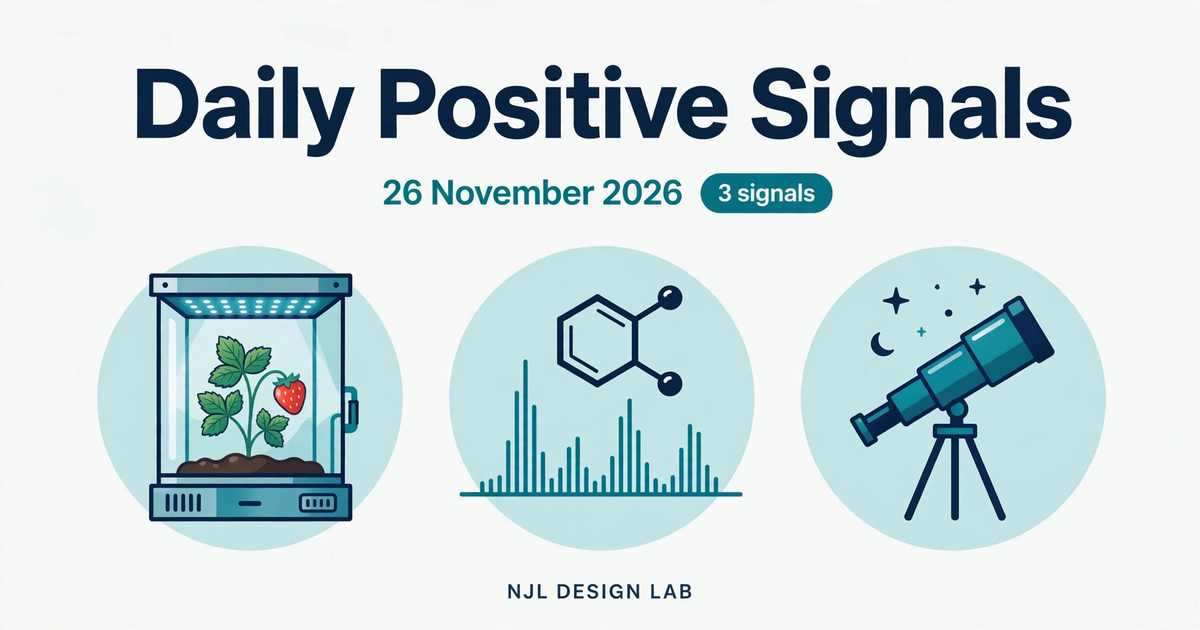
This edition: strawberries, cucumbers, and lemon basil shortlisted for astronaut menus; an AI agent that identifies molecules from their mass spectra with about 97% accuracy; and two amateur astronomers who used AI to surface dozens of possible exoplanets. The thread: the searching is spreading out — more people, and more tools, can now do the finding.
In this edition · 3 signals
- Strawberries, cucumbers, and lemon basil on the Moon’s menu — Space
- An AI that reads a molecule’s fingerprint — AI & chemistry
- Two amateurs, AI tools, and 49 possible new worlds — AI & astronomy
- References
Signal 1 of 3 · Space
Strawberries, cucumbers, and lemon basil on the Moon’s menu
NASA says recent testing points to strawberries, cucumbers, and lemon basil as candidate crops for future Moon and Mars missions (NASA, 2026). At Kennedy Space Center, researchers are growing strawberries in flight-like chambers, testing the leading variety ‘Delizz’ against a wild strawberry (NASA, 2026). The wild strawberry produced twice as many buds, flowers, and fruit from seed, but grew too many runners for a spacecraft, so Delizz kept the top spot (NASA, 2026). Cucumbers could be the first crop from the gourd family grown in space, lemon basil passed preliminary testing and seed sanitization, and a first-of-its-kind prototype growth chamber is set to launch to the International Space Station (NASA, 2026).
Why it matters. Fresh food fights menu fatigue on missions lasting months, and the crops also absorb carbon dioxide, produce oxygen, and recycle water. Growing food in transit turns a consumable into a system.
Evidence status: NASA release (November 25, 2026); the strawberry findings were published in Life Sciences in Space Research (September 2026) and the cucumber findings in HortScience (August 2026); corroborated by independent coverage. Limits: ground and chamber testing so far — none of these crops has been grown and eaten in space yet, and the station chamber is a prototype investigation.
Signal 2 of 3 · AI & chemistry
An AI that reads a molecule’s fingerprint
Google DeepMind released Mass Spec Skills for its Antigravity platform, pairing Gemini’s chemical reasoning with established mass spectrometry tools and public chemical databases (Brunck et al., 2026). The agent runs the chemist’s workflow from a single prompt: cleaning a spectrum, searching reference libraries, predicting a molecular formula, ranking candidate structures, and cross-checking the evidence (Brunck et al., 2026). On a benchmark of 100 compounds, all three tested models identified the exact molecule in about 97% of attempts with the skills, against under 4% with no internet access or skills (Brunck et al., 2026). Even the lightweight Gemini 3.8 Flash matched the two frontier models.
Why it matters. Standard library searches annotate only about 5% of measured spectra, leaving most small molecules unidentified. Automating that workflow could speed drug discovery, environmental monitoring, and natural-product research. It follows yesterday’s report of AI-designed proteins that bind their targets — AI is moving from designing molecules to reading them, too.
Evidence status: DeepMind blog (November 25, 2026) with a 100-compound benchmark; corroborated by independent coverage. Limits: a company-reported benchmark, not peer-reviewed; it cannot tell mirror-image molecules apart from a spectrum alone, and molecules absent from every database can be narrowed down but not confirmed.
Signal 3 of 3 · AI & astronomy
Two amateurs, AI tools, and 49 possible new worlds
Two amateur astronomers used OpenAI’s AI tools to search public NASA telescope data for exoplanets (OpenAI, 2026). Kevin Bond, an OpenAI engineer, used Codex to search observations of about 100,000 Kepler stars; the program flagged more than 200 signals, including 10 from already-confirmed planets (OpenAI, 2026). Two stood out: a brightness dip every 13.8 days around KIC 5689121, consistent with a planet about 2.4 times Earth’s diameter, and a 4.8-day dip around KIC 6691030, consistent with a planet smaller than Neptune (OpenAI, 2026). A SETI Institute astronomer independently found both signals, and Ethan Byrd used Astra on about 19 million stars to produce 49 first-pass candidates, one of which is now with researchers on NASA’s TESS mission (OpenAI, 2026).
Why it matters. Public telescope archives hold millions of stars no professional team can search exhaustively. AI tools that build a search from published methods let individuals surface leads worth scarce follow-up time.
Evidence status: OpenAI post (November 24, 2026); corroborated by TechTimes. Limits: candidates, not confirmed planets — a dip can also come from two stars eclipsing each other; confirmation could take months or years; Bond is an OpenAI engineer, so the account is not neutral.
Editor’s note
Today’s signals share a shape: the searching is spreading out. Astronauts may soon grow their own food instead of eating only packaged rations. Chemists can hand a spectrum to an agent and get a ranked, checkable answer instead of weeks of manual work. And two people working from public archives turned telescope data into leads that professional astronomers are now chasing. None of it is finished — the crops are still in test chambers, the molecule tool cannot settle every structure, and no new planet is confirmed. But each one puts a capability that used to belong to a few specialists into more hands.
That’s the edition — three signals, every claim verified against its sources. Browse past briefs · tomorrow’s lands at 07:15.
The Progress Brief, by email
Useful progress, without the hype
The daily Positive Signals brief and the weekly deep dive, by email. Evidence-checked, concise, no doom.
Free. One daily email, one weekly email. Unsubscribe anytime.
References
- Blockchain.News. (2026, November 25). Google DeepMind unveils Mass Spec Skills for molecular identification. https://blockchain.news/news/google-deepmind-mass-spec-skills
- Brunck, R., Ganscha, S., Guntupalli, S., Lasecki, D., Marfani, G., Mason, J., Masoom, H., Mirshafian, R., Papa, E., & Tsangalidou, Z. (2026, November 25). Identifying molecules with Mass Spec Skills for Antigravity. Google DeepMind. https://deepmind.google/blog/interpreting-mass-spectra-with-google-antigravity/
- Cosmos Week. (2026, November 25). NASA eyes crop candidates for future menus. https://www.cosmosweek.com/en/news/nasa-eyes-crop-candidates-for-future-menus/
- NASA. (2026, November 25). NASA eyes crop candidates for future menus. https://science.nasa.gov/directorates/smd/nasa-eyes-crop-candidates-for-future-menus/
- OpenAI. (2026, November 24). Searching for distant planets with Astra. https://openai.com/index/searching-for-distant-planets-with-astra
- TechTimes. (2026, November 25). OpenAI Codex, Astra flag exoplanet candidates; SETI astronomer matches two signals, none confirmed. https://www.techtimes.com/articles/331554/20261125/openai-codex-astra-flag-exoplanet-candidates-seti-astronomer-matches-two-signals-none-confirmed.htm