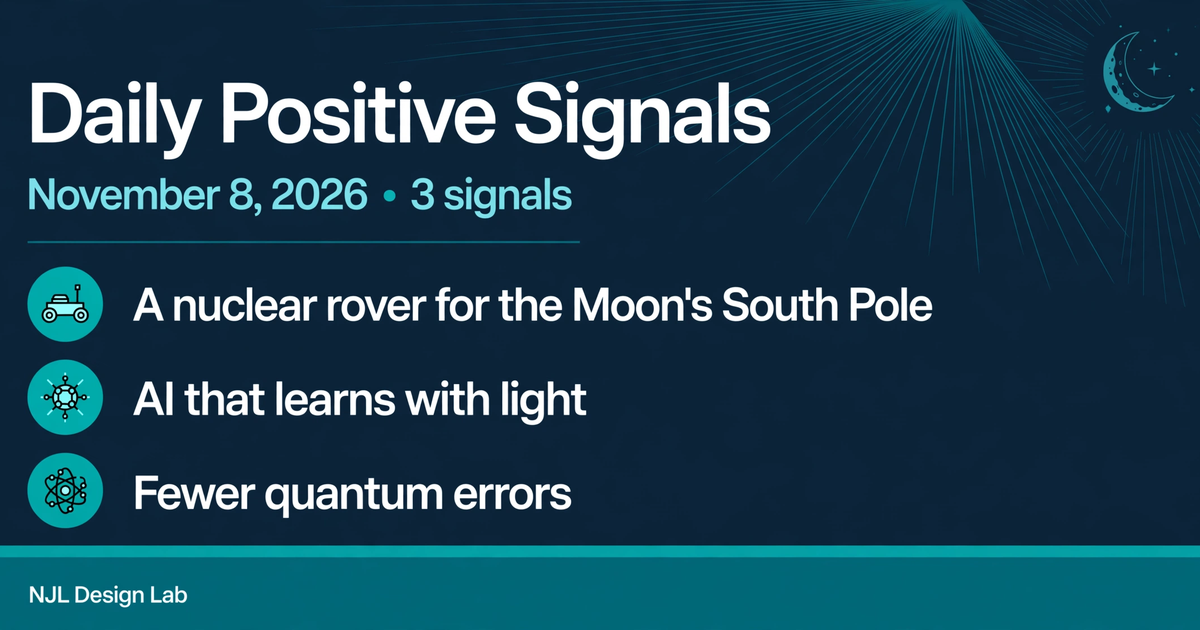
Daily Positive Signals: a nuclear rover for the Moon’s South Pole, AI that learns with light, and fewer quantum errors
On this page
Listen to this brief · about 4 min, story text only
This edition: NASA picks eight companies for a $10 billion Moon delivery programme and a nuclear-powered rover to hunt ice at the South Pole, researchers in Tokyo train AI with light instead of electricity, and a new decoding trick cuts quantum errors. The thread: doing more with what is already proven.
In this edition · 3 signals
Signal 1 of 3 · Space
A nuclear rover to scout the Moon’s South Pole, backed by a $10 billion delivery programme
NASA announced a suite of Moon Base awards on Saturday, November 7, at the MAX POWER aerospace expo at Kennedy Space Center in Florida (NASA, 2026). Eight companies — Blue Origin, Firefly Aerospace, Intuitive Machines, ispace-U.S., Lockheed Martin Space, Northrop Grumman Space Systems, SpaceX, and Voyager Technologies — were selected to compete for lunar cargo deliveries under the 10-year Commercial Lunar Payload Services 2 (CLPS 2) framework, with a combined maximum value of $10 billion (NASA, 2026). The agency is also moving ahead with PROMISE, a six-wheeled nuclear-powered rover that will land at the South Pole to drill one metre into the regolith, test for water ice, and scout landing sites, built by the Jet Propulsion Laboratory from spare Mars rover hardware (NASA, 2026). Blue Origin won a $94 million base contract, plus a $140 million performance option, to deliver the rover on its Mark 1 lander (NASA, 2026).
Why it matters. The awards turn the Moon Base from a plan into a procurement pipeline: cargo, transport, power, and a scout rover are all contracted, with the first elements meant to be waiting on the surface when astronauts arrive.
Evidence status: NASA announcement, independently reported by NASASpaceFlight and Scientific American. Limits: $10 billion is a contract ceiling, not spending; the late-2028 launch and 18-month mission are targets; the Mark 1 lander is unproven.
Signal 2 of 3 · AI
AI that learns with light instead of electricity
Researchers at the University of Tokyo and NTT have published a framework in Nature Computational Science that trains AI using light rather than electrical signals (Zhang et al., 2026). It pairs a training method called state-skipping direct feedback alignment, which learns from the final error instead of recording every intermediate state, with a simpler single-map network architecture (Zhang et al., 2026). The team demonstrated it in simulations and on an optical system built around a 200-metre fibre loop, where the simplified design matched or beat more complex networks while using far less computation (Clark, 2026). Integrated into modern network designs, the authors report about 40% less computation with improved performance (Zhang et al., 2026).
Why it matters. Training AI is energy-hungry, and optical hardware runs cooler and faster in principle. A method that works on real hardware, not only in simulation, is the step most optical-computing ideas never take.
Evidence status: Peer-reviewed paper in Nature Computational Science (November 5, 2026), reported by the University of Tokyo and TechXplore. Limits: the 40% figure is the authors’ reported result, as covered in independent reports; not yet tested on today’s largest language or multimodal models; miniaturisation, stability, and large-scale manufacturing remain open.
Signal 3 of 3 · Engineering
A decoding fix that makes quantum computers err less
Riverlane researchers have published a data-driven method that finds error mechanisms standard noise models miss, by learning them directly from detector data (Schwartzman-Nowik et al., 2026). The technique augments detector error models — the decoder’s map of which errors are likely — with newly discovered correlated mechanisms, each given a defined logical effect so it can be used in decoding (Schwartzman-Nowik et al., 2026). In simulations the augmented model cut the logical error rate by 75% at code distance 15, and on Google’s below-threshold superconducting data it cut the distance-7 error rate by 14% (Schwartzman-Nowik et al., 2026; Quantum Computing Report, 2026).
Why it matters. Quantum error correction only works if the decoder knows what can go wrong. Learning the real error picture from the machine’s own data, rather than assuming it, makes every qubit count for more.
Evidence status: Preprint on arXiv, posted November 4 and announced and independently reported on November 7. Limits: not yet peer-reviewed; the 75% figure is from simulation, and the hardware gain was demonstrated on one public Google dataset at small code distances.
Editor’s note
Today’s thread is reuse. The Moon rover is built from spare Mars rover hardware, the optical computer borrows light, the oldest signal carrier there is, and the quantum decoder learns from the machine’s own mistakes instead of a textbook model. None of these bets on something unbuilt: each one takes a working thing and asks it to do a new job. That is a slower kind of progress than a breakthrough headline, and a more reliable one.
That’s the edition — three signals, every claim verified against its sources. Browse past briefs · tomorrow’s lands at 07:15.
The Progress Brief, by email
Useful progress, without the hype
The daily Positive Signals brief and the weekly deep dive, by email. Evidence-checked, concise, no doom.
Free. One daily email, one weekly email. Unsubscribe anytime.
References
- Clark, G. (2026, November 5). Let there be light—novel AI framework runs on optical hardware. TechXplore. https://techxplore.com/news/2026-11-ai-framework-optical-hardware.html
- NASA. (2026, November 7). NASA awards Moon Base transportation, technology, science projects. https://www.nasa.gov/news-release/nasa-awards-moon-base-transportation-technology-science-projects/
- NASASpaceFlight. (2026, November 8). NASA’s Moon Base plan gains a PROMISE. https://www.nasaspaceflight.com/2026/11/nasas-moon-base-promise/
- Quantum Computing Report. (2026, November 7). Riverlane demonstrates data-driven DEM augmentation to reduce surface-code logical errors. https://quantumcomputingreport.com/riverlane-demonstrates-data-driven-dem-augmentation-to-reduce-surface-code-logical-errors/
- Schwartzman-Nowik, Z., Stafford, M. P., Varbanov, B. M., & Camps, J. (2026). Discovering correlated error mechanisms: Data-driven augmentation of detector error models improving decoding. arXiv. https://arxiv.org/abs/2611.06605
- Zhang, Y., Nakajima, M., Inoue, K., Hashimoto, T., Kuniyoshi, Y., & Nakajima, K. (2026). Scalable physical deep learning using optical dynamics with state-skipping training and single-map architecture. Nature Computational Science. https://doi.org/10.1038/s43588-026-01075-w