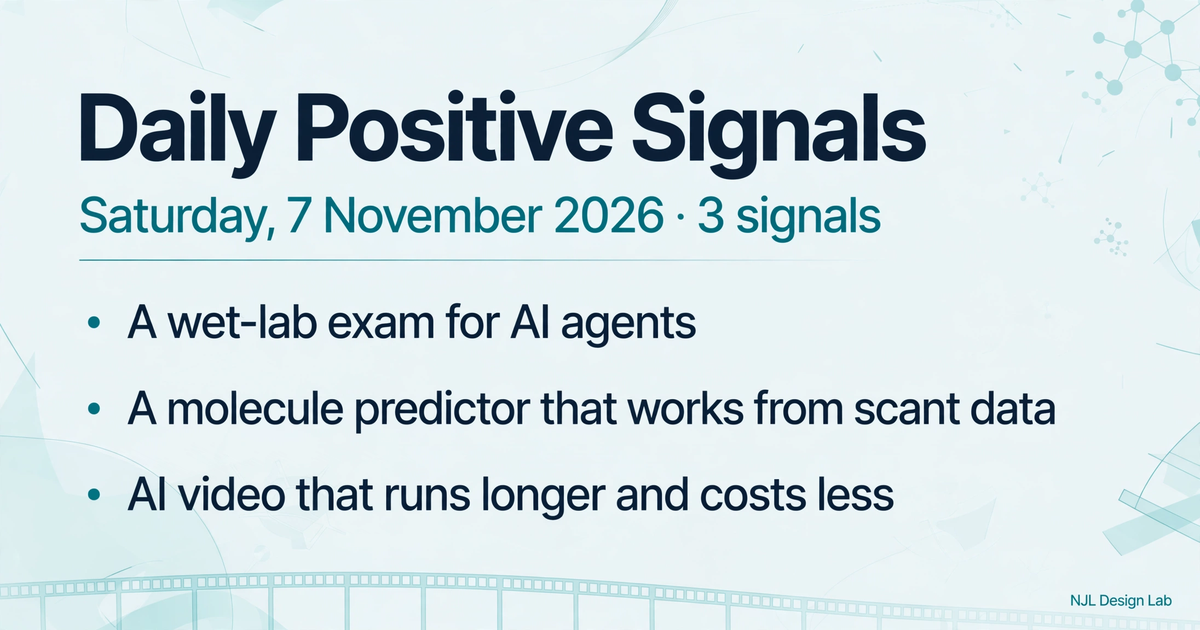
Daily Positive Signals: a wet-lab exam for AI agents, a molecule predictor that works from scant data, and 15-second AI video
On this page
Listen to this brief · about 4 min, story text only
This edition: OpenAI tests AI agents on messy real lab evidence, MIT’s CheMeleon predicts molecule behaviour from far less data, and Google’s video model stretches clips to 15 seconds at a lower price. The thread: AI meeting the real world on its own terms, not the demo’s.
In this edition · 3 signals
Signal 1 of 3 · AI
A wet-lab exam that grades AI agents on real lab evidence
OpenAI, working with enzyme-design company Ligo, has introduced BioBasicsBench, a benchmark of 100 tasks that tests whether AI agents can interpret raw wet-lab evidence: gel images, colony plates, microscopy, sequencing reads, and instrument exports (OpenAI, 2026). Scientists wrote the tasks from their own experiments, each with expert-written grading rubrics, and every task passed review by a Ligo scientist, an external PhD-level wet-lab scientist, and a final internal check (OpenAI, 2026). At the highest reasoning setting, GPT-6 Astra earned 66.7% of the available rubric credit, against 43.8% for GPT-5.6 Sol, across 18,500 graded attempts (OpenAI, 2026).
Why it matters. Most AI science benchmarks use clean published figures. This one tests the messy evidence labs actually produce, including failed experiments and misleading controls, which is exactly where a wrong read wastes weeks of work.
Evidence status: OpenAI announcement with independent coverage from AI Frontier Post and others. Limits: the scores are OpenAI’s own; 66.7% is partial rubric credit, not a pass rate; no human baseline was published, no non-OpenAI model was tested, and the dataset and rubrics were not publicly linked at launch.
Signal 2 of 3 · AI
A molecule predictor that works when data is scarce
MIT researchers, working with BASF, have built CheMeleon, a machine-learning model that predicts how a molecule will behave even when few measurements exist for the property in question (Chandler, 2026). Instead of training on published experimental results, the team pre-trained it on about one million molecules from PubChem, teaching it to predict roughly 1,600 easily calculated descriptors such as molecular weight and oxygen count (Chandler, 2026). The model then fine-tunes on a small amount of task-specific data, and across 58 test cases it outperformed existing methods, including classical models built on expert knowledge (Zalte et al., 2026). It is open source through ChemProp, and pharmaceutical companies are already using it to choose which molecules to synthesise and test (Chandler, 2026).
Why it matters. Drug and materials discovery is slow because testing each candidate molecule in the lab is expensive. A model that narrows the field from little data means fewer wasted syntheses and faster shortlists.
Evidence status: Peer-reviewed paper in the Journal of Chemical Information and Modeling (September 14, 2026), reported by MIT News with independent coverage. Limits: the paper appeared in September; the news is MIT’s November account and reported industry adoption. Predictions still need experimental confirmation, and MIT does not quantify the lab savings.
Signal 3 of 3 · AI
AI video that runs longer and costs less
Google DeepMind has made Gemini Omni 1.2 Flash generally available across the Gemini API and Gemini for business (Nangia, 2026). The model generates and edits video clips natively up to 15 seconds long, up from 10, with durations set in one-second steps and multi-turn conversational editing that refines the same clip instead of regenerating it (Nangia, 2026). It costs $0.07 per second for 720p video, 30% less than Omni 1.1, and outputs carry an imperceptible SynthID watermark (Nangia, 2026; TechTimes, 2026).
Why it matters. Fifteen seconds is long enough for a complete product explainer or ad spot in a single generation. The price cut and edit-in-place workflow make AI video cheaper to iterate for small teams.
Evidence status: Google DeepMind announcement with the Google blog and independent coverage from TechTimes and others. Limits: capability and price claims are Google’s own; no public benchmark numbers or independent hands-on testing were published with the release.
Editor’s note
Today’s thread is reality checks. The wet-lab benchmark grades AI on evidence that is ambiguous, mislabelled, or incomplete, which is what a working lab actually looks like. CheMeleon is built for the opposite problem: the data you wish you had does not exist, so the model learns what it can from what is calculable. And the video model is judged on production terms, length and price per second, rather than a demo reel. None of these is a finished answer: the benchmark still has no human baseline, the molecule predictions still need the lab, and the video claims are still Google’s own. But each one moves the test closer to the work itself, and that is where progress stops being a slide and starts being useful.
That’s the edition — three signals, every claim verified against its sources. Browse past briefs · tomorrow’s lands at 07:15.
The Progress Brief, by email
Useful progress, without the hype
The daily Positive Signals brief and the weekly deep dive, by email. Evidence-checked, concise, no doom.
Free. One daily email, one weekly email. Unsubscribe anytime.
References
- AI Frontier Post. (2026, November 6). OpenAI’s BioBasicsBench tests AI on messy wet-lab evidence: GPT-6 Astra leads at 66.7%, but still misreads the bench. https://aifrontierpost.com/articles/openai-biobasicsbench-wet-lab-benchmark/
- Chandler, D. L. (2026, November 6). How to predict the behavior of molecules from scant data. MIT News. https://news.mit.edu/2026/how-to-predict-molecule-behavior-with-scant-data-1106
- Nangia, A. (2026, November 5). Gemini Omni 1.2 Flash: Fast and cost-effective with longer clips. Google DeepMind. https://deepmind.google/blog/gemini-omni-12-flash-fast-and-cost-effective-with-longer-clips/
- OpenAI. (2026, November 6). Measuring how AI agents handle everyday wet-lab science. https://openai.com/index/measuring-how-ai-agents-handle-wet-lab-science
- TechTimes. (2026, November 6). Google debuts Gemini Omni 1.2 Flash with longer AI clips, better editing, and fewer errors. https://www.techtimes.com/articles/330142/20261106/google-debuts-gemini-omni-12-flash-longer-ai-clips-better-editing-fewer-errors.htm
- Unite.AI. (2026, November 6). MIT details CheMeleon model for low-data molecular prediction. https://www.unite.ai/mit-details-chemeleon-model-for-low-data-molecular-prediction/
- Zalte, A. S., Burns, J., Abreu, C., Green, W. H., et al. (2026). Deep learning foundation models for low-data molecular property prediction. Journal of Chemical Information and Modeling, 66(17). https://pubs.acs.org/jcisd8/article-abstract/66/17/10692/5250516/Deep-Learning-Foundation-Models-for-Low-Data