A Personal Operating System for the Non-Money Side of Life
On this page
Most people have a system for money.
Some people have a system for work.
A few people have a system for fitness.
But the part of life that creates the most drag is often the part with no system at all.
That is the non-money side of life: the calendar, the house, the decisions, the relationships, the energy budget, the small errands, the follow-ups, and the daily friction. If you do not design it on purpose, it tends to design itself around whatever is easiest in the moment.
That is how life gets crowded.
Not because of one big failure, but because of a hundred small defaults.
The goal is not to turn life into another productivity project. The goal is to build a small, repeatable operating system that reduces overhead and protects the parts of life that actually make it feel like yours.
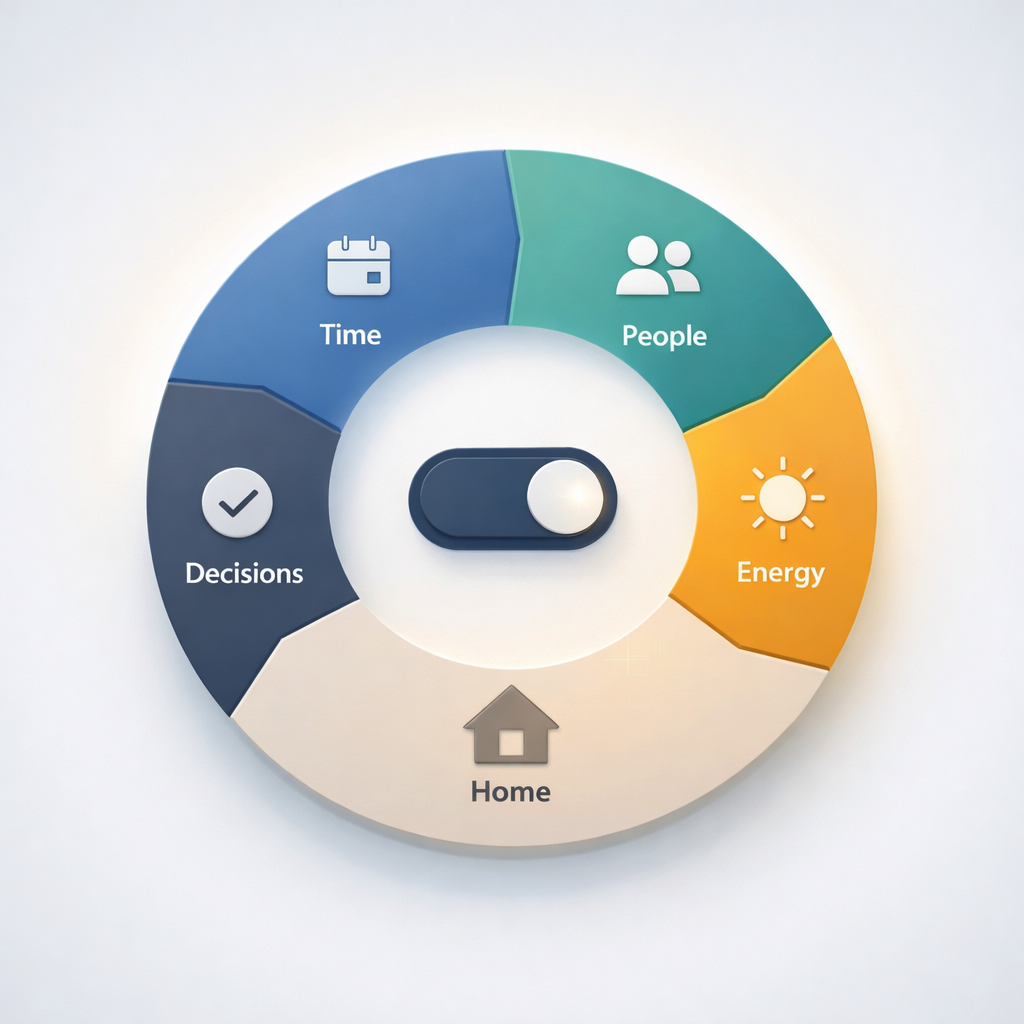
Here is the simple version: a personal operating system is a small set of recurring defaults for time, relationships, energy, admin, and attention.
If something repeats, give it a default.
What a personal operating system is
A personal operating system is not a motivational concept.
It is the small structure that helps you do the same important things without having to renegotiate them every week. It is not about squeezing more output from your calendar. It is about reducing the cognitive load required to live it.
That can include:
- a weekly planning block
- a few recurring social anchors
- a simple way to handle home admin
- a decision rule for repeated choices
- a small amount of tech or automation that removes boring work
The point is not to optimize every corner.
The point is to stop spending attention on things that should already be decided.
If a thing keeps showing up in your life, it probably deserves a system. If it is already a system, it should be a simple one.
The five life loops
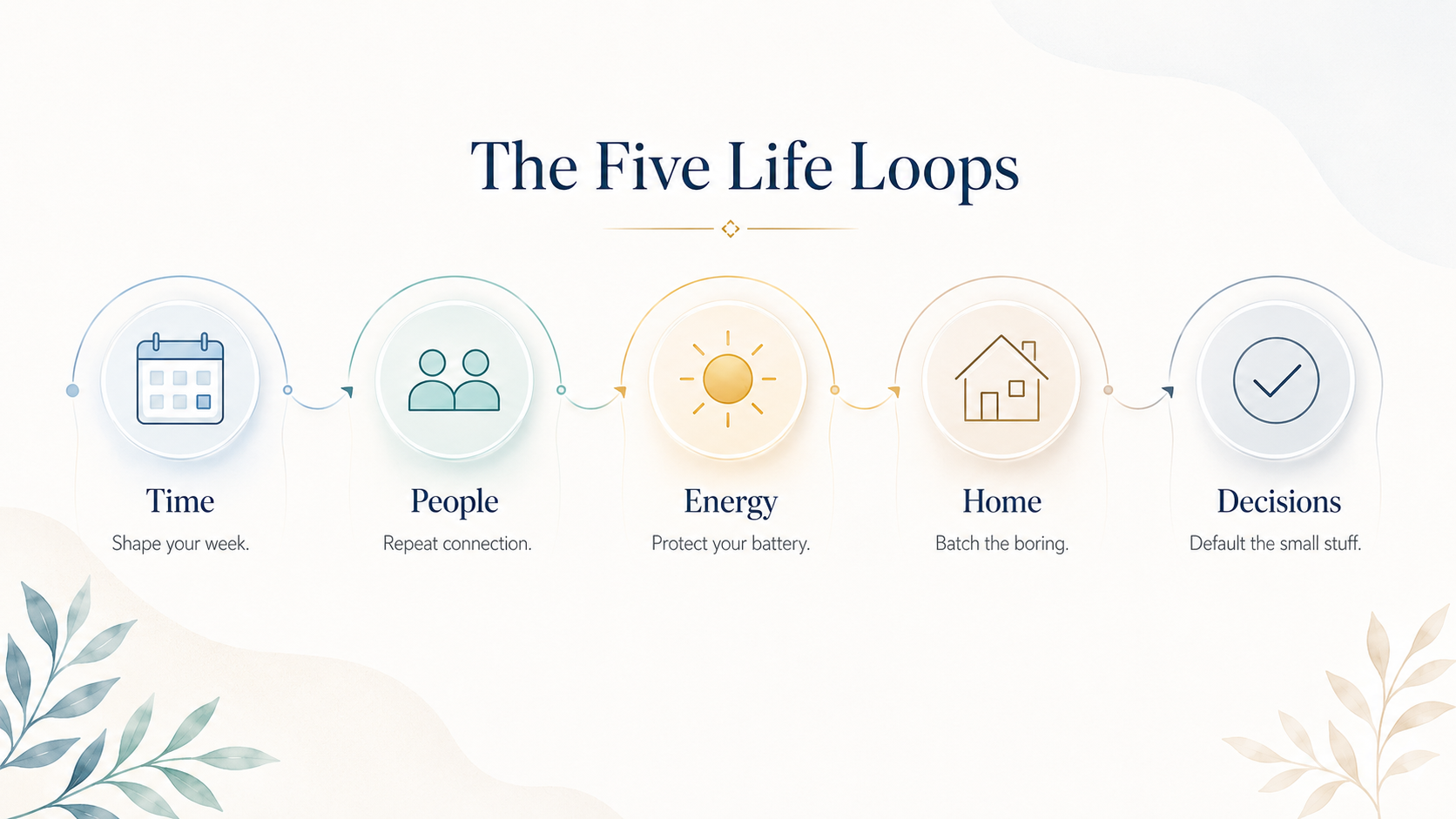
The easiest way to think about a personal operating system is as five life loops.
These are not rigid categories. They are the places where life tends to fray when nothing is holding them together: time, people, energy, home, and decisions.
1. Time
Time is the first system.
If your calendar is just a pile of separate obligations, your week will feel reactive even when nothing is technically wrong.
You need a few anchor points:
- a weekly reset
- a short planning session
- one block for deep work or meaningful personal work
- one block that is intentionally open
- one buffer for the unexpected
The purpose is not to fill the calendar. The purpose is to make the calendar legible.
When time has a shape, it becomes easier to use well.
Takeaway: A legible week is a calmer week.
2. People and community
Most people do not lose connection because they stop caring.
They lose it because they stop repeating anything.
Community does not usually appear by accident. It comes from repeated contact.
That might be:
- a weekly dinner
- a standing coffee
- a recurring class
- a volunteer shift
- a family ritual
- a monthly friend plan
The exact format matters less than the repetition.
One of the biggest life upgrades is moving from “we should get together sometime” to “this happens every Tuesday.”
Takeaway: Repetition turns connection into belonging.
3. Energy
You cannot manage life well if you are always tired, scattered, or overstimulated.
Energy is not just health in the abstract. It is the daily ability to show up without dragging yourself through the day.
A useful energy system is usually simple:
- sleep at a consistent enough time
- move your body regularly
- get outside early when possible
- eat in a way that keeps your day stable
- do not fill every hour with noise
This is not about becoming a wellness project. It is about protecting the basic battery that everything else runs on.
Takeaway: Energy is the multiplier. Without it, every other system gets harder.
4. Home and admin
Home admin is where a lot of hidden friction lives.
Bills. Groceries. Household tasks. Returns. Appointments. Follow-ups. Paperwork.
Tiny things that are not hard individually become exhausting when they are scattered.
The fix is batching.
Pick one block each week and run the boring stuff together. If you can reduce the number of times you have to think about a category of chores, you reduce the amount of life it steals.
Takeaway: Batching turns a dozen interruptions into one contained block.
5. Decisions and attention
This is the least visible loop, and often the most expensive one.
Every week, you make dozens of small decisions that could have been rules instead.
What time do I start? Where do I eat? Should I go to that event? What do I do first? How do I capture this idea? Do I keep this commitment or let it go?
The more often a decision repeats, the more it deserves a default.
Not every choice needs to stay a choice.
Takeaway: Defaults protect your attention from being spent on trivia.
Where custom tools help
Once the life loops are stable, tools can help reduce the remaining friction, but only if they stay small.
Custom tools are useful when they remove overhead from a real recurring task. They are not useful when they become another project.
If a tool helps you:
- capture notes faster
- remember repeating tasks
- track something boring but important
- turn a repeated hassle into a single workflow
then it is probably doing its job.
But the line is simple: if the tool starts becoming the thing you are optimizing, instead of the life it supports, it has drifted.
Use tools to reduce friction. Do not let tools become the new friction.
The best personal systems often look boring from the outside. That is usually a good sign.
A 20-minute weekly reset
You do not need a giant planning ritual.
You need something you will actually repeat.
This is the minimum effective dose: the smallest reset that still keeps life intentional.
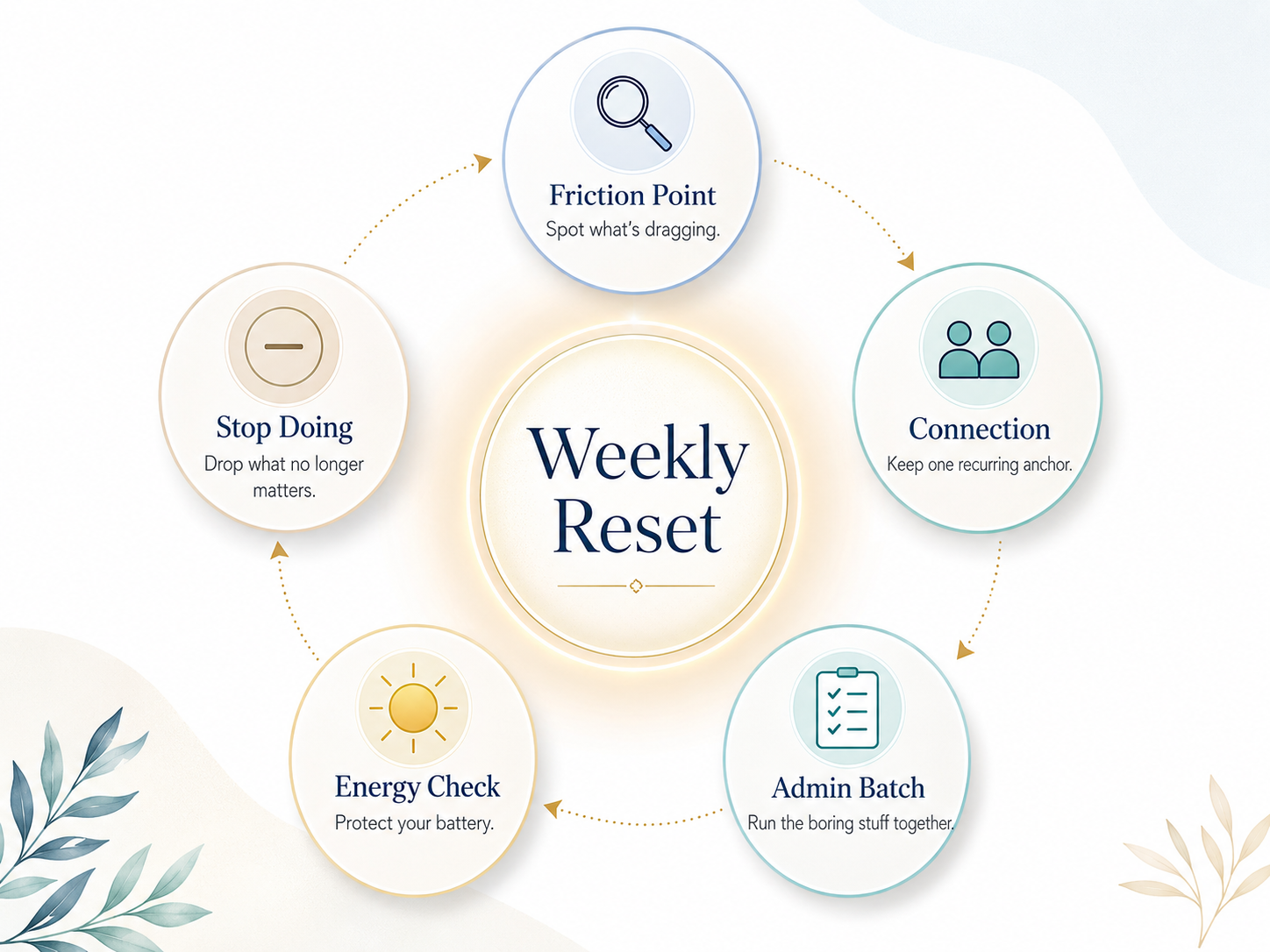
Here is a simple version:
- Find the friction point. Look at the coming week and identify the thing most likely to create drag.
- Protect one connection. Pick one recurring relationship or community anchor and make sure it stays on the calendar.
- Batch one admin task. Choose one home or admin item that has been hanging around and give it a defined block.
- Check your energy. Look at sleep, movement, recovery, and noise for the next few days.
- Stop one thing. Remove one commitment, task, or expectation that no longer deserves attention.
That is the reset.
The point is not to make the week perfect. The point is to make it intentional.
If you repeat this long enough, you start to notice something important: the week feels less like a series of emergencies and more like a system you can trust.
Common mistakes
The first mistake is building too much structure.
If your operating system becomes a second job, it is too heavy.
The second mistake is optimizing the wrong layer.
You can automate a task and still miss the real point of the task.
The third mistake is thinking the whole thing has to be perfectly designed before it can help.
It does not.
The fourth mistake is forgetting community.
A week that is efficient but lonely is not a good system.
You only need enough structure to reduce friction and enough flexibility to stay human.
The rule that keeps the system honest
If a system does not create more life, simplify it.
That is the test.
Not how clever it feels. Not how optimized it looks. Not how many apps or checklists it uses.
Does it give you more attention for the things that matter?
Does it make your week easier to live?
Does it protect the texture of your life instead of sanding it down?
If the answer is yes, keep it.
If the answer is no, delete it or make it smaller.
A good system disappears into the background. A bad one keeps asking for attention.
Where to go next
If you want to keep building systems for everyday life, start with the Life hub, explore the broader Life Systems framework, or use the1% Better web app, built for the idea: small recurring improvements keep everyday life moving in the right direction without turning self-improvement into another heavy system.
The non-money side of life does not have to run on hope, overload, or last-minute decisions.
It can run on a small, repeatable system that keeps the important things visible.
That is usually enough.