Building Local Community Resilience in the Age of AI and AGI
On this page
- AI Changes Communities Before It Changes Civilization
- The Five Pillars of Community Resilience
- 1. Economic Resilience
- 2. Institutional Resilience
- 3. Infrastructure Resilience
- 4. Social Resilience
- 5. Information Resilience
- Local Businesses Become More Important
- Libraries Become AI Infrastructure
- Schools Must Become Community Learning Centers
- Emergency Preparedness Still Matters
- Social Capital Is Infrastructure
- AI Can Strengthen Communities
- Risks Communities Should Prepare For
- Community Resilience Starts Before the Emergency
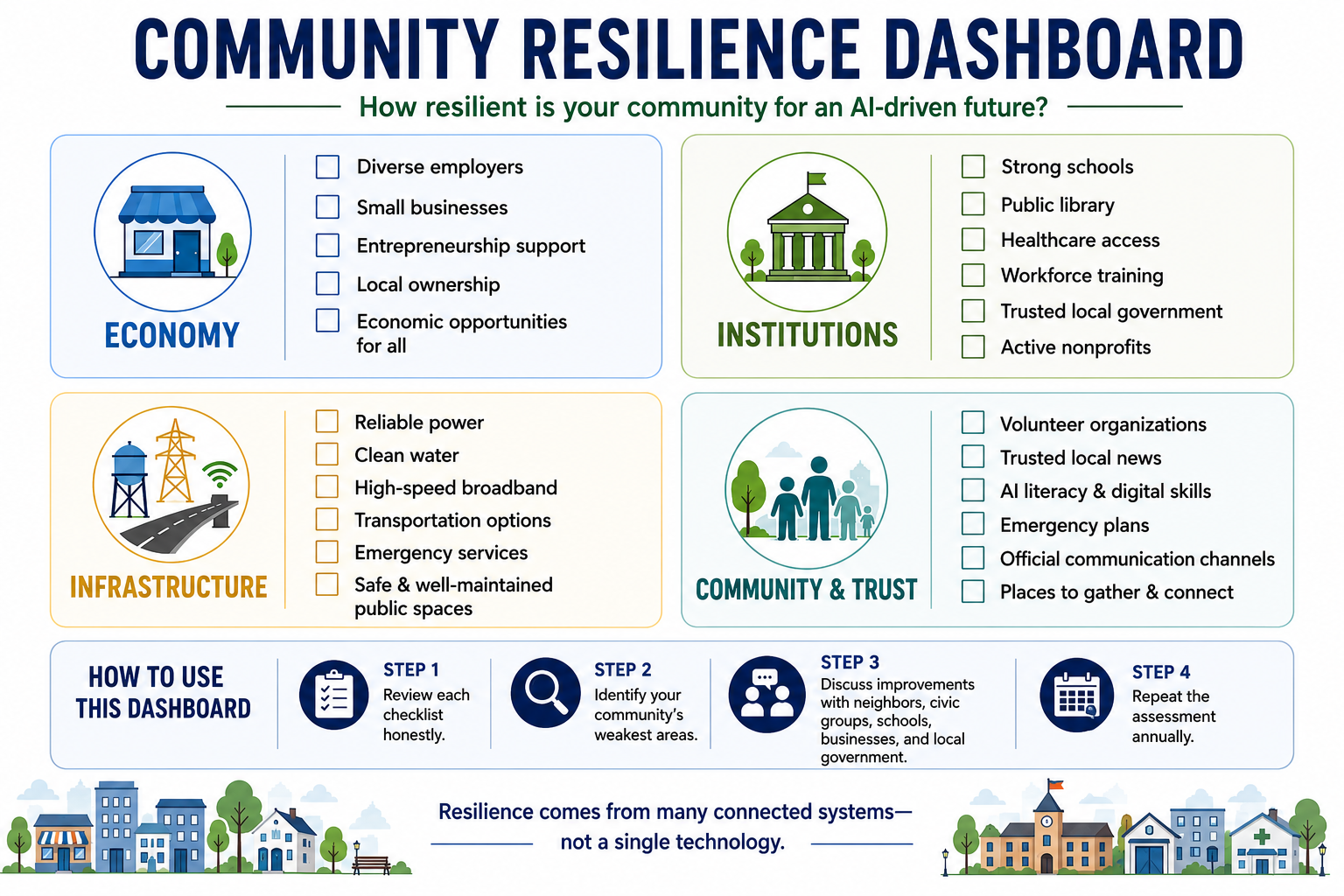
- Community Resilience Checklist
- Economy
- Civic Institutions
- Infrastructure
- Trust
- Preparedness
- Continue the AGI Household Resilience Series
- Final Takeaway
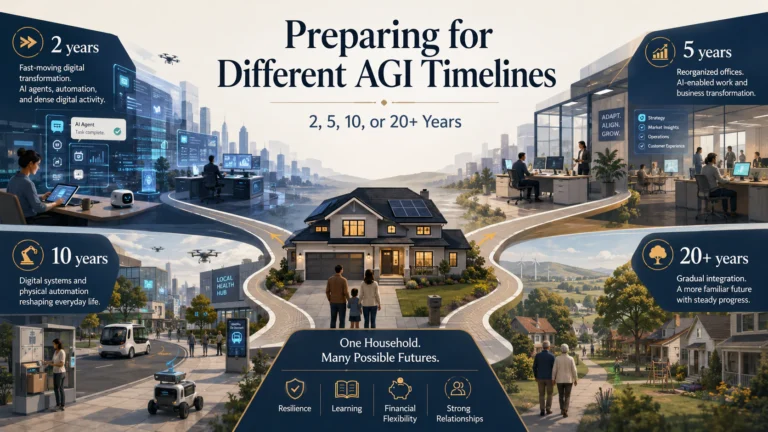
Imagine two neighboring towns.
Both gain access to the same AI tools.
Five years later, one has growing businesses, effective schools, strong volunteer organizations, a busy downtown, and lower unemployment.
The other has empty storefronts, isolated residents, shrinking tax revenue, struggling schools, and declining trust.
The technology was identical.
The community was not.
That is the part of the AI transition that often gets missed. We talk about frontier models, national policy, job automation, and household finances. Those matter. But many of the real effects of AI will arrive through local systems: employers, schools, libraries, hospitals, city services, utilities, churches, small businesses, volunteer groups, and neighborhoods.
The arrival of increasingly capable AI will not affect every community equally.
Some places will adapt faster because they already have diversified economies, trusted institutions, local businesses, resilient infrastructure, active civic organizations, and strong community networks. Others may struggle despite having access to the same tools.
Community resilience depends less on owning the newest AI system and more on how effectively people work together before disruption occurs. The real question is not whether a town can call itself AI-ready. It is whether local resilience is strong enough for residents, businesses, and institutions to adapt together.
AI Changes Communities Before It Changes Civilization
AI is often discussed as a global event.
But people experience change locally.
A hospital changes staffing. A school district adopts AI tutoring. A city automates permitting. A regional employer restructures. A local news source disappears. A utility uses AI to manage demand. A small business uses AI to compete with larger firms. A police department faces deepfake evidence. A library starts teaching AI literacy.
That is how technological change becomes real.
It passes through:
- employers;
- schools;
- hospitals;
- local governments;
- police and fire departments;
- utilities;
- transportation systems;
- housing markets;
- small businesses;
- civic organizations;
- families.
The National Academies report on building and measuring community resilience emphasizes that resilience is not one asset or one plan. It is the ability of communities to prepare for, absorb, recover from, and adapt to disruption. AI should be understood in that same way. It is not only a technology to adopt. It is a force that will test local capacity.
A resilient community is not one that avoids every shock. It is one that can keep solving problems when conditions change.
The Five Pillars of Community Resilience
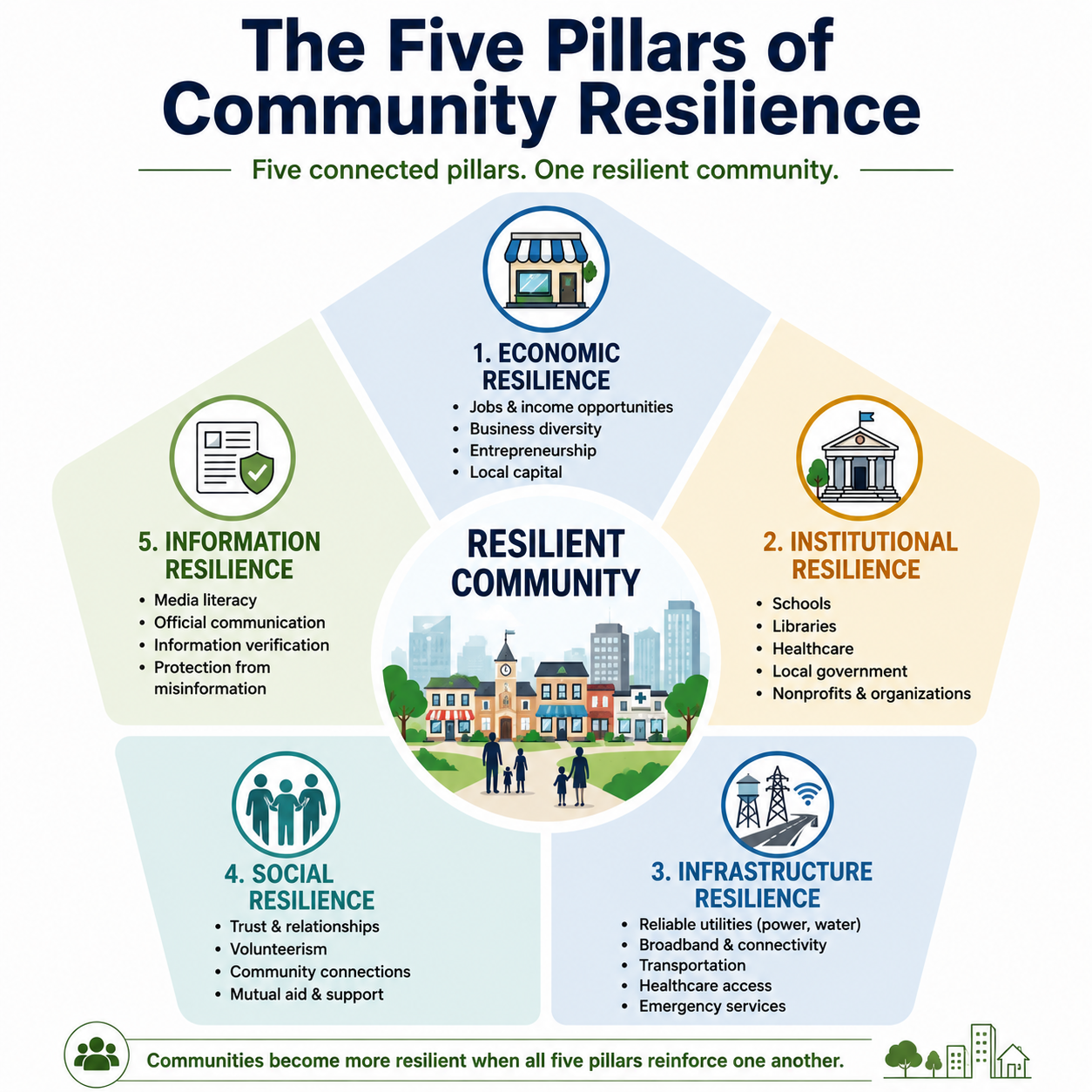
AI-era community resilience rests on five connected pillars.
1. Economic Resilience
Economic resilience asks whether the local economy can absorb disruption.
Key questions:
- How many employers dominate the region?
- Are there small businesses across different sectors?
- Can workers transition if a major employer cuts staff?
- Can entrepreneurs start and test new companies?
- Does local capital stay local?
- Are residents dependent on one industry, one commute pattern, or one large institution?
AI may lower the cost of starting a business, but it may also intensify competition. A region with only one dominant employer is more fragile than a region with many smaller sources of income, services, and ownership.
2. Institutional Resilience
Institutions turn individual effort into organized capacity.
Important local institutions include:
- schools;
- libraries;
- churches and faith communities;
- nonprofits;
- hospitals;
- community colleges;
- universities;
- local government;
- volunteer organizations;
- business associations.
When institutions are trusted and competent, communities can coordinate faster. When institutions are weak or mistrusted, even good tools may not translate into better outcomes.
3. Infrastructure Resilience
AI does not make physical infrastructure irrelevant.
Communities still depend on:
- electricity;
- water;
- broadband;
- roads;
- public transit;
- healthcare access;
- food systems;
- communications;
- emergency response.
AI may improve planning and operations, but it cannot erase the need for reliable power, clean water, functioning roads, and medical care. A community with weak infrastructure enters the AI transition with less room for error.
4. Social Resilience
Social resilience is the strength of relationships.
It includes:
- trust;
- neighbors knowing neighbors;
- volunteerism;
- mentoring;
- clubs;
- sports;
- mutual aid;
- civic participation;
- informal help during emergencies.
This is often underestimated because it does not appear on a balance sheet. But in a crisis, relationships become infrastructure.
5. Information Resilience
AI makes information resilience more important.
Communities need residents who can distinguish:
- truth;
- rumor;
- deepfakes;
- scams;
- misinformation;
- official communication;
- manipulated media.
The Digital Inquiry Group’s Civic Online Reasoning work is useful here because it teaches practical ways to evaluate online information. AI-generated media raises the stakes. A community that cannot tell official guidance from a convincing fake will struggle in emergencies, elections, public health events, and local disputes.
Local Businesses Become More Important
AI can lower startup costs.
A person can now use AI to draft a business plan, build a website, write customer emails, analyze local demand, generate basic code, produce training material, and manage back-office tasks. That does not make entrepreneurship easy, but it lowers some barriers.
Local businesses matter because they create local options.
They include:
- service businesses;
- trades;
- healthcare practices;
- professional services;
- construction;
- agriculture;
- tourism;
- local manufacturing;
- restaurants;
- childcare;
- repair;
- logistics;
- retail.
Locally owned businesses often recycle more economic activity within their communities than absentee ownership, though the result varies by industry, supply chain, wages, and local conditions. The deeper point is economic diversity. A town with many locally rooted firms has more ways to adapt than a town waiting for one distant employer to decide its future.
AI can help small businesses become more capable. But it can also make generic services easier to copy. The resilient local business will usually combine AI-enabled efficiency with something harder to automate: trust, location, physical delivery, community knowledge, service quality, relationships, or specialized expertise.
Communities should ask:
- Are there local suppliers?
- Are there local customers?
- Are there local owners?
- Are there local apprenticeship paths?
- Are there places for small firms to start?
- Are there lenders, mentors, and business networks?
Economic resilience is not only about attracting the next large employer. It is about increasing the number of ways residents can create value where they live. This connects directly to career resilience: the stronger the local opportunity base, the easier it is for workers to reposition when tasks, employers, or industries change. For an individual-level framework, see The AGI Career Transition Playbook.
Remote work and AI-enabled digital businesses also allow some communities to attract residents whose employers are located elsewhere, broadening the local economic base while still increasing demand for local services.
Libraries Become AI Infrastructure
Libraries may become one of the cheapest public investments in AI resilience.
Unlike many technology initiatives, libraries already have public trust, physical locations, trained staff, and a mission centered on broad community access rather than commercial incentives.
Modern libraries are not only places to borrow books. They can become:
- AI literacy centers;
- digital inclusion hubs;
- maker spaces;
- training centers;
- trusted meeting spaces;
- job-search support centers;
- small-business research hubs;
- places where residents learn to evaluate information.
The American Library Association describes libraries as central to digital inclusion and has also developed resources on AI trends and ethics in libraries. That role will likely expand. A library can help residents understand AI tools without forcing every household to figure it out alone.
This matters for equity. If only high-income households, large companies, and elite schools have effective access to AI literacy, local inequality widens. Libraries can help close that gap.
A resilient community should treat the library as civic infrastructure:
- a place to learn tools;
- a place to ask questions;
- a place to access broadband;
- a place to build media literacy;
- a place to gather across age and income lines.
In the AI era, the library is not old infrastructure. It is adaptive infrastructure.
Schools Must Become Community Learning Centers
Learning can no longer end with formal education.
AI will change job tasks, business models, and public services faster than traditional education cycles can update. Communities need learning systems that serve children and adults. This is the community-level version of the same education challenge explored in Raising Children in the Age of AGI.
Schools, community colleges, libraries, and workforce organizations can support:
- adult education;
- AI literacy;
- career transition;
- technical training;
- entrepreneurship;
- community events;
- parent education;
- digital citizenship;
- tutoring and mentoring.
This does not mean every school has to become a technology lab. It means schools should become stronger local learning anchors.
The World Economic Forum Future of Jobs Report 2025 and the ILO 2025 update on generative AI and jobs both point toward task transformation rather than a simple disappearance of work. That requires ongoing learning. Communities that help residents retrain and reposition will be better prepared than communities where workers are left to navigate change alone.
Emergency Preparedness Still Matters
AI does not replace storms, fires, earthquakes, floods, pandemics, cyberattacks, power outages, water failures, or supply disruptions.
Community resilience still includes basic preparedness:
- local emergency plans;
- backup communications;
- emergency operations;
- medical response;
- backup power;
- neighborhood check-ins;
- amateur radio;
- volunteer coordination;
- food and water planning;
- local shelter capacity.
Communities should also think about communication resilience. During disasters, residents need reliable ways to receive trusted information even if internet or cellular service is disrupted.
FEMA’s National Preparedness Goal organizes preparedness around prevention, protection, mitigation, response, and recovery. FEMA’s Community Emergency Response Team program also trains volunteers in practical disaster response.
AI may improve forecasting, logistics, translation, emergency communications, and resource allocation. But when the power is out or the road is blocked, local capacity still matters.
The most resilient communities do not assume that outside help arrives immediately. They build the first layer of response locally.
Social Capital Is Infrastructure
Social capital is the network of relationships, trust, norms, and mutual obligation that helps people cooperate.
Robert Putnam’s Bowling Alone helped popularize the concern that civic life can weaken when people disconnect from clubs, associations, faith communities, neighborhood groups, and public life. Whether one agrees with every part of that analysis, the basic point is hard to ignore: communities work better when people know and trust one another.
People underestimate the practical value of:
- knowing neighbors;
- churches and faith communities;
- sports leagues;
- service organizations;
- veterans groups;
- parent groups;
- Rotary and Lions clubs;
- mutual aid networks;
- volunteers;
- local mentors.
Strong relationships make every crisis smaller.
They help people share information, check on vulnerable residents, find jobs, start businesses, coordinate childcare, respond to emergencies, and resolve problems before they become institutional failures.
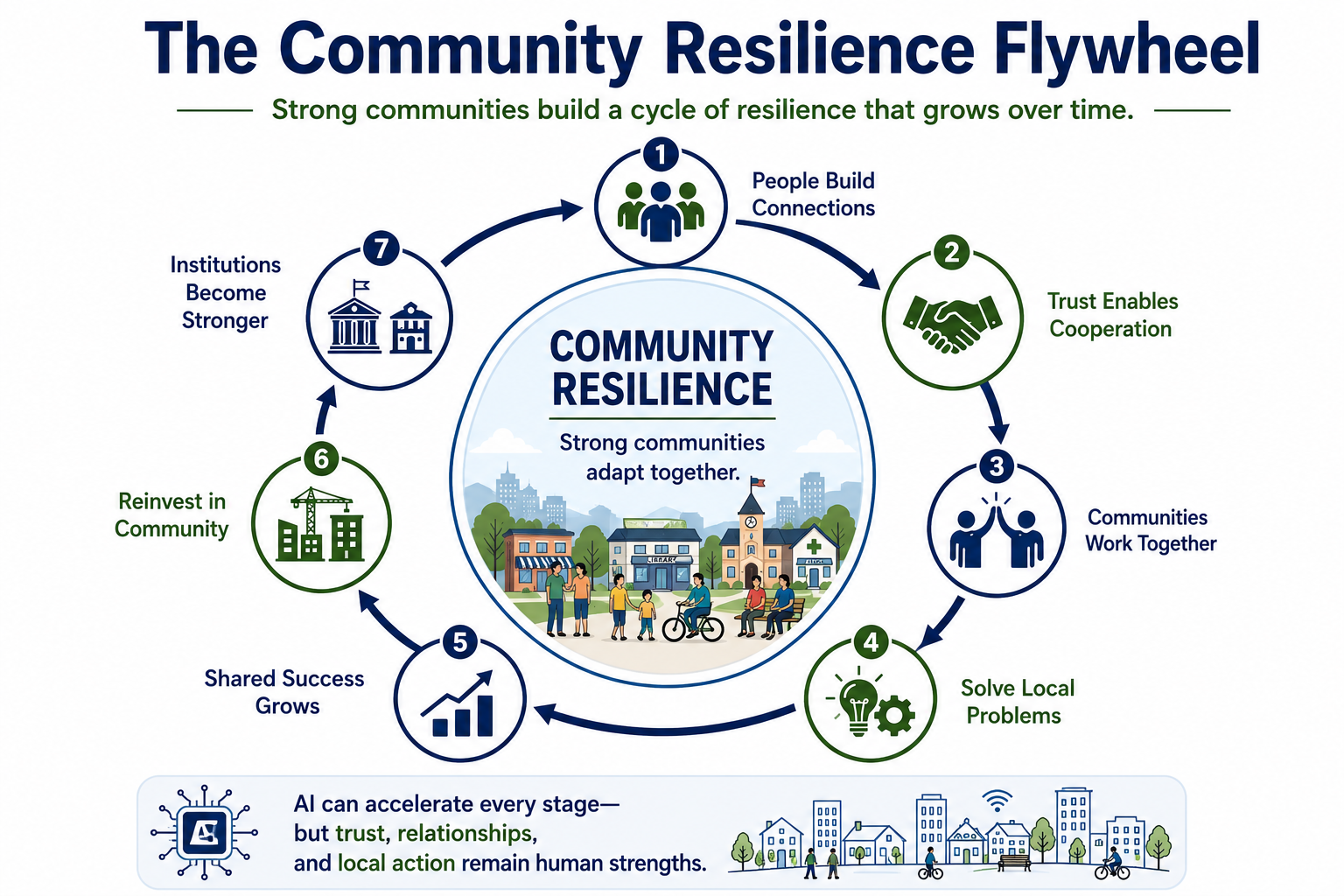
The community flywheel looks like this:
Relationships → trust → cooperation → problem solving → prosperity → investment → more relationships.
AI can help people find information faster, but it cannot attend a neighborhood meeting, coach a youth sports team, or earn a community’s trust over years of shared experience.
AI can amplify communities that already cooperate well. It can help coordinate volunteers, translate notices, analyze local data, and improve services. But it cannot manufacture trust in a community that has stopped practicing it.
AI Can Strengthen Communities
AI is not only a threat to local resilience. It can also be a tool for it.
Potential positive uses include:
- city planning;
- traffic management;
- utility operations;
- healthcare access;
- translation;
- permitting;
- government service navigation;
- small-business support;
- emergency management;
- volunteer coordination;
- accessibility;
- grant writing;
- public communication;
- infrastructure maintenance.
Imagine a small town using AI to translate city notices, help residents navigate benefits, identify pothole patterns, streamline permits, coordinate volunteers after a storm, and help small businesses apply for grants.
Those are not science-fiction uses. They are practical civic technology use cases.
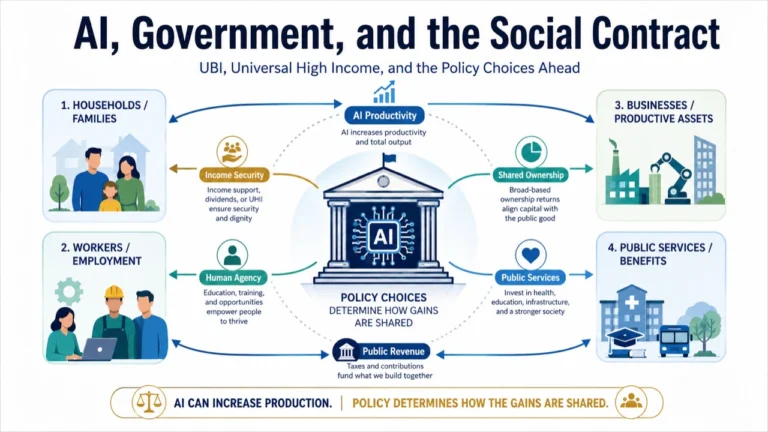
The key is governance. Communities should adopt AI because it solves clearly defined problems, not simply because the technology is available. They need clear rules for privacy, transparency, procurement, accountability, bias, and human review. AI should improve public service without making government less understandable to the people it serves.
Risks Communities Should Prepare For
AI also creates local risks.
Mobile note: Swipe horizontally to view the full table.
| Risk | Potential local impact | Preparation |
|---|---|---|
| Automation | Job loss or wage pressure in exposed roles | Workforce training, employer diversity, career transition support |
| Employer concentration | One large employer restructuring harms the whole region | Small-business development, economic diversification |
| Cybersecurity | Local governments, schools, and hospitals become targets | Security training, backups, incident response plans |
| Deepfakes | Fake audio or video damages trust | Official communication channels, media literacy |
| Scams | Residents are targeted with AI-enabled fraud | Public education, bank and elder-safety partnerships |
| Political polarization | Synthetic content intensifies local conflict | Trusted conveners, transparent processes, local journalism |
| Loss of local journalism | Rumors fill the information gap | Support credible local information sources |
| Digital exclusion | Some residents cannot access new tools | Libraries, broadband, device access, training |
| Privacy | Sensitive resident data is collected or misused | Procurement standards, data minimization, oversight |
| Vendor dependence | Essential public services become tied to one AI platform | Open standards, procurement review, exit planning |
The Cybersecurity and Infrastructure Security Agency’s Rumor Control resources are a useful model for countering false information during high-stakes events. Local governments and civic organizations should have similar habits: clear official channels, rapid correction, and public trust built before the crisis.
Community Resilience Starts Before the Emergency
Community resilience is not only something city managers, school boards, or emergency planners build. Ordinary residents shape it through repeated habits.
A person can strengthen local resilience by doing simple things consistently:
- know your neighbors;
- join one local organization;
- shop locally when practical;
- attend public meetings occasionally;
- volunteer once a month;
- learn one practical emergency skill;
- mentor someone;
- support local journalism;
- introduce yourself to local business owners;
- participate in school or community events.
None of those actions requires expertise in AI. But they create the social fabric that helps a community absorb change.
Communities are not abstract systems. They are the accumulated habits of the people who live in them.
Community Resilience Checklist
Use this as a starting point for evaluating a town, neighborhood, or region.
Does your community have these building blocks?
Economy
- diverse employers;
- locally owned businesses;
- entrepreneurship support;
- workforce training;
- local capital and mentoring networks.
Civic Institutions
- an active public library;
- strong schools;
- nonprofits;
- volunteer organizations;
- neighborhood associations;
- trusted local government.
Infrastructure
- reliable broadband;
- transportation options;
- healthcare access;
- affordable housing;
- resilient utilities and communications.
Trust
- credible local news;
- community groups;
- trusted official communication channels;
- places where residents gather across social lines.
Preparedness
- emergency plans;
- cybersecurity awareness;
- digital literacy programs;
- AI literacy resources;
- practical volunteer response capacity.
No community has all of this perfectly. The point is to identify weak spots before disruption exposes them.
For households, this checklist also matters when choosing where to live. A low mortgage is useful. A strong career is useful. But a household embedded in a resilient community has another layer of protection.
That connects this article to the rest of the AGI Household Resilience series. The household matters. The community around the household matters too.
Continue the AGI Household Resilience Series
This post is part of the AGI Household Resilience series. For the surrounding context, read:
- What Is AGI? What It Is, What It Is Not, and How to Track Progress
- Raising Children in the Age of AGI
- AGI and Financial Independence: How Families Can Prepare for Economic Disruption
- Household Self-Sufficiency in the Age of AGI
- The AGI Mortgage Trap
- The AGI Career Transition Playbook
Final Takeaway
The future will not be determined only by frontier AI labs.
It will also be shaped by neighborhoods, small businesses, libraries, schools, churches, volunteers, families, and local governments.
Communities that already know how to solve problems together will likely adapt to AI more successfully than communities waiting for outside institutions to solve every challenge.
Technology changes capabilities.
Community determines outcomes.
AI may accelerate change, but resilient communities have always shared the same characteristics: people who trust one another, institutions that earn confidence, local businesses that create opportunity, and citizens willing to solve problems together. Those qualities mattered before AI, and they may matter even more after it.