What AI actually is (and what it isn’t)
On this page
Listen to this lesson · about 1 min, audio overview
“AI” is one word for three different things. Mix them up and every conversation about AI goes sideways. Sort them out, and the rest of this series falls into place.
On this page
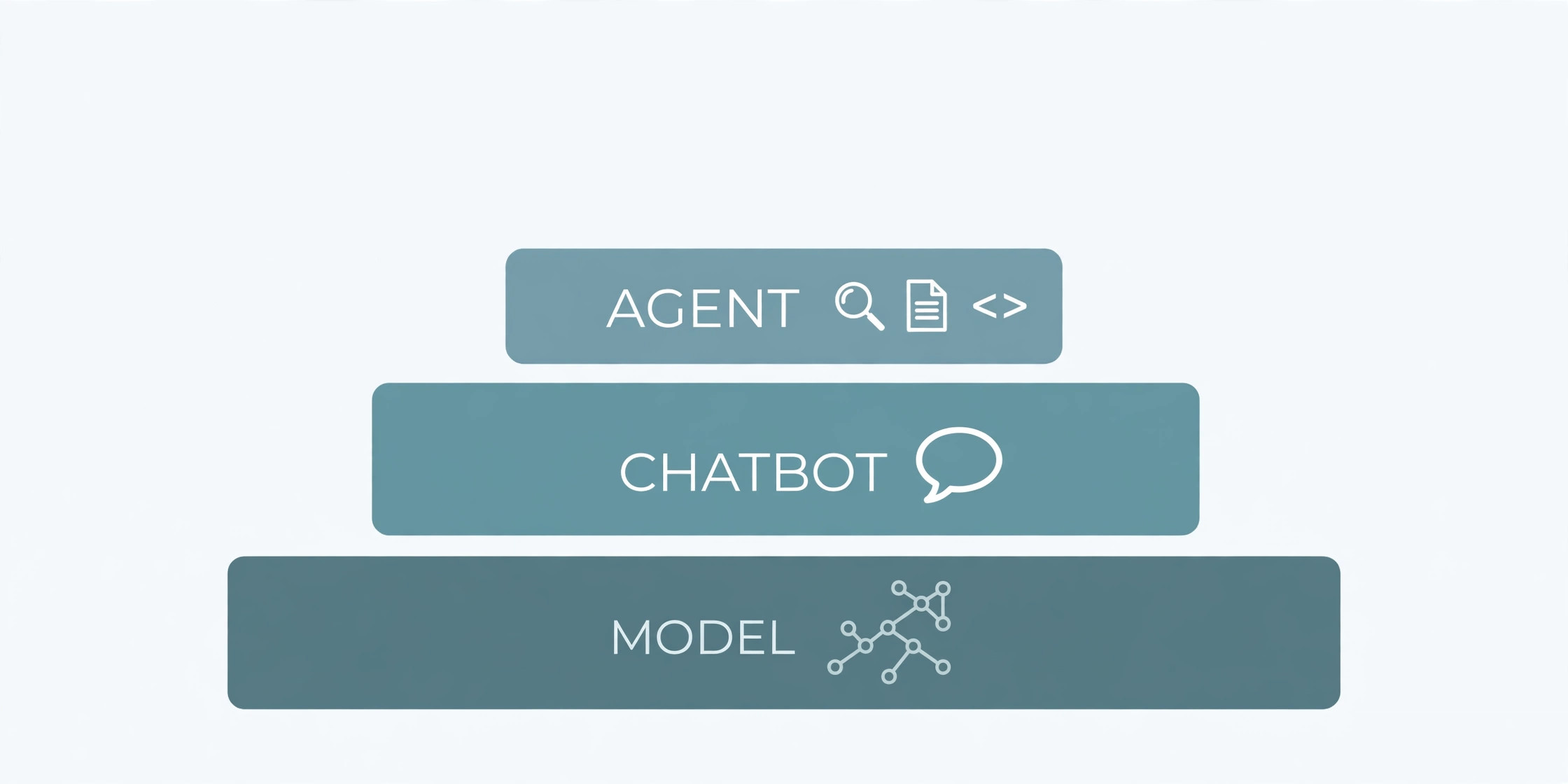
If you have ever read two articles about AI that seemed to disagree completely, there is a good chance they were talking about different things while using the same word. One was talking about a model. The other was talking about a product, or an agent, or a fear about all three at once. This lesson separates the three, because nearly everything else in this series depends on keeping them apart.
1. Models: prediction machines
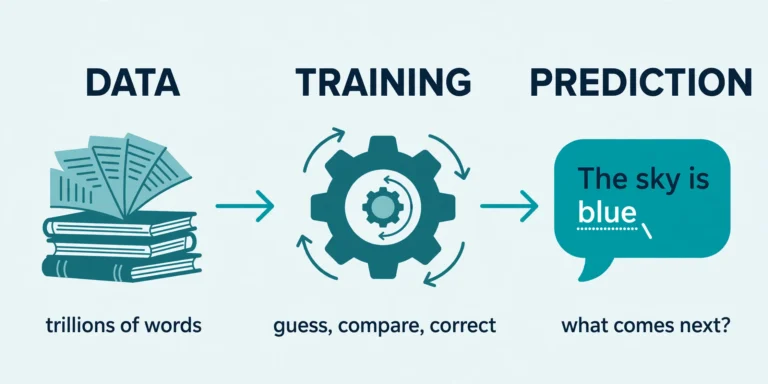
A model is software trained on vast amounts of text, images, code, or other data. Training teaches it patterns: how sentences usually continue, how code is usually structured, what usually follows what. When you give a model an input, it predicts the most likely continuation.
That is the whole trick. It sounds too simple to explain everything AI can do, and that is exactly the point worth sitting with. A model does not look things up, unless it has been given a tool to do so. It does not check facts. It predicts, one piece at a time, based on patterns in its training data. Everything else in AI, every product and every agent, is built on top of this one capability.
A useful analogy is autocomplete with a very good memory of how language works. The analogy breaks down at scale, a frontier model holds far more pattern than any autocomplete, but the mechanism is the same shape: predict what comes next.
2. Chatbots: models with a face
A chatbot is a model wrapped in a conversation. The wrapper adds a chat window, memory of what you have said so far, instructions about how to behave, and safety rules about what it will not do. The model underneath is the same kind of prediction machine. The experience is completely different.
ChatGPT, Claude, and the Gemini app are products, not models. The model is the engine. The chatbot is the car built around it. When a chatbot gives a great answer, that is usually the model doing good prediction plus a good wrapper. When it gives a bad one, the fault can sit in either place: a weak model, or a wrapper that hides what the model can actually do.
3. Agents: models that can act
An agent is a model given tools and permission to act. It can read files, search the web, run code, send messages, and work through a task in steps, checking its own results as it goes. The shift is from answering to doing.
A chatbot answers your question and stops. An agent takes your goal and works toward it: researching a topic across sources and writing up what it found, or editing a software project file by file and testing the result. The prediction engine is the same. What changed is that the model can now take actions in the world and see what happens next.
This is also where the human stays in charge. An agent needs a goal worth pursuing and a final call on whether the result is good enough. That judgment is not something the model can supply for you, and it is the thread this whole series keeps coming back to.
What AI is not
Four things AI is commonly mistaken for, and is not:
- It does not understand the way people do. It predicts patterns in language, not meaning. Fluent output is not the same as comprehension.
- It does not know what is true. It can state false things confidently, because confidence in a prediction is not evidence. Checking is your job, and lesson 4 is entirely about how.
- It does not want anything. A model has no goals or intentions of its own. Whatever it seems to want is a pattern it is continuing.
- It is not one thing. There is no single “AI” coming for your job or your industry. There is a set of tools with different shapes, and the shape matters more than the label.
Why the distinction matters
First, it tells you which tool to reach for. A quick question goes to a chatbot. A multi-step job, research this and write it up, or fix this project, is work for an agent. A task that is mostly prediction, like sorting or drafting in bulk, is a job for a model directly.
Second, it changes how you judge output. A chatbot’s confident tone is a property of the wrapper, not evidence the answer is right. Knowing that the engine underneath only predicts makes checking feel normal instead of paranoid.
Third, it clears up most of the public argument about AI. The hype usually describes an agent while showing you a chatbot. The fear usually describes a model as if it were an agent with goals of its own. Once you can see which of the three someone is actually talking about, the conversation gets much easier to follow, and much harder to be misled by.
Try it
Pick one real task from your week, something you actually need done.
- Write down which of the three you would use, a model, a chatbot, or an agent, and why.
- Try it in a chatbot. Ask it to do the task.
- Find one place where it guessed instead of knowing, and write down how you spotted the guess.
About 15 minutes. The third step is the whole lesson in miniature.
Key terms
- Model: software trained on large amounts of data to predict what comes next.
- Training: the process of teaching a model patterns from data.
- Prediction: the model’s core act, estimating the most likely continuation of an input.
- Chatbot: a model wrapped in a conversation, with memory, instructions, and safety rules.
- Agent: a model given tools and permission to take actions toward a goal.
- Hallucination: a confident-sounding output that is false or invented. Lesson 4 covers it in full.
- Context: the information the model can see while it works, including your conversation so far.
Keep going
Next: Lesson 2, How a model learns: data, training, and prediction. Now that you know what a model is, the next lesson opens it up: what training actually does, why data quality beats data size, and what “prediction” means when a model writes.
Further reading on this site: the deep dive What happens when the chatbot starts doing things?, which follows the chatbot-to-agent shift in the real world.