Daily Positive Signals: a new NASA X-plane, mobile clinics that cut deaths by 71%, and an AI chemist that designs drugs in an hour
On this page
Listen to this brief · about 4 min, story text only
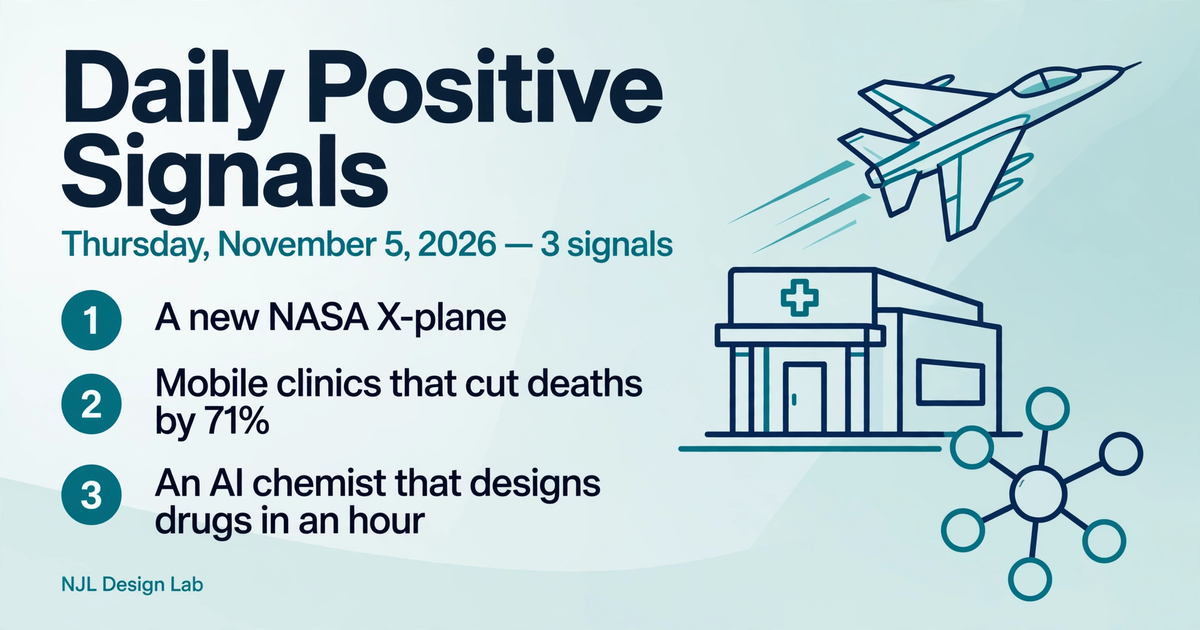
This edition: NASA unveils a crewed X-plane built to test flight controls never flown before, mobile clinics cut deaths by 71% among people who inject drugs, and an AI agent compresses a drug-design workflow from days into an hour. The thread: getting the right thing to the right place, faster.
In this edition · 3 signals
Signal 1 of 3 · Aerospace
A new NASA X-plane built to test flight controls never flown before
NASA has unveiled the X-70 Fractal, a crewed experimental aircraft, at the UP.Summit at its Kennedy Space Center in Florida (NASA, 2026). The jet is built to test advanced flight-control technology and aircraft maneuverability in ways never before demonstrated in crewed flight, and its modular design lets researchers swap experimental payloads quickly between test campaigns (NASA, 2026). It weighs 10,000 pounds at takeoff, cruises at Mach 0.75, reaches 45,000 feet, and flies more than 1,726 miles, with a first flight under the NASA banner expected within two years (Rogoway, 2026).
Why it matters. X-planes exist to test ideas too risky for production aircraft. A crewed, rapidly reconfigurable testbed lets NASA try new flight-control concepts in real air, and move from one experiment to the next without building a new aircraft for each one.
Evidence status: NASA press release, with independent coverage from The War Zone. Limits: only a generated concept image has been released, so the aircraft’s shape is unconfirmed; NASA has not named the manufacturer; first flight is up to two years away.
Signal 2 of 3 · Medicine
Mobile clinics that cut deaths by 71% among people who inject drugs
In five major U.S. cities, delivering HIV and addiction care through mobile medical units cut all-cause deaths by 71% compared with peer navigation to community services alone (National Institutes of Health, 2026). The trial, known as HPTN 094, enrolled 409 adults without HIV who injected drugs and had opioid use disorder, giving one group 26 weeks of peer navigation plus integrated prevention and addiction care on a mobile unit (National Institutes of Health, 2026). The mortality benefit was a secondary outcome, and the trial found no difference between the groups in daily oral HIV prevention or opioid-use-disorder medication use, though 14% of participants were using such medication at 26 and 52 weeks (Medical Xpress, 2026). The results are published in JAMA Psychiatry (Shoptaw et al., 2026).
Why it matters. People who inject drugs face fragmented care, unstable housing, and stigma. Bringing prevention, addiction treatment, and supportive care to them, instead of asking them to navigate separate systems, saved lives even without raising medication uptake.
Evidence status: Peer-reviewed randomized trial in JAMA Psychiatry, with an NIH release and independent coverage from Medical Xpress. Limits: mortality was a secondary outcome, so the finding needs replication; HIV prevention pill use stayed low in both groups; the trial does not show which part of the mobile-unit package drove the benefit.
Signal 3 of 3 · AI
An AI chemist that designs drug molecules in an hour
Google DeepMind has added Cheminformatics Skills to Google Antigravity, turning the agent into a science workbench for drug discovery (Tsangalidou et al., 2026). In a lung-cancer example, the agent searched literature and compound databases, ran matched molecular pair analysis, and proposed new rigidified macrocycles with synthesis routes in about an hour, a workflow that typically takes multiple days (Tsangalidou et al., 2026). The skills are grounded in the open-source RDKit toolkit and connect to the ChEMBL and PubChem databases, with the language model orchestrating the work while deterministic chemistry tools run the calculations (Emergent, 2026).
Why it matters. Drug design is slow partly because chemists spend days wrangling data across formats. An agent that does the curation and proposes testable candidates lets scientists spend their time on hypotheses instead of housekeeping.
Evidence status: Google DeepMind blog post, with independent coverage from Emergent. Limits: a company demonstration, not an independent evaluation; proposed molecules are hypotheses that must still be synthesized and tested in a lab; sparse data and assay noise limit predictive precision.
Editor’s note
Today’s thread is delivery. The X-70 is a delivery platform for flight research, built to carry new ideas into real air. The mobile clinics deliver care to people the health system struggles to reach. The chemistry agent delivers a week of data wrangling in an hour. None of these is a finished answer: a plane two years from flying, a mortality result that needs replication, molecules that still need a lab. But each one shortens the distance between a good idea and the place it has to work.
That’s the edition — three signals, every claim verified against its sources. Browse past briefs · tomorrow’s lands at 07:15.
The Progress Brief, by email
Useful progress, without the hype
The daily Positive Signals brief and the weekly deep dive, by email. Evidence-checked, concise, no doom.
Free. One daily email, one weekly email. Unsubscribe anytime.
References
- Emergent. (2026, November 3). Google Antigravity accelerates drug discovery workflows. https://emergent.sh/news/google-antigravity-accelerates-drug-discovery
- Medical Xpress. (2026, November 4). Combining HIV prevention and addiction treatment in mobile clinics could save lives. https://medicalxpress.com/news/2026-11-combining-hiv-addiction-treatment-mobile.html
- NASA. (2026, November 4). NASA announces X-70 experimental aircraft to advance flight research. https://www.nasa.gov/news-release/nasa-announces-x-70-experimental-aircraft-to-advance-flight-research/
- National Institutes of Health. (2026, November 4). Integrated health service delivery through medical mobile units helped to reduce deaths among individuals at risk for HIV who also inject drugs. https://www.nih.gov/news-events/news-releases/integrated-health-service-delivery-through-medical-mobile-units-helped-reduce-deaths-among-individuals-risk-hiv-who-also-inject-drugs
- Rogoway, T. (2026, November 4). NASA announces X-70 “Fractal” experimental aircraft. The War Zone. https://www.twz.com/space/nasa-announces-x-70-fractal-experimental-aircraft
- Shoptaw, S., El-Bassel, N., et al. (2026). Mobile units for integrated addiction and prevention services for people who inject drugs: The HPTN 094 randomized clinical trial. JAMA Psychiatry. https://doi.org/10.1001/jamapsychiatry.2026.3644
- Tsangalidou, Z., Zhang, R., Singh, S., & LeVine, M. V. (2026, November 3). Agentic cheminformatics with Google Antigravity. Google DeepMind. https://deepmind.google/blog/agentic-cheminformatics-with-google-antigravity/