Daily Positive Signals: a machine-checked proof, a factory-line robot, and planets found by gravity
On this page
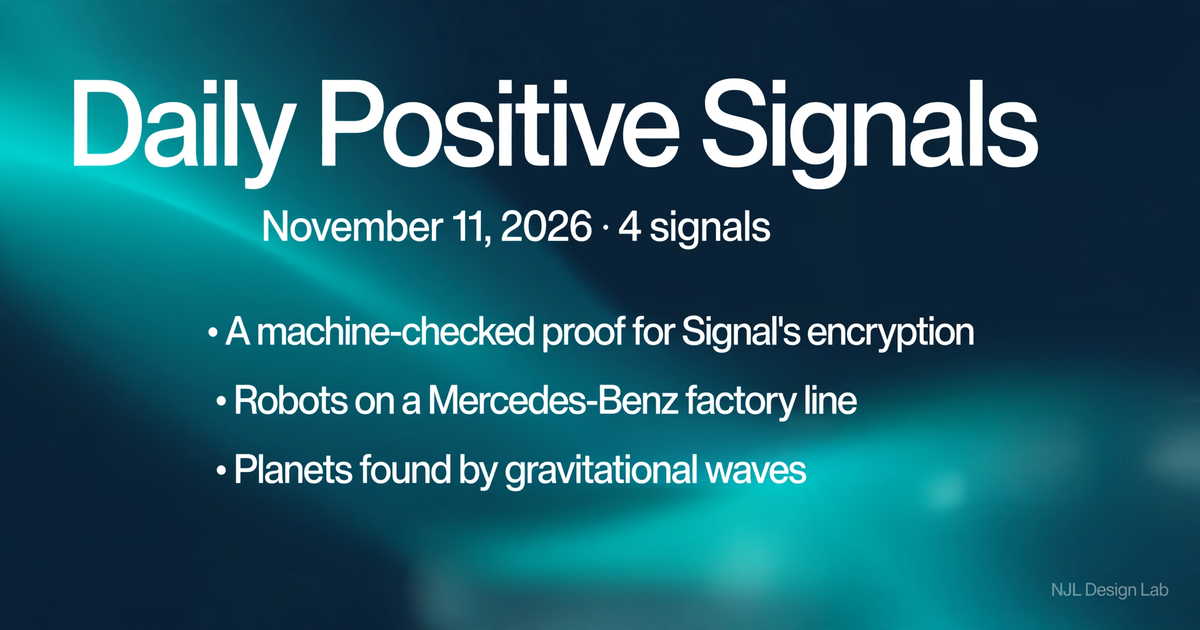
- AI agents prove Signal’s encryption holds, down to the machine code
- Robots that tie bows now work a Mercedes-Benz production line
- Gravitational waves could reveal a whole new population of planets
- Google ships two new AI chip systems, its fourth TPU launch this year
- Useful progress, without the hype
- Know someone this would help?
- References
Listen to this brief · about 6 min, story text only
This edition: AI agents mathematically prove Signal’s encryption; robots run a factory line in Germany and Hungary; gravitational waves open a new way to find planets; and Google ships its fourth AI chip system of the year. The thread: machines that check their own work.
In this edition · 4 signals
- AI agents prove Signal’s encryption holds, down to the machine code — AI
- Robots that tie bows now work a Mercedes-Benz production line — Robotics
- Gravitational waves could reveal a whole new population of planets — Space
- Google ships two new AI chip systems, its fourth TPU launch this year — AI
- References
Signal 1 of 4 · AI
AI agents prove Signal’s encryption holds, down to the machine code
Google DeepMind announced AlphaProof Code on November 10, a system in which AI agents guided by human experts mathematically proved key security properties of the code behind the Signal protocol, the technology that protects billions of private conversations in apps like Signal and Google Messages (Google DeepMind, 2026). The agents verified the post-quantum PQXDH handshake and the Triple Ratchet in libsignal, the library that implements the protocol, generating more than six million lines of proof in Lean, a language that doubles as a strict proof checker (Google DeepMind, 2026). Human researchers wrote and reviewed the formal specifications, and the agents flagged only 1% of the codebase for a second human look (Google DeepMind, 2026). As a sanity check, the team reintroduced two real, previously fixed bugs into an isolated copy of the code; in both cases the system produced a machine-checked proof that the buggy version was insecure (Google DeepMind, 2026).
Why it matters. Most protocol verification stops at the design on paper, but real vulnerabilities hide in the gap between design and implementation. Proving the compiled code itself delivers its privacy promises is the strongest assurance available, and doing it in weeks instead of years means the same rigour can reach medical devices, power grids, and other vital systems.
Evidence status: DeepMind announcement and technical paper (November 10, 2026), independently reported by The Register. Limits: the proof assumes the underlying cryptography is perfect; it covers one-to-one sessions only — key generation, group chats, sealed sender, and server code are outside it — and it targets one compiled build for AArch64 Linux.
Signal 2 of 4 · Robotics
Robots that tie bows now work a Mercedes-Benz production line
Google DeepMind introduced Gemini Robotics 2.5 on November 10, its most capable vision-language-action model to date, which turns camera input and instructions into robot movement (Google DeepMind, 2026). Across more than 200 distinct tasks, including serving food with tongs, tying a bow on a gift box, and pipetting a liquid, the model achieved 30% to 100% higher success rates than earlier baselines and completed tasks 20% to 30% faster (Google DeepMind, 2026). In a proof-of-concept with Apptronik and Mercedes-Benz, Apollo 2 humanoid robots picked and packed automotive brackets on active production lines in Kecskemét, Hungary, and Sindelfingen, Germany, reaching a 96% success rate (Unite.AI, 2026). The model also steers around hazards in real time, improving safe task completion by 33% around obstacles and 43% around nearby people (Google DeepMind, 2026).
Why it matters. Dexterity plus reliability on a real factory floor moves humanoid robots from demonstrations toward useful work. The kitting task is repetitive and physically taxing, so handing it to robots frees technicians for complex build work, while the safety steering is what makes sharing a workspace with people plausible at all.
Evidence status: DeepMind announcement (November 10, 2026), independently reported by Ars Technica and Unite.AI. Limits: all figures are company-reported, not independently validated; the factory work was a proof-of-concept, not a production deployment; the model is rolling out to robotics partners only, with no public API.
Signal 3 of 4 · Space
Gravitational waves could reveal a whole new population of planets
Two studies led by NASA astrophysicists, published November 10 in The Astrophysical Journal, show in new detail how the LISA observatory could detect exoplanets around double white dwarf systems, pairs of dead stars in tight orbits, by the way a planet’s gravity imprints a wobble on the gravitational waves the pair emits (NASA, 2026). LISA could spot a Jupiter-mass planet in such systems up to thousands of light-years away (NASA, 2026). A second paper shows NASA’s James Webb Space Telescope could confirm such planets from the infrared glow they add, detecting a planet five times Jupiter’s mass in a test case 500 light-years away (NASA, 2026). Astronomers estimate the Milky Way holds 10 million double white dwarf systems with orbital periods of less than an hour, and LISA should resolve about 10,000 of them individually (NASA, 2026).
Why it matters. No exoplanet has ever been found around a binary white dwarf. Gravitational waves would open a new way to find planets around stars long past their prime, and to learn whether planets can survive their star’s death.
Evidence status: Two peer-reviewed papers in The Astrophysical Journal (November 10, 2026), reported by NASA and phys.org. Limits: LISA launches in the mid-2030s, so no detections yet — this is a method and a confirmation technique, not a discovery — and the detection estimates assume ideal conditions.
Signal 4 of 4 · AI
Google ships two new AI chip systems, its fourth TPU launch this year
Google announced TPU 8tx and TPU 8i Max on November 9, two new systems in its eighth-generation Tensor Processing Unit portfolio, marking four TPU systems introduced in a single year for the first time (Google, 2026). TPU 8tx is built for secure and confidential inference: paired with fifth-generation AMD EPYC host processors, it keeps sensitive data and model weights protected and isolated even while in active use, and Google reports up to twice lower latency than TPU 8t with a near-zero performance penalty (Google, 2026). TPU 8i Max combines two TPU 8i chips in a single package, doubling compute, SRAM, and high-bandwidth-memory bandwidth for workloads that reason across million-token contexts (Google, 2026). Google also says its Gemini model now helps design chip layouts in hours rather than weeks (Google, 2026).
Why it matters. As AI agents move into production, the bottlenecks are memory and trust. These systems target both at once, and the pace — four systems in a year — shows hardware now iterating at something closer to software speed, with AI itself helping design the next chips.
Evidence status: Google announcement (November 9, 2026), independently reported by TechCrunch, The Hindu, and the Indian Express. Limits: both are new systems built on existing silicon, not new chips; Google gave no pricing or availability dates; all performance figures are company-reported.
Editor’s note
Today’s thread is machines that check their own work. AI agents prove the encryption billions of people rely on, with a proof checker verifying every step. Robots learn to handle delicate objects and steer around the people beside them. A future observatory will listen for planets in ripples of space-time, with a second telescope ready to confirm what it hears. And the chips that run all of this now protect data while they use it. Each item adds capability and, in the same move, adds a way to verify it. That pairing is what turns a fast-moving field into one worth trusting.
That’s the edition — four signals, every claim verified against its sources. Browse past briefs · tomorrow’s lands at 07:15.
The Progress Brief, by email
Useful progress, without the hype
The daily Positive Signals brief and the weekly deep dive, by email. Evidence-checked, concise, no doom.
Free. One daily email, one weekly email. Unsubscribe anytime.
References
- Google. (2026, November 9). Introducing TPU 8tx and TPU 8i Max. https://blog.google/innovation-and-ai/infrastructure-and-cloud/global-network/tpu-8i-max-and-8tx/
- Google DeepMind. (2026, November 10). Formal verification of Signal’s protocol with Gemini. https://deepmind.google/blog/introducing-alphaproof-code/
- Google DeepMind. (2026, November 10). Gemini Robotics 2.5: Accelerating physical intelligence. https://deepmind.google/blog/gemini-robotics-2-5-accelerates-real-world-physical-intelligence/
- McGrath, C. (2026). Receiving exoplanet messages with gravitational-wave carriers: The gravitational-wave radial velocity method. The Astrophysical Journal. https://doi.org/10.3847/1538-4357/aea216
- McGrath, C., Limbach, M. A., Noble, S. C., et al. (2026). Multimessenger exoplanets: Combining infrared excess and astrometry with gravitational-wave detections of double white dwarf exoplanets. The Astrophysical Journal. https://doi.org/10.3847/1538-4357/aea07d
- NASA. (2026, November 10). NASA scientists show how gravitational waves can reveal new worlds. https://science.nasa.gov/missions/lisa/gravitational-waves-can-reveal-new-worlds/
- Phys.org. (2026, November 10). How ripples in space-time can reveal new exoplanets. https://phys.org/news/2026-11-ripples-space-reveal-exoplanets.html
- TechCrunch. (2026, November 10). Google broadens its AI hardware portfolio with two new specialized chips. https://techcrunch.com/2026/11/10/google-broadens-its-ai-hardware-portfolio-with-two-new-specialized-chips/
- The Register. (2026, November 10). Google DeepMind melds humans and AI agents to vet Signal’s secure messaging techniques. https://www.theregister.com/ai-and-ml/2026/11/10/google-deepmind-melds-humans-and-ai-agents-to-vet-signals-secure-messaging-techniques/5308625
- Unite.AI. (2026, November 10). Apollo 2 humanoids hit 96% in Mercedes-Benz sorting proof of concept. https://www.unite.ai/apollo-2-humanoids-hit-96-in-mercedes-benz-sorting-proof-of-concept/