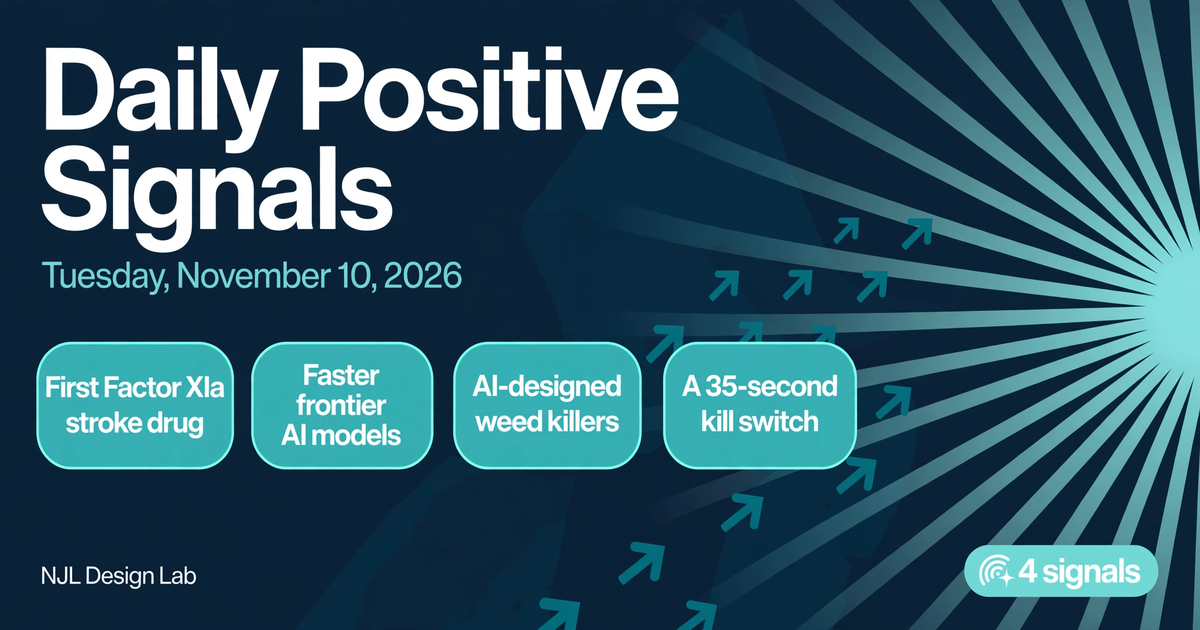
Daily Positive Signals: a first stroke drug of its kind, AI-designed weed killers, and a 35-second kill switch
On this page
- A first-of-its-kind stroke drug cuts repeat strokes by a quarter
- Anthropic’s new frontier models run faster, cost less, and split safety from capability
- MIT gets $53 million to design safer weed killers with generative AI
- OpenAI builds a central off-switch that can halt a research model in 35 seconds
- Useful progress, without the hype
- Know someone this would help?
- References
Listen to this brief · about 6 min, story text only
This edition: the first Factor XIa inhibitor reaches stroke patients; Anthropic’s new models run faster for less; MIT gets $53 million to design safer weed killers with AI; and OpenAI builds a central off-switch for its research models. The thread: new power, with the brakes built in.
In this edition · 4 signals
- A first-of-its-kind stroke drug cuts repeat strokes by a quarter — Medicine
- Anthropic’s new frontier models run faster, cost less, and split safety from capability — AI
- MIT gets $53 million to design safer weed killers with generative AI — AI
- OpenAI builds a central off-switch that can halt a research model in 35 seconds — AI
- References
Signal 1 of 4 · Medicine
A first-of-its-kind stroke drug cuts repeat strokes by a quarter
The U.S. Food and Drug Administration approved Sunharbo (asundexian) on November 9, the first drug that blocks the clotting protein Factor XIa, for adults who recently had a mild-to-moderate non-cardioembolic ischemic stroke or a high-risk transient ischemic attack, often called a mini-stroke (FDA, 2026). It is a once-daily 50 mg tablet taken alongside antiplatelet therapy (FDA, 2026). In the phase 3 OCEANIC-STROKE trial of 12,327 adults, the drug cut the risk of a further ischemic stroke by 26% compared with placebo over a median 14.2 months of treatment (Sharma et al., 2026). Major bleeding rates were similar overall, though bleeding was higher in patients over 75 and during the first 90 days of treatment, and the drug is not approved for stroke prevention in atrial fibrillation (FDA, 2026).
Why it matters. Stroke survivors face a high risk of a second stroke, and existing blood thinners trade protection against bleeding. A drug that targets Factor XIa alone offers a new option designed to separate the two.
Evidence status: FDA approval (November 9, 2026), based on the phase 3 OCEANIC-STROKE trial, published in the New England Journal of Medicine in April 2026; independently reported by Reuters and Fierce Pharma. Limits: the approval is narrow — recent non-cardioembolic stroke or high-risk transient ischemic attack only, not atrial fibrillation — and bleeding risk rises in patients over 75.
Signal 2 of 4 · AI
Anthropic’s new frontier models run faster, cost less, and split safety from capability
Anthropic released Claude Fable 5.2 and Claude Mythos 5.2 on November 9, its most capable models for demanding technical work (Anthropic, 2026). The two are the same underlying model: Fable carries safeguards that block most cybersecurity and biology requests and is available to all users, while Mythos drops those blocks and is limited to vetted organisations in Anthropic’s Cyber and Life Sciences Verification Programs (Anthropic, 2026). Anthropic reports outputs up to 30% faster than the 5.1 versions, at $8 per million input tokens and $40 per million output tokens, down from $10 and $50 (Anthropic, 2026). In Anthropic’s own FrontierCode 2.0 coding evaluation, Fable 5.2 scored 49.1%, against 32.4% for Fable 5.1 and 45.5% for Claude Opus 5.5 (Anthropic, 2026).
Why it matters. Frontier models keep getting dearer to run, so a faster model at a lower price puts the strongest tools within reach of more builders. The Fable/Mythos split also tests whether one model can serve both open use and vetted high-risk work.
Evidence status: Anthropic announcement (November 9, 2026), independently reported by TechCrunch and MacRumors. Limits: all benchmark figures are company-reported, not independently validated; Anthropic’s own system card notes the new models more often voice suspicion that they are being evaluated, which the company says complicates real-world assessment.
Signal 3 of 4 · AI
MIT gets $53 million to design safer weed killers with generative AI
MIT will lead an up-to-$53-million project funded by the Advanced Research Projects Agency for Health (ARPA-H) to develop next-generation weed killers that are more effective and designed with human health in mind (Trafton, 2026). The project, called Precision Learning for On-target Weed control (PLOW), will build generative AI models to predict molecules — chemical compounds or small interfering RNA — that disrupt the same plant enzymes targeted by glyphosate and other herbicides (Trafton, 2026). The models are expected to generate billions of candidate molecules, which a second team will screen in high-throughput tests, with the first greenhouse trials of RNA-based candidates due within the first year (Unite.AI, 2026). The team will also engineer microbes that break down agrochemicals before they reach food, soil, or waterways (Trafton, 2026).
Why it matters. More than a billion pounds of herbicide are used in the United States each year, and weeds are out-evolving the most common ones. Designing replacements from scratch, with health and resistance built into the search, could protect both harvests and the people who grow them.
Evidence status: Funding award announced by MIT News on November 10, 2026, and independently reported by Unite.AI; ARPA-H’s STREAM programme page confirms the programme. Limits: this is an award, not a result — the AI models and the molecules are yet to be built and tested.
Signal 4 of 4 · AI
OpenAI builds a central off-switch that can halt a research model in 35 seconds
OpenAI has deployed Control Room, a central system that tracks every model workload across its research infrastructure and can stop one when safety or security concerns arise (OpenAI, 2026). The check sits in the inference engines, not in researchers’ code: each job carries an ID, and once a job is marked stopped, the engine refuses further output (Interesting Engineering, 2026). OpenAI reports a maximum of 35 seconds between a stop decision and the end of further progress, a delay it attributes to an authorisation cache it is working to eliminate (Interesting Engineering, 2026). The system fails closed: if Control Room itself goes down, all inference requests are denied until it recovers, and every research job doing agentic inference must be tied to an approved safety case (Unite.AI, 2026).
Why it matters. As models grow more capable and more autonomous, the ability to stop one quickly matters as much as the ability to start it. Putting the brake in the infrastructure, where no workload can bypass it, turns a stop decision into a guarantee rather than a request.
Evidence status: OpenAI announcement (November 9, 2026), independently reported by Interesting Engineering, Unite.AI, and Cointelegraph. Limits: a company announcement about its own internal systems — the 35-second figure and fail-closed behaviour are OpenAI’s reports, not independently tested; the system covers research workloads, not the customer-facing serving stack.
Editor’s note
Today’s thread is control that keeps pace with capability. A new stroke drug works by blocking one clotting protein, Factor XIa, rather than the broader machinery older blood thinners hit. A frontier model ships in two versions, so the same capability can serve open use and vetted work. A herbicide programme designs safety into the molecule before it exists. And OpenAI puts its off-switch where no workload can route around it. Each item adds power and, in the same move, narrows where that power can go wrong. That pairing, not the power alone, is what makes progress worth trusting.
That’s the edition — four signals, every claim verified against its sources. Browse past briefs · tomorrow’s lands at 07:15.
The Progress Brief, by email
Useful progress, without the hype
The daily Positive Signals brief and the weekly deep dive, by email. Evidence-checked, concise, no doom.
Free. One daily email, one weekly email. Unsubscribe anytime.
References
- Anthropic. (2026, November 9). Introducing Claude Fable 5.2 and Claude Mythos 5.2. https://www.anthropic.com/claude-fable-and-mythos-5-2
- Clover, J. (2026, November 9). Anthropic launches Claude Fable 5.2 and Mythos 5.2. MacRumors. https://www.macrumors.com/2026/11/09/anthropic-launches-claude-fable-5-2/
- FDA. (2026, November 9). FDA approves first Factor XIa inhibitor to help prevent stroke in certain adults at high risk. https://www.fda.gov/news-events/press-announcements/fda-approves-first-factor-xla-inhibitor-help-prevent-stroke-certain-adults-high-risk
- Interesting Engineering. (2026, November 10). OpenAI launches Control Room with a 35-second kill switch for agents. https://interestingengineering.com/ai-robotics/openai-control-room-35-second-model-shutdown
- OpenAI. (2026, November 9). Control Room: A central system to track and stop model workloads across our research infrastructure. https://openai.com/index/control-room
- Reuters. (2026, November 9). US FDA approves Bayer’s blood thinner to prevent repeat strokes. SRN News. https://srnnews.com/us-fda-approves-bayers-blood-thinner-to-prevent-repeat-strokes/
- Sharma, M., Dong, Q., Hirano, T., et al. (2026). Asundexian for secondary stroke prevention. New England Journal of Medicine, 394(15), 1467–1479.
- TechCrunch. (2026, November 9). Anthropic releases new Mythos and Fable models amid RSI concerns. https://techcrunch.com/2026/11/09/anthropic-releases-new-mythos-and-fable-models-amid-rsi-concerns/
- Trafton, A. (2026, November 10). MIT-led team receives funding to develop next-generation alternatives to modern weed killers. MIT News. https://news.mit.edu/2026/mit-led-team-receives-funding-next-generation-alternatives-modern-weed-killers-1110
- Unite.AI. (2026, November 9). OpenAI deploys Control Room to cut off research model output. https://www.unite.ai/openai-deploys-control-room-to-cut-off-research-model-output/
- Unite.AI. (2026, November 10). MIT secures up to $52.9M from ARPA-H for generative AI herbicide design. https://www.unite.ai/mit-secures-up-to-52-9m-from-arpa-h-for-generative-ai-herbicide-design/