Household Self-Sufficiency in the Age of AGI
On this page
- Self-Sufficiency Is a Cost-Control System
- The Household Cost-Exposure Stack
- What Realistic Self-Sufficiency Looks Like
- Self-Sufficiency vs. Resilience
- Efficiency First, Production Second
- Transportation Is the First Non-Housing System to Audit
- Worked example: an EV that saves energy but raises household burn
- Energy Resilience Starts With a Smaller Load
- Solar: useful production, not automatic independence
- Battery backup: price the interruption, not only the payback
- Do Not Build the Plan Around Expiring Incentives
- Food Resilience: Waste Less Before You Grow More
- Preserve food safely
- Water Resilience Is Regional
- Skills Are the Lowest-Cost Resilience Layer
- The Highest-Impact Protections Outside Housing
- Families With Young Children and a Stay-at-Home Parent
- The Universal Order of Operations
- Regional Case Study: Greater Seattle
- Regional Case Study: San Diego
- Regional Case Study: Austin
- Seattle vs. San Diego vs. Austin
- Greater Seattle
- San Diego
- Austin
- If You Rent
- A Practical 12-Month Household Plan
- Month 1: Build the baseline
- Months 2-3: Take the low-cost wins
- Months 4-6: Build food and energy systems
- Months 7-12: Add selective resilience
- What Not to Do
- Final Takeaway: Design a Household That Needs Less
- Where to Go Next
- Sources and Further Reading
The goal is not to disconnect from society. It is to make your household less expensive to operate when income and prices become harder to predict.
AGI may eventually make many goods and services cheaper. Productivity could rise. Energy systems could improve. Logistics, healthcare, education, and manufacturing could become more efficient.
But households do not get to live in the long-run average. They have to survive the transition.
A family can be financially strong on paper and still be fragile in practice if it depends on two long commutes, financed vehicles, high utility use, expensive convenience food, specialized repair services, and a large stack of monthly payments. If income weakens while fuel, insurance, food, or utility costs rise, those dependencies can tighten at the same time.
The practical question is not, Can we become fully independent from society?
It is this:
Can we reduce the number of outside systems that can force our monthly costs higher when our income becomes less reliable?
That is household self-sufficiency in the AGI era: lower required cash flow, fewer fragile dependencies, useful skills, and more ways to adapt before a disruption becomes an emergency.
Self-Sufficiency Is a Cost-Control System
This is not a prediction that AGI will cause a specific fuel shock, food shortage, or utility crisis. As of June 2026, The Budget Lab at Yale does not find a clear, economy-wide AI labor-market footprint in broad employment data. At the same time, the IMF estimates that almost 40% of global employment is exposed to AI, with the potential for both productivity gains and lower labor demand.
That combination argues for preparation without panic.
The previous NJL Design Lab article, AGI and Financial Independence: How Families Can Prepare for Economic Disruption, focused on liquidity, housing, careers, portfolios, and policy. The first AGI/FI question is whether the household can survive income disruption. The second is how much income the household needs in the first place. This article focuses on that second question: lowering the operating cost of daily life.
Traditional self-sufficiency conversations often begin with solar panels, gardens, rain barrels, batteries, generators, and storage shelves. Those tools can help. But the financial objective comes first.
A household does not need to produce everything. It needs to reduce the expenses that can break the plan.
The Household Cost-Exposure Stack
Start by identifying where outside prices and systems have the most leverage over your monthly life.
Housing remains the largest household cost, but this article focuses mostly on the systems around housing: transportation, food, energy, water, repairs, debt, and regional constraints.
| Exposure | How it pressures the household | First control to build |
|---|---|---|
| Housing | Rent, mortgage, taxes, insurance, maintenance | Keep the full housing cost survivable |
| Transportation | Payments, fuel, insurance, repairs, commuting time | Reduce miles and vehicle obligations |
| Energy and utilities | Rate changes, weather, outages, inefficient equipment | Lower the load before adding generation |
| Food | Price volatility, waste, convenience dependence | Plan, cook, store, then grow selectively |
| Debt | Fixed payments continue after income falls | Remove high-interest and depreciating-asset debt |
| Healthcare and insurance | Premiums, deductibles, uncovered losses | Protect continuity and close coverage gaps |
| Repairs | Labor cost, delays, emergency service premiums | Build safe maintenance and diagnostic skills |
| Income concentration | One employer, industry, customer, or location | Build AI fluency and alternative earning paths |
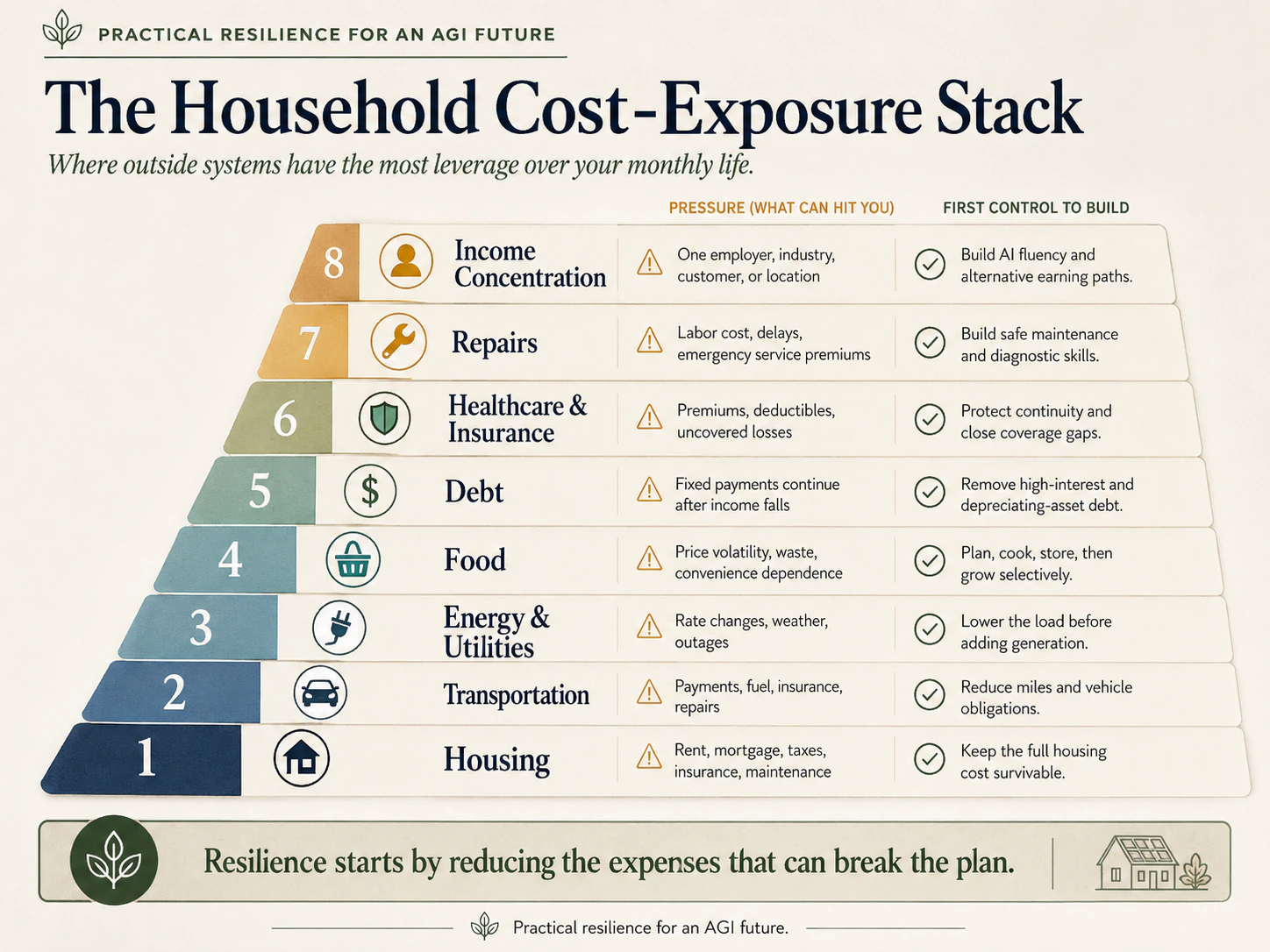
The stack is useful because it prevents a common mistake: buying a visible resilience product while ignoring a larger recurring cost. A battery does not fix an unaffordable mortgage. A garden does not offset two large car payments. Solar does not improve resilience if its financing makes monthly cash flow worse.
What Realistic Self-Sufficiency Looks Like
For most U.S. families, full off-grid independence is neither realistic nor efficient. Modern households benefit from public utilities, professional trades, healthcare systems, food distribution, financial institutions, and local infrastructure.
Realistic self-sufficiency is partial by design. It can mean:
- using less energy and water;
- needing fewer vehicle miles;
- keeping fewer required monthly payments;
- cooking most routine meals at home;
- maintaining a rotating pantry and freezer;
- growing a small amount of high-value food;
- handling safe, basic maintenance;
- keeping emergency cash;
- knowing which professionals to call before a crisis;
- having neighbors, family, and local services you can rely on.
It usually does not mean growing every calorie, disconnecting from the grid, buying specialized gear, keeping livestock for theoretical savings, or attempting dangerous repairs.
The most resilient household is not the one with the most gear. It is the one with the lowest fixed burn rate and the most options.
Self-Sufficiency vs. Resilience
Self-sufficiency means the household can produce, repair, store, or substitute some essentials. Resilience means the household can keep functioning when an external system becomes expensive, unreliable, or unavailable.
The overlap is the goal:
- lower required monthly spending;
- fewer single points of failure;
- more time to make decisions;
- more ways to substitute when prices spike;
- less dependence on perfect income continuity.
The objective is not isolation. It is optionality.
Efficiency First, Production Second
The highest-return resilience move is usually reducing demand before producing your own supply.
| Order | Action | Why it comes first |
|---|---|---|
| 1 | Measure the current cost | You cannot improve a system you have not baselined |
| 2 | Use less | Efficiency is often cheaper than new equipment |
| 3 | Remove fixed obligations | Lower required cash flow helps immediately |
| 4 | Produce selected essentials | Target the categories with good local economics |
| 5 | Store strategically | Inventory creates time, but excess creates waste |
| 6 | Build skills and local options | Capability reduces urgent paid-service dependence |
| 7 | Add backup capacity | Pay for resilience where interruption has a real cost |
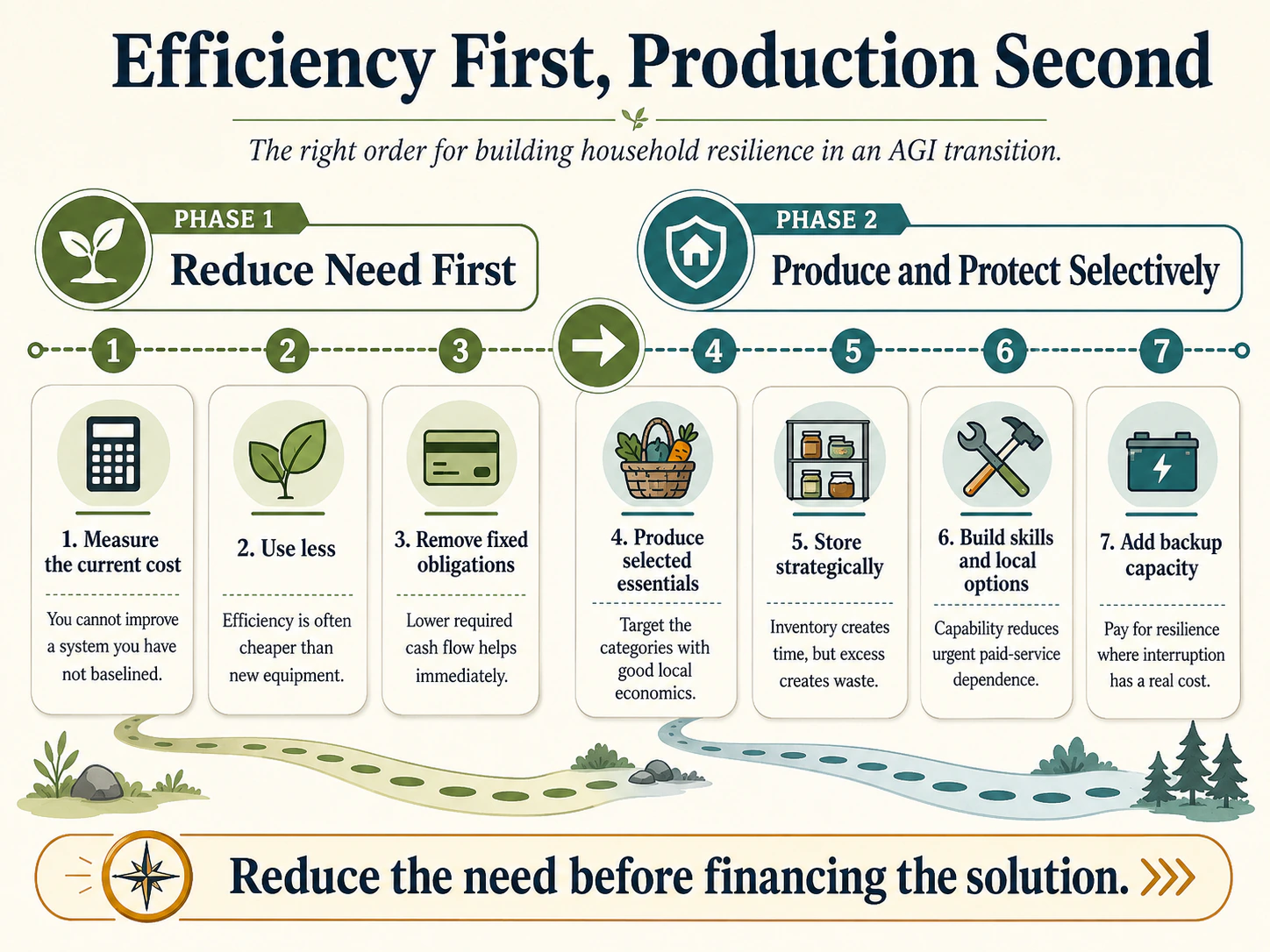
The U.S. Department of Energy makes the same basic point for home energy: reduce electricity loads before buying a renewable-energy system, because a lower load can support a smaller and less expensive system.
The household version is broader: reduce the need before financing the solution.
Transportation Is the First Non-Housing System to Audit
Transportation deserves early attention because it is large, recurring, and connected to other prices. In the 2024 Consumer Expenditure Survey, housing represented 33.4% of average annual spending and transportation represented 17.0%, making transportation the second-largest major category.
A fuel shock does not stop at the pump. It can move through freight, agriculture, delivery, construction, repair services, and the cost of running local businesses. A household with long commutes, two financed vehicles, high insurance, and no alternative way to travel has several exposures tied to the same system.
Use this sequence:
- Reduce required miles. Combine trips, negotiate remote days, move recurring activities closer, use delivery selectively, or change the commute when a job or housing decision already creates an opening.
- Reduce the number of required vehicles. A second vehicle can be useful, but calculate its payment, depreciation, insurance, registration, maintenance, parking, and fuel as one system.
- Keep reliable vehicles longer. Replacing a paid-off vehicle solely to reduce fuel cost often fails the full-cost test.
- Add alternatives. Transit, carpooling, an e-bike, walking, or one flexible vehicle can preserve options even if none replaces every trip.
- Electrify when the math works. Home charging and predictable daily mileage can make an EV or plug-in hybrid useful, but the purchase must reduce total cost rather than only gasoline use.
Worked example: an EV that saves energy but raises household burn
Assume a household drives 12,000 miles per year. Its current paid-off car gets 30 miles per gallon. At an illustrative $4 per gallon, annual fuel cost is about $1,600.
An EV using 0.30 kilowatt-hours per mile at an illustrative home rate of $0.20 per kilowatt-hour would cost about $720 per year to charge. The gross energy savings is roughly $880 per year, before charging losses, rate changes, insurance, registration, tires, charger installation, financing, and depreciation.
The EV saves roughly $880 per year in energy. But if the purchase adds a $500 monthly payment, the household adds $6,000 per year of required cash flow to save less than $1,000 per year in fuel. That is not resilience. It is a larger fixed obligation attached to a more efficient vehicle.
The Department of Energy notes that EVs can have lower fueling and maintenance costs, but also that they often cost more upfront. Use a total-cost comparison, not a gas-price reaction.
Energy Resilience Starts With a Smaller Load
The AGI energy connection is increasingly concrete. The U.S. Energy Information Administration’s June 2026 Short-Term Energy Outlook projects total U.S. electricity consumption rising from 4,195 billion kilowatt-hours in 2025 to 4,271 billion in 2026 and 4,397 billion in 2027. EIA also reports that electricity use by data centers is driving much of the recent demand growth.
That does not mean a new data center automatically raises a particular household’s utility bill. Local prices still depend on regulation, generation mix, grid investment, and utility rate design. But electricity is becoming more economically important. A household that needs less power, can shift flexible use away from peak periods, or can produce some of its own energy has more control during that transition.
Before pricing solar or a battery, pull 12 months of electricity and fuel bills. Note seasonal peaks, rate structure, heating source, water-heating source, and major equipment age.
A home energy assessment can identify where the building leaks energy and which improvements should come first. Common priorities include:
- air sealing and weatherstripping;
- attic insulation where existing levels are inadequate;
- duct and ventilation problems;
- LED lighting and control of always-on loads;
- efficient water fixtures that also reduce water-heating demand;
- thermostat schedules;
- shade and solar-gain control;
- heat-pump water heating or HVAC when replacement is already due.
Do not replace functioning equipment simply because a more efficient product exists. Compare installed cost, expected savings, remaining equipment life, maintenance, comfort, and risk.
Solar: useful production, not automatic independence
Solar can reduce exposure to utility rates and pair well with home EV charging. But the value depends on roof condition, orientation, shading, local electricity prices, export compensation, equipment cost, financing, and how much generation the household uses onsite.
Use NREL’s PVWatts calculator for a first-pass production estimate, then model actual utility rules and contractor proposals.
Grid-tied solar also does not automatically provide outage power. Grid-connected systems include equipment that disconnects during a power failure for safety. Backup operation requires compatible system design, which may include a battery, transfer equipment, a backup panel, or an inverter designed for limited backup loads.
Battery backup: price the interruption, not only the payback
A battery can protect refrigeration, communications, medical equipment, lighting, internet, or limited heating and cooling. That can be valuable even when the pure financial payback is weak.
Separate two questions:
- Will this system reduce the monthly energy bill?
- What is reliable backup worth to this household?
A family that relies on powered medical equipment may value backup differently from a household that can tolerate a short outage. Design around critical loads instead of assuming every circuit must run normally.
Do Not Build the Plan Around Expiring Incentives
Current IRS guidance under Public Law 119-21 ended or limited several federal household energy and vehicle credits after 2025, including clean-vehicle credits and major home-energy credits. Some transition rules may still apply depending on acquisition date, placed-in-service date, and documentation. State, local, utility, and manufacturer programs may also exist. Verify current rules before signing a contract.
The planning lesson is simple: do not build the project economics around an incentive that is uncertain, delayed, or expired.
Decision rule: solar, EVs, and batteries improve resilience when they reduce total household cost or protect a clearly valued critical function. They increase fragility when they add debt, insurance cost, or maintenance complexity without enough benefit.
Food Resilience: Waste Less Before You Grow More
Most households will not grow all their calories, and they do not need to. The realistic objective is to lower grocery waste, preserve buying flexibility, and produce a small share of expensive or perishable food.
Start with waste. The EPA estimates that a household of four spends about $2,913 per year on food that is not eaten. A garden is unlikely to beat that savings opportunity in its first season.
Build the system in this order:
- Plan meals around food already in the refrigerator, freezer, and pantry.
- Keep a visible use-first area for food approaching its limit.
- Freeze ingredients and leftovers before they become waste.
- Maintain a rotating pantry of foods the household already eats.
- Buy bulk quantities only when storage and consumption support it.
- Grow high-value, frequently used crops that fit the local climate.
- Preserve seasonal surplus with tested methods.
Good starter crops often include herbs, greens, tomatoes, peppers, cucumbers, berries, sprouts, and other items that are expensive per pound or lose quality quickly. Potatoes, sweet potatoes, dry beans, and squash can provide more calories, but they require enough space and the right conditions to justify the effort.
Food resilience should reduce stress, not create a second unpaid job. Count time, water, tools, storage, spoilage, and cleanup when deciding whether a garden or preservation habit actually helps.
Composting can turn appropriate food scraps and yard material into a soil amendment. The EPA’s home-composting guidance explains how finished compost can improve soil structure and water retention. It is a soil system, not a substitute for preventing edible food waste.
Preserve food safely
Freezing and dehydrating are accessible entry points. Fermenting, pickling, water-bath canning, and pressure canning require tested recipes and correct equipment.
The National Center for Home Food Preservation should be the default reference. Low-acid foods, including most fresh vegetables, meats, poultry, and seafood, require pressure-canning procedures designed to control botulism risk. Do not improvise processing times, acidity, jar size, pressure, or altitude adjustments.
Water Resilience Is Regional
For most connected households, conservation is more practical than complete water independence.
Start with leaks, fixtures, irrigation, and landscape design:
- repair leaks quickly;
- install WaterSense showerheads, faucets, and toilets when replacement is needed;
- use mulch and drip irrigation;
- group plants by water need;
- reduce ornamental turf where it drives high water use;
- choose climate-appropriate and native plants;
- track outdoor water use separately when possible.
The EPA estimates that an average family can save about 2,700 gallons per year with WaterSense-labeled showerheads, while also reducing water-heating energy.
Rainwater capture can support landscaping where collection is legal and practical. But captured rainwater is not automatically potable. The CDC warns that collected rainwater can contain germs and chemicals and recommends checking local rules, separating it from treated plumbing, and using appropriate testing and treatment for any higher-risk use.
Greywater systems also depend on local plumbing and health codes. Verify rules before installation.
Skills Are the Lowest-Cost Resilience Layer
Basic maintenance skills can prevent a small issue from becoming an emergency service call. They also help a household describe the problem accurately and avoid unnecessary work.
| Area | Useful household capability | Professional boundary |
|---|---|---|
| Home | Caulk, paint, patch small drywall damage, clean gutters safely from the ground where possible | Structural work, roofing, major water intrusion |
| Plumbing | Locate shutoff valves, clear simple traps, repair a toilet flapper | Sewer lines, hidden leaks, major supply work |
| Electrical | Label breakers, reset GFCI outlets, replace batteries and lamps | Panels, new circuits, unknown faults, work requiring permits |
| Vehicle | Check tire pressure, fluids, filters, battery condition, and use a jump pack safely | Brake, steering, high-voltage, or safety-critical repairs beyond competence |
| Food | Meal planning, knife skills, freezing, tested preservation | Unsafe canning experiments |
| Clothing | Sew a button, patch, hem, and repair simple seams | Specialized repairs where replacement damage is likely |
| Technology | Password manager, backups, account recovery, basic device troubleshooting | Security incidents or data recovery beyond your capability |
The rule is not to do everything yourself. It is to know your safe limit, maintain the basics, and have a trusted professional path for the rest.
The Highest-Impact Protections Outside Housing
Once housing is reasonably stable, prioritize the systems that lower required cash flow or preserve decision time.
| Priority | System | What success looks like |
|---|---|---|
| 1 | Transportation | Fewer required miles, reliable vehicles, little or no car debt |
| 2 | Liquidity | Enough accessible cash to avoid forced selling or bad debt |
| 3 | Debt | No high-interest debt and fewer required payments |
| 4 | Food | Low waste, repeatable meals, rotating inventory |
| 5 | Energy efficiency | Lower load, stable comfort, planned equipment replacement |
| 6 | Career adaptability | AI fluency, portable skills, more than one path to income |
| 7 | Healthcare and insurance | Coverage continuity and known deductibles |
| 8 | Repair capability | Preventive maintenance and trusted professional contacts |
| 9 | Selective production | Solar, food, or water systems with sound local economics |
| 10 | Community | People and services that reduce the burden of doing everything alone |
This ranking is not universal. A household with medical equipment may put backup power first. A rural family may require two vehicles. A renter may have limited control over insulation or solar. The method is to identify the largest controllable exposure, not to follow a universal shopping list.
Community is often cheaper than ownership. A tool library, trusted neighbor, local farm share, repair café, family support, shared childcare option, or reliable local trade can reduce dependency more effectively than equipment that sits unused.
Families With Young Children and a Stay-at-Home Parent
For families with young children and a stay-at-home parent, self-sufficiency has a different shape. The stay-at-home parent may already provide work that would otherwise require expensive outside systems: childcare, transportation, food preparation, scheduling, household administration, sick-day coverage, and early-education support. That can be a major resilience advantage.
But the household may also depend heavily on one paid income. That makes liquidity, low fixed costs, insurance, and career adaptability more important.
The goal is not necessarily for the stay-at-home parent to return to work immediately. The goal is to keep the option open. Maintain skills, preserve a professional network, understand backup childcare options, and know how quickly the household could create supplemental income if the primary paycheck became unstable.
For this household type, the priority stack is:
- keep housing and transportation conservative;
- avoid car debt and high fixed payments;
- maintain emergency liquidity;
- protect the working parent’s employability;
- preserve the stay-at-home parent’s income option;
- review term life, disability, health, and renters or homeowners insurance;
- build backup childcare and local support;
- use food, repair, and household systems to lower required cash flow.
The stay-at-home parent is not outside the economy of the household. They are part of the household’s operating system.
The Universal Order of Operations
Before choosing region-specific projects, use the same sequence everywhere:
- Measure the household burn.
- Cut obvious waste.
- Reduce transportation dependence.
- Lower energy and water load.
- Eliminate high-interest and vehicle debt.
- Build pantry, cooking, and food-preservation routines.
- Add selective production: garden, solar, rainwater, or an EV where the full economics work.
- Add backup only for critical functions.
- Build local skills, service relationships, and community options.
The region changes the projects. The sequence does not.
Regional Case Study: Greater Seattle
Seattle is a flexibility problem more than a solar problem.
Greater Seattle combines high housing costs, concentrated professional employment, wet winters, dry summers, and meaningful differences between transit-connected neighborhoods and car-dependent suburbs.
Seattle City Light reports that more than 77% of the power it delivers is generated from carbon-neutral hydroelectricity. That is a regional strength, but it does not eliminate household concerns about outages, winter heating, rate changes, or building efficiency.
Best Seattle priorities:
- Reduce or avoid a long car-dependent commute.
- Use transit, an e-bike, a hybrid, or an EV where the route and charging situation support it.
- Weatherize first: air sealing, insulation, moisture control, and efficient heating.
- Plan backup power around refrigeration, communications, medical needs, and heating-related critical loads.
- Grow cool-season crops and berries suited to the site.
- Use raised beds or drainage improvements where wet soil is a problem.
- Build pantry and freezer routines for winter convenience.
- Evaluate rooftop solar with site-specific production and utility economics rather than regional reputation.
- Avoid concentrating income, employer stock, and housing in the same local technology cycle.
Washington State University Extension identifies many cool-season crops that fit western Washington conditions, including kale, lettuce, peas, carrots, chard, potatoes, brassicas, onions, and spinach. Site drainage, sun, soil, and microclimate still determine results.
Seattle takeaway: flexibility in commute and housing, weatherization, cool-season food production, and modest backup capacity usually come before expensive attempts to go off-grid.
Regional Case Study: San Diego
San Diego is a solar-and-water problem.
San Diego offers strong solar production, mild weather, a long growing season, and favorable conditions for EV operation. It also combines high housing costs, expensive electricity, time-of-use rates, water constraints, and wildfire or insurance exposure in some locations.
Solar and an EV can work well together when the household can charge at home and use a meaningful share of solar production. But the rate plan matters. As of June 2026, current SDG&E residential plans commonly include time-of-use differences and peak periods from 4 p.m. to 9 p.m. California’s Net Billing Tariff generally values exported solar below the retail electricity rate, so self-consumption, charging schedule, and battery dispatch can materially affect the result. Recheck both sources before making a purchase because rate structures change.
Best San Diego priorities:
- Keep the housing payment conservative enough to survive income volatility.
- Model solar, battery, and EV charging together using the actual rate plan.
- Shift flexible electricity use away from peak hours.
- Use drip irrigation, mulch, hydrozoning, and drought-tolerant landscaping.
- Grow high-value food that fits a Mediterranean climate and available water.
- Consider citrus, figs, pomegranates, herbs, tomatoes, peppers, and cool-season greens where the site supports them.
- Reduce food waste before expanding garden infrastructure.
- Review defensible space, evacuation plans, insurance limits, and backup power where wildfire risk is relevant.
- Avoid debt-funded sustainability upgrades unless the full monthly cost improves.
The UC Master Gardeners of San Diego County provide local, research-based gardening and water-wise landscape guidance. Use that local expertise rather than a generic national planting calendar.
San Diego takeaway: turn sunlight and flexible charging into lower exposure, but treat water, rate design, insurance, and financing as part of the same system.
Regional Case Study: Austin
Austin is a heat-and-grid-load problem.
Austin combines strong solar potential and active utility programs with high cooling demand, heat risk, drought exposure, car dependence, and a grid that must serve a growing region.
Austin Energy reported in May 2026 that more than 70% of its power comes from carbon-free resources while electricity demand and reliability needs continue to grow. The household response is not to assume the grid will fail. It is to reduce peak cooling demand and decide which loads truly need backup.
Best Austin priorities:
- Reduce cooling load through air sealing, insulation, shade, efficient HVAC, and thermostat strategy.
- Maintain HVAC before the hottest weather and plan replacement before failure.
- Evaluate solar only after lowering the load.
- Consider battery or generator backup for defined critical circuits, with safe installation and operation.
- Reduce vehicle miles and car debt where possible.
- Use spring and fall gardens, shade cloth, drip irrigation, and heavy mulch.
- Grow heat-tolerant crops such as okra, peppers, southern peas, sweet potatoes, and appropriate herbs.
- Use rainwater primarily for landscape support and follow current local rules.
- Maintain emergency water and heat-response plans.
If using a generator, carbon monoxide, fuel storage, noise, maintenance, and transfer-switch safety matter. CDC guidance says portable generators must remain outside and at least 20 feet from windows, doors, and vents. Backup power should be designed, not improvised.
Austin’s climate office treats extreme heat, flooding, winter storms, aging infrastructure, and rising housing costs as resilience issues. Austin Water currently lists rebates for water-wise landscapes, irrigation upgrades, rainwater harvesting, and some greywater projects, but requirements and funding can change.
Austin takeaway: cooling efficiency is the first resilience asset. Solar, backup power, water conservation, and transportation changes work better after the household has reduced the load they must support.
Seattle vs. San Diego vs. Austin
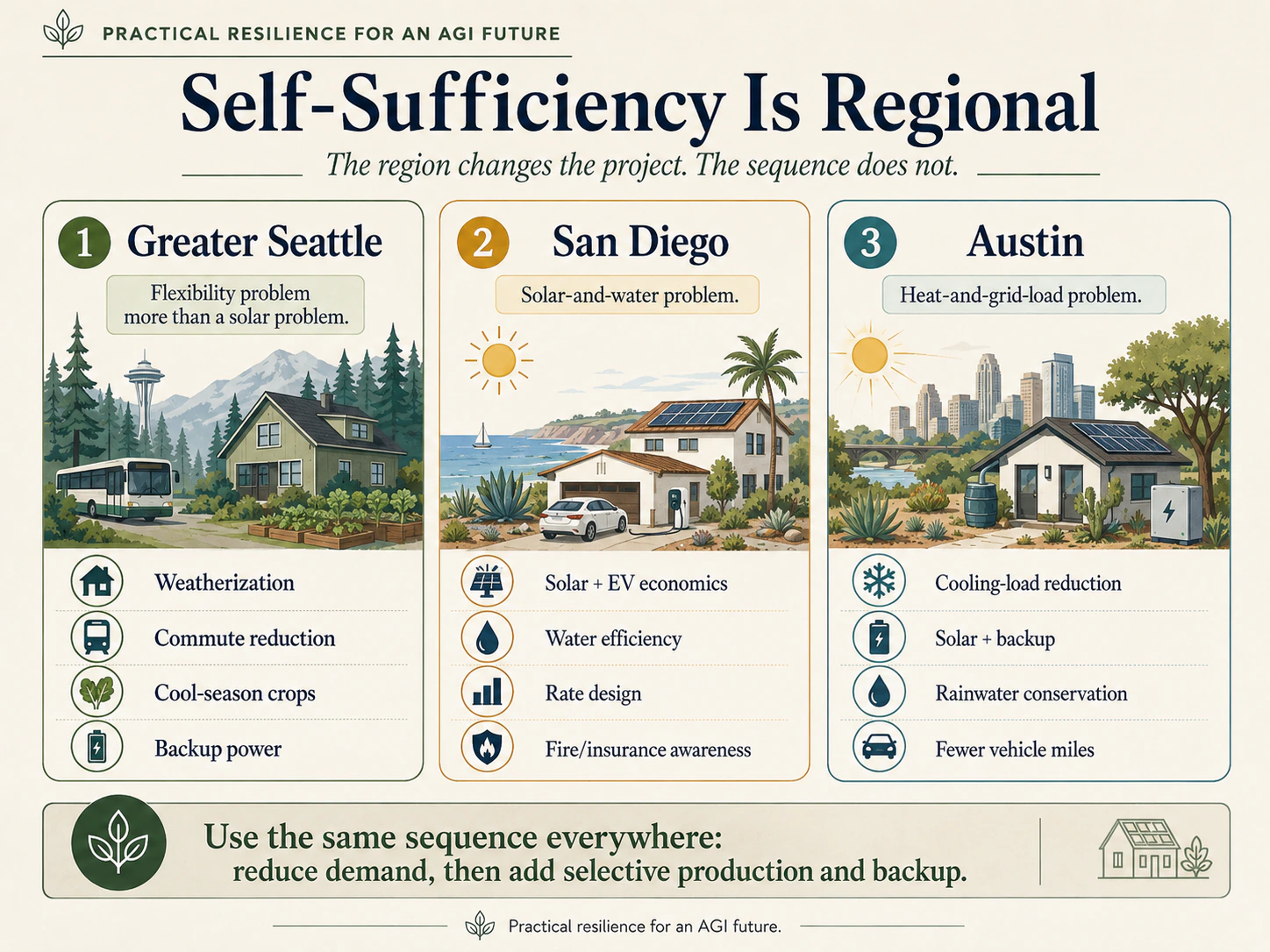
Greater Seattle
- Solar: site-specific
- EV value: useful with home charging and commute fit
- Water constraint: seasonal summer management
- First energy move: weatherization and heating efficiency
- Main caution: high housing plus local income concentration
San Diego
- Solar: strong resource; rate design is critical
- EV value: strong with home charging and rate management
- Water constraint: high
- First energy move: rate optimization and load timing
- Main caution: high fixed costs, water, rates, and insurance
Austin
- Solar: strong resource; reduce cooling load first
- EV value: useful when it replaces fuel use without excessive debt
- Water constraint: high
- First energy move: cooling-load reduction
- Main caution: heat, water, grid peaks, and car dependence
The comparison is not a scorecard. The correct system depends on the property, household, utility, commute, insurance market, and local rules. Even two homes in the same ZIP code can have different solar output, drainage, wildfire exposure, transit access, or repair needs.
If You Rent
Renters may not control the roof, insulation, water systems, landscaping, or major appliances. That does not remove the self-sufficiency strategy. It changes where to focus.
A renter can still build resilience by:
- keeping the rent-to-income ratio conservative;
- choosing a shorter commute when the next lease creates an opening;
- avoiding car debt and using transit, an e-bike, or one-car living where practical;
- maintaining a rotating pantry and cooking routine;
- using container gardens, herbs, sprouts, or microgreens where permitted;
- maintaining renters insurance and knowing the deductible;
- keeping emergency cash and fewer fixed payments;
- tracking utility costs before renewing a lease;
- evaluating the next home for transportation, heat, water, outage, and insurance exposure.
For renters, the strongest self-sufficiency tool is mobility. Do not trade it away casually.
A Practical 12-Month Household Plan
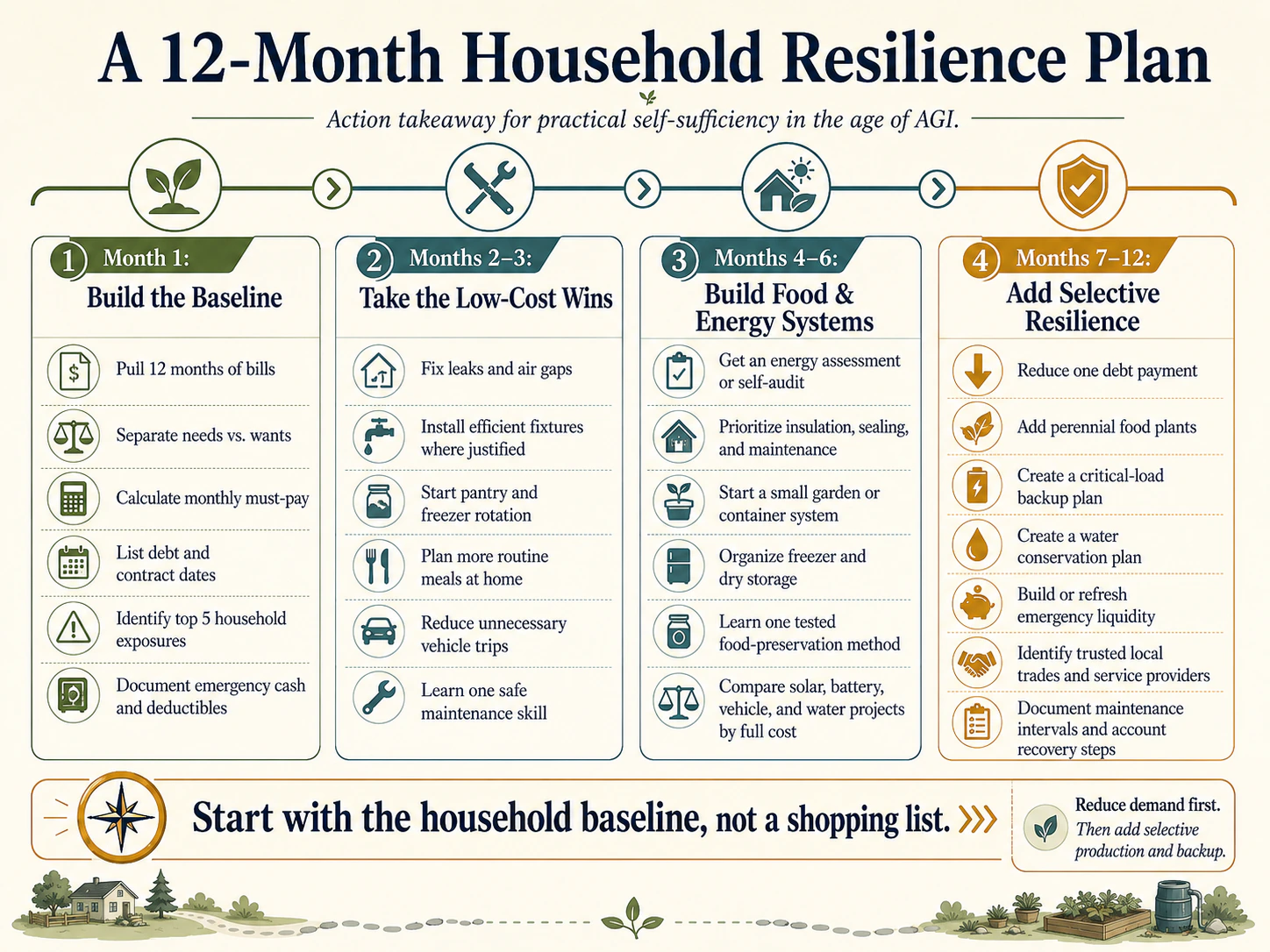
Month 1: Build the baseline
- Pull 12 months of electricity, gas, water, grocery, fuel, vehicle, insurance, and repair costs.
- Separate required spending from optional spending.
- Calculate the household’s monthly must-pay amount.
- List every debt payment and contract end date.
- Identify the five exposures most likely to increase or interrupt daily life.
- Document current emergency cash and insurance deductibles.
Months 2-3: Take the low-cost wins
- Fix leaks and obvious air gaps.
- Install efficient fixtures when replacement is justified.
- Start a refrigerator, freezer, and pantry rotation system.
- Plan more routine meals at home.
- Reduce unnecessary vehicle trips.
- Learn one safe maintenance skill.
- Cancel one recurring cost that does not support the household’s priorities.
Months 4-6: Build food and energy systems
- Get a home energy assessment or complete a structured self-audit.
- Prioritize air sealing, insulation, moisture, and equipment maintenance.
- Start a small regional garden or container system.
- Improve freezer and dry-storage organization before buying more inventory.
- Learn one tested food-preservation method.
- Compare vehicle, solar, battery, and water projects using full installed and operating cost.
Months 7-12: Add selective resilience
- Eliminate or reduce one debt payment.
- Add perennial food plants suited to the site.
- Create a critical-load backup-power plan.
- Create a water plan for conservation, irrigation, and emergency supply.
- Build or refresh emergency liquidity.
- Identify trusted local trades and service providers.
- Document maintenance intervals, shutoffs, warranties, and account recovery steps.
- Review what actually reduced annual household burn before starting the next project.
What Not to Do
- Do not buy production before reducing demand. A smaller load supports a smaller system.
- Do not finance resilience into fragility. Solar, EVs, batteries, gardens, and water systems can all become expensive obligations.
- Do not assume solar provides outage power. Confirm the exact backup design and critical loads.
- Do not buy an expensive EV to save a modest amount on fuel. Compare the entire transportation system.
- Do not grow food your household will not eat. Start with repeat purchases and high-waste items.
- Do not store without rotation. Excess inventory can become clutter and waste.
- Do not use untested canning methods. Follow current, tested food-safety guidance.
- Do not treat captured rainwater as automatically potable. Match water quality to its use and follow local rules.
- Do not DIY hazardous work. Electrical panels, gas lines, structural work, roofing, and major plumbing belong with qualified professionals.
- Do not confuse gear with resilience. Lower fixed costs and liquidity usually create more options than equipment alone.
Final Takeaway: Design a Household That Needs Less
AGI may eventually create abundance. It may also produce an uneven period in which productivity improves before household income, infrastructure, prices, and policy fully adjust.
You do not need to predict that transition perfectly. You need a household that can absorb bad timing.
A resilient household needs less fuel, uses less energy, wastes less food, carries fewer required payments, can produce a small share of useful essentials, handles basic maintenance, protects emergency liquidity, and keeps more than one way to move, work, and respond.
The objective is not independence from every system. It is freedom from any one system having too much power over your monthly life.
The best AGI household plan is not to predict the future perfectly. It is to reduce the number of things that can break your monthly life if the transition gets messy.
Where to Go Next
Start with the household baseline, not a shopping list.
- How to Do an Expense Audit helps identify where cash flow is leaking today.
- The Real Work in FI Is Not the Number. It Is the Control Loop. explains how to keep assumptions visible and correct course.
- AGI and Financial Independence covers income, housing, portfolio, and policy resilience.
- What It Really Costs to Raise a Child in the US applies the same systems approach to family costs.
To test how lower spending, a vehicle change, solar, or a larger cash reserve affects your FI path, use FI Architect for iOS to compare scenarios before committing real money.
Sources and Further Reading
- IMF: AI Will Transform the Global Economy
- The Budget Lab at Yale: Tracking the Impact of AI on the Labor Market
- BLS: Consumer Expenditures, 2024
- U.S. Department of Energy: Home Energy Assessments
- U.S. Department of Energy: Electric Vehicles and Chargers
- U.S. Department of Energy: Grid-Connected Renewable Energy Systems
- U.S. Energy Information Administration: June 2026 Short-Term Energy Outlook
- U.S. Energy Information Administration: Data-Center Power-Demand Growth
- IRS: Public Law 119-21 Clean-Energy Credit Changes
- EPA: Estimating the Cost of Food Waste to American Consumers
- National Center for Home Food Preservation
- EPA WaterSense: Showerheads
- CDC: Collecting Rainwater and Your Health
- Seattle City Light: Power Supply
- WSU Extension: Home Vegetable Gardening in Washington
- SDG&E: Residential Pricing Plans
- California Public Utilities Commission: Net Billing
- UC Master Gardeners of San Diego County
- Austin Energy: Reliable, Clean Energy Future
- City of Austin: Climate Adaptation and Resilience
- Austin Water: Rebates, Tools, and Programs
- CDC: Generator Safety During a Power Outage
This article is educational and is not individualized financial, tax, electrical, plumbing, food-safety, or engineering advice. Verify current incentives, utility tariffs, insurance terms, permits, codes, and safety requirements for your location before making a major purchase or attempting technical work.