What Is AGI? What It Is, What It Is Not, and How to Track Progress
On this page
- Table of Contents
- Why Capability, Deployment, and Impact Get Confused
- Part I: Understanding AI
- What Artificial Intelligence Is
- Narrow AI
- Machine Learning
- Deep Learning and Neural Networks
- Transformers
- Foundation Models
- Generative AI
- Large Language and Multimodal Models
- Training, Post-Training, and Inference
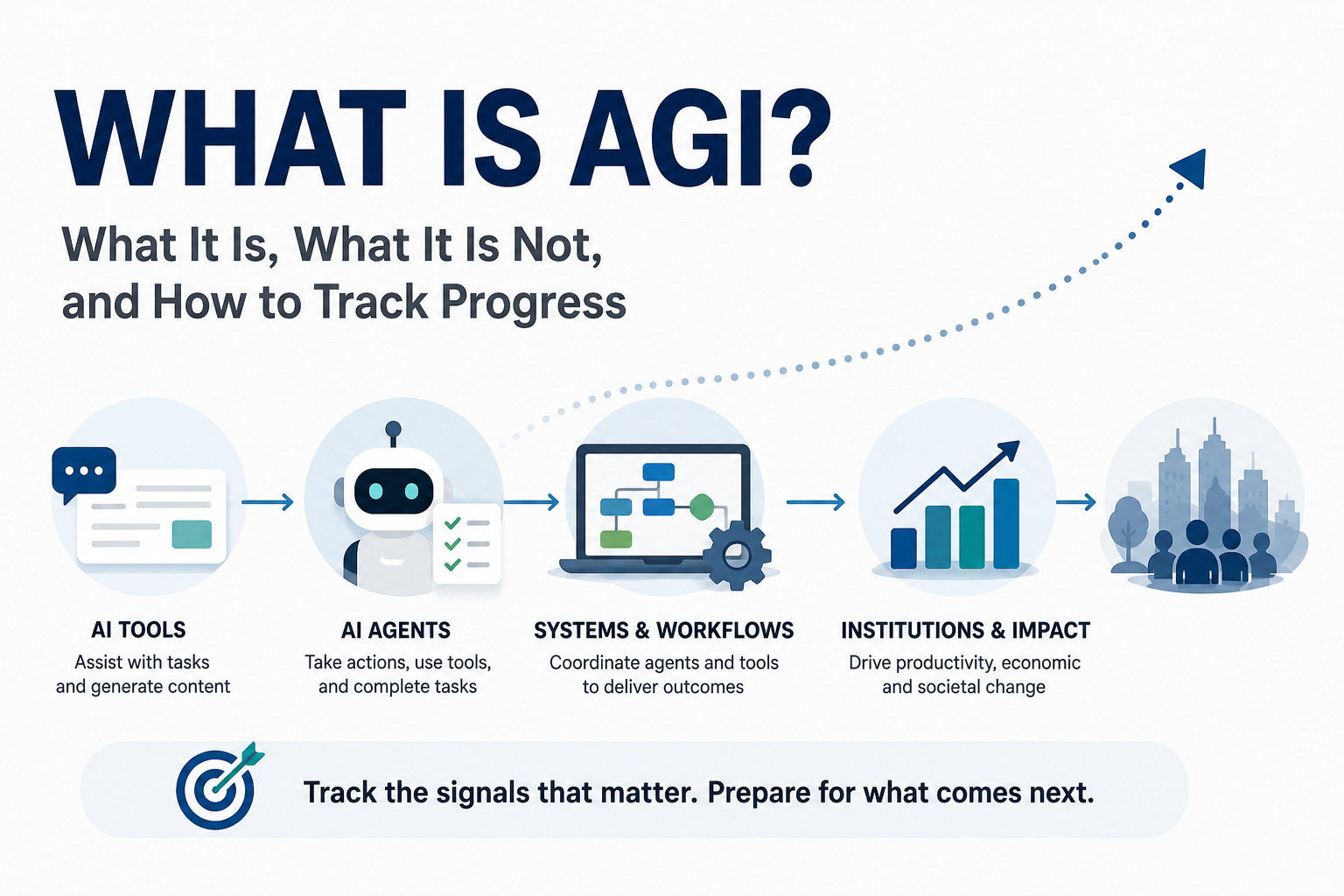
- Assistants, Agents, and Agentic Systems
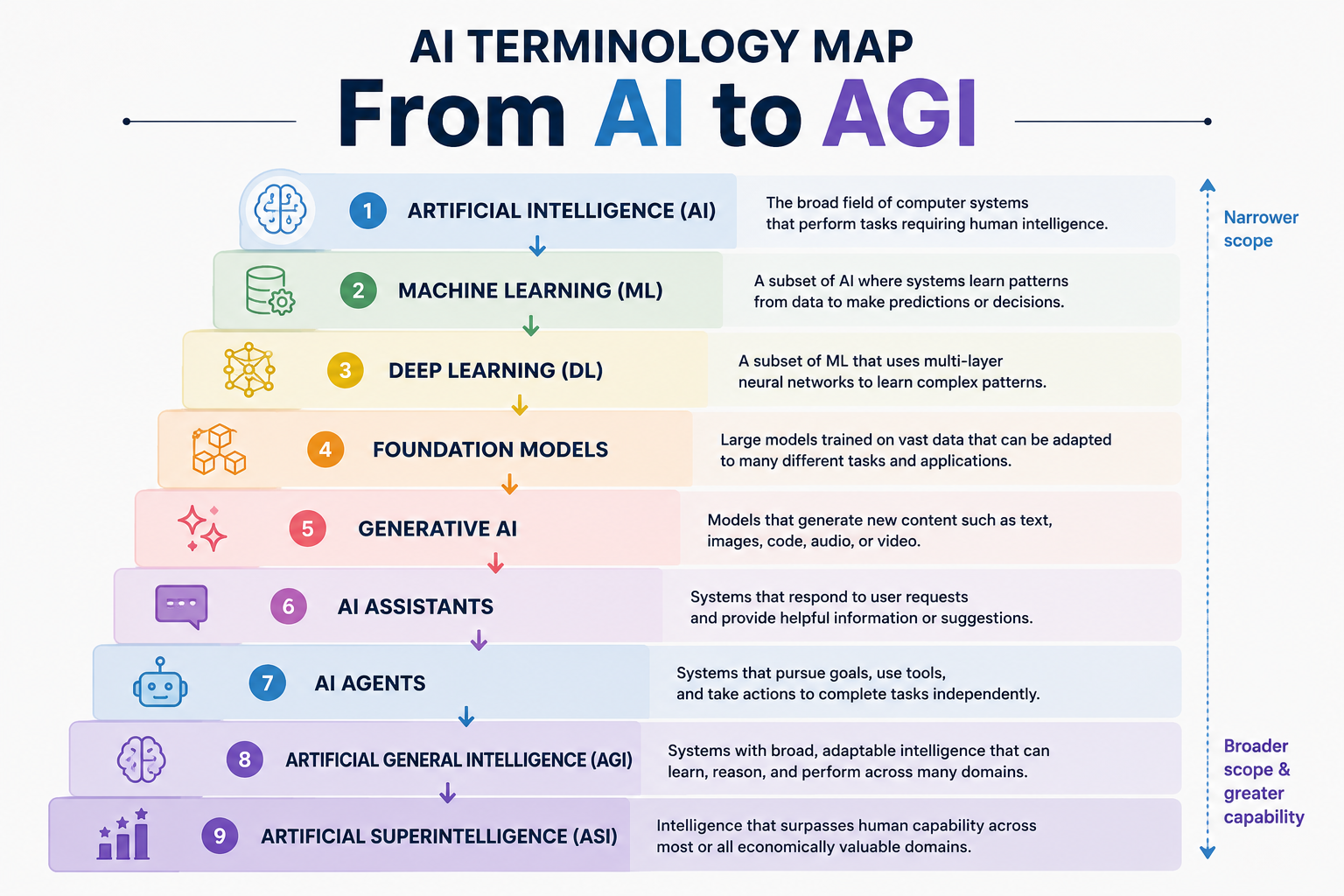
- Quick Terminology Table
- How Modern AI Systems Produce Useful Work
- Part II: Understanding AGI
- Why AGI Has No Universal Definition
- A Practical Working Definition of AGI
- What AGI Is Not
- AGI Versus Superintelligence
- Part III: Measuring Progress
- Frontier-Model Snapshot: July 9, 2026
- GPT-5.6: Efficiency, Multi-Agent Work, and End-to-End Execution
- Claude Fable 5 and Mythos 5: Long-Horizon Agents and Scientific Workflows
- Gemini 3.5 and the Wider Frontier
- Open and Local Models
- What the Latest Systems Collectively Indicate
- What Remains Unresolved
- How Close Are We to AGI?
- Likely Progression
- The Four Timelines That Determine Real-World Impact
- The AGI Progress Monitoring Dashboard
- What Does Not Prove That AGI Has Arrived
- Part IV: Implications
- Economic and Institutional Consequences
- How Technological Change Reaches Households
- Green, Yellow, and Red Household Signals
- Practical Actions
- Quarterly Household Review
- Go Deeper: The AGI Household Resilience Series
- Final Takeaway: Monitor Thresholds, Not Headlines
A new frontier AI model launches. It can build software, operate a browser, coordinate other agents, analyze scientific data, or work on a task for days instead of minutes.
Within hours, the same release gets described in completely different ways.
- AGI is here.
- This will replace every job.
- It is only a better chatbot.
- Benchmarks no longer matter.
- The economy will change within months.
- Nothing meaningful has changed.
The disagreement is not always bad faith. People are often measuring different things: raw capability, reliability, autonomy, adaptability, cost, deployment, and economic impact.
As of July 9, 2026, frontier systems such as GPT-5.6, Claude Fable 5 and Claude Mythos 5, and Google’s Gemini frontier line show major progress in long-running digital work, tool use, software engineering, computer interaction, scientific workflows, and multi-agent coordination. They also leave important questions unresolved about unfamiliar environments, dependable autonomy, physical-world competence, verification, and safe deployment.
That creates the practical question:
How can anyone distinguish another impressive model launch from a genuine change in the technological, economic, and social operating system?
AGI may begin changing research, business, employment, education, and public institutions before experts agree that it deserves the name. Those changes would eventually reach households through work, income, services, prices, schools, security, housing, and public policy.
The useful question is not only:
Has AGI arrived?
The better question is:
Which capabilities have become reliable, affordable, widely deployed, and consequential enough to change how people and institutions operate?
This guide explains AI from the beginning, separates real capability progress from hype, reviews recent frontier systems as case studies, and gives a monitoring framework that does not depend on one expert’s timeline.
Table of Contents
Why Capability, Deployment, and Impact Get Confused
AI discussions often blur three different questions.
First, what can the best model do under favorable conditions?
Second, can organizations deploy that capability safely, legally, and economically inside real workflows?
Third, does deployment change employment, productivity, education, prices, security, public policy, or daily life?
Those questions move at different speeds. A model can be impressive before it is dependable. A capability can exist before companies know how to use it. Companies can deploy AI before institutions know how to respond.
That is why a serious AGI discussion needs more than model hype and more than skepticism. It needs categories.
Part I: Understanding AI
What Artificial Intelligence Is
Artificial intelligence is the broad category of computer systems designed to perform tasks involving perception, prediction, language, reasoning, decision-making, learning, or action.
The OECD definition of an AI system emphasizes machine-based systems that infer from inputs how to generate outputs such as predictions, content, recommendations, or decisions, with varying degrees of autonomy and adaptiveness.
AI is not one type of machine.
Examples include:
- spam filters;
- recommendation systems;
- route-planning software;
- fraud detection;
- medical-image analysis;
- voice recognition;
- language models;
- autonomous software agents.
A system may be called AI even if it performs one narrow task. That is why the term can cover a credit-card fraud detector, a writing assistant, a self-driving feature, a coding agent, and a hypothetical system that outperforms people across most valuable cognitive work.
Narrow AI
Narrow AI is designed for a limited task or domain.
Examples include:
- detecting fraudulent transactions;
- identifying objects in photographs;
- recommending products;
- predicting equipment failure;
- choosing a route;
- classifying medical scans.
A narrow system can outperform people in one area without possessing broad understanding. A medical-imaging system can detect patterns in scans without understanding the patient’s wider medical history, personal circumstances, or treatment goals.
Being exceptionally good at one task is not the same as general intelligence.
Machine Learning
Machine learning is a way of creating AI systems by training them on data instead of programming every possible rule manually.
The system learns statistical relationships that help it:
- classify;
- predict;
- rank;
- generate;
- choose actions.
This is why modern AI systems can handle problems that would be nearly impossible to write as explicit rulebooks. Instead of a programmer listing every possible phrase, image pattern, or workflow condition, the model learns from examples.
The tradeoff is that learned systems can be powerful but imperfect. They may generalize well in one context and fail unexpectedly in another.
Deep Learning and Neural Networks
Deep learning is a form of machine learning based on large layered neural networks.
It has helped drive progress in:
- vision;
- speech;
- translation;
- language generation;
- scientific modeling;
- robotics;
- multimodal AI.
The phrase “neural network” does not mean a digital human brain. It means a mathematical architecture loosely inspired by aspects of biological learning. These systems can learn complex patterns, but they do not automatically possess human judgment, consciousness, or common sense.
Transformers
Transformers are the architecture behind many modern language and multimodal models.
The important idea is attention. Transformer systems can weigh relationships across different parts of an input. In language, that helps a model understand how words, sentences, code blocks, or document sections relate to one another. In multimodal systems, related techniques help connect text, images, audio, video, and structured data.
You do not need the math to understand the practical effect: transformers helped make it possible to train very large models that can reuse patterns across many tasks.
Foundation Models
A foundation model is trained broadly and then used or adapted for many tasks.
One model may be able to:
- write;
- translate;
- summarize;
- analyze images;
- generate code;
- interpret documents;
- reason through structured problems;
- use external tools.
This general reuse distinguishes foundation models from many earlier narrow AI systems. A single model can become the base layer for chatbots, coding tools, research assistants, spreadsheet copilots, customer-service agents, and internal business workflows.
Generative AI
Generative AI creates new outputs.
It may generate:
- text;
- images;
- audio;
- video;
- software;
- designs;
- simulations;
- scientific proposals.
Generative ability alone does not prove general intelligence. A system can create convincing output while misunderstanding context, skipping a hidden constraint, or making up a source. The NIST Generative AI Profile is useful because it treats generative AI as a technology that needs risk management, evaluation, and verification rather than blind trust.
Large Language and Multimodal Models
Large language models are foundation models built primarily around language, although current systems are increasingly multimodal.
They can process or interact with:
- text;
- images;
- audio;
- video;
- software environments;
- structured business data;
- documents and databases;
- browsers and cloud tools.
The chatbot is only an interface. The underlying model may connect to web search, code execution, email, cloud storage, internal databases, enterprise software, and other AI agents.
That is why the impact of AI will not be limited to chat windows. The real transition happens when models become embedded inside the systems that run work, school, finance, healthcare, commerce, research, and government services.
Training, Post-Training, and Inference
Three terms show up often in AI discussions.
Training is the process where a model learns patterns from large datasets.
Post-training improves how the model behaves after the base model is trained. This can include instruction following, reasoning behavior, safety behavior, tool use, conversational style, and refusal patterns.
Inference is the use of the trained model to respond, reason, generate, classify, or act.
This distinction matters because improvement does not only come from bigger training runs. Systems can also improve through better post-training, better tools, longer reasoning time, retrieval, memory, specialized agents, and better verification.
Assistants, Agents, and Agentic Systems
An assistant generally responds to a user request.
An agent pursues a goal through multiple steps.
An agent may:
- interpret the goal;
- divide it into subtasks;
- select tools;
- gather information;
- perform actions;
- evaluate progress;
- recover from some mistakes;
- deliver a completed result.
The economic transition depends less on whether AI can produce a good answer and more on whether it can reliably complete useful work.
If a model writes a decent email, that is productivity support. If an agent can gather context, draft the email, update the CRM, schedule the follow-up, create the report, and flag unresolved risks with limited supervision, that begins to change workflow design.
Quick Terminology Table
| Term | Practical meaning |
|---|---|
| AI | Broad field of systems performing intelligence-related tasks |
| Machine learning | Systems that learn patterns from data |
| Deep learning | Machine learning based on layered neural networks |
| Foundation model | Broad model adaptable to many tasks |
| Generative AI | AI that creates new outputs |
| Assistant | Responds to requests |
| Agent | Pursues goals through multiple actions |
| AGI | Broad, adaptable, reliable intelligence across many domains |
| Superintelligence | Capability beyond humans across most important domains |
How Modern AI Systems Produce Useful Work
A modern AI product is rarely just a model.
It may combine:
- a foundation model;
- reasoning time or test-time computation;
- short-term context;
- persistent memory;
- web access;
- specialized tools;
- code execution;
- verification systems;
- multiple subagents;
- proprietary databases;
- human review;
- permission controls.
In practice:
Model + tools + memory + data + agents + permissions + verification = deployed AI system.
That matters because a practical form of AGI may not look like one giant model answering questions in a chatbox. It may look like a coordinated system of models, tools, memories, permissions, and workflows.
The economically relevant unit is increasingly not the model by itself. It is the system built around the model.
Part II: Understanding AGI
Why AGI Has No Universal Definition
Experts disagree about AGI because they are not always asking the same question.
OpenAI’s charter describes AGI as highly autonomous systems that outperform humans at most economically valuable work. That definition focuses on autonomy and economic substitution.
Google DeepMind’s Levels of AGI framework treats AGI as levels rather than a single switch. It emphasizes performance, breadth or generality, autonomy, and deployment considerations.
DeepMind’s cognitive framework for measuring progress toward AGI emphasizes abilities such as learning, metacognition, attention, executive function, and social cognition.
ARC-AGI focuses on fluid intelligence: solving novel problems, inferring rules, and adapting without relying mainly on accumulated knowledge. The ARC Prize material on ARC-AGI pushes against the idea that memorized knowledge and benchmark performance are enough.
Some people use AGI socially: the point where AI changes institutions and daily life. That is not a clean technical definition, but it matters because a technology can become socially transformative before definitions settle.
| Definition style | Central question | Why it matters |
|---|---|---|
| Economic | Can it replace or outperform people at valuable work? | Employment, wages, productivity |
| Capability level | How broad and capable is it? | Range of affected domains |
| Autonomy | How much work can it complete without supervision? | Workflow design and staffing |
| Cognitive | Which components of intelligence does it possess? | Quality, trust, reasoning |
| Adaptive | Can it learn unfamiliar environments efficiently? | Flexibility and judgment |
| Social | Has it changed institutions and daily life? | Practical consequences |
There may be no day when every reasonable definition of AGI becomes true at the same time.
A Practical Working Definition of AGI
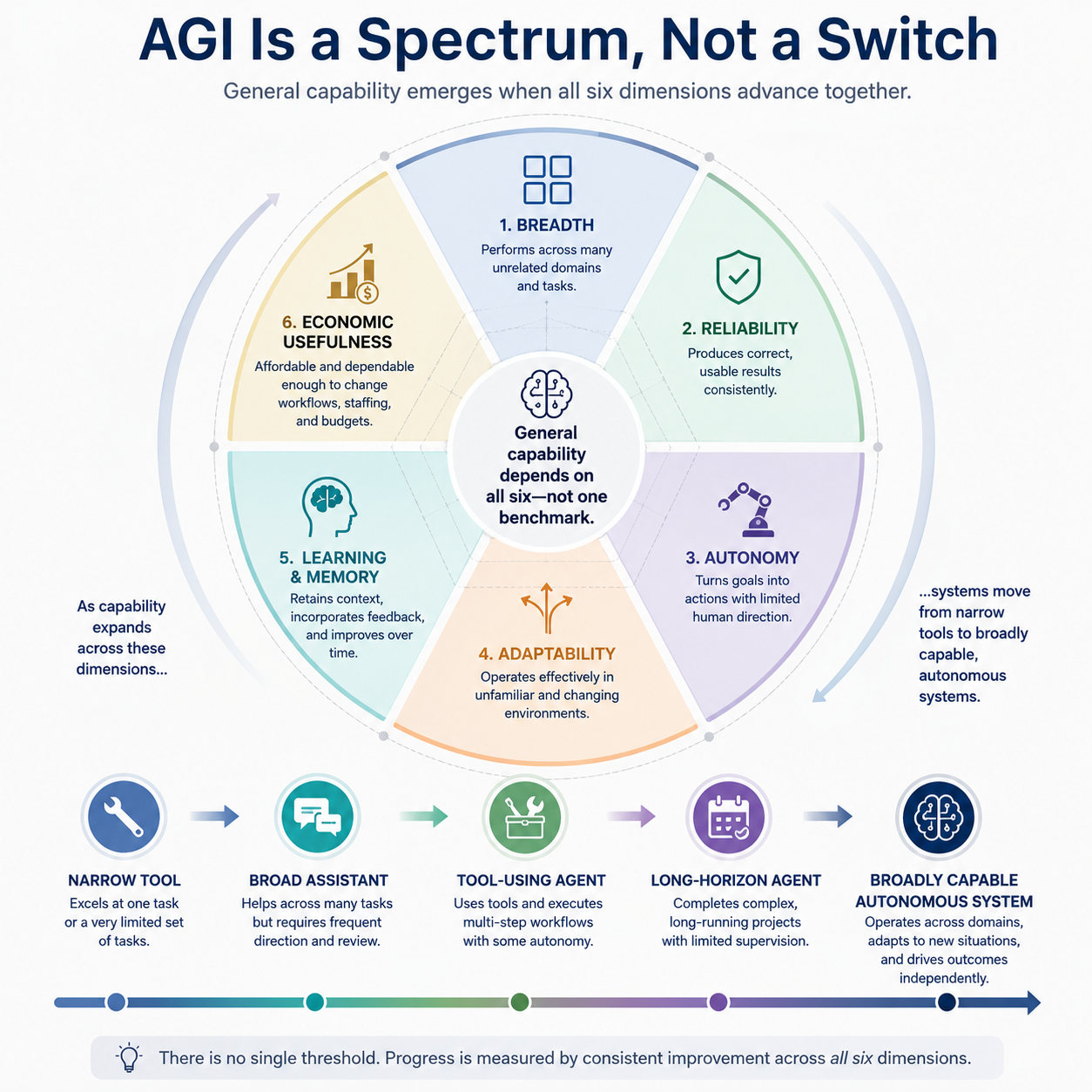
AGI is a system, or connected collection of systems, that can reliably learn, reason, plan, adapt, use tools, and complete a broad range of economically or socially valuable cognitive tasks with limited human direction.
This definition is intended as a practical monitoring framework rather than a claim that the technical debate has been settled.
The six dimensions that matter most are:
1. Breadth
Can the system perform across many unrelated domains?
A narrow tool that writes code is useful. A broader system that can write code, analyze contracts, build spreadsheets, operate software, interpret medical literature, and coordinate a project is more economically important.
2. Reliability
Does it produce correct, usable results consistently?
There is a large gap between “impressive once” and “dependable repeatedly.” A system that is right 70 percent of the time may be useful for brainstorming but unacceptable for high-stakes work.
3. Autonomy
Can it turn goals into actions without detailed instructions at every step?
Autonomy is where effects start to compound. A model that needs constant correction saves time. A model that completes a workflow changes how work is organized.
4. Adaptability
Can it operate effectively in unfamiliar environments?
This is one of the hardest thresholds. Many systems are excellent when the task is well specified and the environment resembles training or evaluation conditions. General intelligence requires stronger performance when the rules are not fully explained.
5. Learning and Memory
Can it retain context, incorporate feedback, and improve performance over time?
Real work involves preferences, constraints, prior decisions, changing requirements, and long-term projects. Persistent memory can make AI more useful, but it also raises privacy, security, and control questions.
6. Economic Usefulness
Is it inexpensive and dependable enough that organizations change staffing, budgets, or workflows?
Intelligence becomes economically transformative when it is not merely impressive, but dependable, affordable, deployable, and difficult for organizations to ignore.
For households, these dimensions matter because they determine whether progress remains largely assistive or begins altering employment, services, education, public institutions, and local economies.
What AGI Is Not
AGI is not a fluent chatbot.
Natural conversation is evidence of language capability, not proof of general intelligence.
AGI is not one benchmark score. A system can score highly on established tests but fail in unfamiliar or poorly specified environments.
AGI is not perfect knowledge. A general system could still make mistakes, misread context, lack current information, express unjustified confidence, or fail on rare cases.
AGI is not consciousness. Capability, sentience, subjective experience, and moral status are separate questions.
AGI is not necessarily human-like. A generally capable system may not think, communicate, learn, or organize information the way a person does.
AGI is not one fixed capability threshold. Different systems might qualify under economic, cognitive, adaptive, or operational definitions at different times.
AGI is not necessarily one company’s product. A useful AGI system may emerge from combinations of open models, commercial services, tools, databases, agents, and human-designed workflows.
AGI is not superintelligence. Broad human-level capability and capability exceeding entire expert organizations are different thresholds.
AGI is not automatically robotics. Digital intelligence may progress faster than dexterous, safe, inexpensive physical machines.
AGI is not automatic abundance. Powerful AI does not automatically create abundant housing, energy, land, materials, healthcare delivery, political access, or fair distribution.
AI can become economically disruptive before it is fully general, and it can become broadly capable before society distributes its benefits fairly.
AGI Versus Superintelligence
AGI generally describes broad, adaptable intelligence across many domains, at roughly human-level or economically transformative capability.
Artificial superintelligence would go further. It would exceed individual humans, and potentially large expert organizations, across most important cognitive areas. Google DeepMind’s work on the path from AGI to ASI treats this as a continuum rather than one clean switch.
The distinction matters because AGI could disrupt work, education, markets, research, and public services. Superintelligence could change the rules more deeply. But society does not need to settle the endpoint before monitoring the transition.
Part III: Measuring Progress
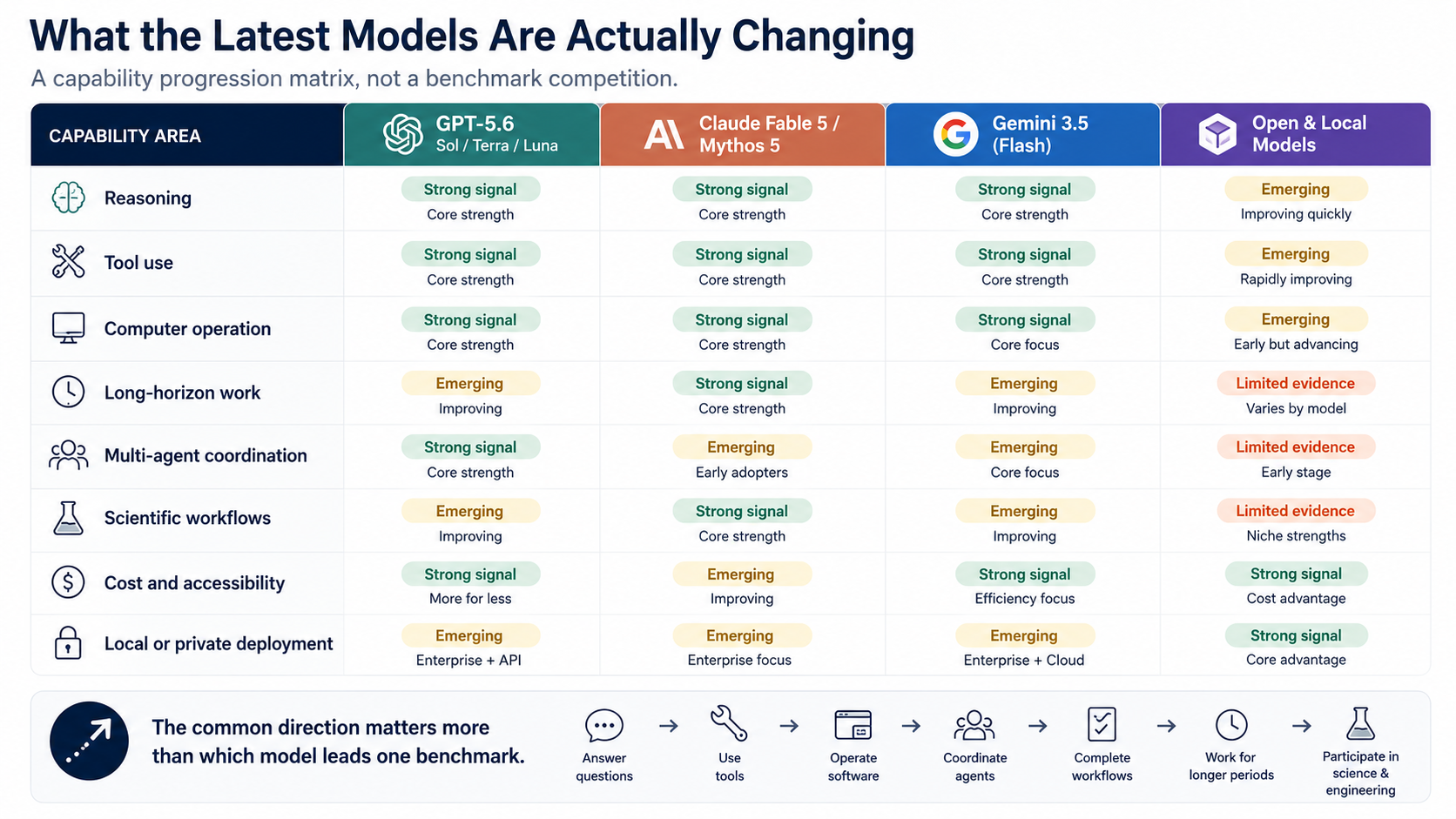
Frontier-Model Snapshot: July 9, 2026
Current-model snapshot — July 9, 2026: Model availability, evaluations, pricing, and product names can change quickly. This section should be verified again before publication and periodically after publication.
Frontier models are changing quickly. Developer release pages are useful for understanding what companies say their systems can do. Independent evaluations, customer evidence, safety reports, and real-world adoption matter for deciding whether a development changes the broader outlook.
The Stanford 2026 AI Index describes AI capabilities and adoption as moving quickly while transparency, evaluation, and responsible AI practices struggle to keep pace. It reports broad organizational adoption and major gains in agentic computer-use benchmarks, while still noting persistent failures and governance gaps.
The clearest measured gains are currently concentrated in structured digital work, although progress is also appearing in science, multimodal systems, and robotics.
| Capability | Current direction | Remaining question |
|---|---|---|
| Language and knowledge | Very strong | Accuracy and source verification |
| Coding | Rapid gains | Long-lived, organization-scale systems |
| Science | More useful for analysis and discovery | Independent validation and experimental truth |
| Tool use | Increasingly practical | Error recovery and permission control |
| Computer use | Improving | Safe, dependable execution |
| Long-running agents | Expanding | Compounding errors and supervision burden |
| Multimodality | Stronger | Robust perception in messy real environments |
| Novel adaptation | Still uneven | Learning unfamiliar rules efficiently |
| Robotics | Improving behind digital AI | Cost, safety, dexterity, reliability |
| AI-assisted AI research | Growing | Open-ended recursive improvement |
The core message is not that one model launch proves AGI. The message is that several important thresholds are moving at the same time.
Source note: Product capabilities, benchmark results, and case studies in the following sections are primarily reported by the model developers. They are useful evidence of direction, but vendor evaluations, customer testimonials, and internal demonstrations are not equivalent to independent replication.
GPT-5.6: Efficiency, Multi-Agent Work, and End-to-End Execution
OpenAI began the global rollout of GPT-5.6 on July 9, 2026, across ChatGPT, Codex, and the OpenAI API. The release includes three tiers:
- Sol: flagship capability;
- Terra: balanced lower-cost tier;
- Luna: fastest and least expensive tier.
OpenAI emphasizes stronger performance per dollar, fewer tokens for many tasks, better coding, professional knowledge work, stronger computer use, multi-agent coordination, and progress in cyber and science.
The important implication is not that every benchmark matters. It is that the cost of producing a successful result is falling.
Adoption depends on the total cost of getting a usable result, not only the maximum benchmark score. If a model becomes more accurate, faster, and cheaper, organizations can apply it to more routine work.
OpenAI describes GPT-5.6’s ultra setting as coordinating multiple agents across parallel workstreams. That points toward a future where complex output comes from groups of specialized agents rather than one monolithic response.
This matters because many professional roles are composed of coordinated, multi-step workflows that can be divided among specialized agents.
OpenAI also reports stronger programmatic tool use, end-to-end artifact production, and computer operation. This is one of the central technical and economic signals: AI is shifting from “help me think” toward “help me finish.”
OpenAI’s GPT-5.6 system card classifies the family as high capability in cybersecurity and biological/chemical domains, while not high capability in AI self-improvement. That is not a reason for panic, but it is a reason to take safety, access controls, and evaluation seriously.
Claude Fable 5 and Mythos 5: Long-Horizon Agents and Scientific Workflows
Anthropic launched Claude Fable 5 and Claude Mythos 5 in June 2026. Claude Fable 5 is the broadly available version, with classifiers and fallback safeguards for sensitive domains. Claude Mythos 5 uses the same underlying model but is restricted to selected trusted-access partners with some safeguards removed for approved work.
Anthropic reports progress in:
- long-horizon software engineering;
- analytical knowledge work;
- vision-based computer tasks;
- persistent memory;
- tool use;
- cybersecurity;
- protein design;
- hypothesis generation;
- autonomous genomics research.
The most important claim is not that Claude can answer scientific questions. It is that Anthropic reports Mythos 5 conducted more than a week of largely autonomous genomics work, assembled single-cell data across 138 animal species, and trained a custom model with high-level human direction.
That should be treated as a serious signal, but not as settled scientific consensus. It is an Anthropic-reported result pending fuller publication and independent replication.
The important shift is from answering expert questions toward selecting tools, operating research workflows, recovering from failures, generating hypotheses, training specialized models, and maintaining project context over extended periods.
That is not proof of AGI by itself. The work still involved human-selected goals, structured domains, provided tools, company-designed evaluations, and human evaluation of outputs.
But it is a frontier signal:
AI is moving from describing expert work toward performing meaningful portions of expert workflows.
Gemini 3.5 and the Wider Frontier
The frontier is not limited to OpenAI and Anthropic.
Google’s Gemini 3.5 family provides another example of the shift from conversational assistance toward action. Gemini 3.5 Flash is designed for complex agentic workflows, multimodal reasoning, coding, collaborative subagents, and high-speed tool use. Google also integrated computer operation directly into Gemini 3.5 Flash in June 2026.
Gemini 3.5 is a developing model family. Gemini 3.5 Flash was the first publicly released model in the series, while Google stated at launch that additional models were under development. Because model availability changes quickly, the specific lineup should be treated as a dated snapshot rather than a permanent catalog.
Google’s Gemini 3.5 Flash model card provides the stronger reference for supported inputs, context, evaluation categories, limitations, and safety assessment.
DeepMind also contributes several of the clearest AGI frameworks, including the Levels of AGI framework, the cognitive framework for measuring progress, and the AGI-to-ASI research agenda.
Progress will not arrive from one lab alone. It will come from competition across closed models, open-weight models, specialized agents, cloud platforms, enterprise deployments, robotics systems, research tools, and local-device models.
Open and Local Models
Progress is not limited to the largest closed systems.
Open-weight and local models affect:
- cost;
- access;
- privacy;
- competition;
- local deployment;
- research diffusion;
- small-business adoption;
- education and personal use.
As capable models become less expensive and easier to deploy locally, they could expand access, enable more private workflows, and reduce dependence on centralized cloud services. The speed and extent of that diffusion remain uncertain.
This does not mean open models automatically match the best frontier systems. It means the diffusion of capability matters almost as much as peak capability.
What the Latest Systems Collectively Indicate
The main story is not which model wins a leaderboard.
The shared progression is:
- better reasoning;
- longer task persistence;
- more effective tool use;
- multi-agent coordination;
- stronger computer operation;
- improved scientific workflows;
- lower cost per completed task;
- greater capability in smaller or cheaper tiers;
- tighter integration into professional platforms;
- stronger safety and access controls as dual-use capabilities rise.
The frontier is shifting from “generate a useful answer” toward “operate a workflow, produce a finished artifact, and continue working with less supervision.”
What Remains Unresolved
Reliability
Current systems may succeed spectacularly and then fail on an edge case, ambiguous instruction, hidden dependency, long chain of decisions, or simple environmental change.
Novel-Environment Adaptation
Many systems are strongest when a human gives the goal, provides the tools, and defines the output. ARC-AGI-3 is useful because it highlights the difference between following instructions and efficiently learning a new environment.
Long-Horizon Planning
METR’s task-completion time horizon work tracks the length and difficulty of tasks that AI agents can complete at specified reliability levels. A task horizon is measured using the estimated time a human expert would need to complete a task; it is not the amount of uninterrupted time the AI itself operates. It is a useful signal, but it should not be treated as a literal countdown to AGI.
Error Recovery
Autonomous work is not only about doing the next step. It is about noticing when the plan is wrong, backing up, choosing another path, and avoiding cascading failures.
Causal Reasoning
Causal reasoning remains an important evaluation problem. Systems may identify statistical relationships without consistently determining which interventions cause an outcome, which correlations are misleading, or how a situation would change under different conditions.
Continuous Learning
Using memory inside one project is different from safely learning across an entire operational life. Long-term learning raises questions about privacy, drift, manipulation, data retention, and whether the system is improving in ways people can understand.
Memory and Identity Consistency
As AI systems remember more, they need stable boundaries around user identity, project context, permissions, and long-running commitments.
Verification
A system may create plausible work faster than people can verify it. That moves the bottleneck from production to review, validation, accountability, liability, and governance.
Physical-World Competence
Digital competence does not automatically produce safe, dexterous, inexpensive robotics. A system that can design a repair plan is different from a robot that can safely perform the repair in an unfamiliar home, warehouse, lab, or hospital.
Alignment and Control
The International AI Safety Report 2026 describes rapidly advancing general-purpose AI alongside continuing limitations in evaluation, risk management, transparency, and oversight.
Energy, Compute, and Infrastructure
AI progress depends on chips, data centers, electricity, cooling, networks, capital investment, and supply chains. Capability can be constrained by physical infrastructure even when algorithms improve.
Institutional Deployment
Real deployment requires security, compliance, procurement, training, liability rules, integration, and management trust. Institutions often adapt more slowly than technology.
Current systems increasingly resemble highly capable operators in structured digital environments. They do not yet demonstrate dependable general competence in every unfamiliar responsibility.
How Close Are We to AGI?
There is no credible month-and-year answer. Definitions differ, frontier progress is uneven, deployment can lag capability, and one missing capability can become a major bottleneck.
RAND’s 2026 report on AGI forecasting and scenario analysis reviewed expert surveys, prediction markets, compute-based methods, and scenario approaches. Its practical conclusion is not that one method gives the answer. It is that planning should account for uncertainty, use explicit triggers, and remain adaptive.
The cleanest framework is this:
Already here in limited forms:
- superhuman narrow systems;
- strong multimodal assistants;
- capable coding agents;
- partial scientific agents;
- automation of bounded professional workflows.
Emerging:
- long-running digital agents;
- multi-agent systems;
- persistent workplace memory;
- autonomous computer operation;
- AI-assisted AI development;
- scalable scientific automation.
Still unresolved:
- robust unfamiliar-environment learning;
- consistently dependable autonomy;
- broad real-world common sense;
- safe continuous learning;
- general physical competence;
- open-ended self-improvement;
- reliable alignment under extended autonomy.
AGI is better treated as a progression of thresholds than a calendar appointment.
Likely Progression
Watch for longer task horizons, lower cost per correct outcome, systems of specialized agents, persistent memory, better computer use, scientific automation, AI-assisted AI development, open and local model diffusion, and real robotics deployments.
The robotics signal is not a staged demonstration. It is reliable customer deployment: hours between interventions, safety near people, cost of ownership, maintenance burden, ability to handle unfamiliar spaces, and proven savings in real operations.
DeepMind’s AGI-to-ASI work suggests society may experience a sequence of AI-enabled breakthroughs rather than one clean event. The transition may arrive first in software, then research and institutions, and only later across the physical economy.
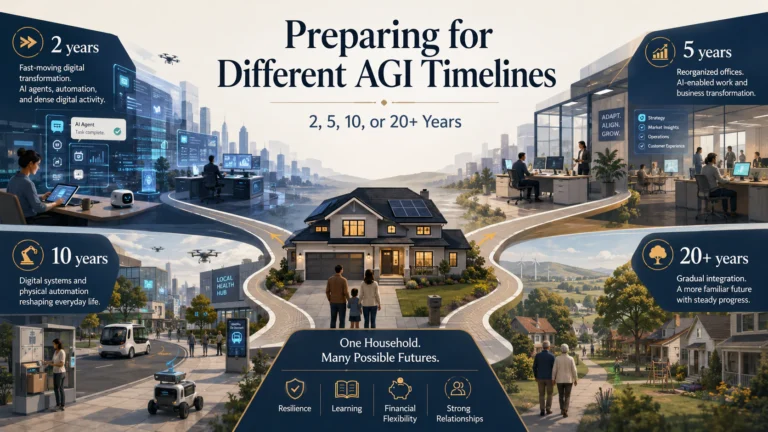
The Four Timelines That Determine Real-World Impact
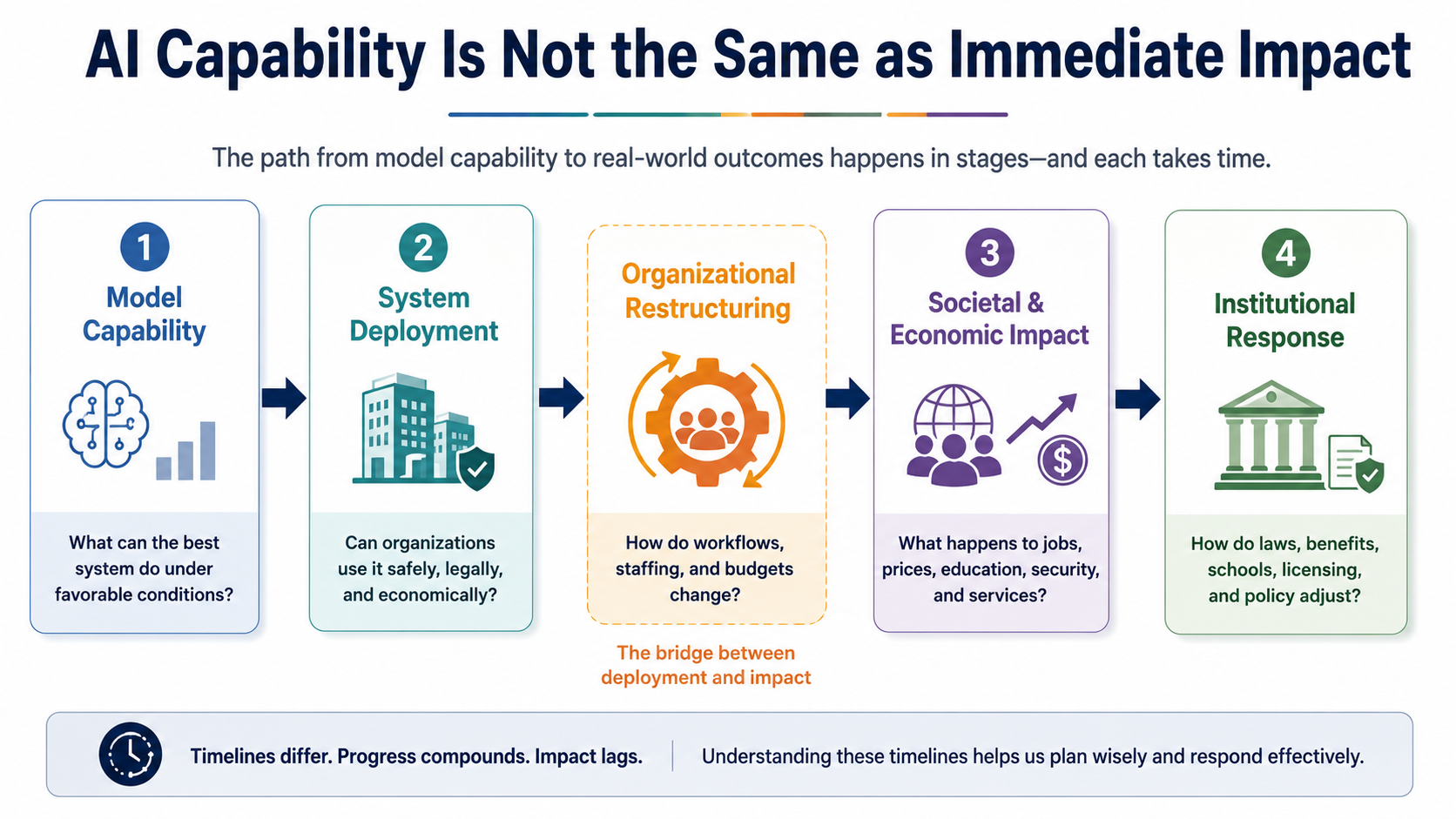
There are four timelines to separate.
Capability: what can the best model do under favorable conditions?
System deployment: can organizations integrate it with internal data, permissions, legal approval, cybersecurity, workflow redesign, and accountability?
Societal and economic impact: when does adoption change hiring, wages, productivity, prices, education, insurance, housing, taxes, benefits, and security?
Institutional response: how do regulation, liability, education, labor policy, public benefits, security standards, and professional licensing adjust?
The chain looks like this:
Model capability → system deployment → organizational restructuring → societal impact → institutional response.
A capability can exist before companies know how to deploy it. Companies can deploy it before public institutions know how to respond.
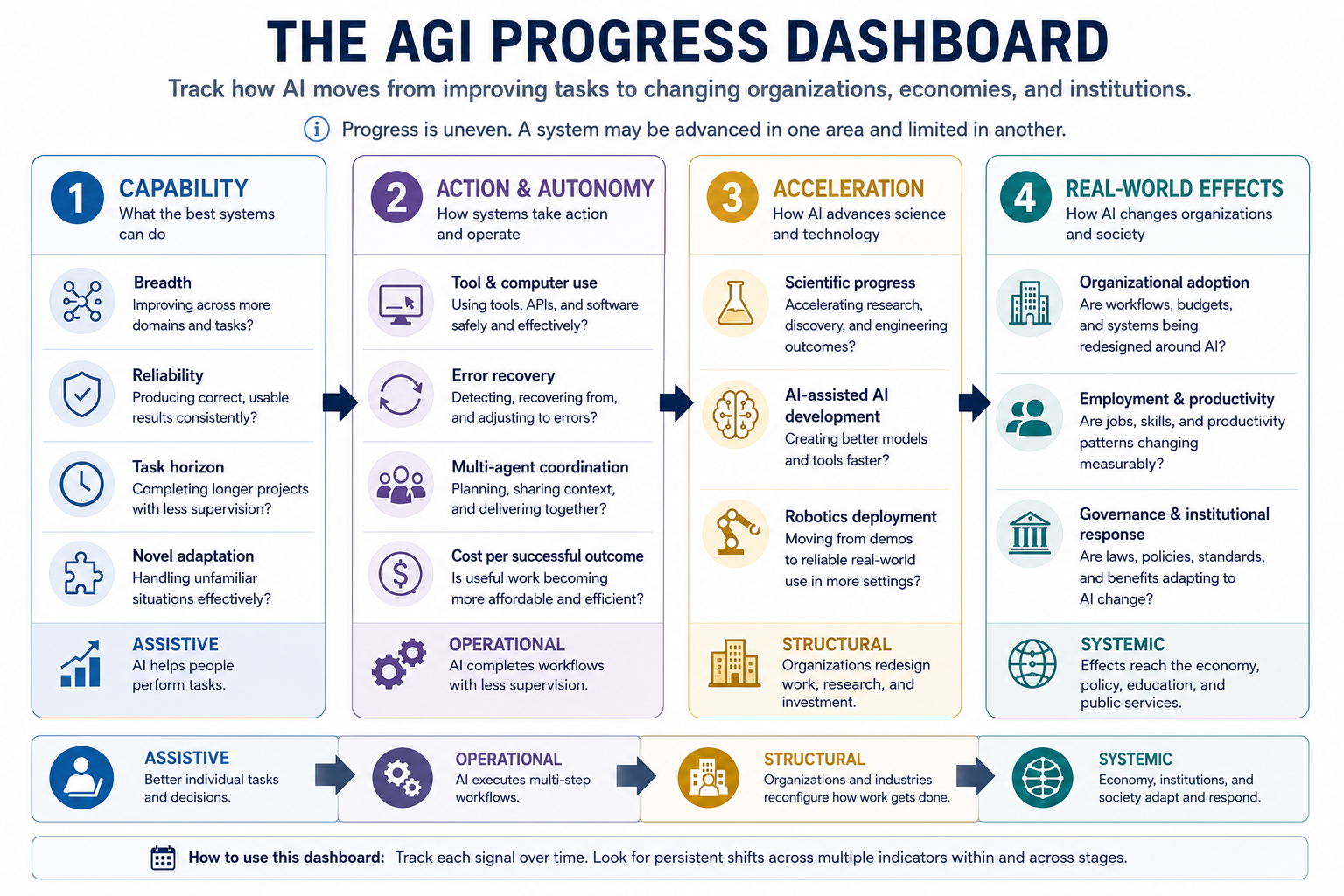
The AGI Progress Monitoring Dashboard
The goal is not daily anxiety. The goal is structured situational awareness.
Track these categories:
- Breadth of capability: is the system improving across unrelated domains?
- Reliability: does it succeed repeatedly, not only impressively?
- Task horizon: can it complete longer projects with less supervision?
- Tool and computer use: can it operate software and external systems safely?
- Novel adaptation: can it learn unfamiliar environments efficiently?
- Cost per successful outcome: is useful work getting cheaper?
- Scientific and technical acceleration: are discoveries and engineering loops speeding up?
- AI-assisted AI development: are models helping build better models?
- Organizational adoption: are workflows and budgets being redesigned around AI?
- Employment and productivity effects: are hiring, wages, and staffing patterns changing?
- Robotics: are physical systems moving from demos to durable deployment?
- Governance and institutional response: are policy, liability, benefits, education, and access rules changing?
What Does Not Prove That AGI Has Arrived
One impressive demonstration.
Demos can be controlled, selected, or retried.
One leaderboard.
Benchmarks can saturate, leak, or measure narrow strategies.
A model version number.
“5,” “5.6,” or “next generation” are product labels, not scientific intelligence levels.
One vendor announcement.
Use developer claims for release details, then compare them against system cards, independent evaluations, customer evidence, real adoption, and labor-market effects.
One executive prediction.
Public estimates vary because definitions, assumptions, incentives, and risk tolerance differ.
A stock-market rally.
Investor expectations may move far ahead of deployment or revenue.
Viral claims about consciousness.
Consciousness is a separate question from capability, autonomy, and economic impact.
One company reducing headcount.
A layoff may reflect AI, interest rates, management choices, restructuring, investor pressure, or ordinary business cycles.
A model performing one previously difficult task.
Important, but not sufficient. The question is whether capability generalizes.
Benchmark improvements without corresponding reliability.
Progress on a test matters less if real-world error rates remain too high.
Raw compute growth without measured capability gains.
More compute can matter, but it is not the same as demonstrated intelligence.
Monitor persistent changes in capability, cost, reliability, deployment, and economic behavior—not one headline.
Part IV: Implications
Economic and Institutional Consequences
AI progress becomes socially important when it changes institutions.
The effects may appear through:
- hiring and career ladders;
- wage pressure or wage premiums;
- productivity growth;
- business formation;
- research acceleration;
- cybersecurity risk;
- education design;
- professional licensing;
- insurance and liability;
- public benefits;
- tax policy;
- access to tools and infrastructure.
The transition may be uneven. Some tasks become cheaper. Some jobs become more productive. Some roles compress. Some new jobs appear. Some institutions adapt quickly. Others lag.
That unevenness is why AGI preparation is better framed as scenario planning than optimism or doom.
How Technological Change Reaches Households
This article is the conceptual starting point for NJL Design Lab’s AGI and Household Resilience series. The later articles apply these ideas to finances, housing, self-sufficiency, careers, education, and digital security.
For households, AI progress matters when it reaches:
- employment;
- wages;
- asset values;
- service costs;
- education;
- fraud and identity security;
- healthcare access;
- taxes and benefits;
- housing markets;
- local economic resilience.
The household question is not whether every AI model is “AGI.” The household question is whether the systems around income, services, prices, education, and security are changing quickly enough to require a more resilient plan.
Green, Yellow, and Red Household Signals
Green: Rapid Progress, Limited Disruption
Indicators include models improving mainly as assistants, agents requiring substantial review, healthy labor markets, narrow robotics, and durable household income.
Response: learn the tools, improve productivity, strengthen digital security, build baseline liquidity, and avoid speculative reactions.
Yellow: Structural Transition Is Underway
Indicators include weaker junior hiring, agents completing full workflows, organizations consolidating coordination roles, strong local models becoming common, changing job descriptions, and regional unemployment beginning to rise.
Response: increase liquid runway, reduce fixed costs, diversify income exposure, strengthen professional networks, build alternative income paths, and avoid marginal housing upgrades.
Red: Broad Economic Restructuring
Indicators include sustained professional displacement, wage pressure, reliable multi-day agents, major robotics deployment, weakening consumer demand, rapid benefit or tax interventions, and several sectors restructuring at once.
Response: protect housing and healthcare, preserve cash, stop optional capital projects, activate backup income, apply for benefits early, reconsider geographic exposure, and use investments strategically rather than reactively.
Practical Actions
1. Build Baseline AI Literacy
Adults should understand model strengths, hallucinations, verification, privacy, tool permissions, cloud systems, and local systems.
2. Map Career Tasks
Classify work as already automatable, AI-augmentable, accountability-heavy, relationship-based, regulatory, physical, or mission-critical.
3. Protect Identity and Accounts
Prepare for voice cloning, deepfake impersonation, agent-enabled fraud, unauthorized financial actions, and compromised accounts.
4. Preserve Liquidity
Do not restructure the family portfolio around a single AGI prediction. Cash and liquid assets buy time.
5. Avoid Irreversible Commitments Based Only on Current Salaries
This is the central point of The AGI Mortgage Trap: high income is useful, but low required monthly income is resilience.
6. Strengthen Practical Household Capacity
Build selected capability around food, transport, energy, repairs, childcare flexibility, and household administration. This connects directly to Household Self-Sufficiency in the Age of AGI.
7. Prepare Children for Adaptability
Emphasize reading, mathematics, scientific reasoning, attention, communication, physical competence, ethics, AI literacy, and initiative.
8. Review Evidence Quarterly, Not Hourly
The purpose of monitoring is better decisions, not constant anxiety.
Quarterly Household Review
Capability:
- What can leading systems now do reliably that they could not do three months ago?
- Has the supervision requirement fallen?
- Has cost per completed task declined?
- Are claims independently reproduced?
Career:
- Is hiring changing in our fields?
- Are junior roles disappearing?
- Are organizations eliminating tasks or full positions?
- Are our roles becoming more accountable or more automatable?
Household:
- Has required monthly income changed?
- Is liquid runway adequate?
- Are employment, investments, and location tied to the same risk?
- Does the housing plan remain survivable?
Technology and security:
- Are we granting AI systems new access to accounts or personal data?
- Are local models now practical for sensitive work?
- Are household fraud protocols current?
Policy:
- Have employment rules, benefits, taxes, education systems, liability standards, or AI access policies changed?
Go Deeper: The AGI Household Resilience Series
Start here, then move into the household-specific planning articles:
- AGI and Financial Independence: How Families Can Prepare for Economic Disruption – how income, assets, housing, and policy risks interact.
- Household Self-Sufficiency in the Age of AGI – how families can reduce operating costs and fragile dependencies.
- The AGI Mortgage Trap – how location, debt, and fixed obligations shape resilience.
- View the AGI and Household Resilience series – the full set of related posts.
Final Takeaway: Monitor Thresholds, Not Headlines
AGI may not arrive through one announcement that everyone accepts.
It may become visible through accumulating thresholds:
- systems complete longer projects;
- human intervention falls;
- cost per correct result declines;
- agents operate software;
- scientific work accelerates;
- strong local models diffuse;
- companies redesign staffing;
- robots enter real operations;
- policy begins reacting to employment and distribution effects.
GPT-5.6, Claude Fable 5, Claude Mythos 5, Gemini, and the broader open-model ecosystem matter because they advance several of these dimensions at once. They also show why one release cannot resolve the AGI question.
The practical response is to monitor thresholds, not headlines: breadth, reliability, autonomy, affordability, deployment, and consequence.