The AGI Career Transition Playbook: How to Protect Income Without Trying to Outrun AI
On this page
- Start With Tasks, Not Job Titles
- Build a personal task inventory
- The Three-Category Task Test
- 1. Automatable tasks
- 2. Augmentable tasks
- 3. Accountable tasks
- Use a simple scoring method
- Move Toward Durable Outcomes
- Use AI to Reach Decisions, Not Produce More Administration
- Build a Second Income Path Before You Need It
- Four Practical Paths
- AI lowers your costs, and everyone else’s
- Federal Employment, Contracting, or Private Industry?
- What to Do After a Layoff
- The First 30 Days: Stabilize
- The First 90 Days: Reposition
- The First 365 Days: Build a More Resilient Career System
- Maintain Professional Identity During Transition
- A Practical Career-Resilience Checklist
- Final Takeaway
- Continue the AGI Household Resilience Series
- Sources and Tools
No one can outrun a tool that gets faster every quarter. But almost anyone can build a career that does not depend on winning that race.
The wrong career question is:
Which job is completely safe from AI?
Almost no knowledge-work occupation can be evaluated that simply. A job is not one thing. It is a bundle of tasks, relationships, responsibilities, permissions, and outcomes. AI may automate part of a role, increase the output of another part, and make the remaining human judgment more valuable, all at the same time, inside the same job title.
The International Labour Organization’s 2025 analysis of generative AI and jobs estimates that roughly one in four jobs worldwide has some degree of exposure to generative AI. Its central conclusion is not that a quarter of all jobs will disappear. Transformation is more likely than elimination, with clerical occupations remaining the most exposed and exposure rising in highly digitized professional and technical work.
That distinction matters more than the headline number. A successful AI career transition starts by examining the work you actually perform, not by searching for a permanently safe job title. Career resilience does not mean trying to become faster than every model. It means understanding which parts of your work are becoming cheaper, which parts are becoming more valuable, and repositioning yourself before a transition becomes an emergency.
This playbook focuses on eight practical moves:
- Map tasks instead of relying on job titles.
- Separate automatable, augmentable, and accountable work.
- Move closer to durable organizational outcomes.
- Use AI to increase output without becoming a replaceable coordinator.
- Build a second path to income.
- Compare federal, contracting, private-sector, and entrepreneurial options.
- Prepare a 30-, 90-, and 365-day response to job loss.
- Maintain professional identity and relationships during a transition.
This article is part of the AGI and Household Resilience series. Earlier pieces looked at the household balance sheet, household operating costs, and the mortgage decision. This one looks at the income side, the engine the rest of the system depends on.
Start With Tasks, Not Job Titles
A title such as program manager, analyst, scientist, attorney, designer, or operations specialist does not reveal how exposed a person’s actual work may be.
Two people with the same title can perform very different work. One analyst spends most of the week collecting information, formatting slides, summarizing documents, and coordinating approvals. Another interprets ambiguous evidence, defends a recommendation to leadership, negotiates tradeoffs, and remains accountable when the decision produces a poor result.
The title is the same. The task exposure is not.
This is why “is my job safe?” produces so much anxiety and so little planning. The question cannot be answered at the title level. It can be answered at the task level, and the task level is something you can actually see, measure, and change.
The U.S. Department of Labor’s O*NET OnLine database lets you examine occupation-specific tasks and search for related careers based on job duties rather than titles. The Department of Labor’s CareerOneStop Skills Matcher can also help identify transferable skills instead of forcing every search through the lens of your current title.
Build a personal task inventory
List the recurring work you actually performed during the last month.
Do not write categories like “project management,” “compliance,” or “research.” Categories hide the exposure. Write specific activities:
- gather status updates from six teams;
- reconcile two reports;
- draft an executive summary;
- interpret a regulation;
- interview a customer;
- approve a technical exception;
- troubleshoot equipment;
- present a recommendation;
- negotiate a deadline;
- certify that a process meets requirements.
Aim for at least 20 tasks. If you cannot get to 20, you are still writing categories.
The Three-Category Task Test
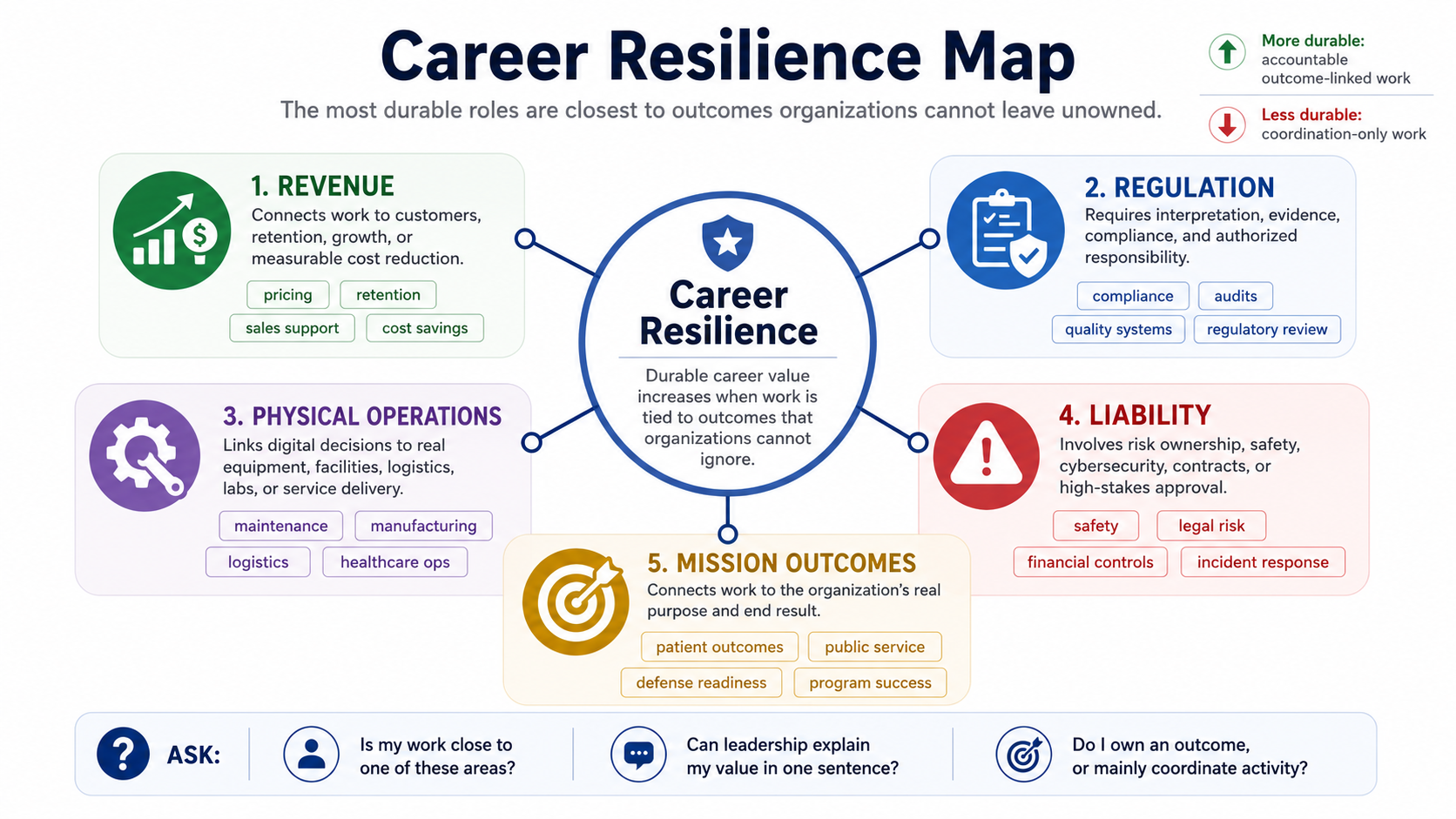
Every task on your inventory falls somewhere across three dimensions: how automatable it is, how augmentable it is, and how much accountability it carries. A single task can score on more than one.
1. Automatable tasks
Tasks that AI or conventional software may complete with little human involvement once the process is configured: routine summarization, first-draft correspondence, data extraction, standard report generation, meeting notes, repetitive code, document comparison, scheduling and administrative follow-up.
Automatable does not mean the task disappears tomorrow. Deployment may be delayed by security requirements, integration cost, regulation, or plain organizational inertia. It does mean the economic value of manually performing the task may decline as the technology becomes cheaper, more reliable, and easier to deploy.
A role built primarily on those tasks therefore deserves closer scrutiny.
2. Augmentable tasks
Tasks where AI can increase speed, range, or quality while a human continues to direct or verify the work: scenario analysis, writing and editing, financial modeling, literature review, software development, design exploration, contract analysis, technical troubleshooting, preparing decision options.
Augmentable tasks cut both ways. They become an advantage if you use AI well, the same person now covers more ground, tests more scenarios, produces cleaner work. They become a risk if the organization concludes that the same total output now requires fewer people. Which way they cut for you depends largely on the third category.
3. Accountable tasks
Tasks where an identifiable person or institution remains responsible for the outcome: approving a safety decision, signing a legal or financial certification, managing a regulated process, communicating a high-stakes recommendation, accepting operational risk, supervising employees, making a clinical judgment, representing an organization to a customer or regulator.
Accountability does not make a role immune to AI. It makes the human contribution easier to defend, because the organization still needs someone to exercise judgment, hold authority, and carry responsibility when the outcome matters.
Use a simple scoring method
For every task on your inventory, record:
Mobile note: Swipe horizontally to view the full table.
| Task | Automatable | Augmentable | Accountable | Evidence of value |
|---|---|---|---|---|
| Draft monthly report | High | High | Low | Saves analyst time |
| Approve risk exception | Low | Medium | High | Carries formal responsibility |
| Customer interview | Medium | High | Medium | Reveals unmet needs |
| Reconcile standard data | High | Medium | Low | Reduces reporting errors |
Then step back and look at the shape of the table. If most of your week sits in high-automatable, low-accountable rows, your professional value is concentrated in exactly the work that is getting cheaper. If most of it sits in augmentable and accountable rows, you have a stronger position and a clearer story to tell.
The goal is not to eliminate every automatable task from your job. Every role carries some. The goal is to prevent your professional value from depending primarily on them.
Move Toward Durable Outcomes
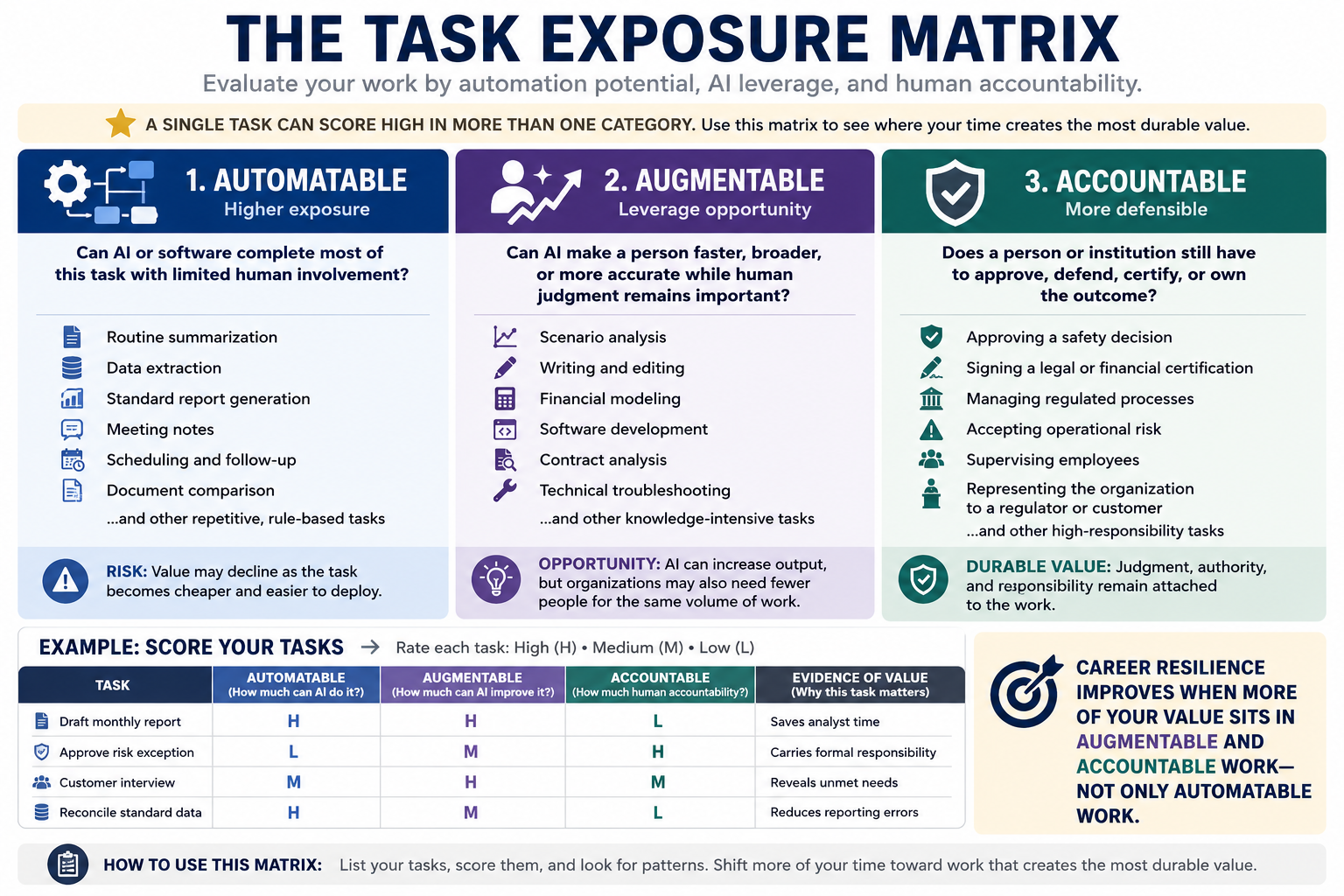
A useful career-resilience heuristic: move closer to areas where organizations cannot tolerate vague ownership. When budgets tighten and workflows are redesigned, roles are generally easier to defend when leadership can explain clearly why the work matters.
Mobile note: Swipe horizontally to view the full table.
| Outcome area | Why it may remain valuable |
|---|---|
| Revenue | Connects work to customers, retention, or measurable cost reduction |
| Regulation | Requires interpretation, evidence, and authorized responsibility |
| Physical operations | Connects digital decisions to real equipment, facilities, or service delivery |
| Liability | Requires risk ownership, approval, and accountability |
| Mission outcomes | Links work to the organization’s actual purpose |
Two notes on this table.
On regulation: AI may review and summarize regulations much faster than a person, but organizations still need qualified people to interpret requirements, evaluate exceptions, and accept responsibility for decisions. The analysis may get faster, while formal accountability often remains with designated people and institutions.
On visibility: proximity to these outcomes only protects you if leadership can see it. Ask yourself, does my work increase revenue, retain customers, reduce a measurable cost, or prevent an expensive failure? And can leadership see that connection without my explaining it? If the answer to the last question is no, the connection may as well not exist.
Use AI to Reach Decisions, Not Produce More Administration
AI can make an employee dramatically more productive. But there is a trap inside that productivity. A person can use AI to schedule more meetings, produce more status reports, route more documents, and summarize more updates, increasing activity without increasing value. If AI makes coordination cheap, becoming an exceptionally efficient coordinator does not protect the role. The organization may eventually restructure the workflow to require less manual coordination.
The objective is different: use AI to move through administrative work so more of your time lands on judgment, decisions, customer insight, technical depth, risk, negotiation, and measurable outcomes.
Instead of:
Use AI to write the weekly report.
Use:
- AI gathers and normalizes status information.
- AI flags inconsistencies and missing evidence.
- You identify the actual decision leadership must make.
- You test the recommendation against operational constraints.
- You present options, consequences, and a recommended course of action.
- You remain responsible for the quality of the decision.
The durable contribution is not the report. It is the judgment the report enables.
The OECD’s research on AI in the workplace has found that many workers using AI report improvements in performance and job quality, while also emphasizing the need for human-centered deployment and adaptation. AI use can be both an advantage and a restructuring pressure. Which one it becomes for you depends on where the reclaimed hours go.
Build a Second Income Path Before You Need It
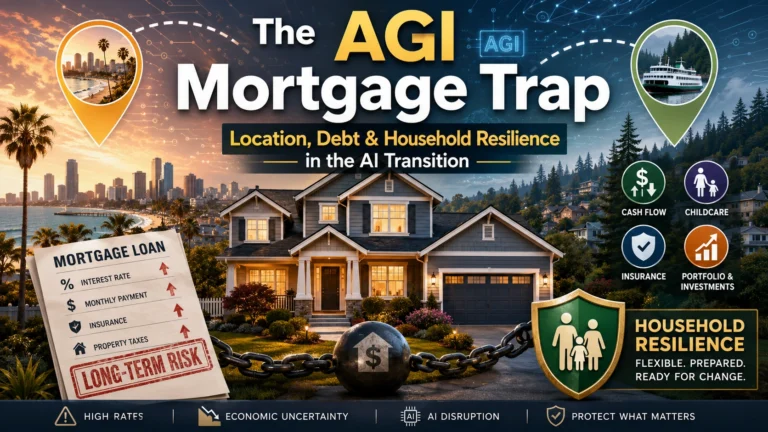
A second income path does not need to replace a salary immediately. Its first purpose is smaller and more important: to prove that you can create value outside your primary employer. That proof changes how you negotiate, how you plan, and how a layoff lands if one arrives. A household with one income source and a fixed mortgage is running the exact concentration risk described in The AGI Mortgage Trap, just on the income side of the ledger.
A useful second-income path should be adjacent to skills you already possess, inexpensive to test, capable of producing an actual customer, maintainable without large fixed costs, and expandable if employment changes. Notice what is not on that list: passive, scalable, or trendy. The first customer matters more than the business model.
Before starting outside work: Review your employment agreement, moonlighting rules, intellectual-property provisions, confidentiality obligations, and conflict-of-interest policies. Keep outside work separate from employer time, equipment, data, accounts, and customers. Federal employees should consult their agency ethics office and review the Standards of Ethical Conduct, because outside employment may require approval or create additional restrictions.
Four Practical Paths
Independent Services
Technical writing, design, analytics, compliance support, process improvement, training, web development, fractional operations. Start with one narrowly defined problem, not a broad consulting identity. “I provide business consulting” requires the customer to figure out what you do. “I help small engineering firms turn internal technical material into customer-ready proposals and training documents” lets one specific customer recognize their own problem in a sentence.
Productized Expertise
Convert repeated work into templates, guides, assessments, calculators, software tools, short courses, or specialized research products. AI has lowered the cost of producing all of these, which means production is no longer the moat. The product still needs a specific buyer and a defensible use case. “Useful to everyone” is another way of saying “urgent for no one.”
Small Digital or Local Business
A durable side business may combine AI with work that remains locally grounded: property services, specialty maintenance, education, professional services, home technology, local logistics. The pattern to look for: AI handles the scheduling, communication, quoting, and paperwork; a human delivers a result that has to happen in a specific place, for a specific customer, to a specific standard.
Government Contracting
Workers with federal, defense, technical, compliance, or mission experience may be able to build services for government customers. SAM.gov Contract Opportunities allows anyone to search active federal opportunities without registering; applying directly as a prime contractor generally requires an active SAM.gov entity registration, and local APEX Accelerators provide no-cost government-contracting guidance, Find an APEX Accelerator. For a new business, subcontracting under an established prime contractor may provide a lower-friction entry point than immediately pursuing a direct federal award.
AI lowers your costs, and everyone else’s
AI can meaningfully reduce the cost of starting and operating a small business: market research, proposals, customer communication, bookkeeping preparation, marketing drafts, internal procedures, software prototypes. The U.S. Small Business Administration’s AI for Small Business resource covers both the uses and the risks, including privacy, security, intellectual property, and accuracy.
But if AI lowered your production costs, it lowered your competitors’ too. Generic content has become inexpensive and easy to produce, and widely available access to general-purpose models is rarely a durable competitive advantage by itself. The defensible layer is usually domain knowledge, customer trust, proprietary workflow, distribution, data, accountability, physical execution, or integration with the customer’s real operations.
Whichever path you choose, resist the urge to build infrastructure first. Do not begin with a complex legal entity, expensive branding, or a full software product. Begin with one test:
Will one real customer pay for this outcome?
Federal Employment, Contracting, or Private Industry?
The following comparison and resources are specific to the United States. Public-sector employment systems differ substantially in other countries.
There is no universally safest sector. Each path concentrates a different risk, and the right choice depends on which risks your household can actually carry.
Mobile note: Swipe horizontally to view the full table.
| Path | Potential strengths | Primary risks | Best fit |
|---|---|---|---|
| Direct federal employment | Mission continuity, formal authority, public-service benefits, regulated processes | Hiring timelines, budget changes, reorganizations, location limits | Workers who value mission, stability, and institutional responsibility |
| Government contracting | Specialized demand, access to mission work, potentially faster hiring | Contract recompetes, customer concentration, funding changes, less control | Specialists comfortable with project and contract risk |
| Private industry | Faster decisions, revenue-linked upside, mobility, equity or bonus potential | Market cycles, layoffs, acquisitions, aggressive automation | Workers who value speed, growth, and commercial outcomes |
| Small business | Control, multiple customers, direct ownership of value | Income volatility, sales responsibility, operational burden | Workers who can solve a defined customer problem independently |
USAJOBS is the official federal career portal. Federal employees facing displacement may qualify for CTAP, ICTAP, or other OPM career-transition assistance depending on their appointment, displacement status, location, and the vacancy involved.
Do not choose based only on salary. A higher salary can be less resilient if it requires high fixed household costs or depends on one employer, one contract, and one narrow market, the same structural issue explored in The AGI Mortgage Trap.
What to Do After a Layoff
Everything above is preparation. This section is response.
A layoff creates financial pressure, but the financial hit is only part of it. It also disrupts routine, identity, confidence, and professional relationships, and those disruptions compound if they are not managed deliberately.
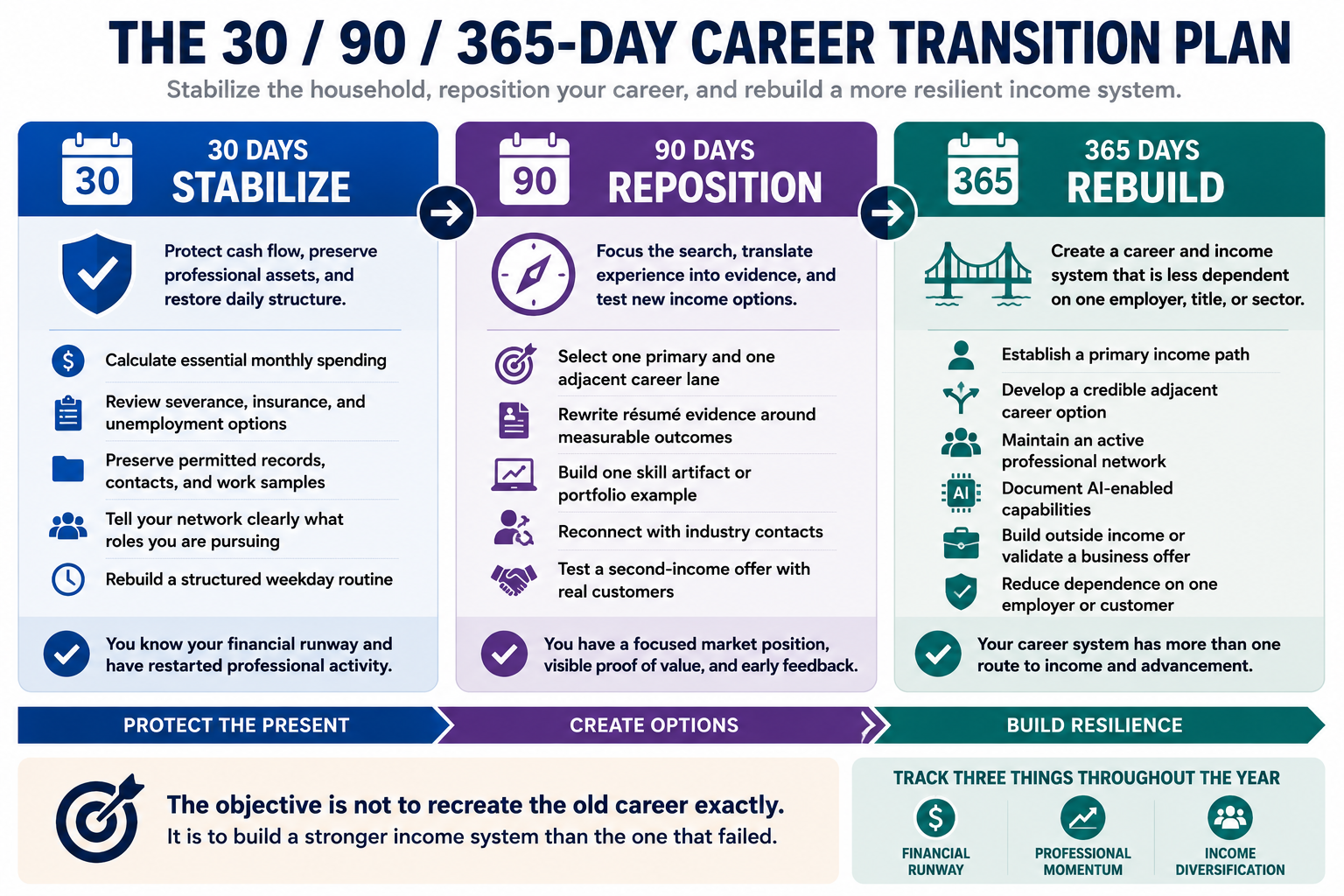
Use three time horizons: stabilize, reposition, rebuild.
The First 30 Days: Stabilize
For most people, the first month should prioritize financial and operational stability before any major career redesign.
Protect cash flow.
- Calculate essential monthly spending, the real minimum, not the current run rate.
- Review severance terms, health insurance options, retirement accounts, and unemployment eligibility.
- Pause large optional purchases.
- Avoid rushed portfolio decisions driven only by fear. Review liquidity needs, taxes, insurance, debt, and the broader household plan before making major changes.
- Determine how many months of runway are available. That number sets the tempo for everything that follows.
For the broader household planning framework, see AGI and Financial Independence.
Preserve professional access. Before accounts close, retain only information you are legally permitted to keep: personal performance records, awards, public work samples, nonconfidential contacts, training history, role descriptions, certifications. Do not take proprietary company data.
Tell people clearly. Do not disappear. The instinct after a layoff is to go quiet until you have good news. That instinct is backwards, the weeks right after a layoff are when your network is most willing to help.
Use a direct message:
My role was eliminated during a restructuring. I am now exploring positions involving regulated operations, technical program delivery, and AI-enabled process improvement. I would value introductions to teams working in those areas.
Specificity is easier to act on than “let me know if you hear of anything.” The first message gives someone three concrete lanes to match against people they know. The second gives them homework.
Rebuild daily structure. Employment supplies structure for free. When it disappears, the structure has to be rebuilt on purpose. Create a weekday schedule with time blocked for applications, outreach, skills, physical activity, family administration, and second-income testing.
The First 90 Days: Reposition
With the household stabilized, the question shifts from “how do I stop the bleeding?” to “where am I actually going?”
Select two target lanes. Do not apply equally to every vaguely related job. Choose one primary lane based on existing credibility, where your record speaks for itself, and one adjacent lane based on transferable tasks, where your task inventory, not your title, makes the case. For example: primary, federal technical program management; adjacent, compliance operations for regulated companies. Two lanes keep the search focused enough to build momentum and broad enough to hedge.
Rewrite evidence around outcomes. Instead of “Managed cross-functional programs,” use “Led a six-team recovery plan that reduced a delayed approval process from 14 weeks to 8 weeks while maintaining regulatory documentation.” The first sentence describes a title. The second describes a result someone paid for. Specific, verifiable outcomes carry far more signal than generic duty statements.
Run a real skill experiment. Do not collect credentials without a target. Choose one skill that appears repeatedly in postings for your target lanes and build an artifact: a working analysis, a software prototype, a process map, a compliance guide, a portfolio case study. An artifact does double duty, it develops the skill and it proves the skill. CareerOneStop provides career-change resources and training information, including potential funding through workforce programs.
Test the second income path. Contact potential customers before spending heavily. The objective by day 90 is not major revenue. It is evidence: one paid project, one letter of intent, several qualified conversations, or a clear reason the offer did not sell. That last one counts. A fast, cheap “no” from the market is worth more than six months of building toward an unvalidated “maybe.”
The First 365 Days: Build a More Resilient Career System
By the end of the first year, aim to have:
- a primary income path;
- a credible adjacent path;
- a functioning professional network;
- documented AI-enabled capabilities;
- at least one outside source of income or a validated business offer;
- lower dependence on one employer or sector;
- a clearer connection between your work and durable outcomes.
This may require accepting a role that is not a perfect continuation of the old title. Measured against the old career, that can feel like a step backward. Measured against the goal, a household income system that survives the next restructuring, it is often a step forward.
The objective is not to restore the prior career exactly. It is to build a stronger system than the one that failed.
Maintain Professional Identity During Transition
Employment is one expression of professional identity. It should not be the only one, and a transition is when you find out whether it was.
Maintain a weekly professional rhythm. Each week:
- speak with two people in the field;
- help one person without asking for anything;
- publish or share one useful insight;
- improve one portfolio artifact;
- apply selectively;
- follow one important industry or policy development;
- record what you learned.
None of these items is impressive alone. Run for six months, the compound result is a professional who never actually left.
Build relationships before asking for referrals. A useful network is not a list of people contacted only during unemployment. Maintain relationships through professional associations, former colleagues, technical communities, local business groups, alumni networks, and volunteer or advisory work. O*NET links occupations to professional associations, which can provide a starting point if you are moving into a new lane.
Separate role loss from capability loss. A restructuring can remove a position without removing expertise, judgment, reputation, relationships, accumulated context, or the ability to learn. The position was the container. The assets were always yours. The professional task after a layoff is translation: converting those assets into a form a new employer or customer can recognize and pay for.
A Practical Career-Resilience Checklist
Review these questions quarterly. Not annually, the technology is not moving on an annual cycle.
Task Exposure
- Which of my tasks can AI now complete reliably?
- Which tasks carry formal accountability?
- Is my role becoming more valuable, or merely more efficient?
Organizational Position
- Am I close to revenue, regulation, operations, liability, or mission outcomes?
- Can leadership explain why my work matters without me in the room?
- Do I own a result, or mainly coordinate other people’s work?
Income Resilience
- Could I earn money from more than one employer or customer?
- Have I validated a second income path with a real buyer?
- Are household fixed costs limiting my career flexibility?
Professional Adaptability
- Do I have evidence, artifacts, not claims, that I can use AI productively?
- Is my network active before I need it?
- Do I know which two career lanes I would pursue after a job loss?
Strong answers improve the odds that a restructuring remains manageable. Weak answers indicate areas that should be addressed before a transition occurs.
Final Takeaway
Do not try to outrun AI at every task. That is an unwinnable strategy, and an unnecessary one. Understand the task structure of your work, automate low-value activity, use AI to improve real outcomes rather than real output, move closer to accountability and mission, build a second path to income, and prepare a transition plan before it is required.
The near-term effect of AI is likely to be uneven transformation rather than the simultaneous disappearance of entire occupations. The IMF similarly emphasizes that AI is changing skills, tasks, hiring, and organizational structures, with particular pressure emerging in entry-level roles and routine office work. The ILO also identifies increased exposure in strongly digitized professional and technical occupations under its updated 2025 methodology.
Career resilience is not certainty. It is something more achievable and more durable: the ability to keep creating value when the tools, employers, titles, and economic conditions change.
Continue the AGI Household Resilience Series
- AGI and Financial Independence: How Families Can Prepare for Economic Disruption
- Household Self-Sufficiency in the Age of AGI
- The AGI Mortgage Trap
Sources and Tools
- ILO, Generative AI and Jobs: A 2025 Update
- ILO, Refined Global Index of Occupational Exposure
- IMF, New Skills and AI Are Reshaping the Future of Work
- IMF, Bridging Skill Gaps for the Future
- OECD, Using AI in the Workplace
- O*NET OnLine
- CareerOneStop Skills Matcher
- CareerOneStop Resources for Career Changers
- USAJOBS
- OPM Career Transition Programs
- SBA, AI for Small Business
- SAM.gov Contract Opportunities
- SAM.gov Entity Registration
- Find an APEX Accelerator
- U.S. Office of Government Ethics, Standards of Ethical Conduct