AI, Government, and the Social Contract: UBI, Universal High Income, and the Policy Choices Ahead
On this page
- What Problem Is Policy Trying to Solve?
- Temporary Displacement
- Wage Compression
- Reduced Working Hours
- Persistent Structural Unemployment
- Wealth Concentration
- Cost-of-Living Mismatch
- The AI Policy Spectrum
- What Universal Basic Income Actually Means
- UBI Versus Guaranteed Income
- UBI Versus a Negative Income Tax
- UBI Versus Existing Benefits
- What Cash Experiments Actually Show
- Finland’s Basic-Income Experiment
- OpenResearch’s Unconditional-Cash Study
- Alaska Permanent Fund
- The Strongest Arguments for UBI
- The Strongest Arguments Against UBI
- Income Security Without Agency
- Universal High Income: Abundance Scenario or Policy?
- Beyond Income: Access, Ownership, and Agency
- Alternatives and Complements to UBI
- Guaranteed Minimum Income or Negative Income Tax
- Wage Subsidies and Refundable Tax Credits
- Unemployment Insurance and Wage Insurance
- Portable Benefits
- Universal Basic Services
- Universal Access to AI and Compute
- Shorter Workweeks and Work Sharing
- Public or Transition Employment
- Social Wealth Funds and Citizen Dividends
- Worker Ownership and Profit Sharing
- Place-Based Transition Policy
- How Could These Policies Be Funded?
- Three Tests for an AI-Era Social Contract
- Dignity
- Capability
- Viability
- A Staged Policy Framework for the AI Transition
- Stage 1: AI Mainly Augments Work
- Stage 2: Concentrated Sectoral Displacement
- Stage 3: Broad Reduction in Labor Demand
- Stage 4: Sustained AI-and-Robotics Abundance
- Test New Systems Before Scaling Them
- Government Shapes the Operating Environment
- Government Will Also Use AI to Administer Benefits
- What Households Should Do Now
- What to Monitor
- Monitor Capacity, Not Only Income
- Final Takeaway
- Sources and Further Reading
- Empirical Research and Official Policy Sources
- Conceptual and Speculative Frameworks
Imagine that AI doubles the productive capacity of an economy.
Factories produce more. Software becomes cheaper. Professional services can be delivered with fewer human hours. Medical, educational, and administrative systems become more automated.
Does every household become wealthier?
Not automatically.
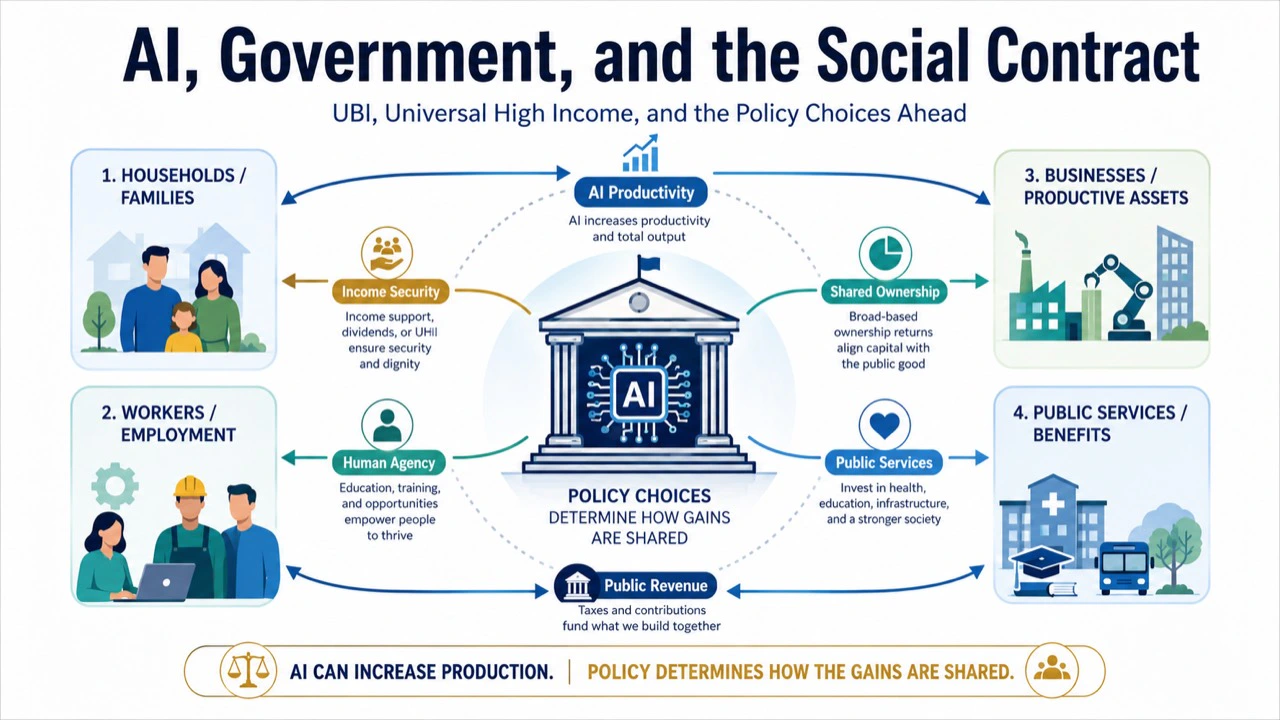
Productivity answers one question: how much can an economy produce? Policy and ownership answer different questions:
- Who receives the income?
- Who owns the productive systems?
- What happens to workers during the transition?
- Which goods become cheaper, and which remain scarce?
- What happens to health insurance, pensions, and benefits tied to employment?
- How are public services funded if labor income becomes a smaller share of the economy?
The International Monetary Fund has warned that AI can widen income and wealth inequality if productivity gains flow disproportionately to capital owners and workers whose skills complement AI. It argues that fiscal policy, social protection, education, and tax policy will matter in determining whether gains are broadly shared.
The central point is simple: AI may create abundance, but abundance does not distribute itself.
This article explains universal basic income, universal high income, and the broader policy menu governments could use as AI changes employment, income security, public services, and ownership. It is not an endorsement of one political program. The purpose is to make the tradeoffs legible.
The debate over universal basic income and AI is therefore part of a larger question about employment, services, ownership, taxation, and social protection.
Source note:The Last Economy is used here as a conceptual source rather than as empirical evidence or a forecast. Several of its questions concerning AI access, ownership, agency, and institutional resilience are useful for evaluating the broader social contract.
Terminology note: In this article, UHI meansuniversal high income, a speculative abundance-stage concept. It does not mean universal health insurance or universal health coverage.
What Problem Is Policy Trying to Solve?
AI-related economic change will not necessarily arrive as one event called “mass unemployment.” Several conditions could emerge, and each calls for a different response.
Temporary Displacement
Workers may lose jobs faster than they can retrain, relocate, or find a new employer, even if new work eventually appears. Relevant tools include unemployment insurance, transition assistance, training, and relocation support.
Wage Compression
People may remain employed while some tasks lose market value. Wage subsidies, refundable tax credits, profit sharing, and worker representation may matter more here than a full universal payment.
Reduced Working Hours
The economy may need less labor, not no labor. A society can respond with fewer jobs, or distribute some gains through shorter weeks, job sharing, flexible retirement, and partial-income support.
Persistent Structural Unemployment
If a significant group cannot find enough market work even after retraining, targeted income guarantees, negative income taxes, basic services, and transition employment become more relevant.
Wealth Concentration
Employment can remain widespread while AI-related profits and capital values accrue to a narrow ownership base. This focuses attention on capital-income taxation, social wealth funds, citizen dividends, pension ownership, employee ownership, and profit sharing.
Cost-of-Living Mismatch
AI may make digital services cheaper while housing, energy infrastructure, healthcare labor, childcare, and transport remain constrained. Cash alone cannot create apartments, clinicians, grid capacity, or childcare places.
The ILO’s 2025 analysis finds that job transformation is a more immediate outcome than the wholesale elimination of occupations, although exposure differs substantially across occupations and countries. That supports a staged response rather than assuming that one policy must solve every possible AI future.
The AI Policy Spectrum
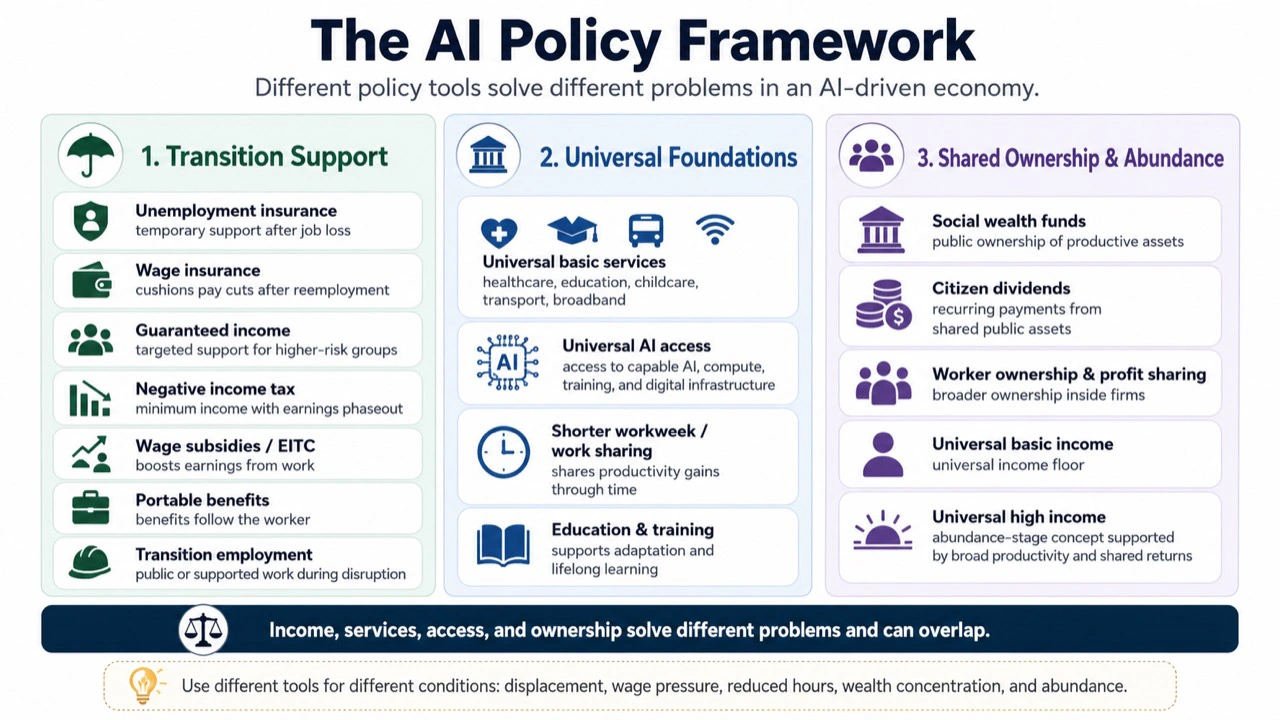
No single program covers every risk. Governments can combine targeted cash, universal services, wage insurance, portable benefits, and shared ownership without adopting a full universal basic income.
| Policy | Basic mechanism | Main objective |
|---|---|---|
| Universal basic income | Regular unconditional payment to nearly everyone | Establish an income floor |
| Guaranteed income | Payment targeted to a defined population | Reduce hardship among higher-risk groups |
| Negative income tax | Income support gradually phases out as earnings rise | Provide a minimum income with an earnings-based phaseout |
| Wage subsidy or EITC | Supplements earnings from employment | Make work pay and support low wages |
| Wage insurance | Temporarily replaces part of pay lost after reemployment | Ease transitions into lower-paid jobs |
| Unemployment insurance | Temporary income after involuntary job loss | Stabilize workers during job search |
| Universal basic services | Public or subsidized access to essentials | Reduce the cash households need |
| Portable benefits | Benefits follow the worker rather than one employer | Protect workers across changing work arrangements |
| Shorter workweek | Shares productivity gains partly through time | Reduce hours instead of employment |
| Job or transition guarantee | Publicly supported work for willing workers | Preserve income, structure, and participation |
| Universal AI access | Public or subsidized access to capable AI, compute, training, and trustworthy digital infrastructure | Prevent productive intelligence from becoming available only to wealthy households and large institutions |
| Social wealth fund | A publicly owned portfolio holds productive assets | Broaden public ownership of capital returns |
| Citizen dividend | Residents receive recurring payments from public assets or designated revenues | Distribute shared returns directly |
| Universal high income | Hypothetical high universal income supported by abundant production, shared returns, and broad access to productive capacity | Enable a high real standard of living independent of employment |
What Universal Basic Income Actually Means
A genuine UBI usually has four characteristics:
- Universal: broadly available rather than targeted only to people below an income threshold.
- Individual: normally paid to people, not households.
- Unconditional: not tied to job search, work requirements, or a specific use of funds.
- Regular: recurring rather than a one-time payment.
That definition helps separate UBI from several related ideas.
UBI Versus Guaranteed Income
Most modern guaranteed-income pilots target a city, income group, family type, age group, or other population. They may be unconditional for recipients, but they are not universal.
UBI Versus a Negative Income Tax
A negative income tax provides support through the tax system and gradually reduces it as earnings rise. A UBI is paid to everyone, though higher-income households can effectively repay much or all of it through progressive taxes.
UBI Versus Existing Benefits
A UBI could supplement existing programs, replace some cash benefits, or be financed partly by consolidating programs. Those designs are not interchangeable. A payment that replaces disability services, housing assistance, and healthcare support has very different consequences from one added on top of a strong social-protection system.
The OECD’s Basic Income as a Policy Option finds that a meaningful payment could close some coverage gaps, but replacing targeted programs with a uniform payment would require substantial resources and can be less effective at reducing poverty than well-designed targeted support.
What Cash Experiments Actually Show
Finland’s Basic-Income Experiment
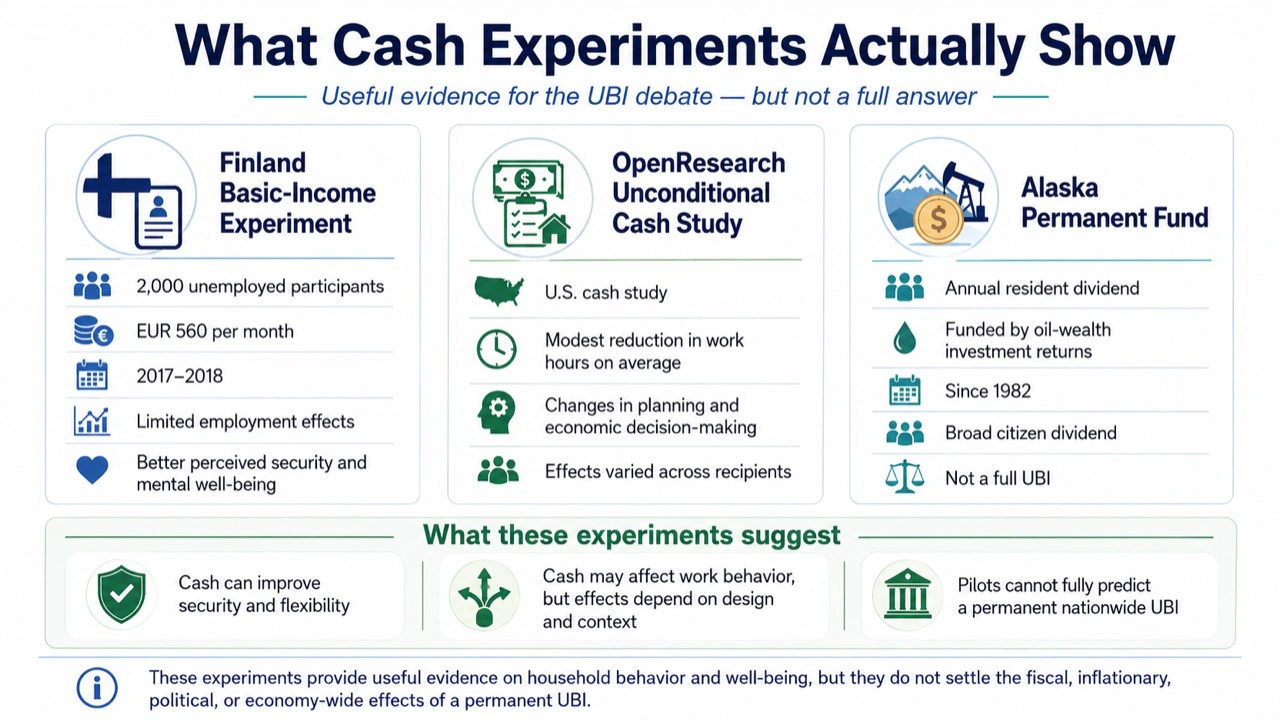
Finland paid 2,000 unemployed people EUR560 per month in 2017 and 2018, without a job-search requirement or withdrawal when someone found work. The final evaluation found relatively limited employment effects alongside better perceived economic security and mental well-being. It was not a national UBI.
OpenResearch’s Unconditional-Cash Study
The U.S. OpenResearch Unconditional Cash Study found modest reductions in average employment and work hours relative to a control group, alongside changes in planning and economic decision-making. An associated NBER analysis found lower labor-force participation and roughly one to two fewer work hours per week on average, with meaningful variation across recipients.
Alaska Permanent Fund
The Alaska Permanent Fund is the best-known long-running U.S. example of a broad citizen dividend. Alaska converted part of its nonrenewable oil wealth into a permanent financial asset and began distributing annual resident dividends in 1982. The fund now also contributes revenue supporting public services.
It is not a full UBI: eligibility is residency-based, payments are annual and variable, and the dividend is not designed to provide a complete basic-income floor.
Evidence takeaway: cash trials provide useful evidence about household behavior, employment, financial security, and well-being. They cannot fully reproduce the taxation, aggregate-demand, price, labor-market, and political effects of a permanent nationwide UBI.
The Strongest Arguments for UBI
Supporters emphasize simplicity, coverage, and flexibility. A universal payment can require less eligibility testing and paperwork than fragmented means-tested programs, while avoiding abrupt benefit cliffs when people earn more.
An income floor can also create room for caregiving, parenting, volunteering, community participation, and early entrepreneurship. It may help people leave unsafe work and reduce the stigma associated with narrowly targeted assistance. The tradeoff is that it also pays people who do not need help.
The Strongest Arguments Against UBI
Critiques of UBI are not necessarily critiques of income security. They usually concern the design, scale, and opportunity cost of a universal cash payment.
A payment large enough to replace employment income would be expensive, even if taxes recover some payment from higher earners. Paying everyone directs funds to households that do not need help, while a uniform payment cannot fully account for disability costs, regional housing prices, medical needs, or dependent care.
Cash cannot create housing, doctors, energy, transport, or care capacity by itself. Employment also supplies routine, relationships, status, and skill development. Finally, any payment can be reduced, taxed, or used to justify cuts elsewhere, so governance matters as much as the initial promise.
Income Security Without Agency
A basic income can protect consumption without resolving who controls the productive systems of the economy. A population could receive enough money to cover basic expenses while still lacking access to advanced AI tools, ownership of productive capital, influence over the platforms governing work and communication, or meaningful opportunities to create and contribute.
This distinguishes support from participation. A policy may support people financially while leaving them excluded from ownership, decision-making, and productive capability. That does not mean every UBI creates dependency. It means UBI should not substitute for addressing concentrated ownership, market power, public services, education, and meaningful participation.
Universal High Income: Abundance Scenario or Policy?
Universal high income, or UHI, is not an established program with settled eligibility, payment levels, or financing. In this article, it means a hypothetical abundance-stage system that could provide everyone with a comfortable or affluent standard of living independent of paid work.
UBI asks: how can every person receive a basic income floor?
UHI asks: could extreme AI and robotics productivity eventually support a high universal income?
That requires far more than a larger UBI. It assumes:
- extraordinary and sustained productivity growth;
- abundant energy and production capacity;
- sharply lower costs for many goods and services;
- broad public access to AI-created wealth;
- a credible ownership or tax mechanism; and
- durable political support for distribution.
Even in a high-productivity economy, scarcity would not disappear evenly. Well-located land, desirable housing, trusted personal care, unique experiences, natural resources, infrastructure capacity, and political influence could remain scarce.
A credible UHI system would therefore involve more than a large recurring payment. It would require high real purchasing power; abundant housing, energy, food, transport, and care capacity; broad access to productive AI; reliable public services; durable ownership or dividend rights; and institutions that preserve autonomy and political participation.
UHI is best treated as a late-stage scenario, not a near-term policy recommendation. It becomes plausible only if productivity, physical supply, public capacity, access to intelligence, ownership, and sustainable financing grow together.
Beyond Income: Access, Ownership, and Agency
Cash support answers an essential question: can people afford to live? It does not fully answer whether they can use the technologies transforming the economy, own a claim on the resulting wealth, learn and create, influence the institutions governing those systems, or find meaningful roles outside traditional employment.
An AI-era social contract may need to address five connected layers:
| Layer | Core question | Possible policy tools |
|---|---|---|
| Income | Can people meet ordinary expenses? | UBI, guaranteed income, negative income tax, wage insurance |
| Essential services | Are core needs affordable and available? | Healthcare, housing support, education, childcare, transport |
| Intelligence access | Can people use capable AI productively and safely? | Public AI access, compute credits, libraries, schools, public-interest models |
| Ownership | Do people receive returns from AI-driven capital? | Social wealth funds, employee ownership, pension ownership, citizen dividends |
| Agency and participation | Can people create, contribute, organize, and influence decisions? | Civic institutions, entrepreneurship support, public work, cooperatives, community programs |
The central policy question is not simply how much money people receive. It is whether people remain capable participants in economic and civic life rather than becoming economically secure but technologically dependent consumers.
Alternatives and Complements to UBI
The practical policy menu is wider than one acronym.
Geographic note: The policy concepts in this article are international, but several examples are specific to the United States. Healthcare systems, tax credits, unemployment programs, employment benefits, and existing social protections differ substantially across countries.
Guaranteed Minimum Income or Negative Income Tax
These approaches target poverty reduction and can phase out as people earn. They require income reporting and can create high marginal tax rates.
Wage Subsidies and Refundable Tax Credits
The U.S. Earned Income Tax Credit supplements the earnings of eligible low- and moderate-income workers. The Congressional Budget Office finds that the credit tends to increase labor-force participation, although its effects vary across populations. Wage subsidies remain tied to employment, so they provide less support to people who cannot find sufficient paid work.
Unemployment Insurance and Wage Insurance
Unemployment insurance replaces part of lost earnings after involuntary job loss. Wage insurance can temporarily replace part of the difference when a displaced worker accepts a new job at lower pay. A 2024 study of the U.S. Trade Adjustment Assistance program found that wage-insurance eligibility increased short-run employment and long-run cumulative earnings, largely by reducing the time workers remained unemployed.
Portable Benefits
Healthcare, retirement savings, disability coverage, and training rights can follow workers across employers, contracts, and self-employment. The OECD argues for broader coverage and more portable entitlements.
Universal Basic Services
Universal basic services reduce the cash a household needs by ensuring access to essentials, including healthcare, education, childcare, broadband, transportation, disability support, and basic energy or water support. The ILO social-protection-floor framework combines essential healthcare with basic income security.
Universal health coverage belongs in this category of social-protection floors and basic services. It should not be confused with universal high income.
Universal Access to AI and Compute
If AI becomes a major gateway to education, healthcare navigation, entrepreneurship, public services, research, and professional productivity, cash income alone may not provide meaningful access. Universal AI access is a possible policy category, not an established right or settled program.
It could include AI tools through schools and libraries, subsidized access, compute credits, public-interest models, small-business support, open resources, and responsible-use training. Access should include not only an interface, but training, privacy protection, accessibility, verification skills, and enough capability to be economically useful.
Shorter Workweeks and Work Sharing
If AI raises output per worker, society can take part of the gain as more leisure rather than only higher production or fewer jobs. Options include shorter weeks, work sharing, flexible retirement, and partial income support. The ILO notes that this pattern has slowed or reversed in some places.
Public or Transition Employment
Government-supported work can preserve routine and participation through elder support, environmental restoration, infrastructure maintenance, tutoring, disaster preparedness, or community health. It also risks administrative complexity and low-value work.
Social Wealth Funds and Citizen Dividends
Governments can hold diversified productive assets and distribute part of the returns to residents. The Alaska Permanent Fund demonstrates the core mechanism: convert a finite public resource into a long-lived asset base that supports dividends and public services.
The distribution question cannot be separated from ownership. If a narrow group owns the productive infrastructure, governments may be left redistributing income only after power has concentrated.
Strategies include public investment funds, pension ownership, employee equity, cooperatives, public stakes in publicly supported technologies, and social wealth funds. The question is whether workers and citizens hold durable claims on the assets generating those profits.
Worker Ownership and Profit Sharing
Employee stock ownership, profit sharing, cooperative models, sectoral bargaining, productivity-linked bonuses, and pension ownership can share gains inside firms and industries. This addresses distribution at the point of ownership and bargaining, not only through tax policy afterward.
Place-Based Transition Policy
AI disruption will be uneven. Exposed regions may need training, business formation support, infrastructure, relocation assistance, public procurement, and regional development funds.
How Could These Policies Be Funded?
There is no single “AI tax” that cleanly solves the problem. Potential revenue sources include:
- capital-income taxation;
- corporate income taxes;
- progressive personal taxes;
- inheritance and estate taxes;
- consumption taxes paired with rebates;
- land-value or property taxation;
- natural-resource and spectrum revenues;
- social wealth fund returns; and
- improved enforcement and fewer avoidance gaps.
The IMF’s fiscal-policy analysis recommends protecting the tax base if labor income becomes less central, strengthening capital-income taxation, and avoiding blunt robot taxes that may discourage productive investment or prove difficult to define.
Every proposal should answer seven practical questions:
- What is the payment or service?
- Who receives it?
- Which existing programs remain?
- How is it financed?
- What happens when prices rise?
- How does it affect work incentives and labor standards?
- How does it account for regional and household differences?
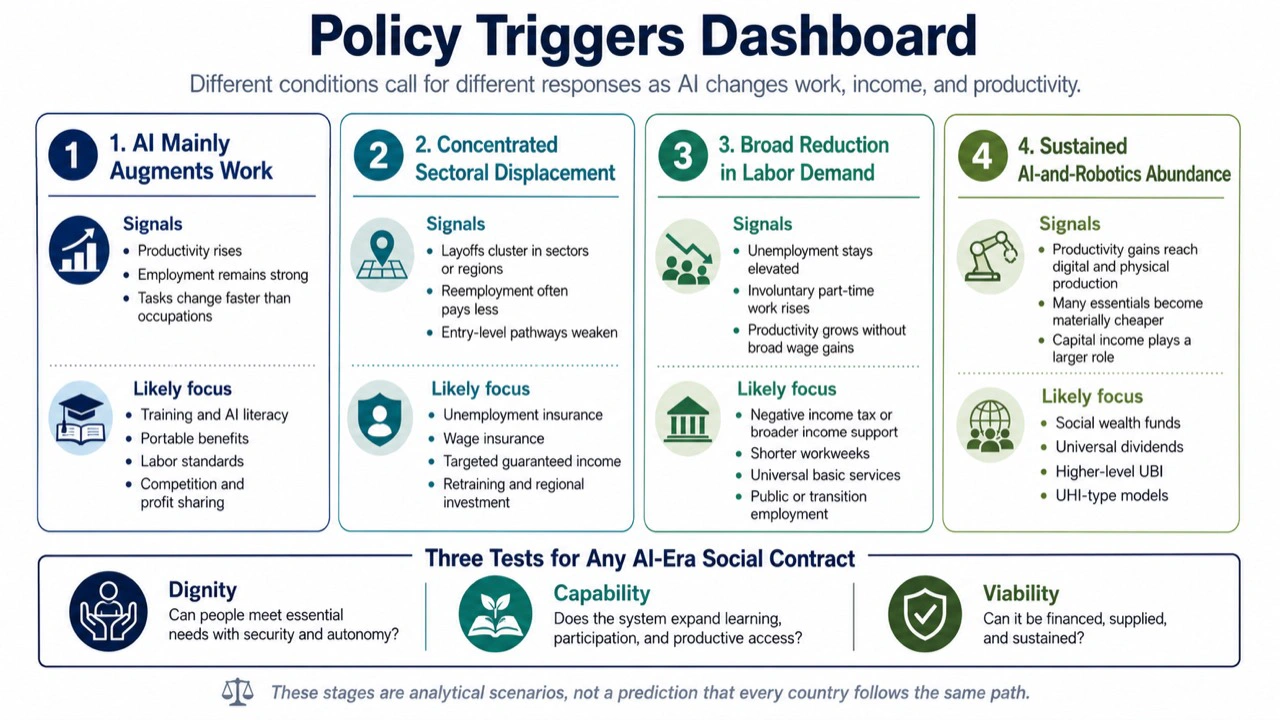
Three Tests for an AI-Era Social Contract
Any proposed support system should pass three tests.
Dignity
Can people meet essential needs without extreme insecurity, coercive conditions, or loss of basic autonomy? Relevant tools include income support, healthcare, housing stability, disability support, and food and energy security.
Capability
Does the system help people learn, create, use advanced tools, start projects, care for others, participate in institutions, and make meaningful choices? Relevant tools include education and training, public AI access, entrepreneurship support, childcare, digital infrastructure, and civic institutions.
Viability
Can the policy be financed, administered, supplied, and politically sustained without weakening the productive and institutional systems on which it depends? Fiscal cost, housing and service capacity, administrative competence, inflation, supply constraints, public legitimacy, productivity, and institutional resilience all matter.
A policy can provide dignity while failing to build capability. It can expand capability while remaining fiscally or institutionally unviable. A durable social contract must address all three.
A Staged Policy Framework for the AI Transition
Policy should respond to measured conditions, not only to forecasts.
These stages are analytical scenarios, not a forecast that every country or industry will move through them in order. Different sectors may experience augmentation, labor shortages, displacement, and abundance at the same time.
Stage 1: AI Mainly Augments Work
Signals: productivity rises, employment remains strong, and tasks change faster than occupations disappear.
Likely focus: education and training, AI access, labor standards, portable benefits, competition policy, and profit sharing.
Stage 2: Concentrated Sectoral Displacement
Signals: layoffs cluster in specific occupations or regions, reemployment occurs at lower wages, and entry-level pathways weaken.
Likely focus: unemployment insurance, wage insurance, targeted guaranteed income, retraining, relocation assistance, and regional investment.
Stage 3: Broad Reduction in Labor Demand
Signals: unemployment and involuntary part-time work remain elevated, labor’s share of income falls, and productivity rises without broad wage gains.
Likely focus: broader guaranteed income or negative income tax, shorter workweeks, universal basic services, social dividends, and expanded public or transition employment.
Stage 4: Sustained AI-and-Robotics Abundance
Signals: strong productivity gains reach digital and physical production, many essential goods become materially cheaper, capital income replaces a large share of labor income, and public revenue mechanisms remain sustainable.
Possible focus: substantial universal dividends, mature social wealth funds, higher-level UBI, UHI-type proposals, and a redefinition of employment, retirement, and the standard workweek.
Test New Systems Before Scaling Them
A complete national model is unlikely to appear fully formed. Cities, states, agencies, employers, universities, and nonprofits can test guaranteed income, wage insurance, portable benefits, public AI access, ownership models, and transition employment.
Local trials cannot reproduce every national effect, but they can reveal administrative failures, participation patterns, public acceptance, privacy risks, and unintended consequences. Strong experiments use predefined objectives, independent evaluation, published costs, privacy safeguards, and clear expansion or termination criteria. For the local institutional dimension, see Building Local Community Resilience in the Age of AI and AGI.
Government Shapes the Operating Environment
Government does not have to choose between controlling the entire economy and remaining passive. It can shape the conditions under which households, firms, workers, and AI systems operate through rights and liability rules, competition policy, public infrastructure, procurement standards, taxation, data and privacy rules, default benefit structures, public research, open standards, and education and training.
The objective is not to predict every outcome. It is to make broadly beneficial behavior easier, reduce extractive incentives, and preserve alternatives when technologies or firms fail.
Government Will Also Use AI to Administer Benefits
AI could help public agencies translate applications, identify missing documentation, detect administrative errors, forecast demand, reduce caseworker paperwork, and guide people through complex systems.
It can also create serious risks: wrongful denial, biased risk scoring, opaque decisions, surveillance, inaccessible appeals, and commercial misuse of sensitive information. The OECD notes that AI can improve access and efficiency in social protection while also risking unfair or opaque decisions.
The governing principle should be simple: automate administration, not accountability.
Consequential decisions should include:
- clear notice;
- understandable reasoning;
- disclosure that an automated system influenced the decision;
- access to human review;
- a meaningful appeal process;
- data minimization;
- auditable decision logs; and
- independent oversight.
What Households Should Do Now
Households should not build a financial plan around a future UBI or UHI. Programs may arrive late, differ across locations, include eligibility conditions, or be less generous than public discussion suggests.
- Maintain liquidity that can bridge the period between a job loss and public support.
- Understand healthcare continuation, unemployment eligibility, retirement vesting, disability coverage, professional licensing, and benefits available through a spouse or public program.
- Develop multiple income and career paths. Policy can cushion a transition, but it cannot preserve a specific title, salary, location, or industry.
- Evaluate locations partly by institutional capacity, including healthcare access, housing supply, training capacity, administrative competence, and public finances.
- Participate in policy discussions before a crisis. The rules adopted before disruption becomes obvious will shape the choices available afterward.
For related planning frameworks, see The AGI Career Transition Playbook, The AGI Mortgage Trap, and Building Local Community Resilience in the Age of AI and AGI.
What to Monitor
The useful signals are not one executive prediction or one policy announcement. Watch the conditions that would make different policy tools more necessary.
| Signal group | What to watch |
|---|---|
| Labor market | Unemployment, labor-force participation, involuntary part-time work, entry-level hiring, job-finding duration, wage losses, and regional layoffs |
| Distribution | Labor’s share of income, capital-income concentration, wage growth by income group, productivity relative to median compensation, and regional inequality |
| Fiscal and real economy | Revenue mix, benefit claims and processing capacity, public debt, and housing, energy, healthcare, childcare, food, and transport costs |
| Policy | Guaranteed-income pilots, shorter-workweek programs, portable-benefit laws, social wealth funds, unemployment-insurance changes, and AI-administration safeguards |
Monitor Capacity, Not Only Income
Employment, wages, productivity, and fiscal indicators remain essential. They may not show whether an AI-era support system is building or depleting the underlying capacity of society.
| Capacity | Questions and possible indicators |
|---|---|
| Physical capacity | Is housing, energy, healthcare, transport, broadband, and infrastructure expanding with demand? |
| Knowledge capacity | Are education, AI literacy, research access, training, and adaptability improving? |
| Social capacity | Are trust, civic participation, institutional competence, and community connection strengthening? |
| Resilience capacity | Is the economy diversified, redundant, recoverable, and able to withstand shocks? |
A policy that raises cash income while weakening housing supply, public capacity, institutional trust, or economic diversity may improve one measure while degrading the system beneath it.
Final Takeaway
AI may make society capable of producing more with less labor. That does not automatically create income security, affordable essentials, broad ownership, personal agency, or political legitimacy.
UBI is one possible response, but an AI-era social contract may need several layers: income protection during disruption; universal access to essential services; broad access to productive AI; portable benefits and shorter working hours; wider ownership of AI-driven capital; and institutions that preserve participation, autonomy, and purpose.
UHI belongs at the far end of that spectrum. It would require more than a large payment. It would require abundant physical supply, broad technological access, sustainable financing, shared ownership, and institutions capable of converting productivity into a high real standard of living.
The central question is not which acronym wins. It is whether the systems built around AI preserve dignity, expand capability, remain viable, and allow people to participate in, not merely consume from, the economy that follows.
Sources and Further Reading
Empirical Research and Official Policy Sources
- IMF: AI Will Transform the Global Economy
- IMF: Fiscal Policy Can Help Broaden the Gains of AI
- ILO: Generative AI and Jobs, 2025 Update
- OECD: Basic Income as a Policy Option
- Kela: Evaluation of the Finnish Basic Income Experiment
- OpenResearch: Unconditional Cash Study
- NBER: The Employment Effects of a Guaranteed Income
- Alaska Permanent Fund Corporation: History
- CBO: Factors Affecting the Labor Force Participation of People Ages 25 to 54
- NBER: Wage Insurance for Displaced Workers
- OECD: The Future of Social Protection
- ILO: Social Protection Floors Recommendation No. 202
- OECD: Using AI to Manage Minimum-Income and Unemployment Benefits
Conceptual and Speculative Frameworks
- The Last Economy: A Guide to the Age of Intelligent Economics, Emad Mostaque and Intelligent Internet. Used here as a conceptual source, not as empirical evidence or a policy forecast.