Raising Children in the Age of AGI: Skills, Education, and Human Agency
On this page
- Childhood Is Not a Race Against AI
- The Purpose of Education Is Changing
- Foundations Become More Important, Not Less
- Reading
- Writing
- Mathematics
- Scientific Reasoning
- Statistical Judgment
- The Foundation Stack
- Learn How to Learn
- AI Literacy Without AI Dependency
- Attention Is Becoming a Competitive Advantage
- Physical-World Competence Still Matters
- Human Skills Become More Valuable
- Creativity, Entrepreneurship, and Initiative
- Teach Children to Evaluate Information
- AI Tutors and AI Companions
- Does College Still Matter?
- Choosing Schools in the AGI Era
- Protect Children’s Privacy
- Practical Household Actions
- Continue the AGI Household Resilience Series
- Final Takeaway
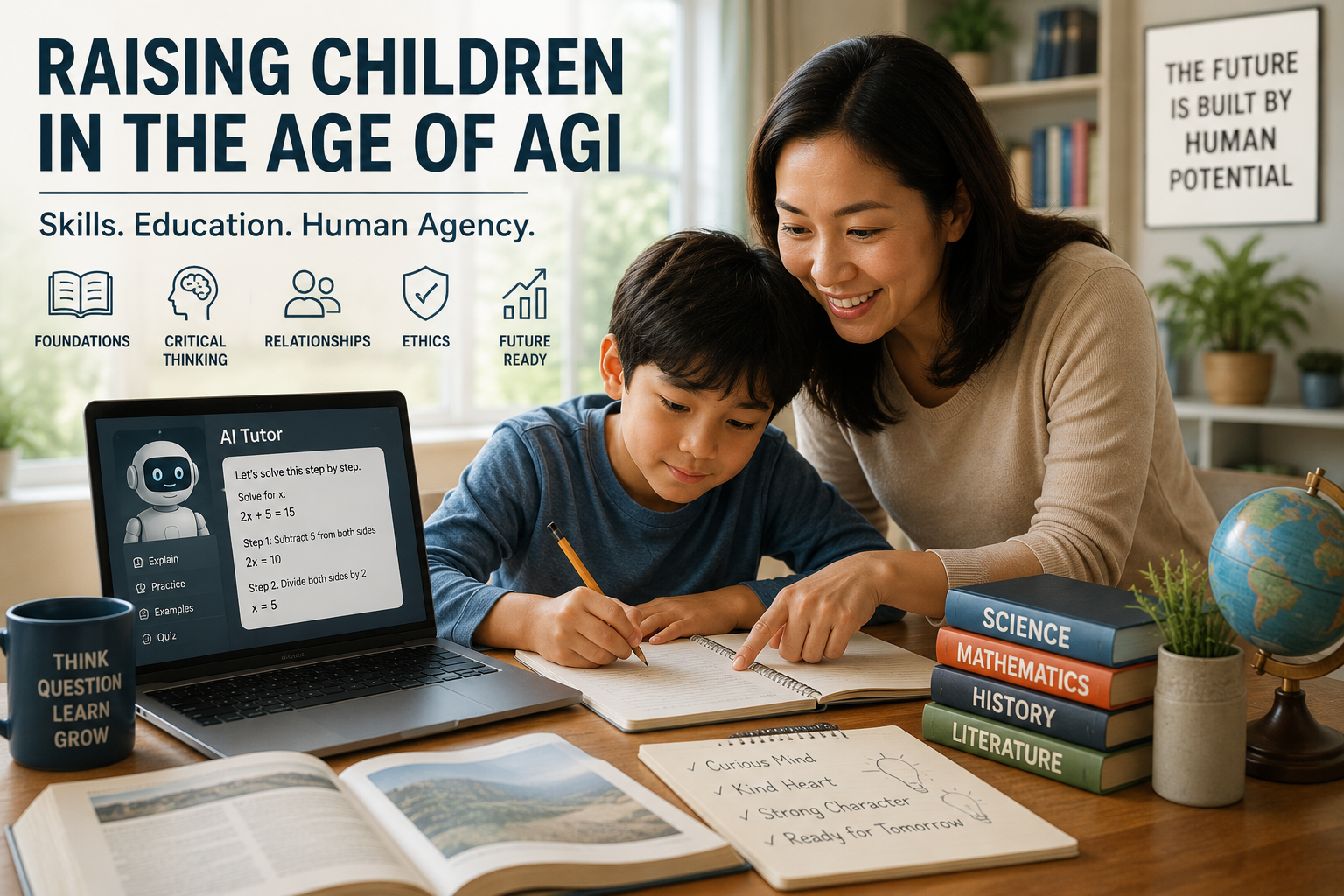
A child asks ChatGPT to explain algebra.
An AI tutor turns a confusing lesson into a personalized practice plan.
A writing assistant generates a first draft in seconds.
A language app adjusts to the learner’s weak spots.
Homework that once took hours can now take minutes.
That creates a question parents, educators, and policymakers cannot avoid:
If knowledge becomes cheap, what should children actually learn?
This is becoming one of the defining education questions of the AI era.
Previous technologies changed access to information. Search engines made facts easier to find. Calculators changed arithmetic. Smartphones changed communication. AI goes further because it increasingly performs parts of writing, coding, research, translation, tutoring, planning, design, and routine cognitive work.
The goal of parenting and education is therefore changing.
Not because children need to compete against AI.
Because they need to learn how to direct, question, verify, and live alongside increasingly capable systems without surrendering their own judgment.
UNESCO’s AI Competency Framework for Students gives a useful anchor. It emphasizes a human-centered mindset, ethics, foundational AI knowledge, responsible use, and co-creation with AI. That is the right starting point. The purpose is not to raise children who can always get an answer. The purpose is to raise children who can decide when the answer is worth trusting, when it is not enough, and when the human has to take responsibility.
Childhood Is Not a Race Against AI
Parents naturally worry about preparing children for an uncertain future.
That concern can lead to another trap: trying to optimize every childhood decision around the newest technology.
Children do not need to become AI experts at eight years old.
They need healthy development:
- reading;
- friendships;
- physical play;
- curiosity;
- responsibility;
- confidence;
- sleep;
- conversation;
- family relationships.
Those remain the foundation on which every later skill depends.
A child with strong habits, healthy relationships, emotional resilience, and a love of learning can adapt to changing technology. A child optimized only for the current tools may struggle when the tools inevitably change.
The goal is not to raise children for today’s AI.
The goal is to raise adaptable adults.
The Purpose of Education Is Changing
Traditional education often rewarded four things:
- remembering facts;
- following procedures;
- producing standardized answers;
- completing work individually.
AI changes the economics of those tasks.
That does not make knowledge obsolete. It makes knowledge more strategic.
Children still need facts, vocabulary, historical context, mathematical fluency, scientific concepts, and domain knowledge. Without those foundations, they cannot recognize when an AI answer is wrong. They cannot tell whether evidence is weak. They cannot notice when two claims conflict. They cannot ask a better follow-up question.
AI changes the value of knowledge. It does not eliminate the need for knowledge.
The U.S. Department of Education’s report on AI and the future of teaching and learning makes a similar point: AI can support new forms of interaction, feedback, and adaptation, but human judgment, educator involvement, and policy guardrails remain central. The opportunity is not to replace learning. The opportunity is to improve learning without losing the human purpose of education.
The educational goal should shift from “Can the child produce the answer?” toward a more durable set of questions:
- Does the child understand the concept?
- Can the child explain the reasoning?
- Can the child verify the answer?
- Can the child apply the idea in a new situation?
- Can the child make a decision when the tool is uncertain?
- Can the child remain responsible for the work?
That is the difference between using AI as a tool and allowing AI to become the child’s substitute for thinking.
Foundations Become More Important, Not Less
The more capable AI becomes, the more important human foundations become. Children who lack core skills will not be liberated by AI. They will become dependent on systems they cannot evaluate.
Reading
Reading is not just decoding words.
Children need sustained reading, comprehension, synthesis, argument evaluation, and the ability to sit with a difficult text long enough to understand it. AI summaries can help, but a child who never develops deep reading becomes dependent on someone else’s compression of the world.
That is risky because every summary is a choice. It leaves things out. It weights ideas. It may distort nuance. It may miss tone, uncertainty, or contradiction.
In an AI-rich environment, strong readers have leverage. They can compare the source to the summary. They can notice what was lost. They can ask sharper questions. They can move beyond the easy answer.
Writing
Writing develops thinking.
Children should still learn outlining, argument, explanation, persuasion, revision, and style. Even if AI can draft quickly, the student still needs to know what the piece is trying to do.
Writing forces a child to make decisions:
- What is the claim?
- What evidence supports it?
- What should come first?
- What is unclear?
- What should be removed?
- What would persuade a skeptical reader?
If AI drafts everything, children may skip the very struggle that builds reasoning. The answer is not to ban AI forever. The answer is to preserve writing as a thinking practice before using AI as an editing, feedback, or comparison tool.
Mathematics
Math is not only arithmetic.
Mathematics teaches abstraction, logic, structure, modeling, precision, and error checking. Those skills become more valuable when AI can generate confident language around weak reasoning.
Children do not need to do every calculation by hand forever. But they do need enough fluency to recognize when an output is unreasonable. A child who understands ratios, probability, compounding, graphs, and constraints can evaluate AI-generated claims about money, science, risk, and tradeoffs.
Scientific Reasoning
Scientific reasoning teaches children how to move from curiosity to evidence.
They should understand:
- hypotheses;
- evidence;
- experimentation;
- replication;
- uncertainty;
- competing explanations.
This matters because AI can generate endless confident explanations. Some will be useful. Some will be incomplete. Some will be wrong. Scientific thinking gives children a disciplined response to confident language: what would count as evidence?
The National Academies’ How People Learn II emphasizes that learning depends on cognitive, developmental, social, cultural, and contextual factors. Children do not become strong thinkers by receiving more output. They become strong thinkers by building mental models, practicing, receiving feedback, and applying ideas in meaningful contexts.
Statistical Judgment
Statistical judgment is becoming a basic life skill.
Children should understand:
- averages;
- probability;
- uncertainty;
- risk;
- sample size;
- base rates;
- correlation versus causation.
AI often presents uncertainty as polished language. A child who hears a confident explanation may assume the model knows. Statistical judgment gives them a better habit: how likely is this, how do we know, and what would change the answer?
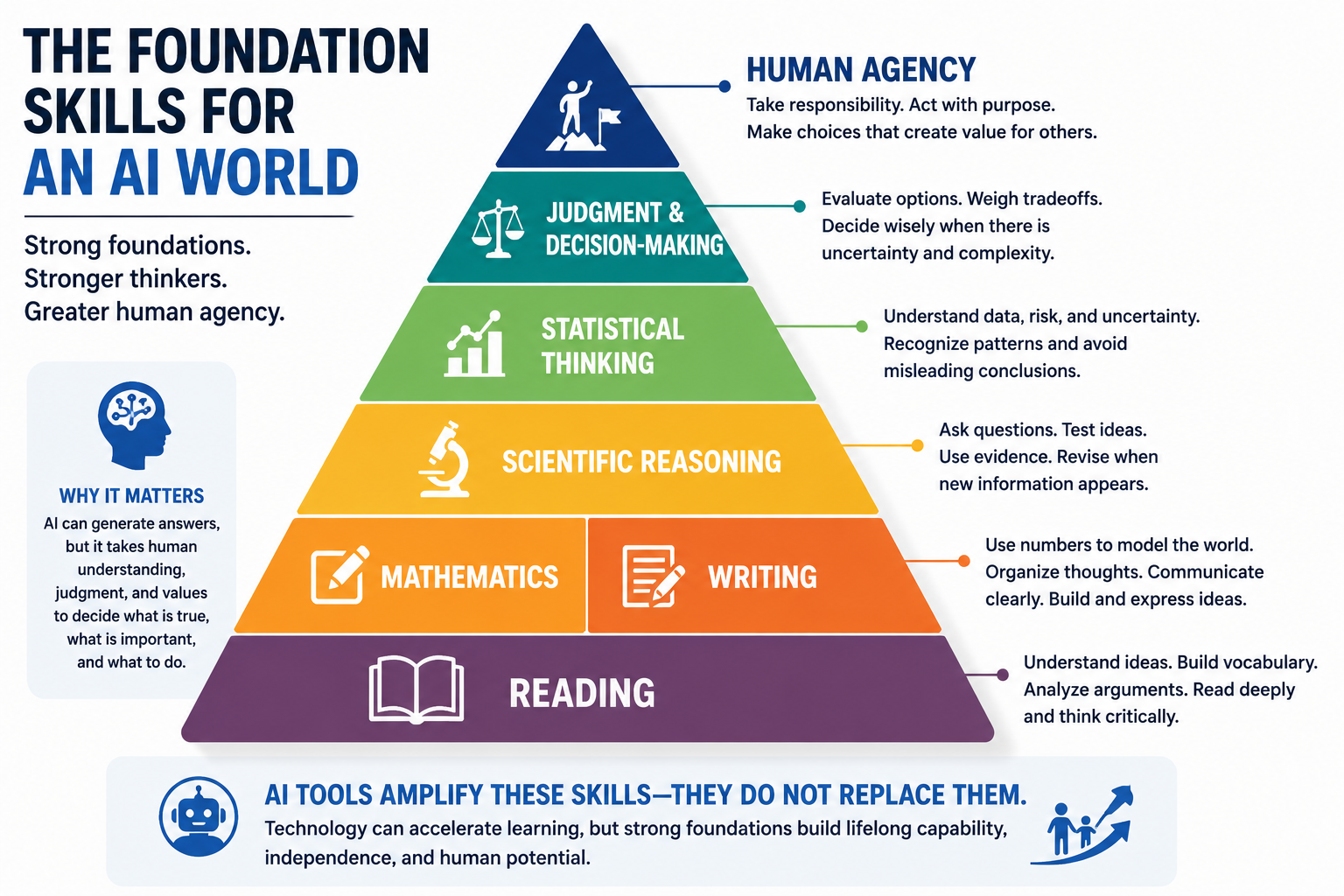
The Foundation Stack
The foundation is not one subject. It is a stack:
| Layer | Core capability |
|---|---|
| Reading | Understand and evaluate language |
| Writing | Organize and clarify thought |
| Mathematics | Model structure, quantity, and constraint |
| Scientific reasoning | Test claims against evidence |
| Statistical judgment | Think clearly under uncertainty |
| Judgment and decision-making | Choose responsibly when no tool can decide for you |
AI can sit on top of that stack. It should not replace it.
Learn How to Learn
Children also need the meta-skill underneath every subject: learning how to learn.
That means teaching them to:
- ask better questions;
- break large problems into smaller parts;
- practice deliberately;
- seek feedback;
- revise;
- persist when the first attempt fails;
- notice which strategies actually help them improve.
This matters because no parent can predict the exact tools, careers, or institutions a child will face as an adult. The durable skill is the ability to enter a new domain, tolerate confusion, practice intelligently, and improve.
How People Learn II emphasizes that learning is active, contextual, and shaped by prior knowledge, motivation, culture, and feedback. Children need more than answers. They need the habit of building understanding.
AI Literacy Without AI Dependency
Children need AI literacy. They also need protection from AI dependency.
AI literacy should include:
- how models work at a basic level;
- why models can hallucinate;
- how bias can enter systems;
- when to verify outputs;
- what information should not be shared;
- how tools differ;
- how prompting affects output;
- how to compare models;
- when a human expert is still needed.
UNESCO’s student framework treats students not merely as users, but as responsible participants and co-creators. That matters. Children should learn that AI systems are designed by people, trained on data, shaped by incentives, and deployed inside institutions. They are not neutral oracles.
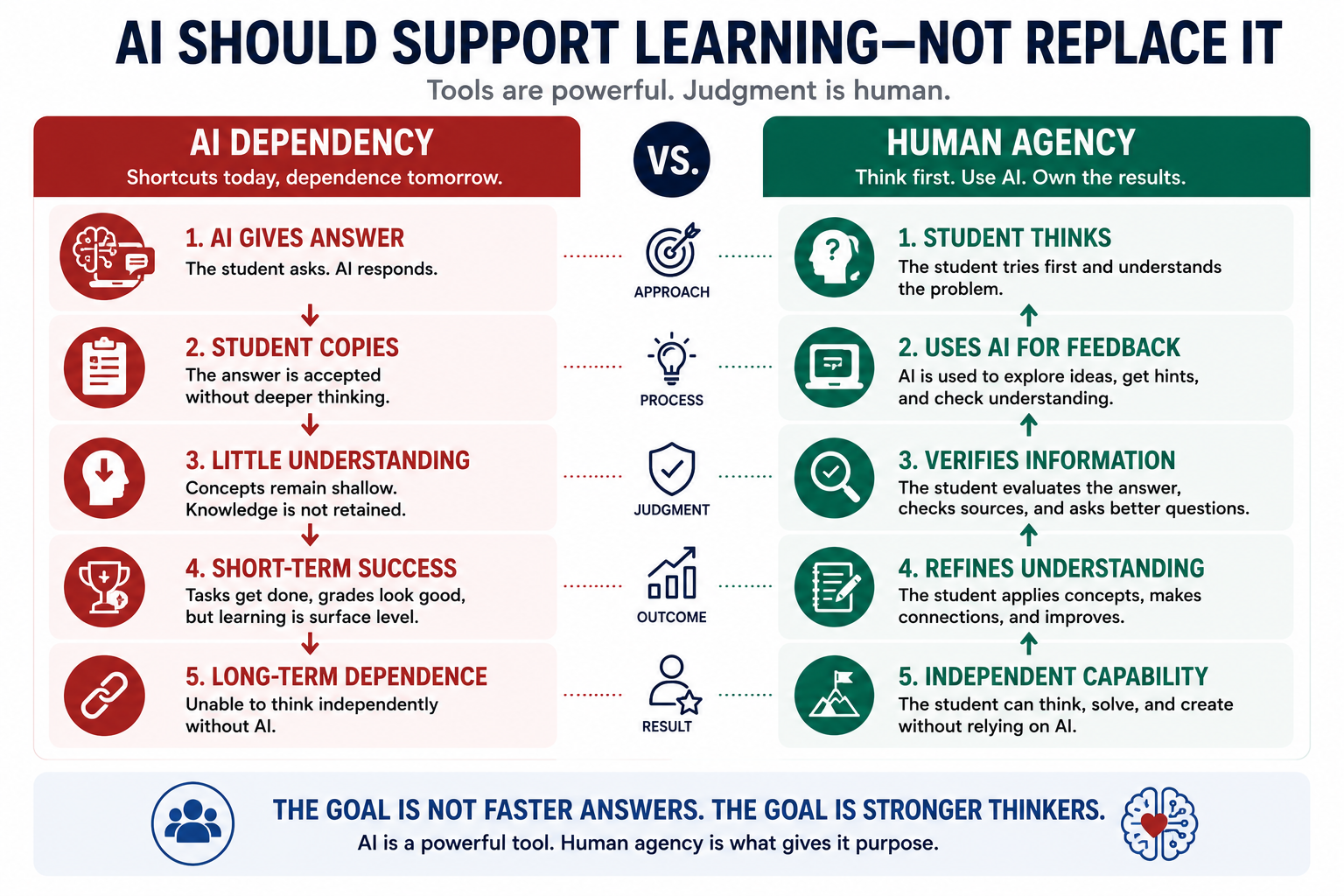
There is a difference between using AI and depending on AI.
Using AI means the child can explain the problem, check the answer, revise the output, and remain responsible for the final work.
Depending on AI means the child cannot proceed without it, cannot tell whether the answer is sound, and cannot explain the result in their own words.
The goal is not children who can always get an answer. It is children who know when not to trust one.
Practical household rule:
If a child uses AI for schoolwork, ask them to explain the answer without the tool.
If they cannot explain it, they do not own it yet.
Attention Is Becoming a Competitive Advantage
Children are growing up inside an attention economy.
Notifications, short-form video, algorithmic feeds, games, AI companions, personalized entertainment, and instant answers all compete for the same limited resource: sustained attention.
AI may make this more intense. If entertainment becomes more personalized, tutoring becomes more responsive, and generated content becomes endless, children will need stronger habits around focus.
Deep work, patience, concentration, deliberate practice, and long reading are not old-fashioned. They are becoming more valuable because they are becoming harder to maintain.
Attention shapes learning. A child who can stay with a hard book, a math problem, a musical instrument, a sport, a repair project, or a difficult conversation is building a form of agency. They are learning that effort can change ability.
The attention loop can move in two directions.
| Distraction loop | Focus loop |
|---|---|
| Distraction | Focus |
| Fragmentation | Practice |
| Shallow learning | Mastery |
| Poor judgment | Independent thinking |
Parents cannot remove every distraction. But they can protect routines where attention has room to develop:
- daily reading;
- device-free meals;
- focused homework blocks;
- outdoor play;
- practice time for music, sport, art, or craft;
- boredom without immediate digital rescue.
In an AI world, attention is not just a productivity skill. It is a character skill.
Physical-World Competence Still Matters
AI may know how to replace a faucet.
That does not mean the faucet replaces itself.
Children still need competence in the physical world:
- sports;
- outdoor play;
- cooking;
- gardening;
- repair;
- navigation;
- first aid;
- driving when age-appropriate;
- manual skills;
- basic household systems.
The future will not be purely digital. Housing, food, energy, water, health, transportation, weather, and physical safety will still matter. Even in a world with powerful AI, people live in bodies, homes, neighborhoods, and ecosystems.
Physical competence also builds confidence. A child who can cook a meal, fix a small problem, read a map, take care of a younger sibling, grow food, or navigate a real place learns that capability is not confined to screens.
This connects directly to household resilience. The same family logic behind Household Self-Sufficiency in the Age of AGI applies to children: do not confuse information access with competence.
Human Skills Become More Valuable
Most organizations ultimately run on trust, not information.
AI can increase access to information. It can summarize meetings, draft messages, generate reports, and support analysis. But people still need to work with other people.
Children should practice:
- communication;
- listening;
- negotiation;
- leadership;
- conflict resolution;
- empathy;
- teaching;
- trust-building;
- responsibility;
- initiative.
These are not soft skills in the dismissive sense. They are social infrastructure.
In a world where information is cheap, the premium shifts toward judgment, trust, context, and responsibility. The person who can understand a problem, work with others, make a promise, follow through, and repair trust after conflict will still matter.
Schools and families should therefore protect activities that build real human interaction:
- team sports;
- group projects;
- debate;
- volunteering;
- clubs;
- part-time work;
- family responsibilities;
- mentoring relationships;
- public speaking;
- collaborative problem-solving.
AI can support those activities. It should not replace them.
Creativity, Entrepreneurship, and Initiative
AI makes it easier to produce content.
That is not the same as creating value.
Children should learn the difference between making something and solving a problem that matters to someone.
Creativity in the AI era should include:
- problem finding;
- experimentation;
- customer understanding;
- taste;
- ownership;
- resilience;
- iteration;
- judgment about what is worth making.
A child can use AI to make a logo, draft a story, generate a simple app, or design a flyer. That is useful. But the deeper lesson is to ask:
- Who is this for?
- What problem does it solve?
- What would make it better?
- What feedback did we get?
- What did we learn?
Entrepreneurship does not have to mean building a company. It can mean running a small neighborhood service, organizing a fundraiser, selling a craft, tutoring a younger student, building a useful tool, or improving a local process.
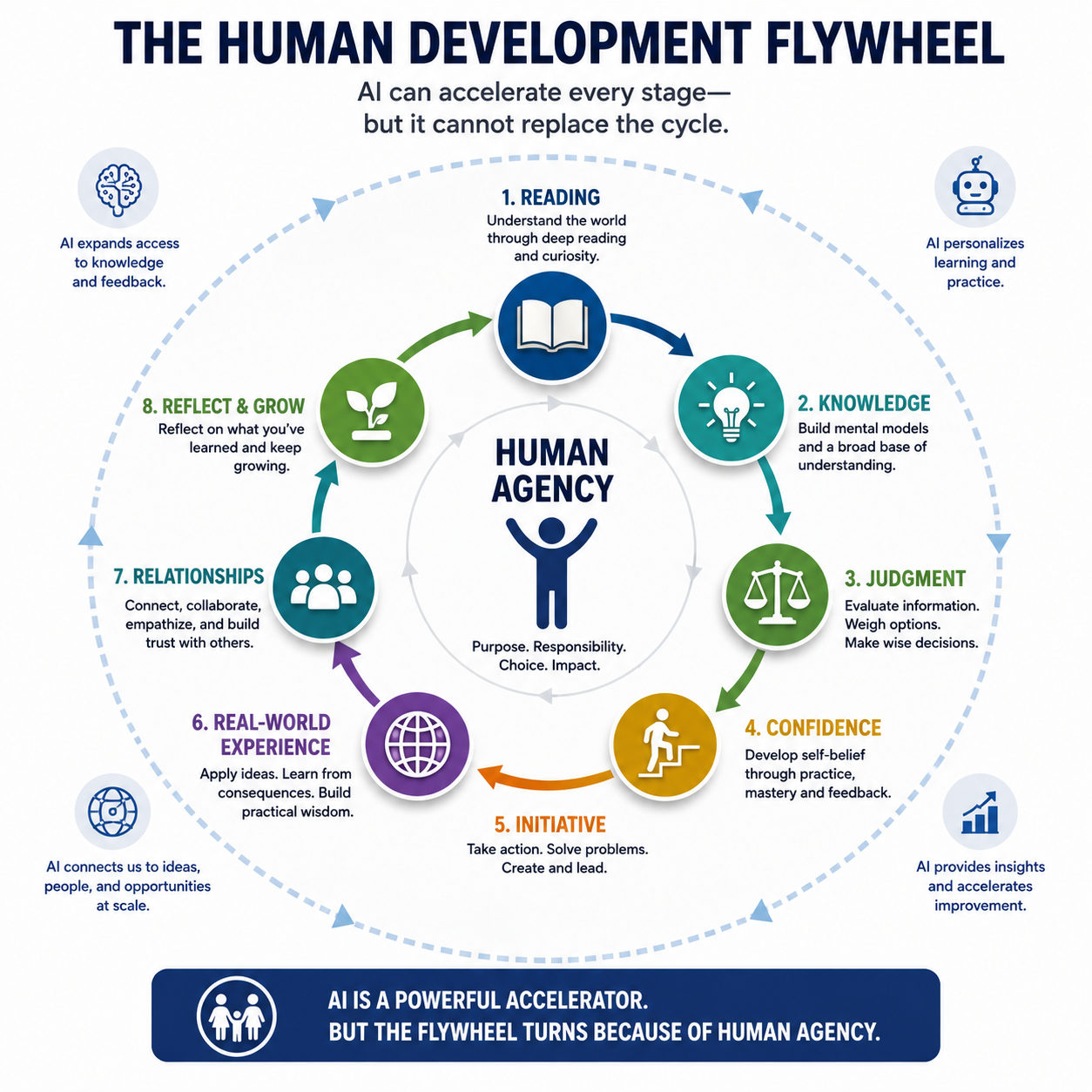
The point is initiative: seeing a problem, taking responsibility, trying something, learning from the result, and improving.
Teach Children to Evaluate Information
AI makes information verification more important.
Children will encounter:
- deepfakes;
- voice cloning;
- synthetic images;
- AI-generated news;
- fake experts;
- fabricated citations;
- manipulated screenshots;
- emotionally targeted content.
The Stanford History Education Group’s Civic Online Reasoning materials are built around a simple problem: students need explicit instruction in evaluating online information. The related lateral-reading approach asks students to leave the original page, investigate the source, and compare evidence across sources.
That habit becomes even more important when AI can generate credible-looking material at scale.
A basic verification checklist:
| Question | Why it matters |
|---|---|
| Who created this? | Source identity matters |
| What evidence is provided? | Claims need support |
| Is there a primary source? | Original evidence beats summaries |
| Can another reliable source confirm it? | Independent confirmation reduces risk |
| Could the media be manipulated? | Images, audio, and video can be synthetic |
| Is it trying to make me angry or afraid? | Emotional manipulation weakens judgment |
| What would change my mind? | Good thinking leaves room for correction |
Parents can practice this casually. When a claim appears in a video, article, or AI answer, ask:
How would we check that?
That question may become one of the most important digital citizenship habits a child can learn.
AI Tutors and AI Companions
AI tutors could be valuable.
They may help with:
- personalized practice;
- language learning;
- math support;
- special education;
- individual pacing;
- feedback;
- study planning;
- confidence for students afraid to ask questions.
The U.S. Department of Education notes that AI may help educators address variability in student learning and improve feedback loops. That upside is real.
But AI tutors and companions also create risks:
- dependency;
- emotional attachment;
- commercial incentives;
- privacy exposure;
- inaccurate feedback;
- social substitution;
- reduced tolerance for human friction.
AI systems are becoming more conversational, personalized, and persistent. Some children may begin treating them as friends or trusted confidants. Parents should remember that these systems are products created by companies with technical and commercial objectives. They do not have independent obligations to a child’s long-term well-being in the way parents, teachers, counselors, or close friends do.
UNICEF’s policy guidance on AI for children emphasizes safety, privacy, fairness, transparency, accountability, child development, and well-being. Those principles should apply directly to AI tutors and companions.
The practical rule is simple:
AI should supplement teachers, parents, friends, mentors, and peers. It should not replace them.
If an AI tutor helps a child practice algebra, that can be useful. If an AI companion becomes the child’s primary source of emotional support, that deserves much closer attention.
Does College Still Matter?
The wrong question is:
Will college disappear?
The better question is:
What does college actually provide, and which parts remain valuable in a world with AI?
College can provide:
- structured learning;
- credentials;
- professional networks;
- research access;
- identity formation;
- mentoring;
- internships;
- licensure pathways;
- exposure to difficult ideas;
- social development.
Different fields will evolve differently.
Medicine, nursing, engineering, law, teaching, trades, research, computer science, design, public service, and business do not all use education the same way. Some fields require credentials and supervised practice. Some may shift toward portfolios and demonstrated skill. Some may blend formal education with work-based learning.
The value proposition of college is likely to become more differentiated rather than disappear. Excellent schools may become even more valuable. Weak credential factories may become less valuable.
The World Economic Forum’s Future of Jobs Report 2025 and the ILO’s 2025 update on generative AI and jobs both point toward task transformation rather than a simple disappearance of work. That suggests education will still matter, but the signal employers and institutions look for may change.
The safest conclusion is not “college is over” or “college is always worth it.” The better conclusion is:
Education has to be evaluated by what it builds: capability, judgment, credential value, relationships, and access to meaningful work.
Choosing Schools in the AGI Era
Do not rank schools only by technology access.
Ask how the school uses technology and what human capabilities it protects.
A useful school evaluation scorecard:
| Question | What to look for |
|---|---|
| Does it teach reading deeply? | Sustained reading, discussion, comprehension |
| Does it protect writing as thinking? | Outlining, drafting, revision, argument |
| Is math taught conceptually? | Modeling, reasoning, problem-solving |
| Does science include evidence and uncertainty? | Experiments, claims, replication |
| Is AI literacy explicit? | Tool limits, verification, privacy, ethics |
| Is technology deliberate? | Purposeful use, not constant distraction |
| Are students speaking and collaborating? | Discussion, projects, presentations |
| Is hands-on work preserved? | Labs, art, building, repair, outdoor learning |
| Are children taught to evaluate media? | Source checking, lateral reading, evidence |
| Are students allowed to struggle? | Productive struggle builds durable learning and resilience |
| Does the school respect privacy? | Clear policies, limited data collection |
Parents do not need every school to be perfect. They need to know the tradeoffs.
A school with every device but little reading, writing, discussion, or hands-on work may not be preparing children well. A school that bans every tool without teaching AI literacy may also fall short.
The best schools will likely be the ones that combine strong foundations, responsible technology use, human relationships, and real-world problem solving.
Protect Children’s Privacy
AI raises the stakes of student privacy.
Parents should pay attention to:
- education technology platforms;
- AI tutoring tools;
- student profiling;
- voice recordings;
- biometric data;
- behavioral data;
- advertising;
- model training;
- long-term digital identity.
Many AI tools improve by collecting interaction history. Parents should distinguish between tools that process a child’s work temporarily and services that permanently retain interaction histories for profiling, product improvement, or future model training.
The Future of Privacy Forum’s student privacy resources and guidance on vetting generative AI tools for schools are useful references because they move beyond vague concern into procurement, governance, and legal compliance questions.
Parents should ask:
- What data is collected?
- Who owns it?
- How long is it stored?
- Is it sold or shared?
- Is it used for advertising?
- Is it used for model training?
- Can parents opt out?
- Can data be deleted?
- What happens after the child leaves the school or platform?
Children cannot meaningfully consent to every long-term data use. Adults have to create the guardrails.
Practical Household Actions
Parents do not need a perfect AGI timeline to act.
Start with practical habits:
- Read together every day.
- Ask children to explain AI-generated answers in their own words.
- Teach math beyond homework completion.
- Use AI with children, not secretly for them.
- Limit passive AI entertainment.
- Encourage projects that require effort over time.
- Teach basic repair, cooking, and household competence.
- Practice public speaking and conversation.
- Discuss online misinformation and deepfakes.
- Delay unnecessary social media when possible.
- Review privacy settings and school technology tools.
- Encourage curiosity, not just performance.
- Protect boredom and unstructured play.
- Help children build real relationships with adults and peers.
- Model ethical AI use yourself.
The point is not to create anxious children who fear the future. The point is to create capable children who can meet it.
Continue the AGI Household Resilience Series
This post is part of the AGI Household Resilience series. For the surrounding context, read:
- What Is AGI? What It Is, What It Is Not, and How to Track Progress
- AGI and Financial Independence: How Families Can Prepare for Economic Disruption
- Household Self-Sufficiency in the Age of AGI
- The AGI Mortgage Trap
- The AGI Career Transition Playbook
Final Takeaway
The children who thrive in an AGI world may not be the ones who memorize the most facts or use AI the fastest.
They are more likely to be the ones who combine strong foundations, good judgment, healthy relationships, practical competence, ethical reasoning, and the confidence to act when no model can decide for them.
AI may make answers inexpensive.
It may even make many forms of routine cognitive work commonplace.
But judgment, responsibility, relationships, initiative, and human agency become more valuable, not less, when powerful tools are available to everyone.