Robotics and the Physical Economy: When AI Leaves the Screen
On this page
- Intelligence Is Not Physical Capability
- Why the Physical World Is Hard
- Physical AI Is More Than a Robot
- Digital vs. Physical Automation
- Which Industries Change First?
- Humanoid Robots Are Only One Path
- The Economics of Physical Labor
- Why Adoption Takes Time
- What Robotics Means for Workers and Households
- Preparing for the Physical AI Economy
- Robotics, Infrastructure, and Local Resilience
- The Business Economics of Robotics
- What to Watch
- Final Takeaway
- Sources and Further Reading
# Robotics and the Physical Economy: When AI Leaves the Screen
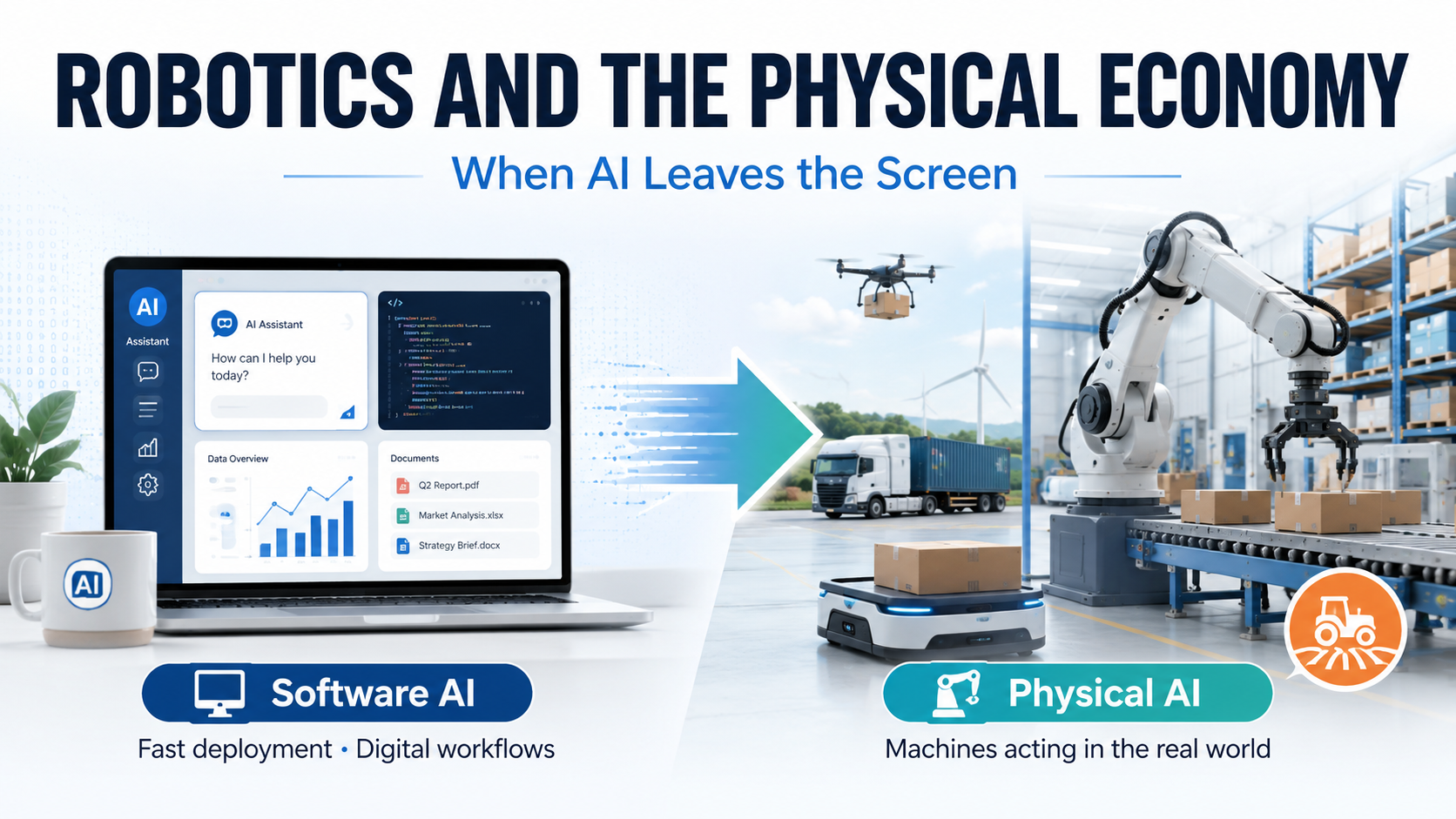
Most AI demonstrations happen on a computer.
Writing. Programming. Research. Images. Video. Planning. Conversation.
That is where the fastest progress is visible because software can be copied, updated, tested, and deployed quickly. A new model can reach millions of users through an app, browser, API, or enterprise platform almost overnight.
But the economy is not only software.
Someone still has to build homes, repair power lines, harvest crops, stock warehouses, install plumbing, operate ports, manufacture airplanes, maintain hospitals, deliver packages, and care for people in physical spaces.
The question is not simply:
Can AI perform economically valuable work?
The larger economic question is:
Can AI reliably act in the physical world?
Those are very different problems.
Software AI changes information first. Robotics changes production, logistics, infrastructure, care, construction, agriculture, and the physical services that keep daily life running. That second transition may be larger over the long run, but it will likely unfold more slowly because physical capability is harder to scale than digital capability.
This distinction matters for careers, households, businesses, investors, and communities. It helps explain why AGI may disrupt knowledge work before it transforms the entire physical economy.
Intelligence Is Not Physical Capability
A frontier AI model can write code, summarize scientific papers, draft legal language, analyze data, or operate software tools. That is impressive. But physical work requires a different stack of capabilities.
A useful robot needs more than intelligence.
It needs:
- motors;
- sensors;
- batteries or power systems;
- cameras or perception hardware;
- safety systems;
- durable materials;
- maintenance;
- repair parts;
- manufacturing capacity;
- installation;
- insurance;
- regulatory approval;
- field support.
Software can be distributed through the cloud. Robots must be built.
Once deployed, software can often serve additional users at relatively low marginal cost, although compute, support, licensing, and integration costs remain. A robot requires materials, assembly, shipping, deployment, and support. Software can fail, be patched, and relaunched. A robot that fails in a warehouse, hospital, road, farm, or construction site can damage property or injure someone.
That is why the digital AI timeline and the robotics timeline will not move at the same speed.
A software rollout looks like this:
Capability -> product update -> millions of users
A robotics rollout looks more like this:
Capability -> prototype -> manufacturing -> installation -> safety validation -> maintenance network -> replacement cycle
The difference is not trivial. It shapes how quickly AI changes the economy.
A company can add AI writing or coding tools in a quarter. Rebuilding a warehouse, hospital workflow, factory line, farm operation, or construction process around robots may take years.
Why the Physical World Is Hard
Humans underestimate the physical world because we move through it constantly.
A person can pick up a towel, open an unfamiliar cabinet, walk over uneven ground, adjust grip on a wet glass, and notice that a stair is slippery without consciously solving each problem.
For robots, those tasks are difficult.
The physical world is full of variation:
- lighting changes;
- floors are uneven;
- objects are fragile;
- materials bend or slip;
- weather changes conditions;
- people move unpredictably;
- tools differ by location;
- homes are not standardized;
- kitchens are cluttered;
- construction sites change daily;
- hospitals include safety-critical human interaction.
A robot that performs well in a controlled demonstration may still struggle in messy reality.
Picking fruit is hard because each fruit has a different shape, location, ripeness, and required grip strength. Construction is hard because job sites are temporary, irregular, and filled with changing hazards. Elder care is hard because the work combines physical assistance, emotional judgment, safety, privacy, and trust.
The physical world punishes overconfidence.
This is why robots are already useful in structured environments, but general-purpose robotics remains hard. The more controlled the environment, the easier automation becomes. The more open-ended the setting, the more difficult deployment becomes.
Physical AI Is More Than a Robot
The phrase “physical AI” is becoming more common because it points to something broader than a machine with motors.
Many software-AI systems are trained primarily on digital information such as language, images, video, and code. Physical-AI systems must additionally connect perception and reasoning to action in real environments. They must reason about objects, weight, friction, balance, force, momentum, spatial relationships, and cause and effect.
A language model can describe how to stack boxes. A physical AI system has to understand how the boxes shift, how much force to apply, whether the surface is stable, what happens if the load tilts, and how to recover when reality differs from the plan.
This is sometimes called embodied intelligence because the system learns through interaction with the physical world, not only by reading information about it. It is also why robotics companies and AI labs increasingly discuss world models, simulation, robotic foundation models, and training systems that connect perception, planning, and action.
Companies such as NVIDIA, Google DeepMind, Tesla, Figure, Agility Robotics, and Boston Dynamics approach this problem from different angles, but the economic question is the same: can intelligence become reliable enough to act safely and affordably in physical environments?
Digital vs. Physical Automation
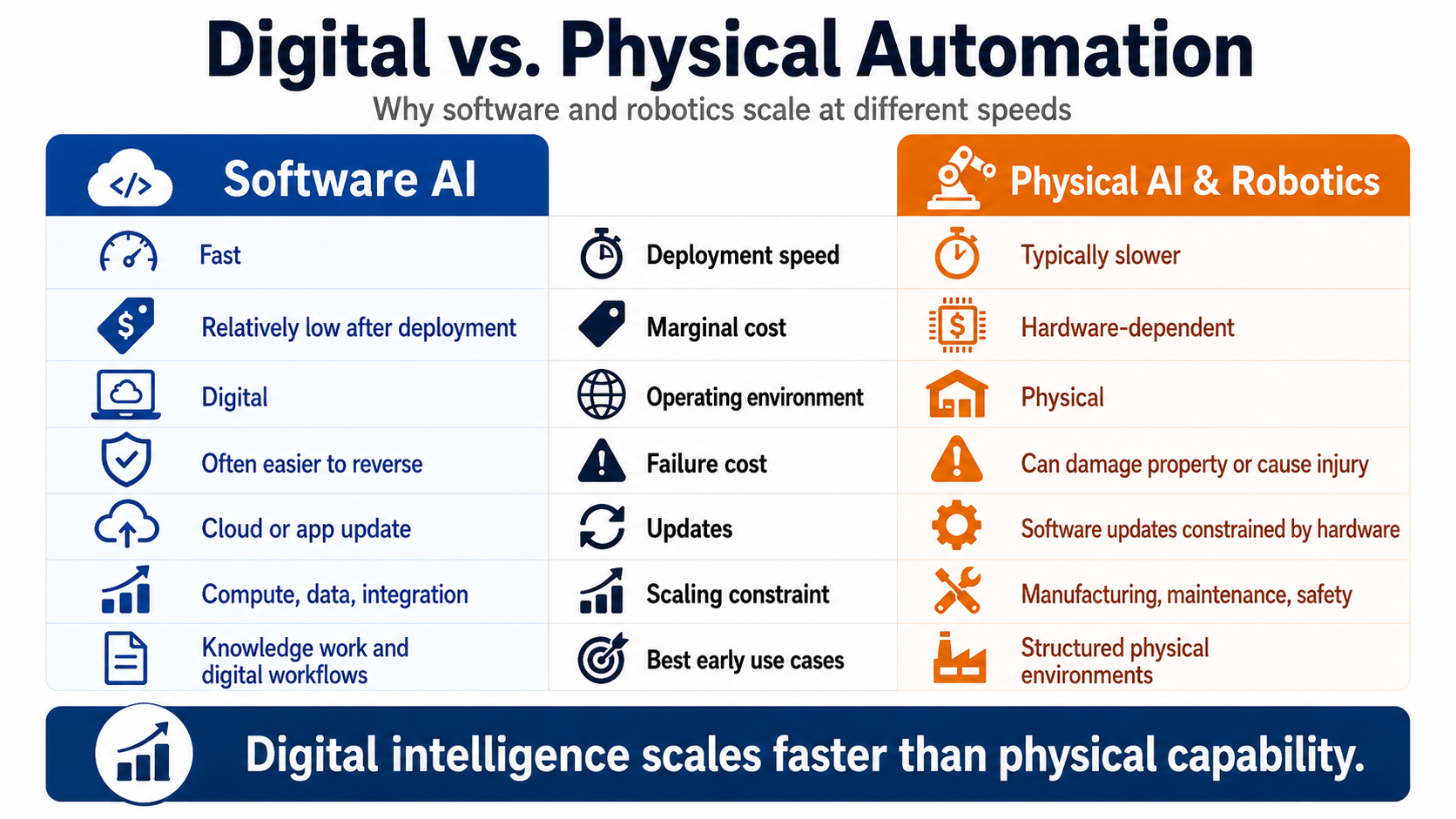
The economics of automation differ sharply between software and robotics.
This is the first major lesson of the AI robotics economy:
Digital intelligence scales faster than physical capability.
That does not mean robotics is less important. It means robotics has a different adoption curve.
Software AI may reshape work first. Robotics may determine how deeply AI eventually reshapes housing, healthcare, agriculture, logistics, construction, manufacturing, and energy.
Which Industries Change First?
Robotics adoption will not arrive everywhere at once.
Industries with structured environments, repetitive tasks, labor shortages, high injury risk, or strong return on investment will move first. Industries with unstructured human environments, complex judgment, and high safety requirements will move more slowly.
Demographics also matter. Robotics is not driven only by technical capability. Aging populations, fewer working-age adults in some countries, caregiver shortages, manufacturing shortages, logistics shortages, and persistent difficulty staffing physically demanding roles all increase demand for automation. In some sectors and regions, robotics may supplement a workforce that employers already struggle to recruit or retain.
| Industry | Relative near-term fit for robotics | Why |
|---|---|---|
| Warehouses | Strong near-term fit | Structured environments, repetitive movement, clear productivity metrics |
| Manufacturing | Strong near-term fit | Controlled settings, repetitive processes, existing automation culture |
| Agriculture | Favorable fit | Labor shortages, repetitive field tasks, strong incentive to reduce waste |
| Mining | Favorable fit | Dangerous work, remote operations, equipment-heavy workflows |
| Ports and logistics | Favorable fit | High throughput, large capital budgets, measurable delays |
| Construction | Selective fit | Large labor need, but highly variable sites |
| Healthcare | Selective fit | Strong need, but safety, privacy, and regulation slow deployment |
| Restaurants | Selective fit | Some structured kitchen tasks, mixed customer-facing complexity |
| Home services | More difficult fit | Every home differs, high variability, trust matters |
| Elder care | More difficult fit | Physical assistance plus emotional and ethical complexity |
This is an illustrative sequencing framework, not a probability forecast. Adoption will vary by task, location, labor costs, regulation, and operating environment.
This is sequencing, not permanence.
Home robots may eventually become much more capable. Humanoid robots may eventually work in settings designed for people. But the first broad economic changes are more likely to appear in warehouses, factories, logistics networks, agriculture, and specialized commercial environments than in every living room.
Humanoid Robots Are Only One Path
Many people hear “robotics” and picture a human-shaped machine.
Humanoids matter because the built world was designed around the human body. Doors, stairs, shelves, tools, steering wheels, sinks, kitchens, and workplaces assume a person-sized operator with arms, hands, legs, vision, and balance. A humanoid robot that can use existing infrastructure could be highly flexible.
But humanoids are only one path.
Humanoid robots receive substantial media attention, but most current robot deployments remain specialized systems designed for particular industries and tasks.
Robotics already includes:
- industrial arms;
- warehouse robots;
- surgical robots;
- autonomous tractors;
- drones;
- mining vehicles;
- delivery robots;
- inspection robots;
- cleaning robots;
- port automation systems;
- robotic exoskeletons;
- mobile manipulation platforms.
A warehouse robot does not need to look human to move inventory. A drone does not need arms to inspect infrastructure. An autonomous tractor does not need legs to work a field. An industrial arm does not need a face to assemble parts.
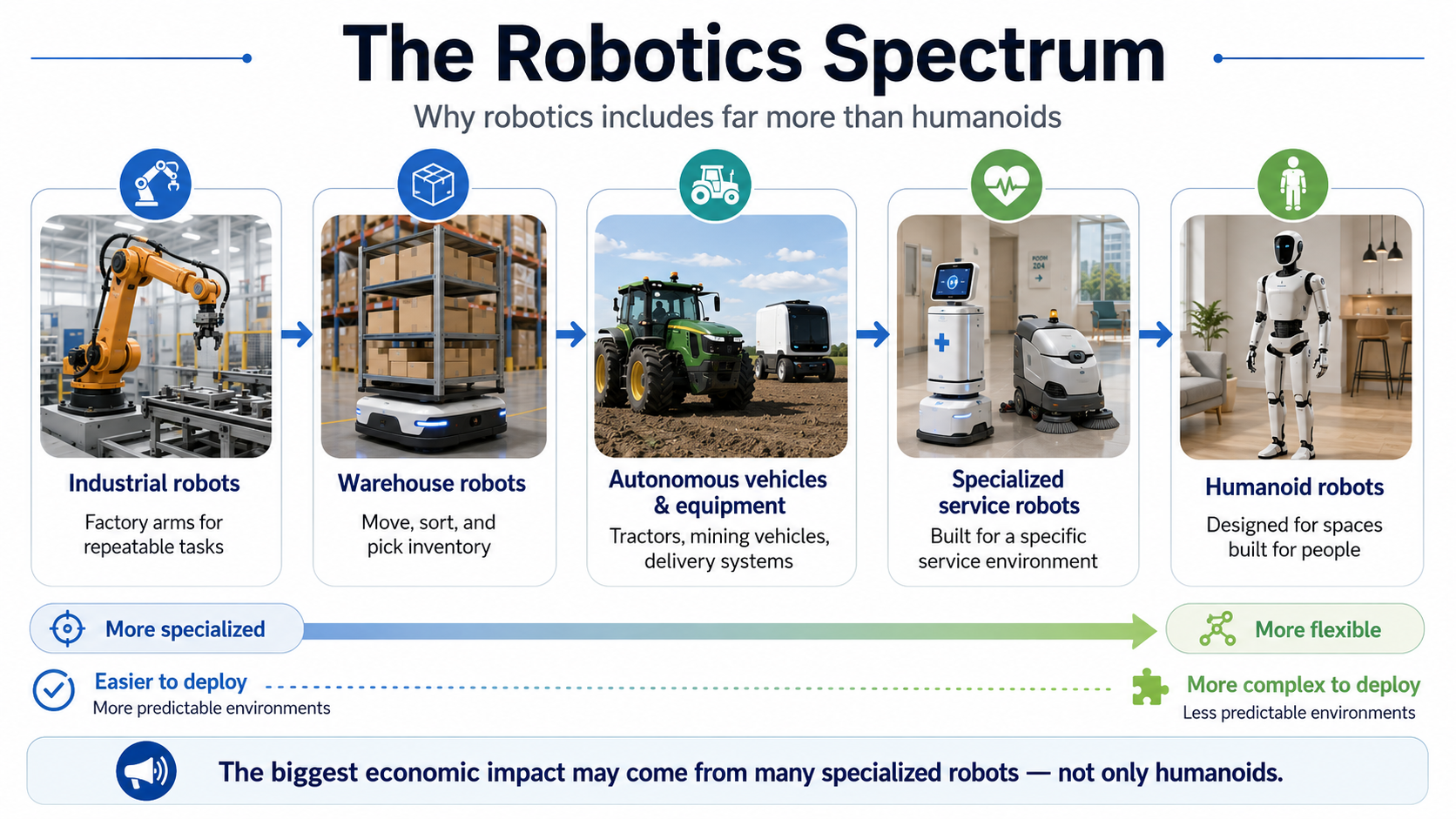
The largest economic impact may come from many types of robots, each designed around a specific task or environment.
The robotics spectrum looks roughly like this:
| Type | Flexibility | Deployment difficulty |
|---|---|---|
| Industrial robots | Low to medium | Lower in controlled factories |
| Warehouse robots | Medium | Moderate |
| Autonomous vehicles and equipment | Medium | High safety and regulatory burden |
| Specialized service robots | Medium to high | Depends on environment |
| Humanoid robots | Potentially high | Very high |
Humanoids are exciting because they promise generality. Specialized robots are important because they may be easier to justify economically.
Both matter.
The Economics of Physical Labor
A robot does not need to be perfect to be useful. But it does need to make economic sense.
A business comparing robots to human labor is not only comparing hourly wages. It is comparing the full operating system of work.
A robot must compete against:
- wages;
- benefits;
- training;
- turnover;
- injury risk;
- insurance;
- management overhead;
- quality control;
- downtime;
- capital cost;
- financing cost;
- depreciation;
- maintenance;
- software fees;
- spare parts;
- safety compliance;
- integration cost;
- facility redesign.
That comparison can favor robots quickly in some settings.
If a task is repetitive, physically demanding, hard to staff, measurable, and performed in a controlled environment, automation becomes attractive. Warehouses, factories, mines, farms, and logistics hubs often fit this pattern.
But the comparison can also delay adoption.
If a robot is expensive, fragile, hard to maintain, difficult to integrate, or unsafe around people, the return on investment may fail even if the technology is impressive. A robot that works in a demo but requires constant human rescue may not reduce labor needs. It may simply create a new supervision burden.
Frequent human intervention generally weakens the economics of automation by adding labor, delay, and supervision costs back into the workflow.
The practical question is not:
Can a robot do the task once?
The better question is:
Can the robot do the task safely, repeatedly, affordably, and with less total operational burden than the current system?
That is the threshold that matters.
Why Adoption Takes Time
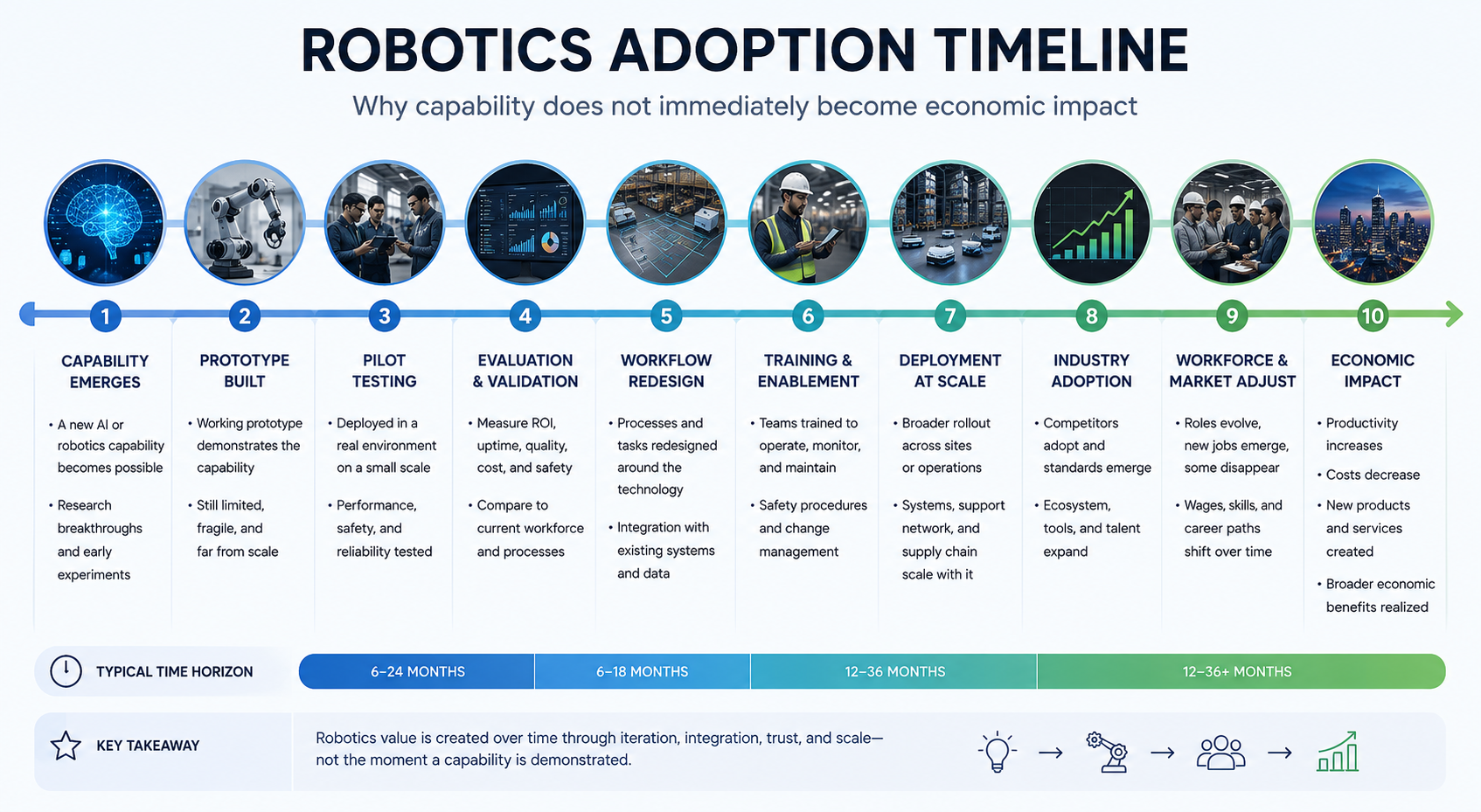
AI capability does not immediately become economic impact.
This is true for software. It is even more true for robotics.
The adoption path usually looks like this:
- A capability becomes possible.
- A prototype demonstrates it.
- A pilot tests it in a real environment.
- The organization measures cost, safety, downtime, and output.
- Workflows are redesigned around the system.
- Staff are trained to operate and maintain it.
- The company expands deployment.
- Competitors respond.
- The labor market adjusts.
- The broader economy feels the effect.
Skipping steps is difficult because physical systems create real-world liabilities.
A company can experiment with an AI writing tool quietly. It cannot deploy a fleet of robots in a hospital, factory, city street, or construction site without safety planning, insurance, procurement, employee training, and operational support.
This explains why AGI does not instantly remake civilization.
The digital economy can change quickly. The physical economy has friction.
Machines must be built, financed, deployed, maintained, trusted, and replaced. Supply chains must scale. Regulations must adapt. Workers must learn new roles. Facilities may need redesign.
Capability is only the beginning.
What Robotics Means for Workers and Households
Robotics does not simply remove jobs. It changes the composition of work and the timing of household risk.
AI may affect digital work before it affects physical services. That means some white-collar roles may experience disruption sooner than many skilled trades, healthcare support roles, logistics roles, or field service roles. But physical work is not immune.
In many industries, workers may interact with more intelligent equipment. Some tasks may disappear. Some tasks may become safer. Some jobs may shift toward supervision, maintenance, troubleshooting, quality assurance, and coordination.
The likely direction is not:
Every physical job disappears overnight.
It is more likely:
Physical work becomes increasingly automated, instrumented, supervised, and integrated with software.
That creates demand for people who understand both the physical system and the digital layer around it.
Useful roles may include:
- robotics technicians;
- field service specialists;
- automation integrators;
- industrial maintenance workers;
- safety supervisors;
- process engineers;
- controls technicians;
- logistics coordinators;
- equipment operators using autonomous systems;
- data and operations analysts;
- workers who can train, inspect, and troubleshoot robotic workflows.
The safest worker is not necessarily the one doing a task exactly the old way. It may be the person who understands the task deeply enough to improve, supervise, maintain, or redesign the system around it.
Over time, households should expect:
- more robotics in warehouses and logistics;
- more automation in manufacturing;
- more autonomous equipment in agriculture and mining;
- more AI-assisted maintenance and inspection;
- more robots in hospitals and elder-care settings, starting with support tasks;
- more construction technology, prefabrication, and site automation;
- more demand for technicians who can maintain automated systems;
- more hybrid roles combining tools, data, equipment, and judgment.
Households should avoid two extreme assumptions.
The first extreme is thinking robotics will eliminate all physical work immediately. That underestimates the difficulty of the physical world.
The second extreme is thinking physical work is permanently protected. That underestimates how quickly capability, capital, and labor shortages can push automation once systems become reliable.
A practical household strategy is to build adaptability around the middle. Careers tied to physical systems may remain important, but the best opportunities may go to people who can work with intelligent tools, not only around them. Work that combines domain judgment, physical reality, safety, customer trust, and system-level responsibility may be more durable.
Preparing for the Physical AI Economy
The physical AI economy rewards people who can connect software, hardware, operations, and judgment.
That does not mean everyone needs to become a robotics engineer. It means more people may benefit from understanding how intelligent systems interact with the real world.
Useful areas include:
- basic AI literacy;
- automation concepts;
- mechanical systems;
- electrical systems;
- sensors and controls;
- safety systems;
- industrial processes;
- logistics;
- maintenance;
- troubleshooting;
- systems integration;
- data interpretation;
- cybersecurity for connected equipment.
For young people, this argues for strong foundations: math, science, reading, writing, technical literacy, hands-on skills, and problem solving.
For adults, it argues for selective upskilling. A project manager in manufacturing should understand automation. A logistics manager should understand warehouse robotics. A nurse leader should understand clinical AI tools and assistive robotics. A tradesperson should understand smart systems, diagnostics, and connected equipment.
People who understand both software and physical systems may become especially valuable.
That includes:
- electricians who understand smart energy systems;
- mechanics who understand sensors and diagnostics;
- construction professionals who understand automation and prefabrication;
- healthcare workers who understand assistive technology;
- operations leaders who can integrate AI into real workflows;
- engineers who can translate between models, machines, and frontline reality.
The transition does not only reward coders. It rewards translators between intelligence and implementation.
Robotics, Infrastructure, and Local Resilience
Robotics also connects directly to community resilience.
Communities with strong technical education, trade programs, community colleges, manufacturing bases, logistics hubs, healthcare institutions, and local maintenance capacity may adapt better to physical AI than communities that depend entirely on distant employers and imported expertise.
A region that can train technicians, repair equipment, support small manufacturers, and upgrade infrastructure has more options. A region that loses local technical capacity may become dependent on outside vendors for essential systems.
AI may be global. Robotics deployment is local.
Robots operate in specific buildings, fields, roads, clinics, warehouses, factories, and homes. The benefits depend on local institutions, workforce skills, infrastructure, procurement decisions, and maintenance capacity.
This is why physical AI is not only a technology story. It is also a regional development story. For more on the local layer, see Building Local Community Resilience in the Age of AI and AGI.
The Business Economics of Robotics
Robotics also changes how we should think about the AGI economy.
Software companies can grow quickly because digital products scale quickly. Robotics companies face more capital intensity, longer deployment cycles, hardware margins, supply chains, liability, and service obligations.
That does not make robotics less important. It makes the business model different.
Economic value may be distributed across robot manufacturers, components, chips and sensors, simulation software, integrators, maintenance networks, training providers, and the companies that redesign operations around robotic systems.
In many cases, the value may not accrue only to the company building the humanoid robot. It may accrue to the firms that deploy robotics effectively inside logistics, agriculture, manufacturing, healthcare, defense, and infrastructure.
The important question is not only:
Who builds the robot?
It is also:
Who uses robotics to produce more with less fragility?
Many of the largest economic gains may come from the companies that successfully integrate robotics into existing industries rather than from robot manufacturers themselves. History suggests that enabling technologies often create widespread value throughout supply chains, software providers, component manufacturers, service organizations, and the firms that redesign operations around the new capability.
What to Watch
For the AI robotics economy, demonstrations are less important than deployment evidence.
Watch three groups of signals.
Technical reliability:
- lower intervention rates;
- more operating hours between failures;
- clear safety records;
Commercial economics:
- declining cost per completed task;
- lower total cost of ownership;
- paid commercial customers;
- repeat purchases;
- fleet expansion;
Organizational integration:
- normal workflow use;
- maintenance capacity;
- insurance acceptance;
- worker training programs;
- deployments beyond carefully controlled pilots.
A viral robot video is interesting. A customer renewing a contract, expanding a fleet, and reducing costs is more important.
The real signal is not whether a robot can complete a task once. It is whether organizations trust it enough to redesign operations around it.
Final Takeaway
Software AI is transforming information.
Robotics transforms production.
Those are different timelines.
This distinction explains why AGI may disrupt knowledge work before it fully reshapes the physical economy. The digital economy can change in months because software can be copied, integrated, and updated quickly. The physical economy changes over years because machines must be built, deployed, financed, maintained, regulated, and trusted.
The future is unlikely to be a world where humans disappear from physical work overnight.
It is more likely to be a world where humans increasingly work alongside intelligent machines while industries gradually redesign themselves around new capabilities.
The most important economic shift may not be when AI becomes better at answering questions.
It may be when intelligence becomes reliable enough to move through the world, handle materials, maintain infrastructure, care for people, and produce physical goods at scale.
The software-AI transition is already accelerating. Industrial automation is well established, but the next phase, more adaptable physical AI that can perceive, reason, and act across varied environments, is still developing.
Understanding the distinction between software intelligence and physical capability helps explain many of the themes explored throughout this series. Career transitions, household resilience, local communities, manufacturing, infrastructure, and long-term economic change depend not only on what AI can analyze or generate, but on what intelligent machines can reliably do in the physical world.
Software intelligence changes information.
Physical AI changes what the economy can build, move, maintain, and deliver.
That is when AI truly leaves the screen.
Sources and Further Reading
- International Federation of Robotics: World Robotics 2025
- IFR: World Robotics 2025 Industrial Robots
- IFR: World Robotics 2025 Service Robots
- Google DeepMind: Gemini Robotics
- Google DeepMind: Gemini Robotics ER 1.6
- NVIDIA Cosmos: Physical AI with World Foundation Models
- NVIDIA: Physical AI Reasoning, World, and Action Models
- OECD: Artificial intelligence
- World Economic Forum: Future of Jobs Report 2025
- NIST: Artificial Intelligence
- NVIDIA Isaac Robotics Platform
Commercial robotics examples: