When the First Rung Disappears: How Do People Build Experience in an AI Economy?
On this page
- What the Evidence Does and Does Not Show
- There are reasons to watch junior opportunities closely
- The causal story is unsettled
- How Experience Is Actually Built
- Build a Ladder of Responsibility
- 1. Practice safely
- 2. Deliver under review
- 3. Own a bounded outcome
- 4. Handle exceptions
- 5. Teach and improve the process
- Look for Paid Pathways With Real Supervision
- Build Work Samples That Can Be Questioned
- A hypothetical example
- Use AI to Strengthen the Learning Loop
- Employers Need to Budget for Future Expertise
- Education Should Connect Learning to Reviewed Work
- Household Support Needs Boundaries and a Purpose
- A 30, 90, and 365 Day Experience Plan
- First 30 days: identify the missing step
- First 90 days: complete a reviewed cycle
- First 365 days: look for progression
- A Practical First Rung Checklist
- Final Takeaway
- Continue the AGI Household Resilience Series
- Sources and Tools
Entry-level work produces today’s output and tomorrow’s experienced people. If artificial intelligence (AI) changes the first job, workers, employers, educators, and households need a better way to preserve the learning inside it.

A junior analyst prepares a report. A senior colleague questions the assumptions. The analyst goes back to the source, corrects an error, and learns which detail changes the decision.
The report is the visible product. A more capable analyst is another product of the same work.
Now imagine the first draft arrives almost instantly. The organization can produce the report with fewer hours of junior effort. That may be a genuine improvement. But if the junior position disappears with the drafting work, something else has to replace the practice, feedback, and gradually increasing responsibility it once provided.
This is the question behind the first rung of a career ladder: where will experienced people come from if fewer organizations make room for beginners?
Some entry routes may narrow, but evidence does not show entry-level work disappearing everywhere or prove that AI alone caused recent declines. Waiting for a definitive economy-wide answer, however, will not help a person choosing between two training programs or a manager redesigning a junior role today.
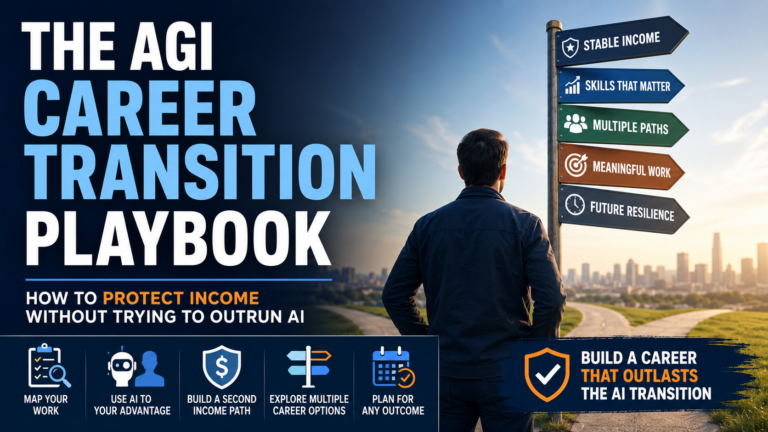
The AGI Career Transition Playbook explains how to move toward valuable outcomes and accountable work. This article takes the next question seriously: how does someone earn the judgment and credibility required to take on those responsibilities?
The practical response has five parts:
- Preserve repeated work and expert correction.
- Make responsibility increase in steps that a learner can actually handle.
- Favor paid pathways with identifiable supervisors and real outcomes.
- Build work samples that show decisions, verification, and improvement.
- Give the transition a household plan without making family wealth a prerequisite for entry.
The evidence and public resources below are primarily U.S.-focused. The learning framework also applies to career changers and people returning after a break. Beginning a new kind of work is not confined to one age group.
What the Evidence Does and Does Not Show
There are reasons to watch junior opportunities closely
Revelio Labs’ September 2026 tracker, released October 1, reports weaker posting demand in highly AI-exposed occupations, particularly junior roles. Its headline posting gap between the most and least exposed occupations was −29%, narrower than July’s −40%. These are relative estimates against an October 2022 baseline, not the percentage of all jobs eliminated. Revelio Labs, September tracker.
A separate Revelio analysis of 75 million tech postings since 2024 finds advertised requirements moving toward fewer listed skills and greater experience depth. Average required experience performing the advertised skills increased from approximately 4.6 to 4.8 years. These are requirements in tech advertisements, not a measure of what every employer actually hires. Revelio Labs, tech hiring analysis.
For a beginner, even a modest shift can matter. A market that asks for more demonstrated competence while offering fewer supervised ways to acquire it creates a difficult entry problem.
The causal story is unsettled
Revelio’s tracker also finds employment growth at firms classified as AI adopters, including junior growth, and fewer Worker Adjustment and Retraining Notification (WARN) layoff notices at more-exposed firms. Exposure estimates possible task capability; its adoption proxy uses AI-integrator job postings. Neither measure cleanly isolates what AI caused, and adopting firms were already growing faster. Revelio Labs, September tracker.
There is directly conflicting evidence. In a May 2026 analysis using Lightcast postings and a different exposure measure, New York Fed researchers found that high-exposure hiring weakness began before ChatGPT. They also found no clear post-2022 divergence between junior and senior postings within highly exposed occupations. Different samples, definitions, periods, and methods can produce different answers. Audoly, Guerin, and Topa, May 14, 2026.
The sensible conclusion is narrower than a prediction of universal job loss: entry pathways deserve attention, while the contribution of AI remains an empirical question. Business conditions, training practices, work location, and employer choices also matter.
A household should watch actual openings, paid placements, and hiring requirements in its target field. A manager should examine what beginners are still getting to practice. Both can act on those observations without claiming to know the final employment effect of AI.
How Experience Is Actually Built
“Experience required” is a compressed description of several different things.
An employer may want someone who recognizes a bad input, knows when a routine procedure no longer fits, can explain an uncomfortable result, or asks for help before an error becomes expensive. Time in a role can expose a person to these situations, but time alone does not guarantee learning.
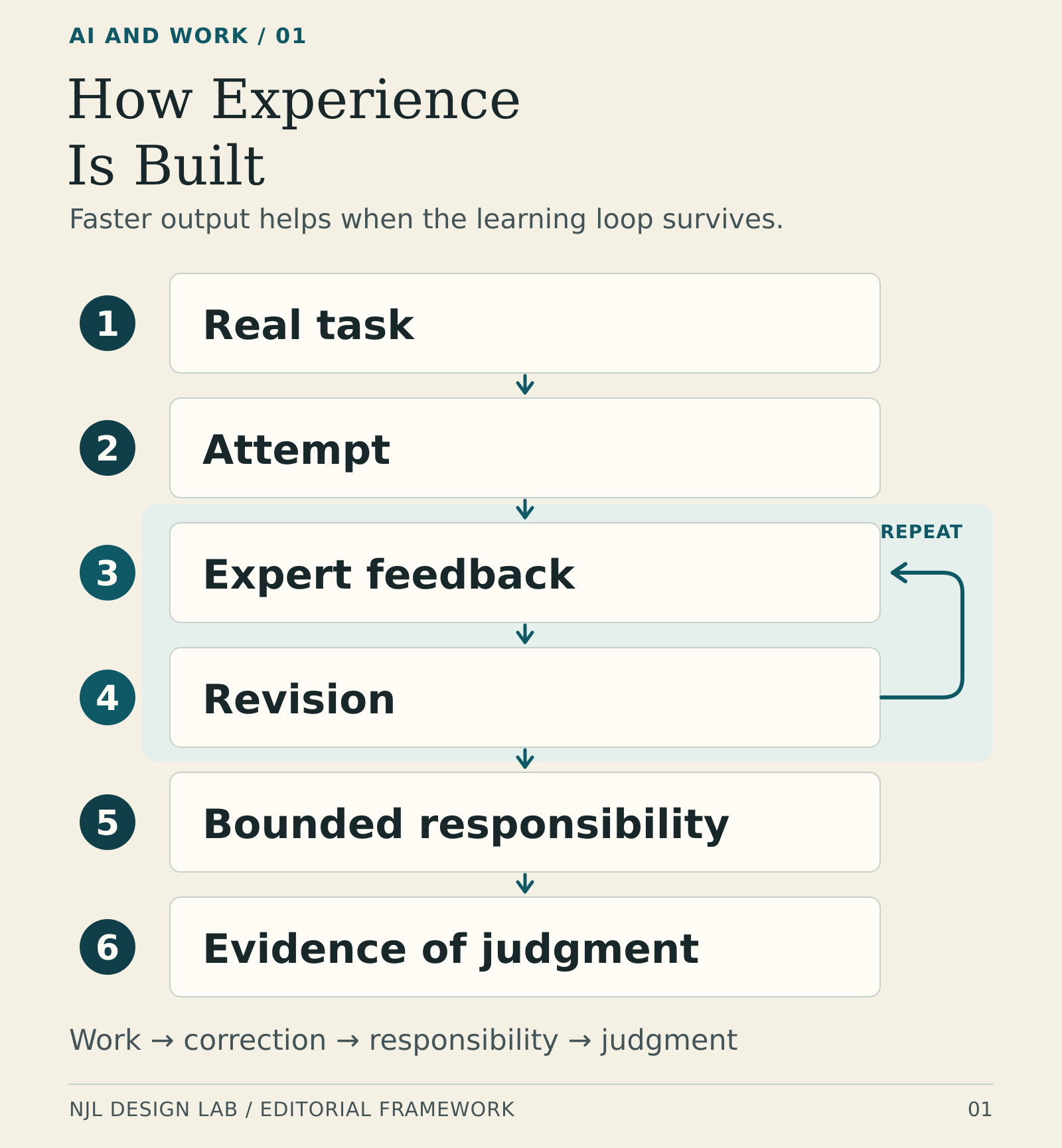
A useful way to design experience is to look for a repeatable sequence:
- A real task. Someone needs a result, with a purpose and constraints.
- An attempt. The learner makes choices rather than only watching.
- Expert feedback. A qualified reviewer identifies what is wrong, incomplete, or unusually good.
- Revision. The learner acts on the feedback and explains the change.
- Bounded responsibility. The next assignment gives the learner a manageable increase in ownership.
- Evidence of judgment. The record shows what the learner can now do and when they know to escalate.
This is an editorial framework for evaluating a learning opportunity, not a validated scoring system. Its value is that each stage can be inspected.
A role can be busy and still offer little development. If every task ends with copying an AI answer into another system, nobody reviews the reasoning, and no responsibility changes, the worker may accumulate activity without learning much about the underlying work.
AI can help at several stages: generating practice cases, explaining unfamiliar concepts, proposing alternatives, and identifying questions to bring to a supervisor. The design problem is keeping the learner inside the decisions that develop competence.
Build a Ladder of Responsibility
A beginner does not need to jump directly from a course to unsupervised ownership. A workable pathway makes the next step visible and limits the cost of mistakes.
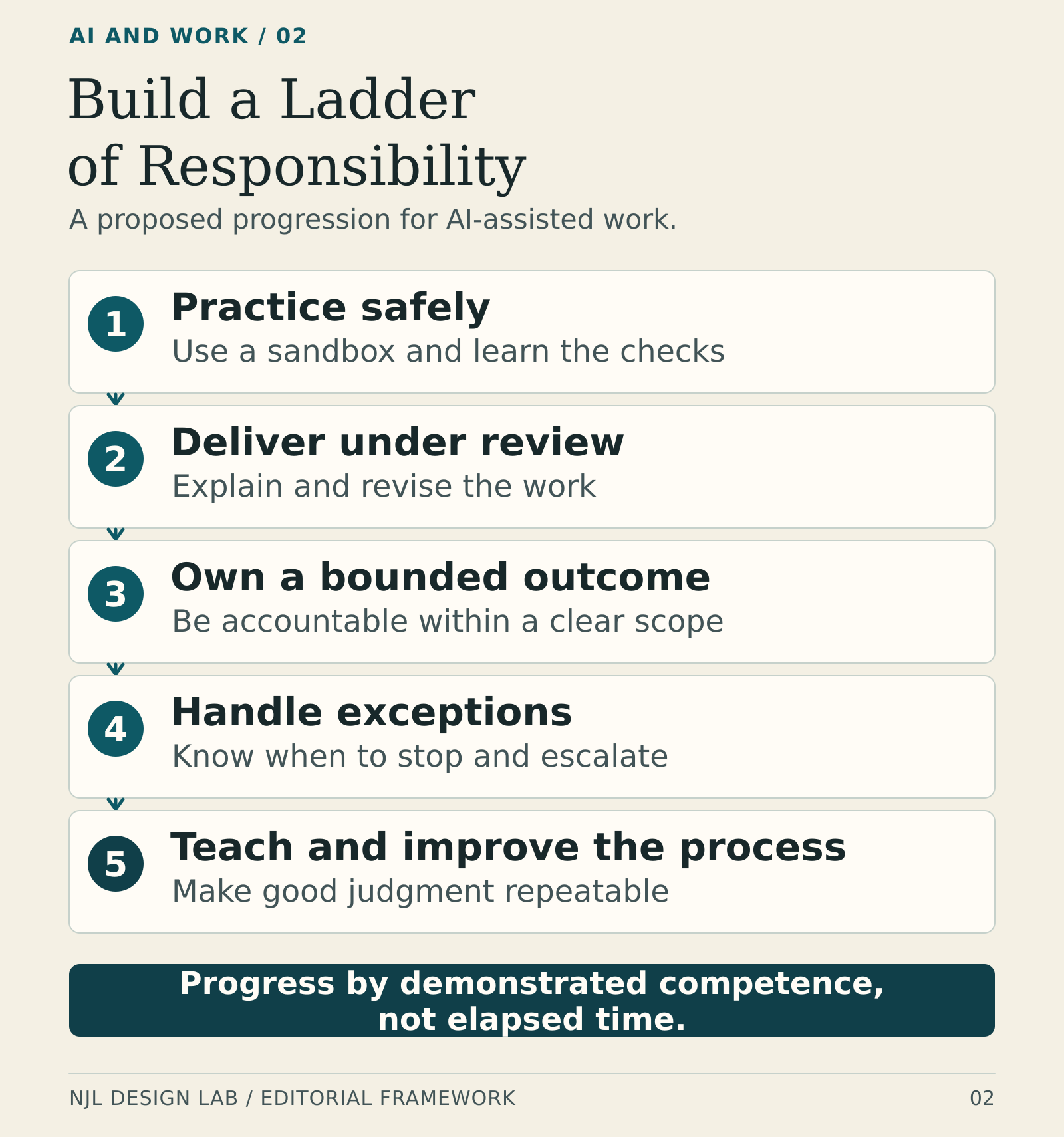
The following progression can be adapted to many fields. Licensing, safety rules, and professional requirements still govern who may perform or approve particular work.
1. Practice safely
Use public, synthetic, or properly authorized training material. Recreate a small workflow, explain the steps, and compare the result with a trusted reference.
A learner analyzing a public dataset should be able to explain the columns, missing values, and denominator before presenting a chart. An AI-generated explanation is a starting point to investigate, not evidence that the learner understands it.
The advancement question: can the person perform and explain the basic work, including its limits?
2. Deliver under review
Give the learner a real assignment with a named reviewer, clear acceptance criteria, and a deadline that leaves time for correction. The reviewer approves the output before anyone relies on it.
The learner should bring a recommendation, its supporting evidence, and unresolved questions. The reviewer should explain important corrections rather than silently replacing the work.
The advancement question: can the person reliably produce usable work after review and avoid repeating known errors?
3. Own a bounded outcome
Expand responsibility within an agreed limit. The person might own a routine weekly report, a low-risk process improvement, or one defined part of a larger project. Specify decisions they may make, decisions requiring approval, and conditions that trigger escalation.
Ownership should come with authority, access, and support. Giving a junior employee a consequential risk to carry without those protections is poor supervision.
The advancement question: can the person keep a limited commitment, notice trouble, and get help in time?
4. Handle exceptions
Introduce unfamiliar cases with appropriate supervision. Ask what assumption has changed, which source should be trusted, and whether the normal process should stop.
For an AI-assisted workflow, include plausible but incorrect outputs. The learner should demonstrate how they would detect the problem and what they would do next. Merely accepting or rejecting an answer is less informative than explaining the test.
The advancement question: can the person recognize when the standard method is insufficient?
5. Teach and improve the process
Ask the person to explain a recurring problem to another learner, improve a checklist, or document why an exception needed special treatment. A process improvement should preserve necessary review rather than removing it for speed alone.
The advancement question: can the person make the work more reliable for someone else?
Move between these stages based on demonstrated competence. A fixed number of weeks is not evidence that someone is ready, and some work will always require qualified supervision.
Look for Paid Pathways With Real Supervision
A useful search starts with the learning arrangement, alongside the job title.
U.S. Registered Apprenticeship provides one established model: paid work, structured training, mentoring, wage progression, and a recognized credential. Applicants can use Apprenticeship.gov’s career-seeker resources to find opportunities and program sponsors. Availability, entry requirements, and terms vary.
Other routes may include paid internships, cooperative education, employer training programs, internal rotations, and paid return-to-work placements. A label alone tells little about their quality. Ask what actually happens after entry.
Before committing, get concrete answers:
- Who will review my work, and is time reserved for that review?
- What will I do during the first month?
- Which tasks will I be expected to perform without AI assistance?
- What responsibilities could I earn next, and how is readiness assessed?
- What are the pay, hours, costs, and conditions in writing?
- What evidence of completed work can I keep or describe afterward?
- What happened to recent participants, including those who did not finish?
If a provider advertises a placement rate, ask for the time period, denominator, definition of a placement, and whether the jobs are paid and related to the training. A testimonial cannot answer those questions.
Do not assume that buying another course solves a shortage of supervised opportunities. A course may be worthwhile when a specific role requires its credential or when it addresses an identified skill gap. Before a large commitment, check whether actual employers recognize it and whether the program includes the kind of practice the role demands.
For people who need income immediately, the search may require a two-part plan: paid work that supports the household now, and a manageable route toward the target field. That is a constraint to design around, rather than a reason to prescribe an unaffordable period of unpaid work.
Build Work Samples That Can Be Questioned
When polished output is easy to generate, a portfolio needs to reveal more of the process behind it.
A useful work sample lets a reviewer ask: what did this person understand, decide, check, and improve?
Build a small evidence dossier for a completed project:
- The brief: who needed what, and why.
- The constraints: time, data, tools, access, budget, or other limits.
- The first approach: what you tried and why.
- The AI contribution: where tools helped and what you personally checked.
- The verification: source checks, tests, comparisons, or review criteria.
- The revision: a meaningful error or weakness and how you addressed it.
- The outcome: what was delivered and what was actually observed.
- The boundary: what remains uncertain or outside your responsibility.
Distinguish a simulated project from live work. Distinguish a proposed benefit from a measured result. If nobody used the prototype, say that. If a supervisor approved the work, describe their role accurately and obtain permission before naming them or sharing their comments.
A hypothetical example
Suppose a career changer builds a scheduling analysis with synthetic data for a fictional repair business.
A weak case study presents a dashboard and claims that it could transform operations.
A stronger case study explains how appointment lengths were modeled, identifies an incorrect assumption in the first version, compares two scheduling rules, and shows what changes when a technician is unavailable. It states that the data are synthetic and that savings have not been demonstrated in a real business.
The second version gives an interviewer something concrete to examine. The candidate can be asked to change an assumption, explain a tradeoff, or identify what data would be needed before deployment.
Where permitted, a later paid assignment can add evidence from real users and real constraints. The earlier simulation remains useful, but the two should never be presented as equivalent experience.
A concise, inspectable case study is preferable to a large collection whose origins and claims cannot be checked. Keep only materials you are authorized to retain. Confidential employer work, customer information, private code, and restricted data do not become portfolio assets because you helped create them. Use an approved description or a separate synthetic example when necessary.

Use AI to Strengthen the Learning Loop
There is evidence that AI can help beginners perform better. The published study Generative AI at Work followed 5,172 customer-support agents during a staggered rollout. It found an average productivity increase of 15%, measured as issues resolved per hour, with less-experienced and lower-skilled workers gaining in both speed and quality, alongside evidence of learning. This was one workplace setting, not proof that AI creates entry-level jobs everywhere. Brynjolfsson, Li, and Raymond, 2025.
The practical opportunity is to use assistance while checking whether the learner’s own competence improves.
Try a three-part routine:
- Attempt before assistance. State the problem, sketch an approach, and identify uncertainty before asking a tool to solve it.
- Compare and verify. Examine where the AI’s approach differs. Check consequential claims against authoritative sources or appropriate tests.
- Demonstrate understanding. Explain the result without reading the generated answer. Rework part of the task when an input changes.
For supervisors, occasionally assess a relevant task with limited assistance. The purpose is to find gaps in understanding and confirm that a person can handle a tool outage or detect a bad answer. Follow workplace policies and make assessment conditions clear in advance.
A learner should be able to say both how AI improved the work and where human review remained necessary. Neither hiding tool use nor treating every generated answer as suspect helps a reviewer understand actual competence.
Employers Need to Budget for Future Expertise
An organization redesigning a workflow should ask what happens to its supply of experienced people as well as its output per employee.
If junior tasks are automated, the learning may need to be deliberately re-created elsewhere. Pair a beginner with a reviewer on a small outcome. Rotate learners through intake, execution, quality checks, and customer feedback. Preserve access to exceptions and post-project reviews rather than letting junior staff see only the clean final answer.
Give mentors protected time and credit for developing others. A manager who is rewarded entirely for short-term delivery has little room to train a colleague whose work initially needs correction.
The work arrangement matters too. Research by Emanuel, Harrington, and Pallais links proximity to colleagues with more feedback and mentorship in a studied firm, and identifies remote-work-related training frictions as a possible contributor to weaker opportunities for young graduates. Its results should not become a blanket claim that every remote role is unsuitable for beginners. New York Fed, June 1, 2026.
The management question is specific: where and when does feedback happen? A remote program can schedule paired work, live review, and accessible office hours. An office can leave a junior employee isolated at a desk. Evaluate the actual learning arrangement.
Track a few development outcomes alongside production:
- Time until a learner can complete a defined task to standard.
- Repeated errors and how quickly they are corrected.
- Responsibility gained, with appropriate approval.
- Retention and progression after the placement.
- Whether access extends beyond candidates who can afford to work for little or no pay.
These measures will not settle the economics of every junior position. They make the cost of eliminating a training pathway harder to overlook.
Education Should Connect Learning to Reviewed Work
A school or training program can teach foundations, but students also need opportunities to apply them under realistic constraints.
When comparing programs, ask about paid placements, employer partnerships, supervisor involvement, and the work students must defend or revise. Request examples of assessment: does a student merely submit an artifact, or explain it, test it, and respond to questions about its limitations?
For AI-assisted assignments, a final answer can be accompanied by a short decision record, source checks, and an explanation of revisions. The assessment should reflect the skills the program claims to teach.
A degree or credential can still be essential for a profession. The relevant question is what combination of foundational education, required qualification, and supervised work provides a credible route into that field. Neither a degree alone nor a portfolio alone is a universal substitute for the whole pathway.
The broader educational foundation is covered in Raising Children in the Age of AGI. The transition into work adds a further requirement: someone must make room for the learner to become useful through practice.
Household Support Needs Boundaries and a Purpose
Early-career transitions already involve family resources. In the Federal Reserve’s 2025 household survey, 49% of adults under 30 lived with a parent, and 47% of adults ages 18–29 received help from outside their household to pay an expense during the prior year. These are descriptive findings, not evidence that AI caused either arrangement. Federal Reserve, 2025 SHED.
For households able to help, the useful question is what the support makes possible. It might fund transportation to a paid placement, provide a temporary room, cover a required examination, or create a few protected hours each week for practice.
Agree on the arrangement before pressure builds:
- What support is available, and what can the household safely afford?
- What is the learner’s paid-work and development plan?
- Which responsibilities remain theirs?
- When will the arrangement be reviewed?
- What evidence would justify continuing, adjusting, or ending the experiment?
- What happens if hiring takes longer than expected?
Make the review about evidence and capacity, without turning every application rejection into a judgment of character. A useful period may produce a stronger work sample, a credible reference, or a clear reason to change direction before it produces a job offer.
Family support cannot be the universal answer. Some beginners are already supporting other people. Employers, schools, and workforce programs should design paid pathways and practical support so that access to experience does not depend on a private financial cushion.
A 30, 90, and 365 Day Experience Plan
These are review points, not promises of employment or competence on a fixed timetable. Adjust the pace to income needs, disability, caregiving, required qualifications, and the field itself.
First 30 days: identify the missing step
Choose one target kind of work and examine a manageable sample of current openings. Record the tasks, entry requirements, pay where available, and evidence of supervision. Look beyond repeated copies of the same advertisement.
Speak with people doing or supervising that work. Ask what beginners struggle with, what a credible first assignment looks like, and which qualifications are genuinely required.
Select one small practice project and identify a qualified person who could review it. Set a spending limit before buying tools or training. If income is urgent, put the paid-work search first and scale the project accordingly.
First 90 days: complete a reviewed cycle
Finish the project, obtain substantive feedback, revise it, and write the evidence dossier. Practice explaining it and responding to a changed assumption.
Apply selectively to paid opportunities that provide a plausible next step. Track interviews and the reasons for rejections when available. Separate a missing credential, weak work evidence, and a shortage of openings; they call for different responses.
If a course is not producing reviewed work or improving access to the target role, reassess it before adding another course. If the target market offers few viable openings, test an adjacent route while protecting current income.
First 365 days: look for progression
Review whether the year produced broader responsibility, stronger references, better judgment, and a more stable income path. Count the work you can now complete and explain, including the situations where you know to ask for help.
A first role may be a bridge rather than the final destination. Keep the bridge useful by identifying the next responsibility it can provide. If the role offers neither sustainable income nor a credible learning path, that is a reason to reconsider it.
For the broader question of how quickly to change plans as AI develops, use Preparing for Different AGI Timelines.
A Practical First Rung Checklist
Before choosing a program, placement, or junior role, ask:
- Is there real work to attempt, with clear limits?
- Is a qualified reviewer named and available?
- Will I revise work after feedback?
- Can I explain what the AI did and verify what matters?
- Is there a defined next level of responsibility?
- Are compensation, costs, and commitments clear?
- Can I retain or describe credible evidence with permission?
- Does the arrangement fit the household’s actual resources?
For employers and educators, add one more question: if the routine task is automated, where will the learner now encounter the decisions and corrections that task used to teach?
Final Takeaway
The first rung of a career is valuable because it connects limited ability to real responsibility through repeated practice and correction.
AI can improve that process. It can also give an organization a reason to remove some of the work that previously supported it. The outcome depends partly on choices about hiring, supervision, assessment, and access.
Workers can seek reviewed projects and build credible evidence. Households can support a bounded transition when resources allow. Employers and educators carry a larger obligation to maintain paid routes into competence.
An economy that needs experienced people must keep creating opportunities for people to become experienced.
Continue the AGI Household Resilience Series
- The AGI Career Transition Playbook: task exposure, income options, and transition planning.
- Raising Children in the Age of AGI: education, foundational skills, and human agency.
- Preparing for Different AGI Timelines: household preparation across several possible futures.
- AGI and Household Resilience: the full reading path.
Sources and Tools
- Revelio Labs, AI Labor Market Tracker: September 2026, released October 1, 2026.
- Revelio Labs, Tech Hiring Is Getting More Specialized, September 1, 2026.
- Richard Audoly, Miles Guerin, and Giorgio Topa, Do Job Postings Show Early Labor-Market Effects of AI?, New York Fed Liberty Street Economics, May 14, 2026.
- Erik Brynjolfsson, Danielle Li, and Lindsey Raymond, Generative AI at Work, The Quarterly Journal of Economics, May 2025 issue.
- Natalia Emanuel, Emma Harrington, and Amanda Pallais, Remote Work Leaves Younger Workers Sidelined, New York Fed Liberty Street Economics, June 1, 2026.
- Federal Reserve, Report on the Economic Well-Being of U.S. Households in 2025, May 2026.
- U.S. Department of Labor, Apprenticeship.gov: Career Seekers.
Research reviewed October 9, 2026. The practical frameworks are editorial recommendations, not forecasts or guaranteed employment outcomes.