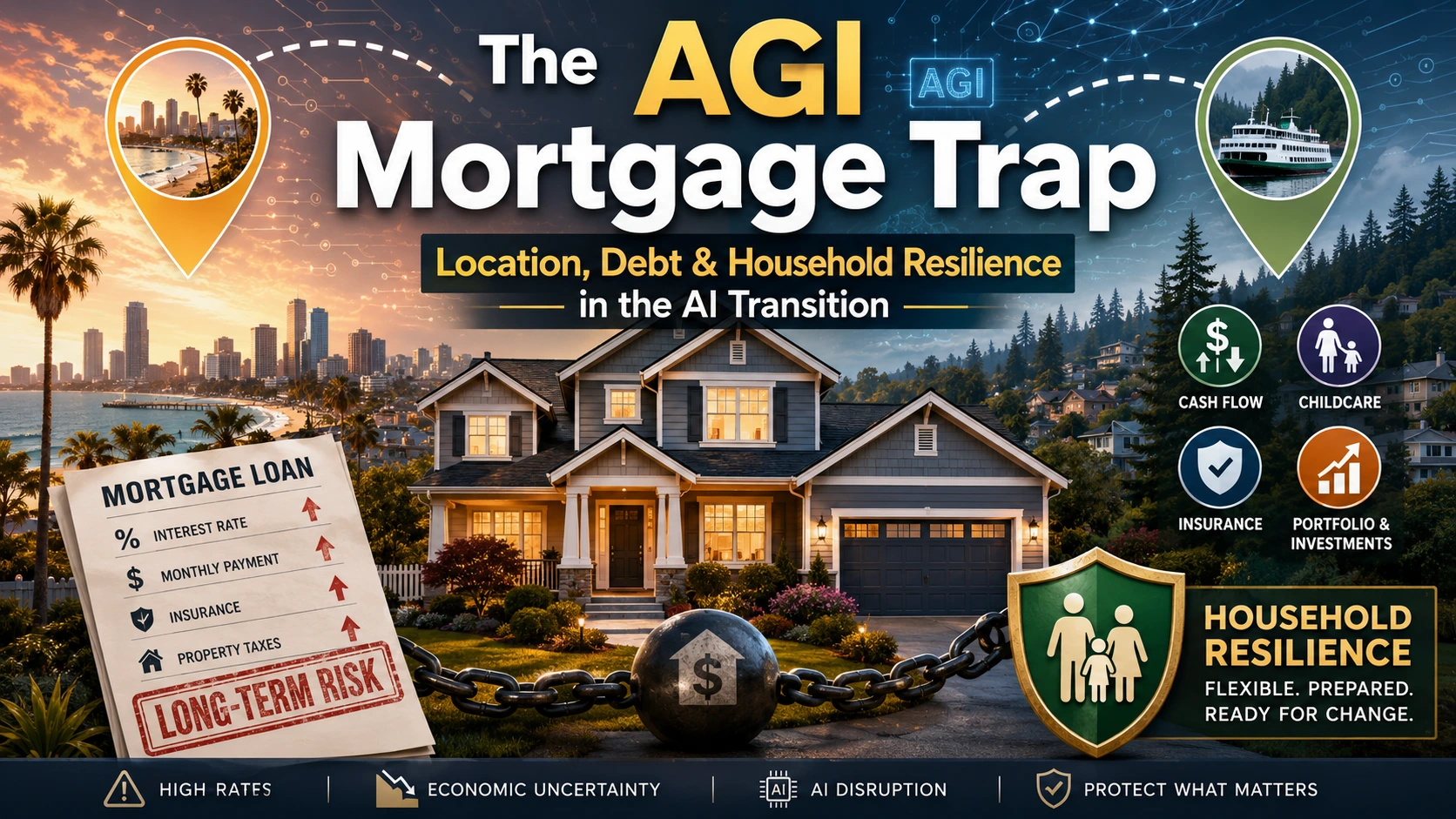
The AGI Mortgage Trap: Why Location, Debt, and Household Resilience Matter More Than Net Worth
On this page
- The Messy Middle Is a Planning Scenario, Not a Prediction
- A Mortgage Converts Future Income Into a Fixed Obligation
- Why Net Worth Is Not Enough
- Build an AGI Household Resilience Dashboard
- 1. Monthly burn
- 2. Liquid runway
- 3. Fixed-cost exposure
- 4. Income durability
- 5. Concentration
- 6. Local economy
- 7. Household production
- 8. Optionality
- Career Density Versus Household Resilience
- Case Study: San Diego Versus Poulsbo and Kitsap County
- San Diego: stronger career density, higher operating cost
- Poulsbo and Kitsap: lower burn, narrower private-sector market
- Use VA Financing to Preserve Resilience, Not Maximize House Size
- Assumable VA loans
- Treat Refinancing as Upside, Not Survival
- Household Inflation Will Not Look Like One Number
- Career Resilience Means Owning Outcomes
- The Stay-at-Home Parent Is Part of the Household Economy
- Robotics Is Future Upside, Not Today’s Foundation
- What If Money Really Does Become Less Important?
- The AGI Home-Buying Stress Test
- What Makes a Home AGI-Ready?
- A Family Decision Framework
- 1. Define the minimum stable life
- 2. Calculate required monthly income
- 3. Classify income by durability
- 4. Score the location
- 5. Stress-test the mortgage
- 6. Preserve optionality
- 7. Buy only when the system works
- What Not to Do
- Practical Paths for Different Households
- If you rent
- If you already own
- If you are moving back to the United States
- If you are eligible for a VA loan
- Preserve Agency Through the Transition
- Go Deeper
A large net worth cannot protect a household from a payment it cannot carry.
A family can have strong careers, a seven-figure portfolio, and a clean path to homeownership. On paper, the decision looks straightforward: estimate the monthly payment, compare it with current income, and buy the house the family can afford.
But that calculation assumes the labor market, local economy, childcare arrangement, portfolio, and cost of living remain stable enough for today’s income to keep doing tomorrow’s work.
The AGI transition makes that assumption harder to trust.
The old question was: Can we afford this house based on today’s income?
The better question is:
Can this household keep the house if one income weakens, the portfolio falls, childcare changes, insurance rises, and the local economy slows at the same time?
This is not an argument against buying a home. It is an argument against turning uncertain future income into a fixed obligation that only works under optimistic assumptions.
The safest household during a disruptive AI transition may not be the one with the highest salary or largest net worth. It may be the one that needs the least money each month to remain stable, has the most durable cash flow, maintains the strongest liquid runway, and preserves the most options when conditions change.
That is the AGI mortgage trap: using the income of the old economy to buy a house that only works if the old economy keeps functioning normally.
This article walks through three linked decisions: how to stress-test a mortgage, how to measure household resilience beyond net worth, and how to evaluate whether a location supports the household during a volatile AI transition.
The Messy Middle Is a Planning Scenario, Not a Prediction
No one knows when AGI will arrive, how quickly organizations will adopt it, or whether its benefits will spread broadly. Capability, adoption, and household impact are different timelines.
The IMF estimates that almost 40% of global employment is exposed to AI-driven change, with greater exposure in advanced economies. Exposure is not the same as elimination. Some workers will become more productive; others may face weaker demand, lower wages, or fewer openings. The IMF’s 2026 work analysis also emphasizes that new skills and occupations can emerge alongside automation.
The current evidence remains mixed. The Budget Lab at Yale found no clear economy-wide AI effect in its May 2026 labor-market analysis, while warning that conditions could change quickly. That is a useful correction to both panic and complacency.
For this article, the messy middle means a planning scenario in which AI capability advances faster than labor markets, institutions, and household systems adapt. It could include:
- faster task automation without immediate mass unemployment;
- hiring slowdowns and fewer entry-level roles;
- wage pressure in exposed occupations;
- uneven productivity gains across companies and regions;
- market volatility as investors reprice winners and losers;
- policy experiments that arrive after households already feel stress;
- cheaper digital services alongside expensive housing, insurance, energy, and childcare.
For household planning, the highest-risk window is not the exact arrival of AGI. It is the period when AI is capable enough to change hiring, wages, and business models, but before policy, benefits, education, housing, and family systems have adapted.
A household does not need full AGI for these pressures to matter. It only needs enough restructuring to make income less predictable while the mortgage remains fixed.
The problem is not that abundance never arrives. The problem is that bills arrive monthly while institutions adapt slowly.
A Mortgage Converts Future Income Into a Fixed Obligation
A mortgage can be a useful way to secure housing, build equity, and stabilize part of the household budget. It can also concentrate risk.
The payment becomes dangerous when the household also depends on:
- two uninterrupted professional incomes;
- expensive childcare so both adults can work;
- a future refinance;
- continued appreciation in the home;
- a rising portfolio that can be sold in an emergency;
- one dominant local industry;
- employer stock tied to the same sector as household income.
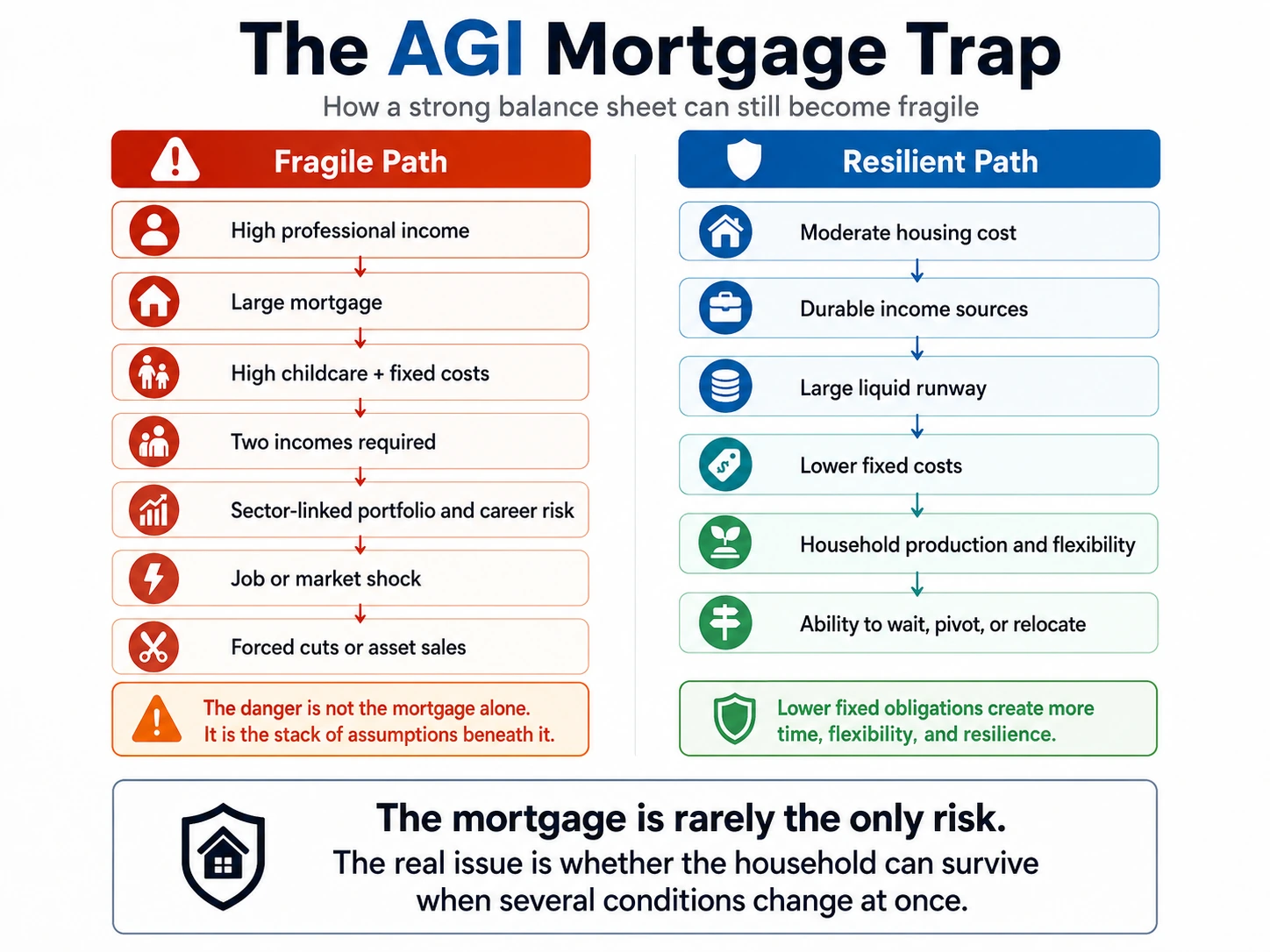
The trap is not the mortgage by itself. It is the stack of assumptions beneath it.
| Old housing question | Resilience question |
|---|---|
| What house can we afford? | What payment survives an income shock? |
| What is our maximum approval? | What is our maximum safe obligation? |
| Can we refinance later? | Does the payment work if rates never fall? |
| Will the home appreciate? | Can we stay if its value falls? |
| Are we high earners? | How durable and independent are our incomes? |
| Do we have enough net worth? | Do we have enough liquid runway? |
The family does not need the perfect AGI prediction. It needs a mortgage that works when the prediction is wrong.
Throughout this article, full housing cost means principal and interest, property taxes, homeowners insurance, HOA dues, utilities, and a realistic maintenance reserve.
Why Net Worth Is Not Enough
Consider a family with $1.2 million invested, two professional incomes, two children in childcare, a large mortgage, and substantial exposure to one industry.
That household looks wealthy. But it may have less room for error than the balance sheet suggests.
If one income disappears while equities fall 35%, the family faces two bad choices: cut spending fast enough to carry the house, or sell assets into a drawdown. If both careers and much of the portfolio are exposed to the same economic cycle, the risks are correlated rather than diversified.
Traditional balance-sheet metrics do not show this clearly:
| Metric | What it shows | What it can miss |
|---|---|---|
| Net worth | Assets minus debts | Liquidity and timing |
| Income | Current earning power | Job durability and sector exposure |
| Home value | Estimated paper wealth | Taxes, insurance, maintenance, and payment risk |
| Portfolio size | Long-term capital | Drawdown and forced-sale risk |
| Mortgage approval | What a lender will tolerate | What the family can survive |
Net worth measures what the household owns. Resilience measures how long the household keeps working when conditions change.
Build an AGI Household Resilience Dashboard
A single net-worth number is too blunt for this problem. A better dashboard tracks eight variables.
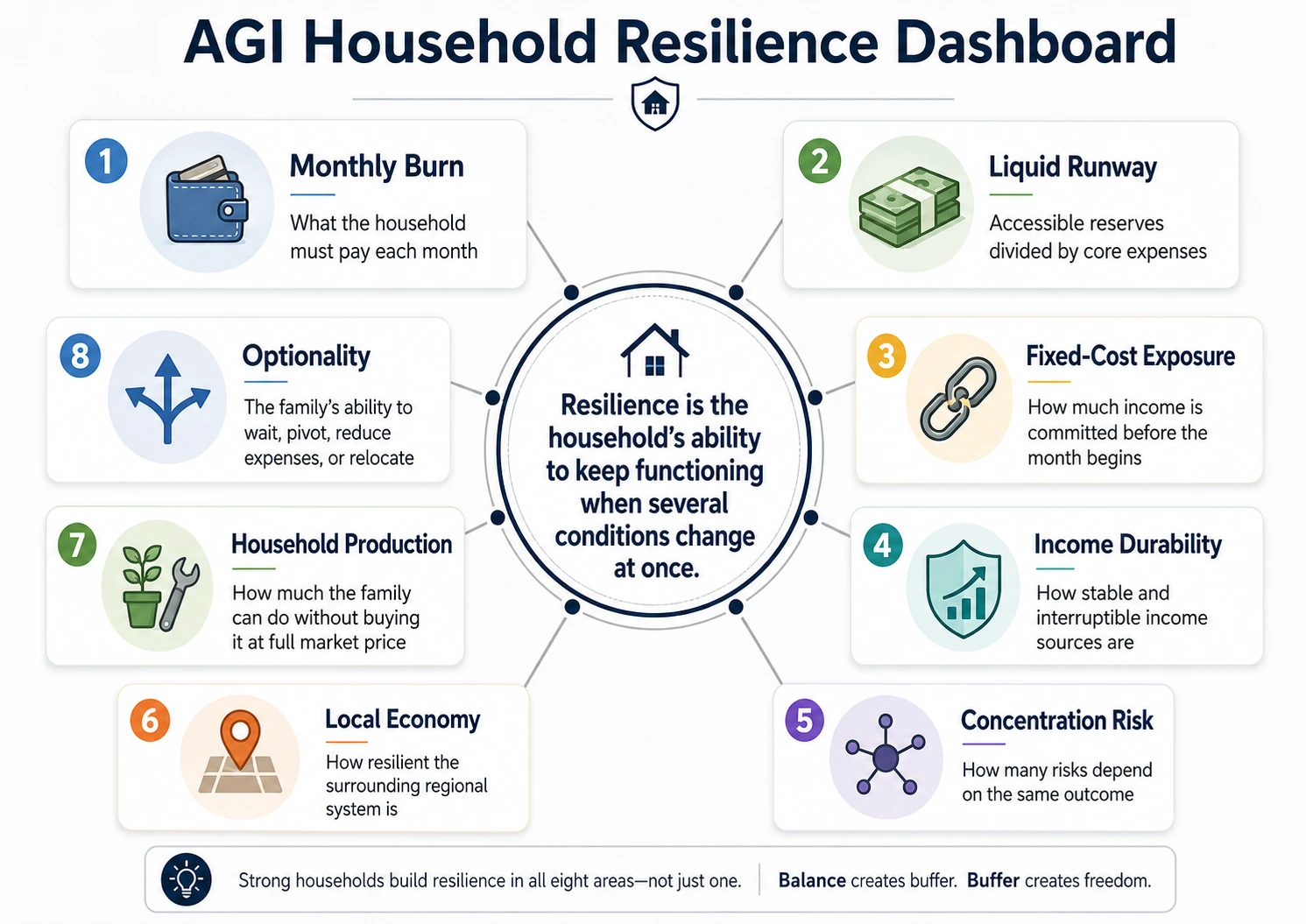
1. Monthly burn
Calculate the household’s core monthly cost, not its average credit-card bill. Include:
- mortgage or rent;
- property taxes, insurance, HOA, and maintenance;
- utilities and internet;
- food and household essentials;
- transportation;
- childcare;
- healthcare;
- minimum debt payments;
- essential subscriptions;
- required savings for irregular expenses.
The number should answer: What does this household need each month to remain stable without pretending that maintenance, medical care, or annual bills do not exist?
2. Liquid runway
Divide liquid, low-volatility assets by core monthly burn.
Liquid runway = accessible reserves / core monthly expenses
A conventional emergency fund may cover three to six months. A household with children, a high housing payment, one primary earner, variable income, or two careers exposed to the same sector may reasonably choose a larger buffer. An 18-to-24-month target can be a planning benchmark for a high-risk transition, not a universal prescription. The upper end belongs to households with the least ability to cut costs or replace income quickly.
Retirement accounts and home equity should not be counted as cash-equivalent runway. They may be valuable, but accessing them can involve taxes, penalties, market losses, borrowing risk, or a forced sale.
3. Fixed-cost exposure
Track the share of take-home income already committed before the month begins.
Mortgage, car loans, childcare contracts, private-school tuition, HOA dues, debt payments, and other recurring obligations reduce the household’s ability to adapt. A high savings rate can disappear quickly when it depends on unusually high income rather than low required spending.
4. Income durability
Do not label income simply as salary, benefits, or investments. Ask what can interrupt it.
| Income source | Resilience characteristics |
|---|---|
| VA disability or similar benefits | A meaningful non-market floor, subject to eligibility and policy |
| Mission-critical federal, defense, or public employment | Potentially durable, but not immune to budgets, hiring freezes, or reorganization |
| Regulated healthcare, infrastructure, or safety work | Often supported by physical need, liability, and regulation |
| Domain-specific biotech or pharmaceutical work | More defensible when tied to clinical, regulatory, quality, or evidence accountability |
| Generic coordination or reporting work | More exposed when the work is primarily summarization, scheduling, or tracking |
| Remote private-sector role | Geographically useful, but the arrangement can change |
| Microbusiness income | Valuable optionality after demand is proven; unreliable before then |
| Portfolio withdrawals | A backup source that becomes weaker during a drawdown |
The goal is not to declare one employer or sector safe. It is to understand what makes income durable and what could weaken it.
5. Concentration
Count the risks that depend on the same outcome.
Two pharma jobs, employer stock, a biotech-heavy local economy, and an expensive home near the same employment cluster are not four separate strengths. They are one concentrated bet.
The same is true for a technology job, a growth-heavy portfolio, and a home price supported by technology-sector wealth. Diversification has to exist across income, assets, and location, not only inside an index fund.
6. Local economy
Evaluate the systems surrounding the household:
- employer and sector diversity;
- federal, military, healthcare, education, and infrastructure anchors;
- housing and childcare affordability;
- commuting and transportation options;
- healthcare access;
- energy and insurance costs;
- climate exposure;
- dependence on wealth from a nearby metro.
No local economy is shockproof. The question is whether several independent systems support it.
7. Household production
Household production is the work a family can do without buying it at full market price: cooking, food storage, childcare flexibility, basic repairs, gardening, transportation efficiency, energy management, and competent use of AI tools.
This is not an off-grid fantasy. It is a way to lower the amount of cash income required to keep daily life working. The companion article, Household Self-Sufficiency in the Age of AGI, develops this layer in detail.
8. Optionality
Optionality is the hidden asset that most spreadsheets miss.
Can the family rent for another year? Can one parent step back temporarily? Can expenses fall within 30 days? Can the household move without selling into distress? Can either adult pivot toward a more durable role? Can the family wait through a weak market?
Liquidity buys time. Low fixed costs buy choices. Optionality is what those choices become.
Career Density Versus Household Resilience
The highest-paying metro is not automatically the safest place to live during a disruptive transition.
Career-dense regions offer more employers, stronger networks, and higher salaries. They can make a job search easier when one company fails. But high housing, childcare, tax, and transportation costs can make the household dependent on keeping those salaries.
| Factor | Career-dense metro | Resilience-oriented region |
|---|---|---|
| Job openings | More | Fewer |
| Salary ceiling | Higher | Lower to moderate |
| Housing cost | Usually higher | Often lower |
| Two-income pressure | Often higher | Potentially lower |
| Ability to change employers | Stronger | Weaker unless work is portable |
| Ability to lower monthly burn | Often weaker after buying | Stronger if housing remains modest |
| Exposure to one cluster | Can be high | Depends on local anchors |
Career density helps when one employer fails and comparable employers are still hiring. Household resilience helps when the entire category of work changes.
The best location is not necessarily the cheapest or the most prestigious. It is the place where the household remains viable across the largest number of scenarios.
Case Study: San Diego Versus Poulsbo and Kitsap County
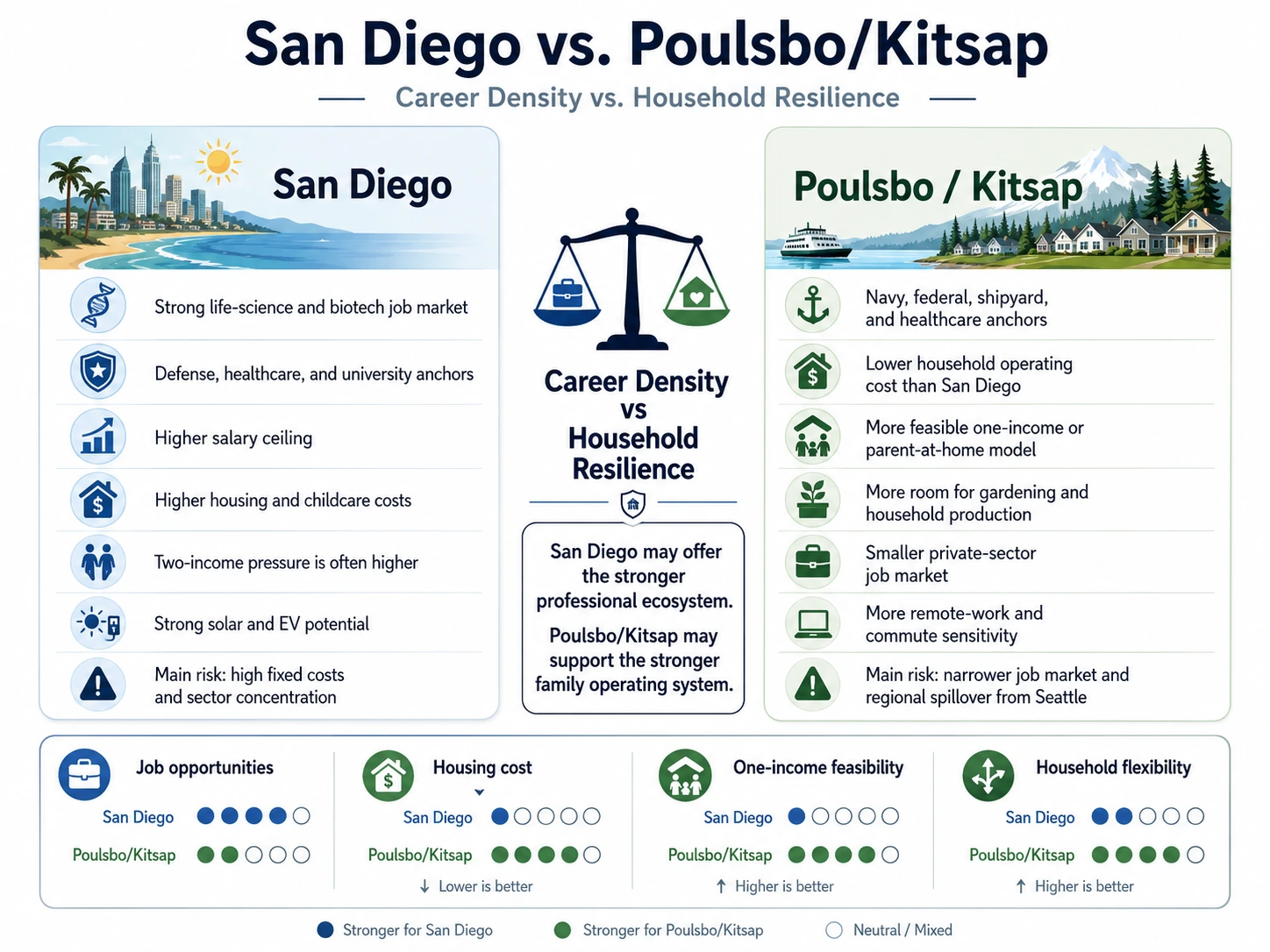
This comparison is not about declaring one city universally better. It shows how two good locations can create very different household risk profiles.
San Diego: stronger career density, higher operating cost
San Diego offers a deep life-sciences ecosystem, major defense activity, universities, healthcare systems, and extensive professional networks. Biocom described a stabilizing life-science funding environment in early 2026 after several volatile years, but stabilization is not the same as immunity from funding cycles or restructuring.
The household tradeoff is cost. High housing and childcare expenses can make two professional incomes feel mandatory. A family may gain access to more employers while losing the ability to tolerate a long search.
San Diego’s resilience improves when:
- housing remains conservative relative to one income;
- the two adults work in different risk pools;
- at least one career is tied to clinical, regulatory, defense, healthcare, or other accountable work;
- the household maintains enough liquidity to survive a prolonged search;
- solar, EV charging, or efficiency upgrades lower total cost without adding fragile debt.
San Diego becomes fragile when both adults depend on the same life-science cycle, childcare is required to preserve both incomes, and the mortgage assumes that professional salaries continue uninterrupted.
Poulsbo and Kitsap: lower burn, narrower private-sector market
Kitsap County has a different structure. The Washington Employment Security Department reported 96,600 county jobs in May 2026. The Kitsap Economic Development Alliance’s 2026 profile describes a public-sector-heavy economy anchored by Naval Base Kitsap and planned federal investment in the Puget Sound Naval Shipyard.
That creates potential durability, especially for work connected to defense, shipyard modernization, healthcare, federal program delivery, and infrastructure. It does not guarantee employment. Federal hiring can be slow, budget decisions matter, and the local private-sector market is smaller.
The household advantages can include a lower housing cost than San Diego, more room for household production, and a more realistic one-income or parent-at-home model. The disadvantages include fewer local life-science roles, ferry and commute constraints, remote-work dependence, and exposure to spillover from the broader Seattle economy.
Kitsap’s resilience improves when the working adult secures durable local or federal employment before the household commits to a mortgage. It weakens when the plan depends on a remote role that can be revoked or on commuting patterns the family has not tested.
San Diego may offer the stronger professional ecosystem. Poulsbo may support the stronger family operating system. The right answer depends on which system the household is actually building.
Use VA Financing to Preserve Resilience, Not Maximize House Size
A VA-backed loan can allow an eligible borrower to buy with no down payment and without monthly mortgage insurance, preserving cash that would otherwise be used at closing. That can be valuable when liquidity is a deliberate part of the resilience plan.
It can also make overbuying easier.
No down payment does not mean no risk. A larger balance produces a larger payment, less initial equity, and more exposure if the home must be sold during a weak market. The VA explicitly notes that full entitlement does not mean a borrower can obtain any loan size; lenders still evaluate income, debts, credit, and assets.
The right rule is simple: use VA financing to preserve resilience, not to expand the purchase until the payment consumes the resilience.
Assumable VA loans
An existing VA loan may be assumable with approval. If its rate is materially below current market rates, the payment advantage can be substantial. But the headline rate is only the first question.
Evaluate:
- the remaining loan balance;
- the sale price and resulting cash gap;
- assumption eligibility and servicer approval;
- processing time;
- release of the seller’s liability;
- the seller’s VA entitlement;
- closing costs and the assumption funding fee;
- how much liquidity remains after closing.
Official VA materials describe an approved assumption as a transfer that includes a release-of-liability process. The VA funding-fee schedule currently lists a 0.5% funding fee for loan assumptions, unless an exemption applies.
A low-rate assumption can improve resilience. Draining most of the household’s liquid reserves to cover the equity gap can erase that advantage.
Veterans receiving qualifying service-connected disability compensation may be exempt from the VA funding fee. Confirm the household’s actual status with the VA and lender before using an exemption in the purchase model.
Treat Refinancing as Upside, Not Survival
Freddie Mac reported an average 30-year fixed mortgage rate of 6.49% on July 9, 2026. No credible source can tell a household exactly where mortgage rates will be in 2029 or 2033.
Mortgage rates depend on more than the Federal Reserve’s policy rate. Long-term Treasury yields, inflation expectations, deficits, mortgage-backed security demand, prepayment risk, and lender spreads all matter. Even if short-term rates decline, mortgage rates may not fall by the same amount.
That makes a precise future rate table false comfort. A better planning rule is:
Buy only if the payment works at the rate available when the loan closes. Treat any future refinance as optional upside.
For stress testing, model no refinance and then add a higher-rate or higher-cost case. The purpose is not to predict the market. It is to make sure the household is not depending on a prediction.
Household Inflation Will Not Look Like One Number
AI may reduce the cost of software, analysis, administrative work, education content, and some professional services. Physical constraints may respond much more slowly.
| Category | Plausible AGI pressure |
|---|---|
| Software and digital services | Lower cost or more capability per dollar |
| Research, coding, and routine analysis | Lower marginal cost |
| Housing and land | Constrained by location, supply, and regulation |
| Insurance | Driven by claims, replacement costs, regulation, and climate |
| Energy and grid access | Influenced by infrastructure and demand |
| Childcare | Limited by physical care, staffing, trust, and regulation |
| Healthcare access | Mixed; intelligence may get cheaper before delivery does |
| Local repair work | Physically constrained until robotics becomes capable and widespread |
In the May 2026 CPI release, overall inflation was 4.2% over 12 months, while shelter, energy, food, medical care, and other household categories followed different paths. The point is not the specific monthly reading. It is that a household experiences its own inflation basket.
The things made of intelligence may get cheaper. The things made of land, energy, trust, regulation, and physical access may not.
Career Resilience Means Owning Outcomes
AI can already summarize meetings, draft plans, update trackers, synthesize research, prepare slides, and produce status reports. A project manager whose value is limited to moving information between systems is exposed even if the job title remains.
More defensible work combines AI with domain knowledge, accountability, regulation, physical operations, or consequences that require trusted human judgment.
For a project or program manager, that can mean moving toward:
- federal program management;
- defense acquisition and mission delivery;
- VA or Defense Health Agency modernization;
- clinical operations and evidence generation;
- quality, compliance, and regulatory programs;
- cybersecurity and data governance;
- AI governance and validation;
- infrastructure or physical-world delivery.
OPM’s federal classification system includes the 0340 Program Management series, 0343 Management and Program Analysis series, and 1102 Contracting series. These are useful search paths, not guarantees of protection. The deeper principle is to move closer to the mission, the regulated decision, the budget, the risk, or the outcome.
The safest project manager is not the person who tracks the work. It is the person accountable for outcomes in a domain where mistakes matter.
The Stay-at-Home Parent Is Part of the Household Economy
A parent at home may replace childcare, transportation, meal preparation, scheduling, sick-day coverage, household administration, and other services the family would otherwise buy with after-tax income.
That can make a lower-income household more resilient than a higher-income household with a much larger operating cost. But it also concentrates paid income in one adult.
The household should protect both sides of the system:
- maintain strong liquidity;
- keep housing and transportation conservative;
- carry appropriate term-life and disability coverage;
- protect the working parent’s employability;
- preserve the at-home parent’s skills and professional network;
- understand backup childcare options;
- build local support;
- know how supplemental income could be created if needed.
Household production is not free. Time, tools, energy, and opportunity cost still matter. Its value is that it can reduce required market income while giving the family more control over how work gets done.
In the AGI transition, the household itself becomes an operating system.
Robotics Is Future Upside, Not Today’s Foundation
Capable humanoid robots could eventually make gardening, cleaning, lifting, basic maintenance, food preparation, and elder support far cheaper. If those systems become safe, reliable, affordable, and repairable, they could materially change household economics.
That outcome should not support today’s mortgage.
Robotics still faces cost, safety, dexterity, energy, maintenance, liability, and real-world reliability constraints. Build the household systems now. Add the robot later if it becomes useful enough to lower costs without adding a new layer of fragility.
What If Money Really Does Become Less Important?
Some AI leaders, including Elon Musk, have argued that AI and robotics could eventually create abundance, make work optional, and reduce the importance of money or retirement savings.
That may describe a possible destination. It does not provide a transition plan.
| Abundance endpoint | Household transition reality |
|---|---|
| Money may matter less | Mortgages are enforceable now |
| Work may become optional | Income still pays current bills |
| Debt may lose significance | Servicers still expect payment |
| Retirement may change | Savings still buy time and flexibility |
| Goods may become abundant | Access can remain unequal for years |
A family should remain open to the possibility that AGI changes money itself. But it should not bet its children’s housing stability on the timing of that outcome.
Musk may be describing the destination. Families still have to survive the road.
The AGI Home-Buying Stress Test
Before buying, answer these questions with numbers rather than intuition:
- Can we carry the full housing cost on one income for 12 months?
- Can we carry it if one adult earns 40% less?
- What happens if the portfolio falls 35% when income weakens?
- What happens if childcare rises 25%?
- What happens if property taxes and insurance rise 20%?
- Does the purchase still work without refinancing?
- Can we stay if the home’s value falls 15%?
- Can we avoid selling equities during a crash?
- Can we retain an appropriate liquid runway after closing?
- Could one parent step back from paid work temporarily?
- Are both incomes tied to the same sector or funding cycle?
- Does the local economy have several durable anchors?
- Does this home reduce or increase the household’s required income?
- Can it support remote work, storage, efficiency, and practical household production?
- Is the mortgage survivable under bad assumptions, not only the expected case?
If the house only works under optimistic assumptions, it is not AGI-ready.
What Makes a Home AGI-Ready?
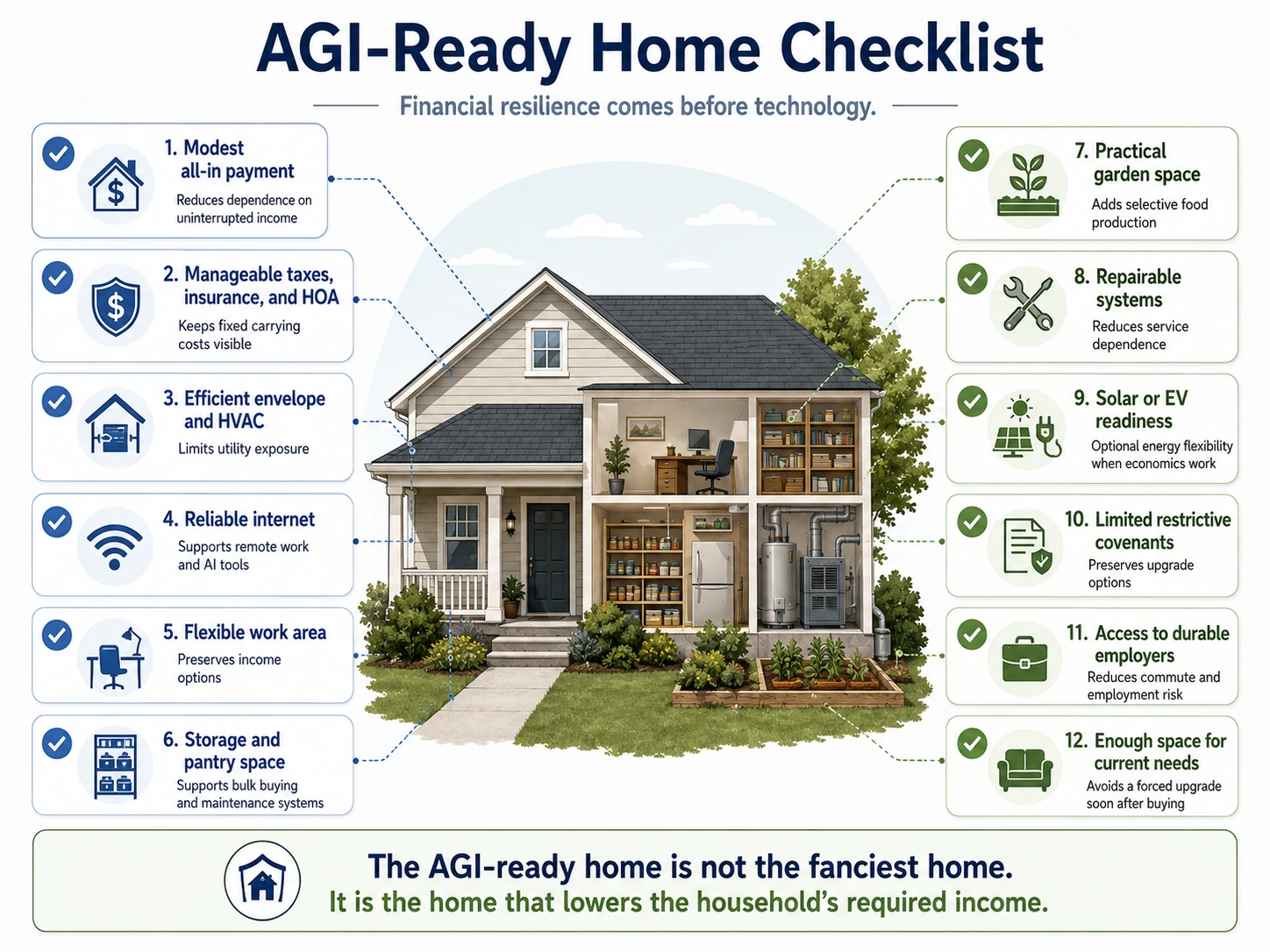
An AGI-ready home is not a bunker and it is not the house with the most technology. It is a home that lowers the household’s required income while preserving access to work, community, and essential services.
Financial resilience comes before technology. Solar panels, batteries, EV chargers, gardens, and robotics matter only after the all-in payment is survivable.
| Feature | Resilience value |
|---|---|
| Modest all-in payment | Reduces dependence on uninterrupted income |
| Manageable taxes, insurance, and HOA | Keeps fixed carrying costs visible |
| Efficient envelope and HVAC | Limits utility exposure |
| Reliable internet | Supports remote work and AI tools |
| Flexible work area | Preserves income options |
| Storage | Supports bulk buying, maintenance, and pantry systems |
| Practical garden space | Adds selective food production |
| Repairable systems | Reduces service dependence |
| Solar or EV readiness | Creates optional energy flexibility when economics work |
| Limited restrictive covenants | Preserves upgrade options |
| Access to durable employers | Reduces commute and employment risk |
| Enough space for current needs | Avoids a forced upgrade soon after buying |
The AGI-ready home is not the fanciest home. It is the home that lowers the household’s required income.
A Family Decision Framework
Use this sequence before choosing a property.
1. Define the minimum stable life
Write down what the household actually needs: safe housing, healthcare, food, transportation, childcare or a parent-at-home plan, internet, emergency reserves, community, and work flexibility.
2. Calculate required monthly income
Include the full cost of housing and the irregular expenses that easy affordability calculators omit.
3. Classify income by durability
Separate reliable income from cyclical, revocable, speculative, and portfolio-based sources. Do not count a side business before customers exist.
4. Score the location
Evaluate employer diversity, public-sector anchors, housing, taxes, healthcare, childcare, energy, climate, transportation, and community support.
5. Stress-test the mortgage
Use worse assumptions than the base case. Test income and market losses together.
6. Preserve optionality
Do not make a permanent commitment merely because the household is tired of uncertainty. Renting can be an active strategy when it buys information, liquidity, or time.
7. Buy only when the system works
The home should fit the household resilience system. The household should not be forced to reorganize its entire life around the mortgage.
What Not to Do
- Do not buy the maximum house a lender approves.
- Do not assume two high incomes will remain uninterrupted.
- Do not rely on a future refinance.
- Do not count unproven side-business income.
- Do not drain liquidity merely to become a homeowner.
- Do not assume AGI abundance arrives before the bills.
- Do not tie career, portfolio, and housing risk to one sector.
- Do not ignore childcare as a major fixed-cost risk.
- Do not treat a VA loan as permission to overbuy.
- Do not confuse a high salary with resilience.
- Do not count home equity as emergency cash.
Practical Paths for Different Households
If you rent
Use renting to preserve options. Test the local job market, learn commuting patterns, build liquidity, and understand the true cost of childcare, healthcare, utilities, and insurance before buying. A year of informed renting can be cheaper than one poorly timed purchase.
If you already own
Build a maintenance reserve, avoid dependence on a HELOC, and improve efficiency before adding expensive systems. Refinance when the verified savings justify the transaction costs. Add solar, batteries, or an EV only when the full household math improves.
If you are moving back to the United States
Model healthcare, childcare, taxes, transportation, and insurance before comparing salaries. Secure at least one credible income path, preserve liquidity, and consider renting for six to twelve months before committing to a location. Cross-border tax and investment decisions should be reviewed with qualified professionals before assets are sold or residency changes.
If you are eligible for a VA loan
Confirm the Certificate of Eligibility, funding-fee status, entitlement, lender terms, and full cash-to-close amount. Compare a standard purchase with any viable assumption opportunity. Preserve cash intentionally, but do not use zero-down financing to make an unsafe payment appear affordable.
Preserve Agency Through the Transition
AGI may eventually make intelligence, services, and physical labor far cheaper. Money, work, debt, and retirement may look different in a world of broadly distributed abundance.
Households cannot live inside that endpoint before it exists.
During the messy middle, the old and new systems may overlap. Families may receive extraordinary AI capability at low cost while still paying old-world prices for housing, childcare, healthcare, energy, taxes, insurance, and physical access.
That is why the mortgage matters.
The safest household is not automatically the one with the highest income. It is the household that can keep functioning when income changes. It has enough liquidity to wait, a low enough burn rate to adapt, income tied to durable demand, and enough location flexibility to move before distress makes the decision.
The best AGI housing decision is not the one that maximizes lifestyle today. It is the one that preserves agency through the transition.
Go Deeper
- AGI and Financial Independence: How Families Can Prepare for Economic Disruption
- Household Self-Sufficiency in the Age of AGI
- Explore FI Architect for iOS to model housing, income, and financial-independence scenarios.
This article presents a general scenario-planning framework rather than individualized recommendations.