Preparing for Different AGI Timelines: What Changes If the Future Arrives in 2, 5, 10, or 20+ Years?
On this page
- Before Asking "When," Define What Is Arriving
- 1. Frontier Capability
- 2. Functional or Economic AGI
- 3. Reliable Autonomous AGI
- 4. Physical AGI
- 5. Transformative Economic Impact
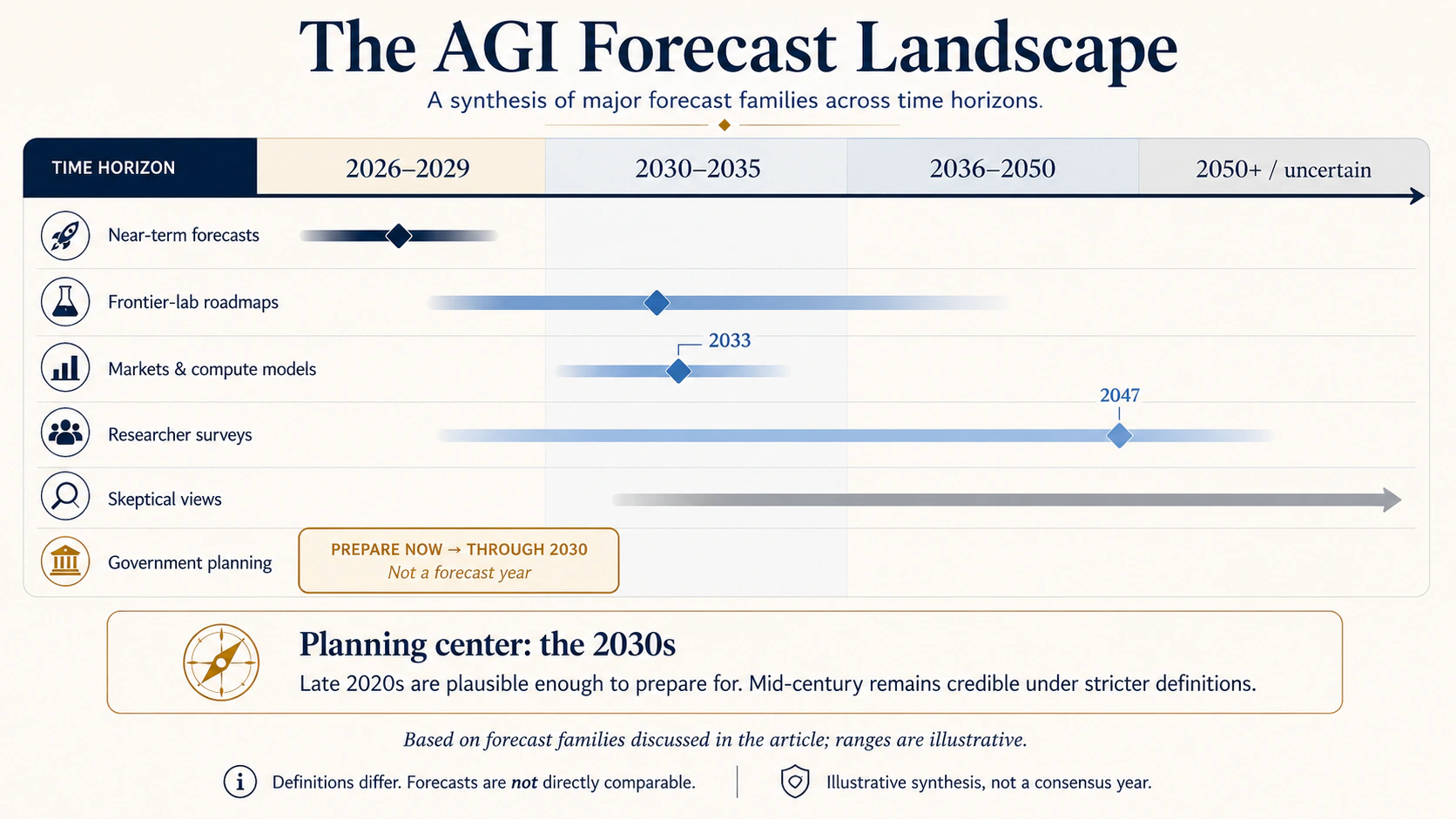
- What the Major Forecasting Groups Currently Say
- Aggressive Near-Term Forecasts: 2026 to 2029
- Frontier-Lab Roadmaps: Late 2020s Through the 2030s
- Prediction Markets and Compute Models: Early 2030s
- Broad Researcher Surveys: Around Mid-Century
- Skeptical and Paradigm-Shift Views
- What Governments Are Actually Planning For
- The Closest Thing to a 2026 Timing Consensus
- Why Smart People Produce Radically Different Dates
- The Five Clocks of AI Change
- Clock 1: Model Capability
- Clock 2: Reliable Autonomy
- Clock 3: Organizational Deployment
- Clock 4: Physical-Economy Transformation
- Clock 5: Institutional and Household Response
- Four AGI Timeline Scenarios
- Scenario 1: Rapid Transition, 0 to 3 Years
- Scenario 2: Accelerating Transition, 3 to 7 Years
- Scenario 3: Gradual Transition, 7 to 15 Years
- Scenario 4: Delayed or Repeatedly Deferred Transition, 15+ Years
- Robust Actions Versus Timeline-Sensitive Bets
- Watch Capabilities, Not Personalities
- Agent Reliability
- Economic Performance
- AI-Assisted AI Development
- Labor-Market Effects
- Physical Deployment
- Institutional Response
- Create Household Decision Triggers
- Green: Capability Growth, Limited Structural Impact
- Yellow: Organizational Restructuring Is Spreading
- Red: Broad Economic and Institutional Restructuring
- A 30-, 90-, and 365-Day Preparation Plan
- First 30 Days
- First 90 Days
- First 365 Days
- How Often Should the Forecast Be Updated?
- Final Takeaway
- Sources and Further Reading
- Forecast Synthesis and Independent Research
- Frontier-Lab and Executive Views
- Direct Forecasts and Alternative Views
- Government Planning
Depending on whom you ask, transformative artificial intelligence may arrive in 2026 or 2027, around 2029, during the early 2030s, near mid-century, several decades later, or not through the current technical approach at all.
Anthropic has told the U.S. government that what it calls "powerful AI" could emerge in late 2026 or early 2027. Ray Kurzweil continues to forecast AGI around 2029. RAND's 2026 review finds that prediction markets and compute-based models now place central estimates in the 2030s. The largest broad survey of published AI researchers places its median for machines outperforming humans at every task at 2047. Skeptics argue that current architectures still lack important capabilities and may require a new paradigm.
Which prediction should a household trust?
None of them completely.
A household does not need to identify the exact AGI year. It needs to avoid decisions that fail catastrophically if the timeline is faster or slower than expected.
The goal is not to predict one future. It is to remain functional across several.
This article maps the forecast evidence, five clocks of change, and four household scenarios.
Forecast snapshot, July 16, 2026: This is an editorial synthesis, not a formal consensus. Executive statements are views, not independent findings. Recheck time-sensitive forecasts before publication.
Before Asking "When," Define What Is Arriving
Much of the disagreement is definitional. RAND notes that forecasts may target benchmark performance, economically useful AGI, autonomous goal pursuit, full labor automation, or broad social transformation. Even when definitions are aligned, substantial disagreement remains.
Five thresholds help separate the questions. These are practical planning thresholds used in this article, not universally accepted technical definitions.
1. Frontier Capability
Can the best available system outperform skilled humans on selected cognitive tasks?
Current systems already match or exceed expert performance on selected standardized evaluations in mathematics, coding, science, and other cognitive domains. Yet the International AI Safety Report 2026 describes their capabilities as "jagged": systems may perform impressively on difficult evaluations while remaining unreliable on some simpler, multistep, or physical-world tasks.
2. Functional or Economic AGI
Can a system perform a broad range of economically valuable digital work at human level or better?
That might include completing a software project, performing multi-day research, operating business systems, managing a workflow with limited supervision, and learning unfamiliar professional tasks. Functional AGI could affect employment before a system possesses every form of human cognition.
3. Reliable Autonomous AGI
Can the system pursue goals over long periods, recover from errors, handle uncertainty, and recognize when human help is needed?
This threshold matters more operationally than one benchmark score. Current agents still struggle with coherent long-term planning, unexpected obstacles, and error recovery. Reliability determines whether AI remains an assistant or becomes part of an organization's operating structure.
4. Physical AGI
Can comparable intelligence act reliably through robots, vehicles, laboratories, factories, hospitals, farms, and homes?
Physical capability depends on hardware, sensors, dexterity, safety, maintenance, manufacturing, insurance, and local integration. As discussed in Robotics and the Physical Economy, software can spread quickly while machines must be built and maintained.
5. Transformative Economic Impact
Have companies, labor markets, schools, housing decisions, tax systems, and public institutions actually reorganized?
This may occur well after a laboratory or company declares an AGI threshold. A capability can exist before organizations can deploy it, and organizations can deploy it before households or governments adapt.
Experts can disagree by twenty years while describing different milestones in the same transition.
What the Major Forecasting Groups Currently Say
Forecasts are not equally reliable or directly comparable. Five groups provide a useful map.
Aggressive Near-Term Forecasts: 2026 to 2029
Anthropic's policy submission describes "powerful AI" as Nobel-level capability across many fields, digital-interface navigation, extended autonomous work, and some control of physical systems. It places that possibility in late 2026 or early 2027.
Anthropic has access to internal research evidence unavailable to outsiders. Because this is a developer's own projection rather than an independent estimate, it should be treated as informed but interested.
Ray Kurzweil continues to forecast AGI around 2029, based largely on computing and price-performance trends. Elon Musk presented an exceptionally short timeline in a 2026 Moonshots interview. Treat it as an outlier scenario, not a household base case.
Recent Moonshots panels featuring Peter Diamandis, Emad Mostaque, Salim Ismail, Dave Blundin, and Alexander Wissner-Gross generally place greater weight on rapid compounding, AI-assisted development, and near-term knowledge-work automation. This represents an entrepreneurial forecasting cluster, not a representative survey of AI researchers.
The late-2020s camp should be treated as a consequential scenario, not a statistical consensus.
Frontier-Lab Roadmaps: Late 2020s Through the 2030s
OpenAI describes a progression rather than one formal date. In January 2025, Sam Altman wrote that OpenAI was "confident" it knew how to build AGI "as traditionally understood" and forecast agents joining the workforce. In The Gentle Singularity, he described useful agents, possible novel insights in 2026, and more capable real-world robotics later.
In its November 2025 AI Progress and Recommendations, OpenAI said it expected very small AI-generated discoveries in 2026 and more significant discoveries from 2028 onward, while cautioning that day-to-day life could remain surprisingly stable even during rapid capability growth. These are company expectations, not independently validated timelines.
Google DeepMind's 2026 AGI-to-ASI report describes human-level AGI as a concrete next-decade target for major AI organizations. It also identifies potential bottlenecks and argues that change may arrive through a sequence of AI-enabled breakthroughs rather than one clean event.
Despite different definitions, lab roadmaps treat the late 2020s through the 2030s as consequential. This is not a joint forecast.
Prediction Markets and Compute Models: Early 2030s
RAND reports that relevant Metaculus forecasts moved from about 2070 in 2020 to approximately 2033 in early 2026. One compute-centric model also produced a median near 2033.
This is probably the strongest basis for saying that the early 2030s are becoming a center of gravity in several formal forecasting methods.
Prediction markets use narrow resolution criteria. Compute models depend on investment, hardware, algorithmic progress, and AI-research assumptions. Few long-horizon AGI forecasts have resolved.
Broad Researcher Surveys: Around Mid-Century
The largest published survey of its kind asked 2,778 researchers who had published in major AI venues. Its aggregate estimates gave a 10% chance of unaided machines outperforming humans at every task by 2027 and a 50% chance by 2047.
The same survey placed a 10% probability on all human occupations becoming fully automatable by 2037, but the 50% date was 2116. That enormous gap shows why technical capability and economic transformation should not be treated as one forecast.
The 2023 survey remains more representative of researchers than a collection of prominent executives.
For the survey's strict all-task definition, the researcher median does not make arrival before 2030 the most likely outcome. It does assign a nontrivial probability to that possibility.
Skeptical and Paradigm-Shift Views
Yann LeCun argues that human-level intelligence likely requires systems that build world models, plan, adapt, and learn more like humans and animals. Meta's JEPA research is intended to address limitations in systems trained mainly to predict tokens or pixels.
Gary Marcus argues that AGI is not imminent because current language-model approaches remain brittle and unreliable under unfamiliar conditions. Robotics researcher Rodney Brooks emphasizes a separate constraint: physical competence, dexterity, and safe deployment progress on a different clock from software. His 2026 predictions scorecard expects major physical limitations to persist well into the next decade.
Current systems could become economically transformative without achieving robust general intelligence on the most aggressive schedule.
What Governments Are Actually Planning For
Governments rarely endorse one AGI date, but their policies address major AI effects during this decade.
The U.S. AI Action Plan focuses on innovation, infrastructure, and international leadership without naming an AGI year.
The United Kingdom's AI Opportunities Action Plan covers compute, skills, adoption, and public services. Its Government Office for Science published five AI scenarios through 2030 to test policy rather than predict one outcome.
The European Union's AI Act regulates current general-purpose and high-risk systems through phased obligations rather than waiting for AGI.
China's 2017 New Generation Artificial Intelligence Development Plan established 2030 as a target for global AI leadership and broad industrial development. That is a national technology and economic objective, not a prediction that AGI will arrive by 2030.
The International AI Safety Report does not predict an AGI date. It concludes that progress through 2030 could slow, continue, or accelerate sharply.
Governments are converging on a prepare-now, plan-to-2030 posture, not a consensus that AGI definitely arrives by 2030.
The Closest Thing to a 2026 Timing Consensus
There is no expert consensus year. The most defensible synthesis is a probability distribution.
- Forecasts are moving earlier. Surveys, markets, and compute models have all shifted toward shorter timelines.
- The late 2020s are a credible high-impact scenario. They are not the broad median, but enough informed leaders assign the period meaningful weight that it should not be ignored.
- The 2030s are the practical planning center. Frontier roadmaps, quantitative forecasts, and government scenarios make this the most useful central planning band.
- Mid-century remains a defensible median for strict definitions. The largest broad researcher survey centers all-task human-level capability around 2047.
- Economic impact will not wait for formal AGI. Agents can change hiring, entry-level work, fraud, research, and software development before experts agree on a label.
- Full physical and occupational automation is likely to lag the first digital capability thresholds. Robotics, capital replacement, regulation, maintenance, infrastructure, and organizational change create friction.
Editorial synthesis: As of July 2026, a consequential late-2020s scenario deserves preparation, the early-to-mid-2030s form a useful central planning band, mid-century remains credible under strict definitions, and a substantial probability extends much later.
Why Smart People Produce Radically Different Dates
Different definitions explain part of the gap. "Powerful AI," "human-level machine intelligence," "functional AGI," "transformative AI," and "full labor automation" are not equivalent.
Frontier-lab leaders see internal scaling results, research failures, compute plans, and product roadmaps. Outside researchers see a broader public record but lack proprietary information.
The largest disagreements concern scaling. Near-term forecasters assume continued compute growth, algorithmic gains, better agent reliability, AI-assisted AI research, and rapid diffusion. Longer-timeline forecasters emphasize diminishing returns, energy and data limits, unreliable reasoning, missing world models, embodiment, and the possibility that new architectures are required.
Forecasters also target different outcomes. A coding agent that removes part of a software team's workload is economically important, but it is not the same as a machine capable of every human responsibility.
Incentives also shape emphasis. They do not make a forecast false, but affect how much weight it should receive.
RAND's most important warning is that AGI forecasting remains immature. It lacks a long record of resolved forecasts, stable benchmarks, independent validation, and deep institutional infrastructure.
The Five Clocks of AI Change
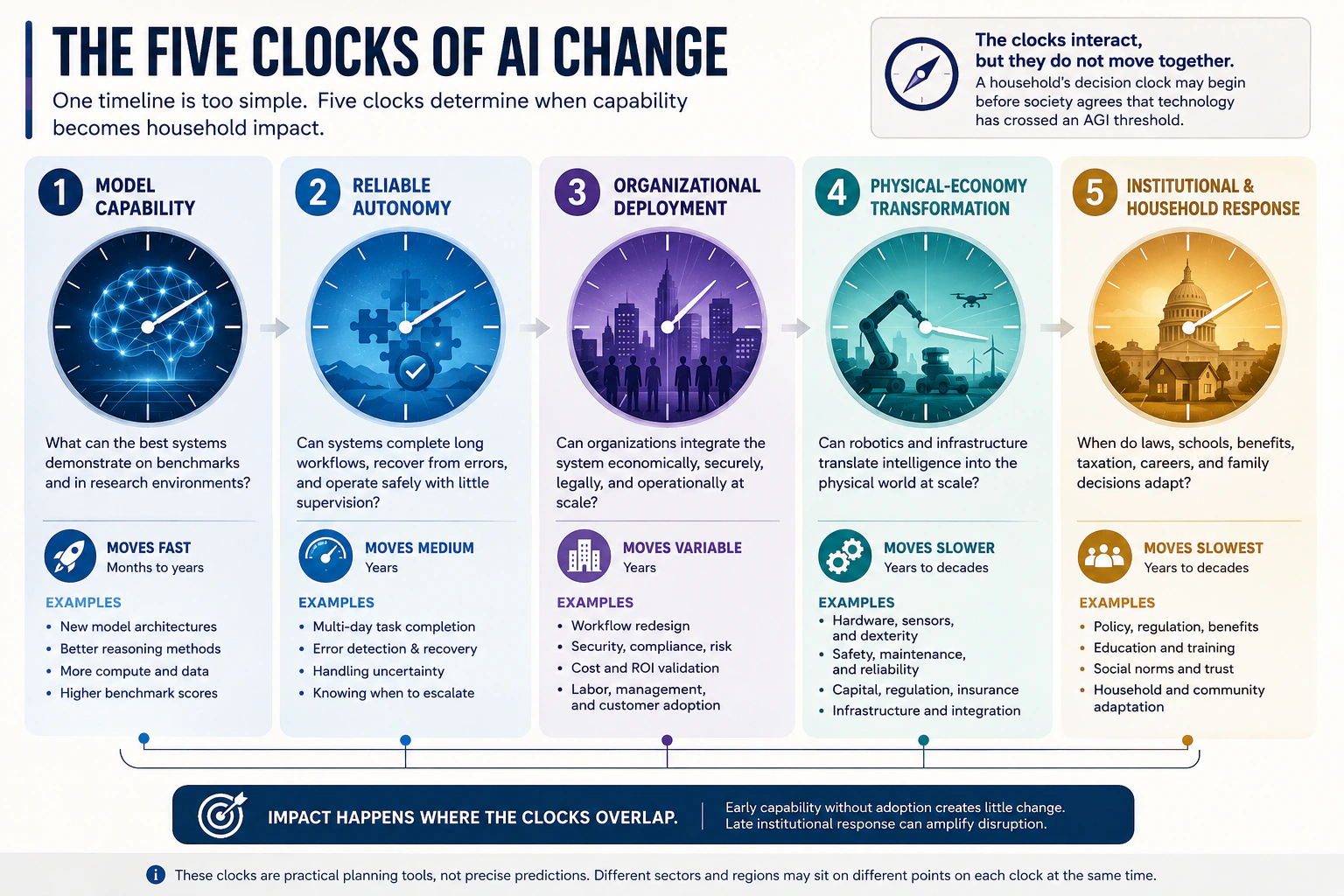
One timeline is too simple. Five clocks determine when capability becomes household impact.
Clock 1: Model Capability
What can the best systems demonstrate? This clock can advance rapidly through better models, tools, data, reasoning methods, and compute.
Clock 2: Reliable Autonomy
Can systems complete long workflows, recover from errors, operate safely, and require little supervision? This may lag benchmark capability.
Clock 3: Organizational Deployment
Can companies integrate the system economically, securely, legally, and operationally? Deployment depends on data access, cost, workflow redesign, risk, labor relations, management, and customer acceptance.
Clock 4: Physical-Economy Transformation
Can robotics and infrastructure translate intelligence into construction, manufacturing, healthcare, energy, logistics, agriculture, and household services? This is likely to move more slowly than pure software.
Clock 5: Institutional and Household Response
When do laws, schools, benefits, licensing, taxation, mortgages, careers, and family decisions adapt? Institutions often respond after capability becomes visible. Households may need to respond earlier.
A household's decision clock may begin before society agrees that technology has crossed an AGI threshold.
Four AGI Timeline Scenarios
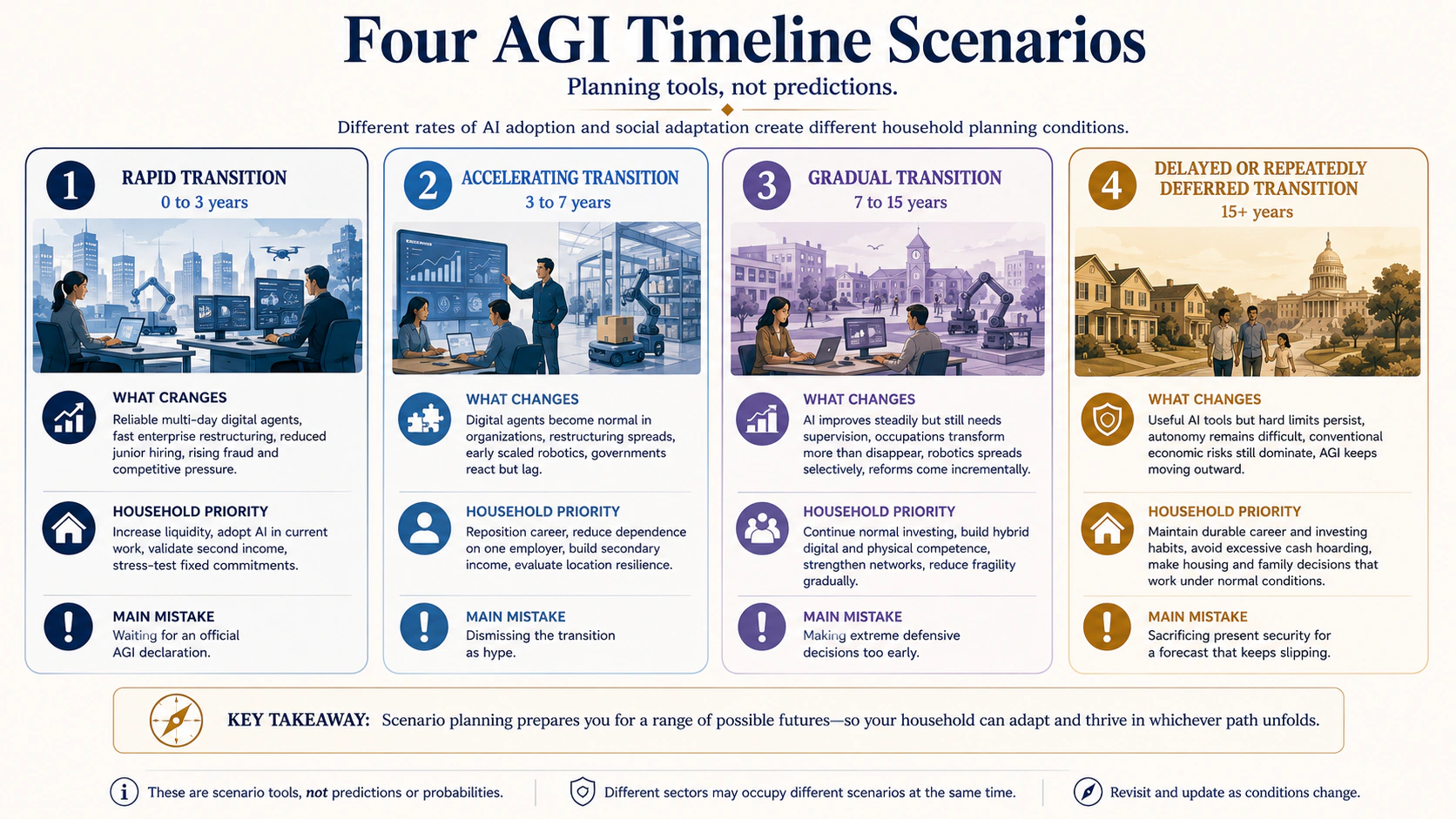
These scenarios are planning tools, not predictions. Different sectors may occupy different scenarios at the same time.
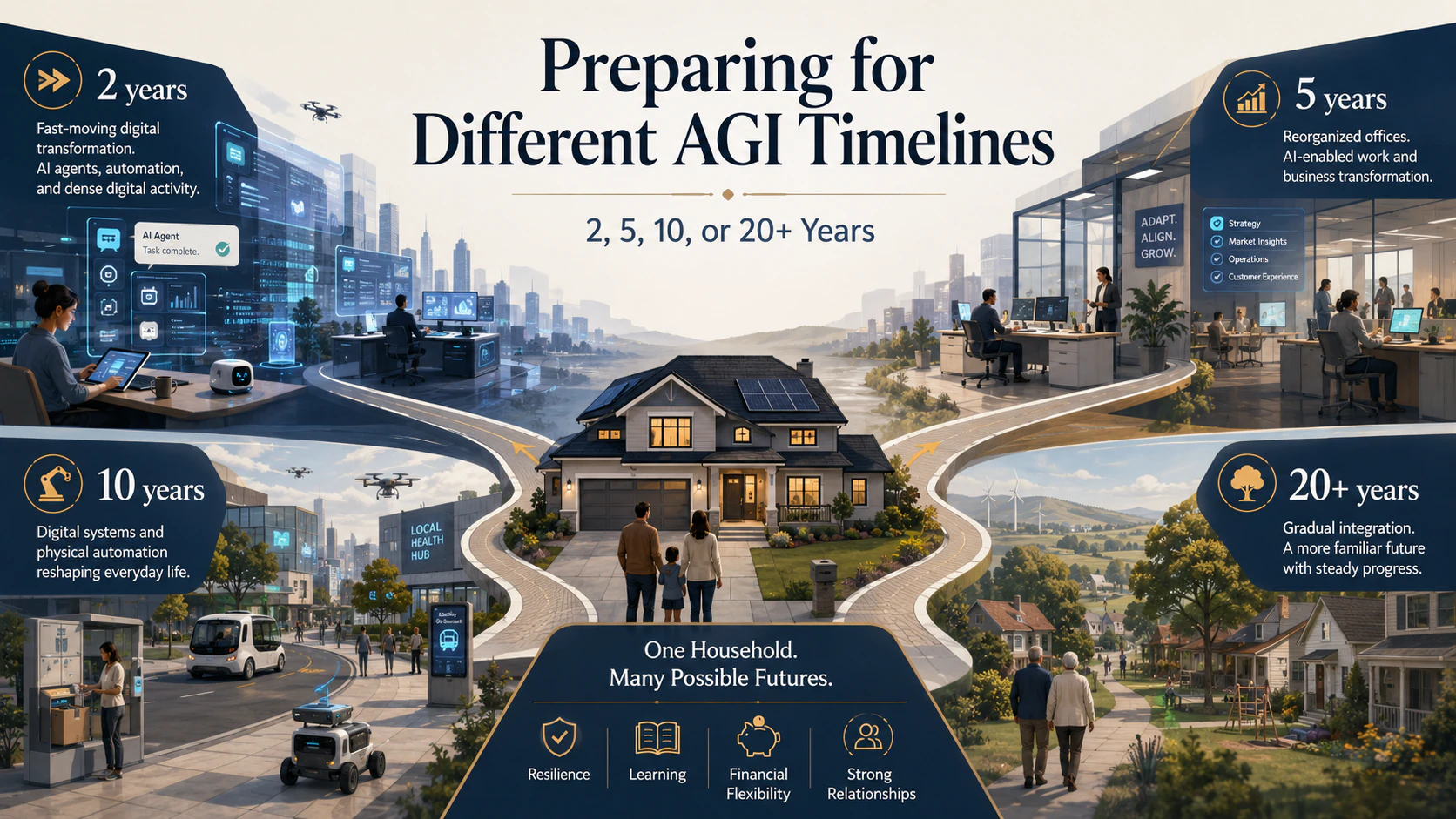
The 2-, 5-, 10-, and 20-year horizons in the title are simplified planning waypoints. The scenarios below use wider ranges because technological and economic transitions do not follow precise calendar boundaries.
Scenario 1: Rapid Transition, 0 to 3 Years
This scenario assumes agents become reliable across multi-day digital workflows, inference costs fall, AI accelerates software and AI research, and enterprises move from pilots to structural staffing changes while policy and education lag.
The first effects would likely include reduced junior hiring, smaller administrative and professional-service teams, AI-native competitors, increased fraud, and greater returns to people who control workflows and capital.
It would not mean that every physical job disappears, housing becomes abundant, robotics reaches every household, or governments instantly introduce universal income.
Household priorities: increase accessible liquidity, avoid unnecessary fixed commitments, map automatable and accountable tasks, adopt AI in current workflows, validate a second income path, preserve benefit options, and stress-test mortgage and geographic concentration.
Main mistake: waiting for an official AGI declaration before acting.
Scenario 2: Accelerating Transition, 3 to 7 Years
This scenario assumes digital agents become normal inside organizations, reliability improves gradually, restructuring spreads, additional robotics systems become commercially viable and expand beyond limited pilots, and governments expand transition programs but remain reactive.
Traditional entry-level pathways may narrow. Output per employee may rise while wage pressure spreads through digitized professions. Demand may increase for technical integration, operations, regulation, security, and accountability.
Household priorities: complete a deliberate career repositioning, move closer to revenue or mission outcomes, establish a functioning secondary income stream, reduce dependence on one employer, and evaluate locations for employer diversity, infrastructure, schools, and community resilience.
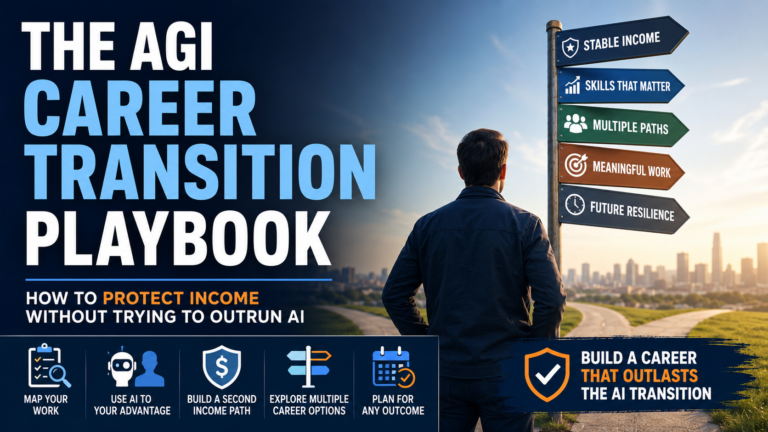
Use The AGI Career Transition Playbook for career exposure and Raising Children in the Age of AGI for education decisions.
Main mistake: dismissing the transition as software hype after organizations begin redesigning staffing and workflows.
Scenario 3: Gradual Transition, 7 to 15 Years
This scenario assumes AI improves steadily but continues to need supervision, new architectures or integrations are required, organizations have time to adjust, robotics spreads through structured sectors, and governments reform benefits incrementally.
Occupations may transform more often than they disappear. Productivity gains may diffuse unevenly, and demographic labor shortages may coexist with digital displacement.
Household priorities: continue ordinary retirement and investment planning, build hybrid digital and physical competence, invest in durable education, reduce fragility gradually, build diversified ownership, and strengthen local and professional networks.
Main mistake: making extreme defensive decisions that damage current life because a rapid transition remains possible.
Scenario 4: Delayed or Repeatedly Deferred Transition, 15+ Years
This scenario assumes current architectures encounter hard limits, long-horizon autonomy remains difficult, compute or energy constrains scaling, physical systems remain expensive, and AGI repeatedly appears five to ten years away.
AI would still change work. Conventional business cycles, housing, healthcare, debt, demographics, and geopolitics would remain central risks.
Household priorities: avoid abandoning a durable career prematurely, holding excessive cash for decades, or postponing family life solely because of an AGI forecast. Continue investing, maintain insurance, make housing decisions that work under ordinary conditions, and help children build capabilities useful with or without AGI.
Main mistake: sacrificing present security, relationships, education, or retirement for a forecast that may repeatedly move outward.
Robust Actions Versus Timeline-Sensitive Bets
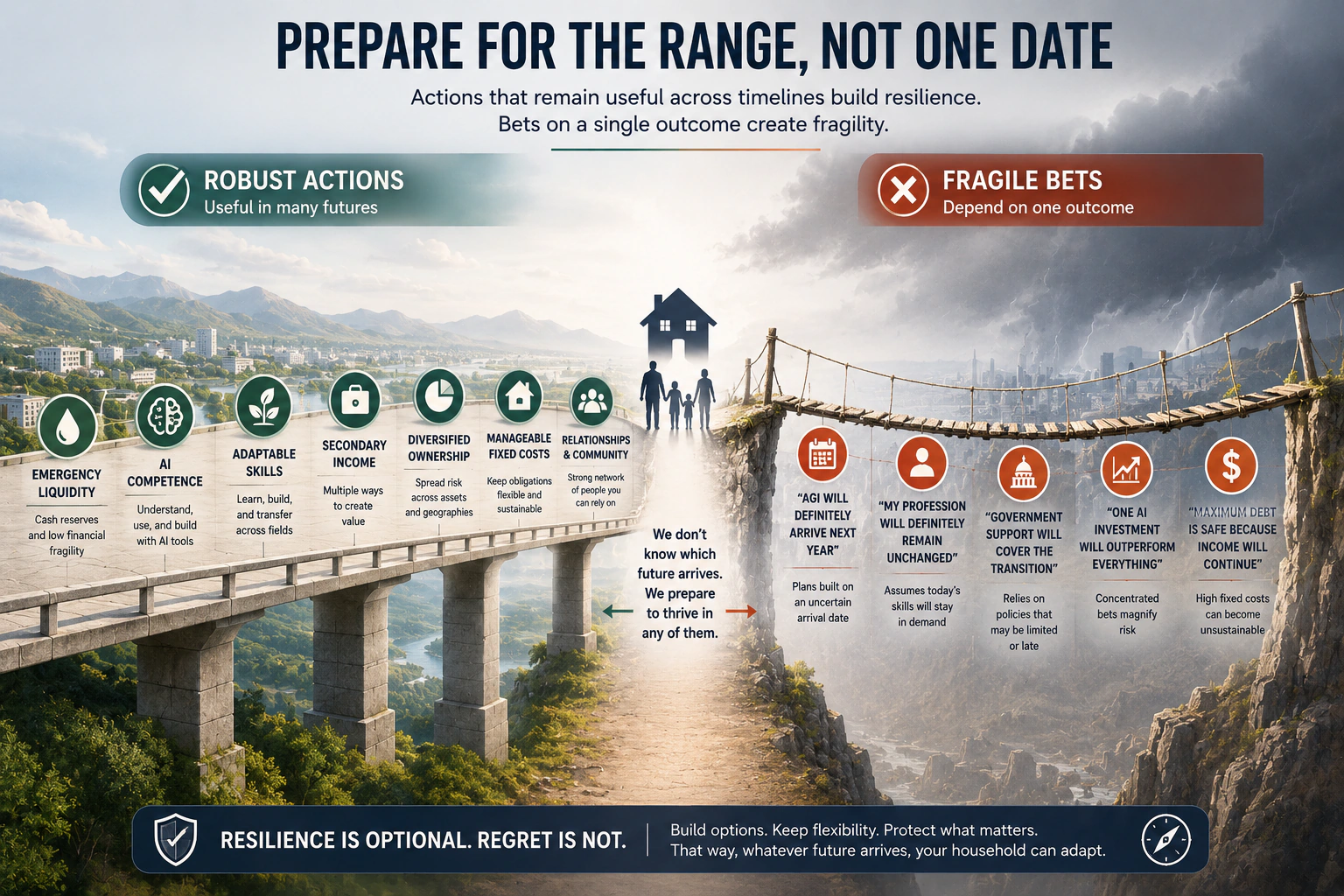
The best decisions remain useful when the forecast is wrong.
| Action | Robust across timelines? | Recommended treatment |
|---|---|---|
| Learn to use AI in current work | High | Start now |
| Map tasks rather than job titles | High | Review quarterly |
| Maintain emergency liquidity | High | Scale to household and career risk |
| Reduce unnecessary fixed costs | High | Do gradually |
| Build a second income path | High | Validate before disruption |
| Strengthen foundational education | High | Start now |
| Develop physical-world competence | High | Useful under every scenario |
| Maintain professional and community relationships | High | Continuous |
| Diversify employer and sector exposure | High | Build over time |
| Abandon a viable profession immediately | Low | Require strong evidence |
| Sell diversified investments because AGI is near | Low | Avoid forecast-driven panic |
| Take on a maximum-size mortgage | Low | Stress-test income disruption |
| Move solely because of an AGI prediction | Low | Require independent reasons |
| Depend on future UBI or UHI | Very low | Exclude from baseline planning |
| Bet heavily on one AI company or asset | Very low | Avoid concentration |
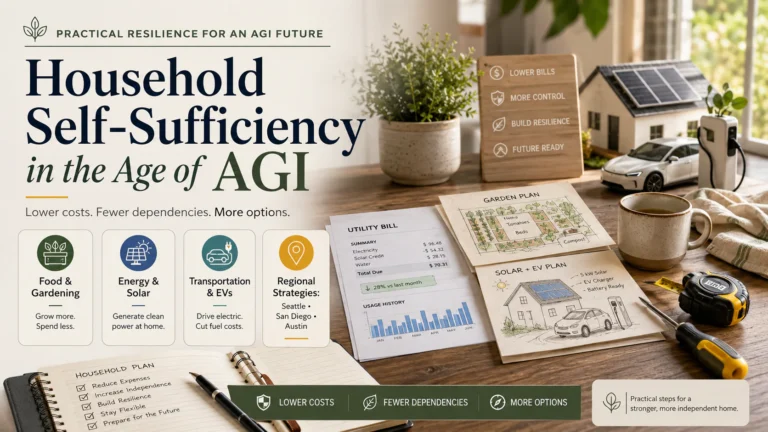
The financial principles in AGI and Financial Independence, Household Self-Sufficiency in the Age of AGI, and The AGI Mortgage Trap are robust across all four scenarios.
Prefer reversible actions that remain useful if the timeline is wrong.
Watch Capabilities, Not Personalities
Do not update a household plan every time a chief executive appears on a podcast. Track observable signals.
Agent Reliability
- How long can systems work without intervention?
- Can they recover from mistakes?
- Can they maintain goals when conditions change?
- Can they identify uncertainty and escalate appropriately?
Economic Performance
- What is the cost per successfully completed workflow?
- Do customers renew contracts and expand use?
- Are companies redesigning headcount and processes?
- Are productivity gains visible outside technology firms?
AI-Assisted AI Development
- Are models generating useful research ideas?
- Are they writing and validating meaningful parts of AI research?
- Is algorithmic progress accelerating?
RAND identifies AI's contribution to AI research as one of the most important indicators of potentially rapid capability gains. OpenAI likewise treats AI-assisted AI research as a strategic milestone.
Labor-Market Effects
Track entry-level hiring, wages, involuntary part-time work, reemployment pay, occupational transitions, and regional concentration. One company's layoff is not a trend. Similar changes across unrelated sectors are more important.
Physical Deployment
Track paid robot deployments, intervention rates, maintenance, fleet expansion, cost per completed task, safety, and insurance acceptance.
Institutional Response
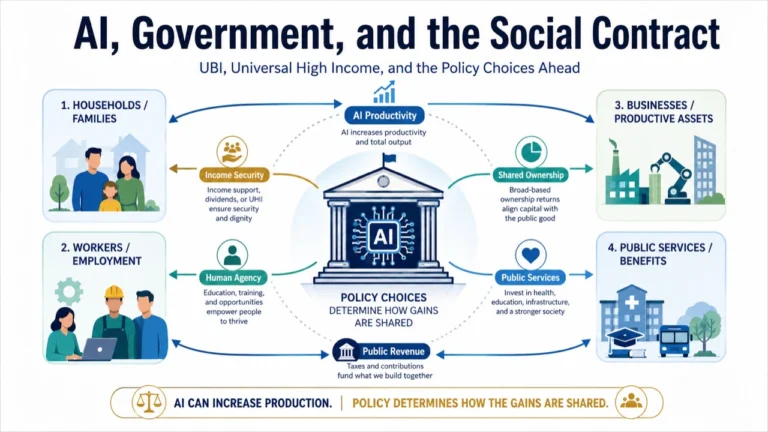
Track benefit reform, training capacity, licensing, school policy, AI procurement, universal-service proposals, social wealth funds, and government scenario planning. AI, Government, and the Social Contract explains why policy responses will depend on observed labor and productivity conditions.
Create Household Decision Triggers
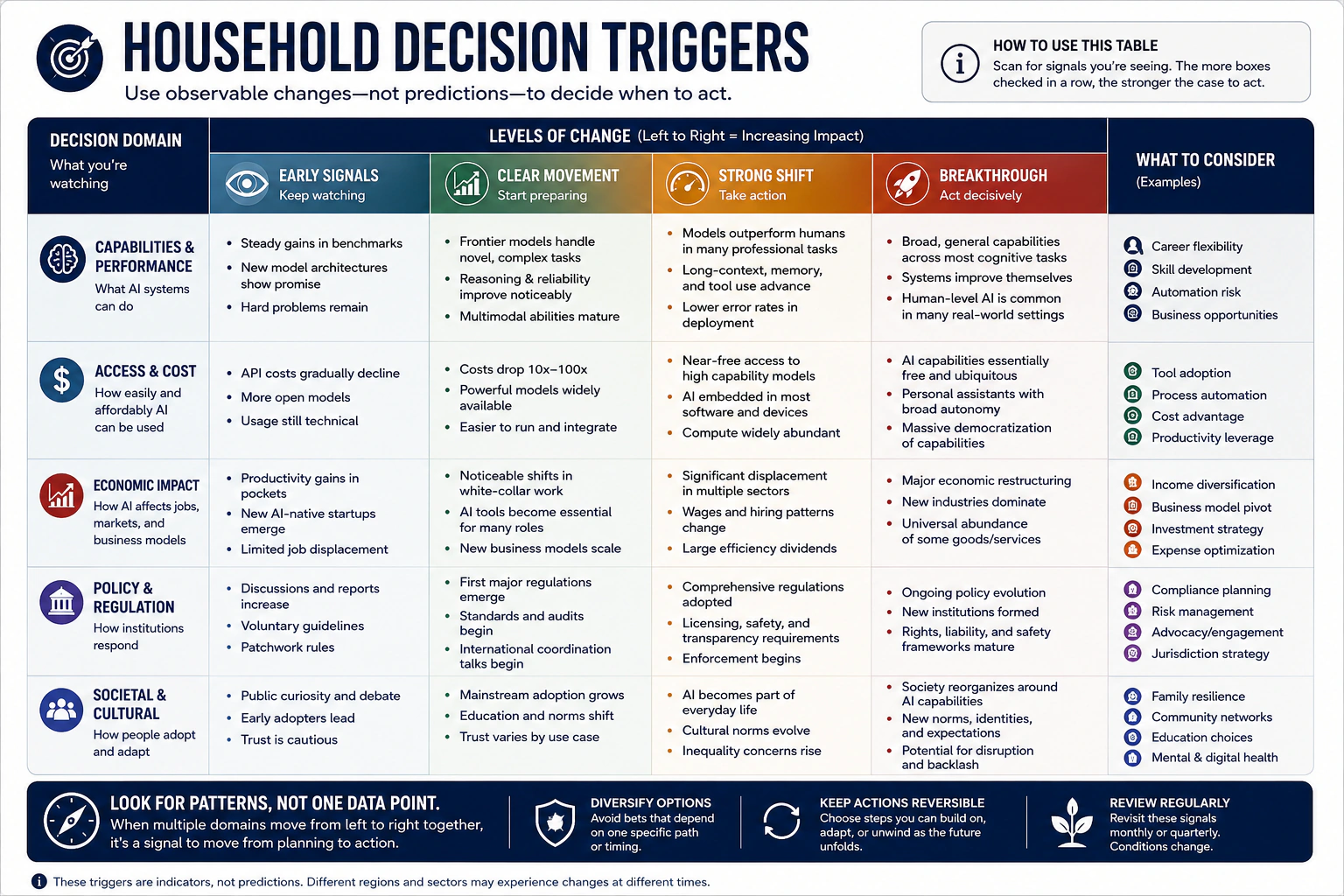
Forecast less. Define evidence that causes action.
Green: Capability Growth, Limited Structural Impact
Possible signals: systems improve but remain assistants, hiring remains broadly stable, most workflows require close review, and robotics remains specialized.
Response: learn, experiment, strengthen finances, and avoid panic.
Yellow: Organizational Restructuring Is Spreading
Possible signals: multi-day agents become dependable, entry-level hiring falls across several sectors, employers reduce teams rather than merely add tools, and wage pressure becomes visible.
Response: accelerate career repositioning, increase liquidity, validate alternative income, and reconsider large fixed commitments.
Red: Broad Economic and Institutional Restructuring
Possible signals: persistent labor-demand reduction across unrelated sectors, AI performs major research and management workflows, working hours or labor's share decline substantially, governments enact broad transition policies, and physical automation spreads at scale.
Response: prioritize resilience, reduce concentration, use available support, protect healthcare and housing, and activate career or geographic contingency plans.
Do not assign one color to the whole economy. A household can face yellow conditions in one profession while the national labor market remains green.
A 30-, 90-, and 365-Day Preparation Plan
First 30 Days
- Complete a household exposure review.
- Identify income concentration and inventory each adult's job tasks.
- Test leading AI tools in current work.
- Calculate essential monthly expenses and review benefit continuity.
First 90 Days
- Build one AI-enabled work artifact.
- Reduce one recurring cost and begin or validate one secondary-income offer.
- Update professional evidence around outcomes and strengthen five important relationships.
- Review major future commitments such as housing, education, and relocation.
First 365 Days
- Establish an appropriate liquidity target.
- Create a functioning second income path or credible fallback.
- Reduce dependence on one employer, customer, location, or industry.
- Build an annual timeline review with documented decision triggers.
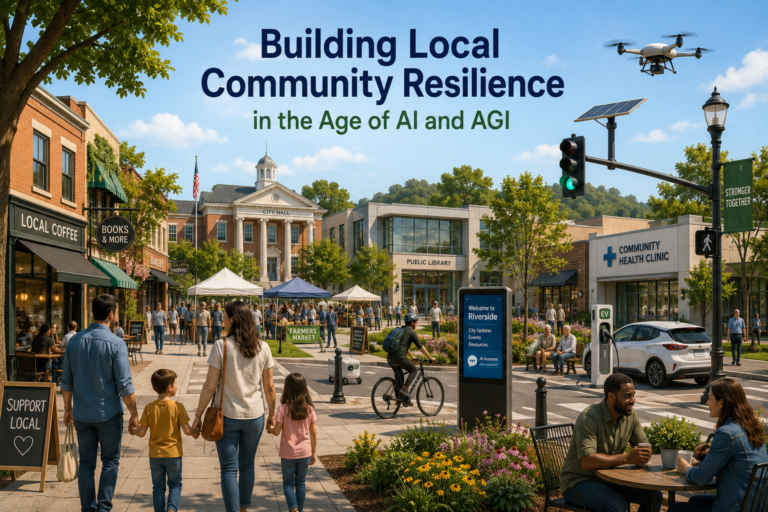
Community capacity matters too. Building Local Community Resilience in the Age of AI and AGI provides a framework for evaluating local employers, institutions, infrastructure, social capital, and information integrity.
How Often Should the Forecast Be Updated?
Use a light quarterly signal review, a deeper annual household review, and an immediate reassessment after a major capability or deployment threshold.
Do not change the plan after every model release.
Ask seven questions:
- Have systems become more autonomous, or only better at benchmarks?
- Are organizations changing staffing, or merely experimenting?
- Is cost per completed task falling?
- Is AI accelerating AI research?
- Is robotics moving beyond pilots?
- Are institutions changing benefits, licensing, taxation, or education?
- Which household assumptions are no longer true?
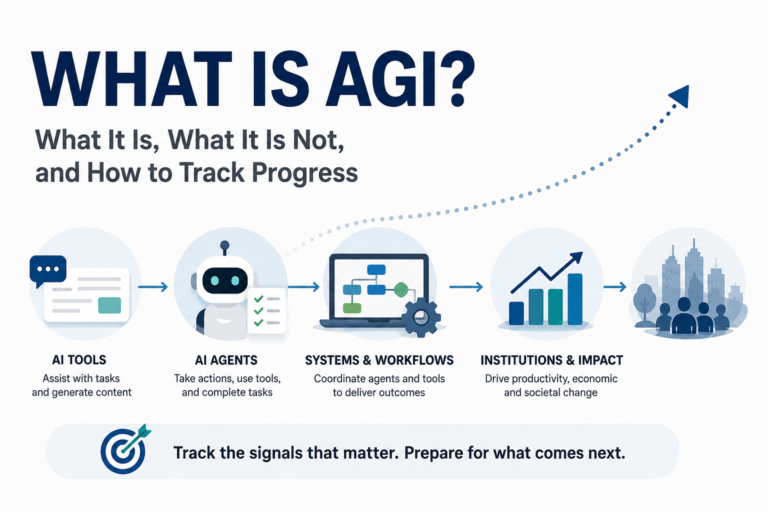
For a broader capability-monitoring framework, begin with What Is AGI? What It Is, What It Is Not, and How to Track Progress.
Final Takeaway
Peter Diamandis, Emad Mostaque, Elon Musk, Ray Kurzweil, Dario Amodei, Sam Altman, Demis Hassabis, broad researcher surveys, prediction markets, skeptics, and governments do not agree on one AGI date.
They are not always forecasting the same threshold.
But disagreement does not justify ignoring the issue.
The late 2020s are plausible enough to prepare for. The 2030s are important enough to use as a central planning horizon. Mid-century remains credible under stricter definitions. A delayed transition remains possible.
The correct household strategy is neither maximum urgency nor maximum complacency. It is robust preparation:
- strengthen liquidity;
- lower unnecessary fragility;
- build adaptable skills;
- use AI without becoming dependent on it;
- diversify income and ownership;
- protect education, relationships, and community; and
- define the evidence that would cause the plan to change.
No household needs to know the exact year AGI arrives.
It needs to remain capable if the future arrives earlier, later, or in a form no one forecast correctly.
Sources and Further Reading
Forecast Synthesis and Independent Research
- RAND: Artificial General Intelligence Forecasting and Scenario Analysis
- International AI Safety Report 2026
- Thousands of AI Authors on the Future of AI
Frontier-Lab and Executive Views
- Anthropic: Recommendations to OSTP for the U.S. AI Action Plan
- Sam Altman: Reflections
- Sam Altman: The Gentle Singularity
- OpenAI: AI Progress and Recommendations
- OpenAI: Built to Benefit Everyone, Our Plan
- OpenAI: Ten Years
- Google DeepMind: From AGI to ASI
Direct Forecasts and Alternative Views
- Moonshots: The 2026 Timeline
- Moonshots: 2026 Predictions, AI Automates Knowledge Work, Autonomous Robots, and AI CEOs
- Moonshots: Ray Kurzweil, AGI by 2029
- Moonshots: Elon Musk on the AGI Timeline
- Meta AI: I-JEPA and Yann LeCun's World-Model Approach
- Gary Marcus: AGI Is Not Imminent
- Rodney Brooks: Predictions Scorecard 2026