
AGI and Financial Independence: How Families Can Prepare for Economic Disruption
On this page
- The Real AGI Risk Is the Household Cascade
- Do Not Plan for One Future
- Scenario 1: The Abundance Transition
- Scenario 2: The Messy Transition
- Scenario 3: Debt-Deflation Labor Shock
- When Could AGI Disruption Matter?
- Financial Independence Is Not Just a Number. It Is a Control System.
- Housing: Renters, Homeowners, and the Mortgage Trap
- Renters are not safe, but they are flexible
- Homeowners may get relief, but should not rely on it
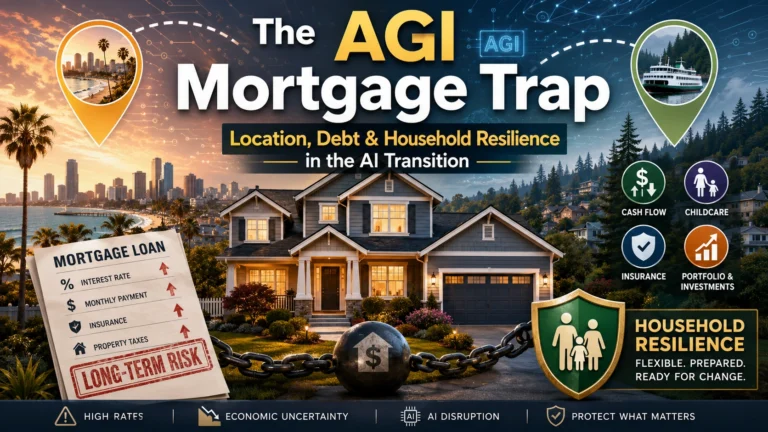
- The high-mortgage household
- Case Study: A Family of Four With $1.5M
- Scenario A: The family rents
- Scenario B: The family owns with a $900k mortgage
- Career Resilience: Become the Human in the Accountability Loop
- Basic science research
- Project management
- Portfolio Strategy: Own the Upside, Survive the Drawdown
- What Not to Do
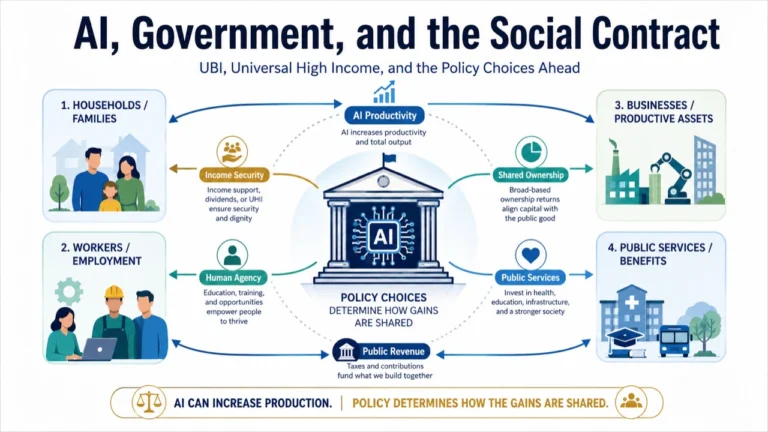
- Government Policy Is the Swing Factor
- The AGI Household Checklist
- 30-day actions
- 90-day actions
- 12-month actions
- 3-year actions
- Final Takeaway: Build Optionality Before You Need It
- Where to go next
- Sources and further reading
The best AGI plan is not a prediction. It is a household system that can survive bad timing.
Most conversations about AGI split into two clean stories.
In one story, AI creates abundance, work becomes optional, and the cost of basic needs falls. In the other story, AI destroys jobs, markets break, and households are left exposed.
Neither story is useful enough on its own. The practical household problem is more immediate: what happens to your income, housing payment, portfolio, emergency fund, and FI plan if AI disrupts labor faster than the economy adapts?
That is the planning problem. Not predicting the exact AGI timeline. Not betting everything on utopia or collapse. Building a system that keeps working when the timing is bad.
That is the risk worth planning around.
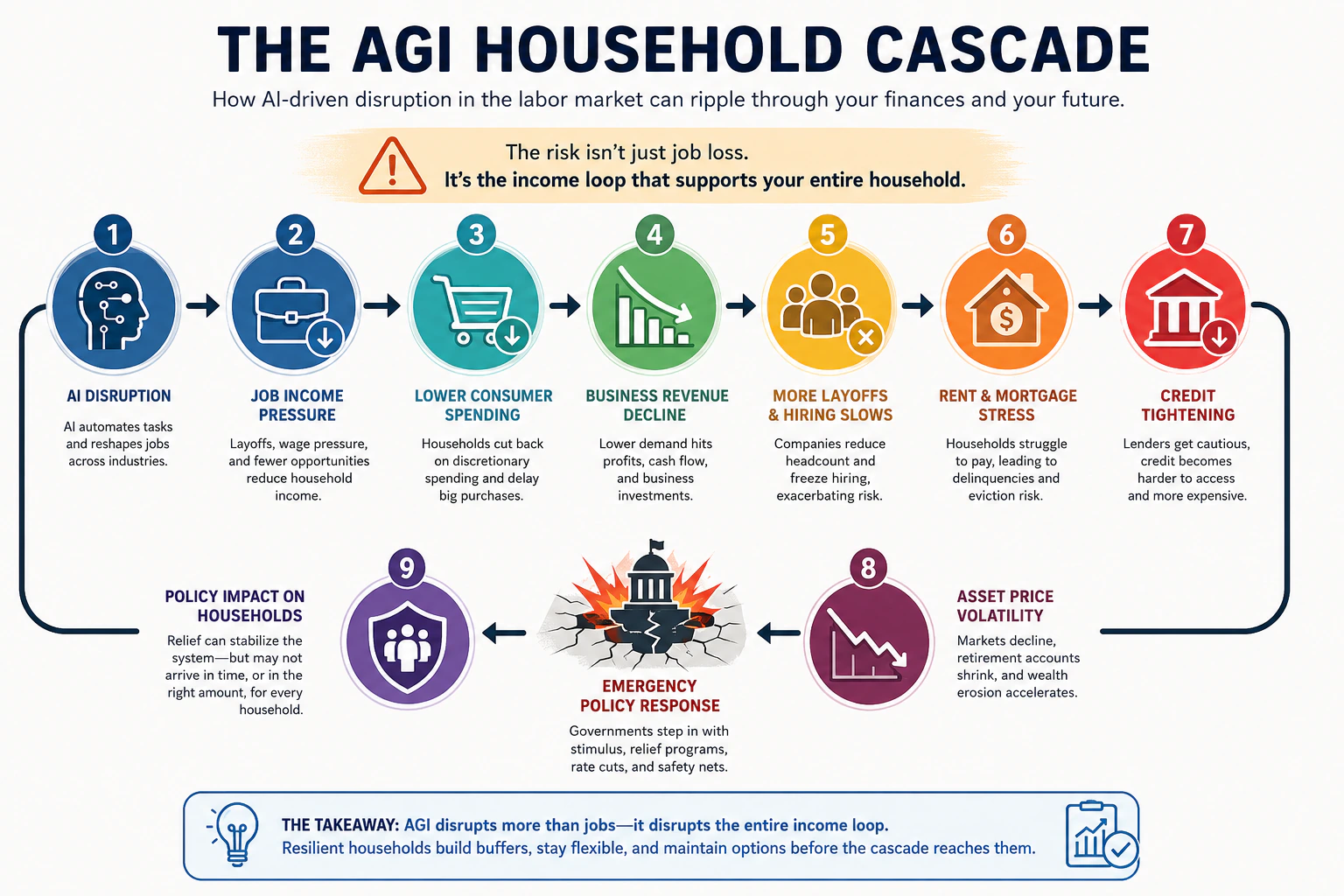
If workers lose income, they spend less. If households spend less, businesses lose revenue. If businesses lose revenue, more jobs come under pressure. If households cannot pay rent or mortgages, lenders, landlords, and local economies feel the stress. The problem is not only whether AI can do a specific job. The problem is the income loop that supports the whole household system.
AGI does not make financial planning obsolete. It makes household resilience more important.
The Real AGI Risk Is the Household Cascade
Do not reduce AGI risk to one question: Will AI replace my job?
That question matters, but it is too narrow. A job can be difficult for AI to replace and still become economically fragile if the customers, employer, funding source, or local economy behind that job weakens.
An electrician may not be directly replaced by a model. But if homeowners delay renovations, builders slow projects, offices cut maintenance, and credit tightens, the electrician can still lose income. The same logic applies to scientists, project managers, sales teams, consultants, real estate professionals, and many service businesses.
Think of AGI risk as a stack:
| Risk layer | Household question | Planning response |
|---|---|---|
| Job substitution | Can AI do meaningful parts of my work? | Map tasks, not job titles. |
| Demand collapse | Can my customers or employer still pay? | Check second-order exposure. |
| Portfolio shock | Do markets fall when I need liquidity? | Hold enough safe assets to avoid forced selling. |
| Housing stress | Can I still pay rent or mortgage? | Stress-test the full housing payment. |
| Credit stress | Do lenders tighten when I need options? | Keep credit clean before distress. |
| Policy shift | Do taxes, benefits, or bailouts change the plan? | Prepare for support, but do not depend on it. |
| Social transition | Does the system stabilize or fragment? | Preserve location, work, and spending flexibility. |
The question is not only whether AI can do your job. It is whether enough people will still have income to buy what you do.
The IMF has estimated that almost 40% of global employment is exposed to AI, with advanced economies facing higher exposure. That does not mean every exposed job disappears. It means more households should prepare for income volatility, wage pressure, changing skill demands, and policy responses.
Do Not Plan for One Future
The worst household plan is the one built around a single confident prediction.
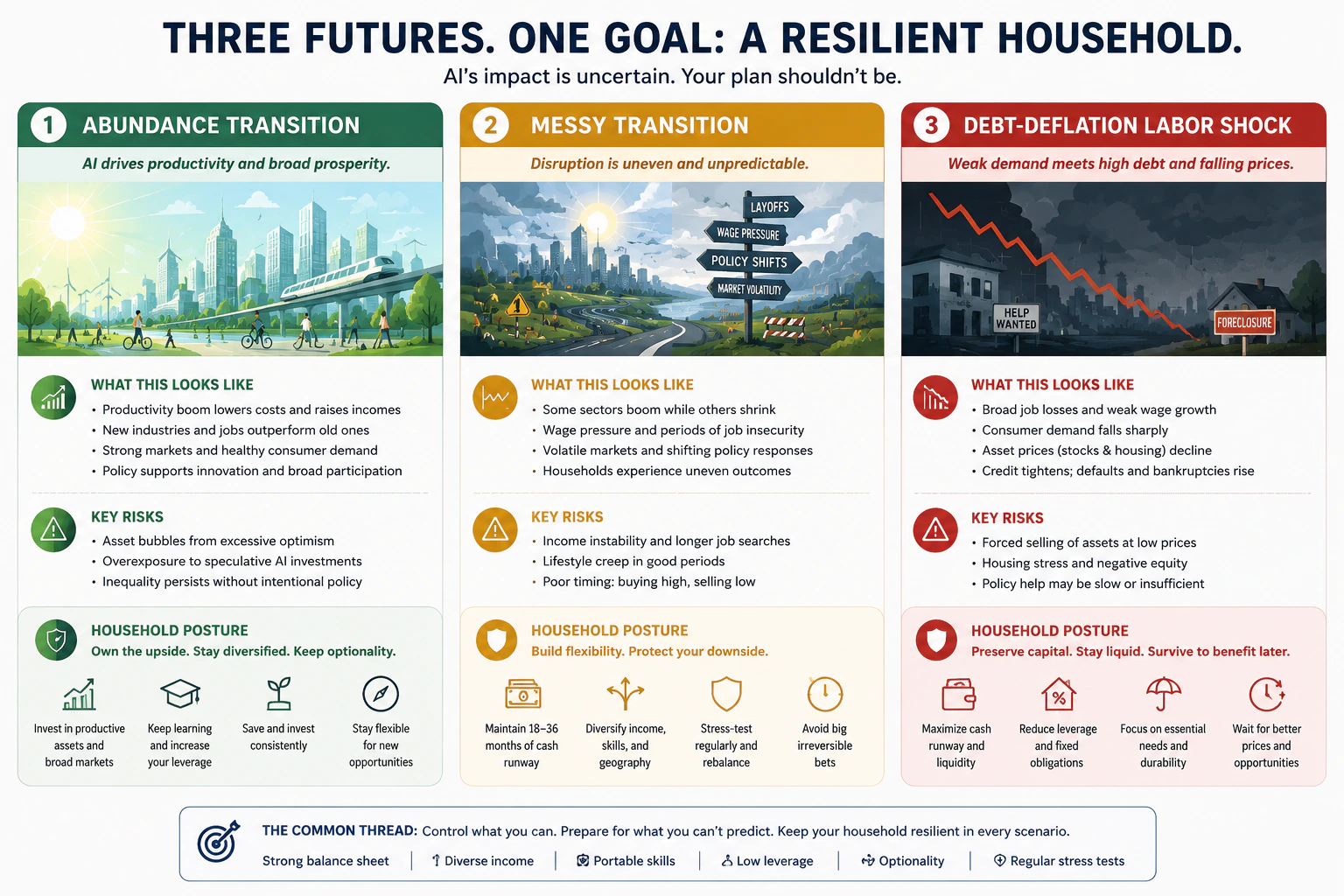
If you assume abundance arrives quickly, you may take too much risk. If you assume collapse is inevitable, you may miss upside and make life smaller than it needs to be. The better approach is to stress-test three futures.
Scenario 1: The Abundance Transition
In the optimistic scenario, AI raises productivity, accelerates science, lowers the cost of services, improves healthcare and education, and eventually makes many essentials cheaper. Public policy may redistribute some AI-driven gains through stronger safety nets, public services, UBI, an AI dividend, or broader access to AI tools.
This is possible. McKinsey has estimated that generative AI could add trillions of dollars in annual value across business functions, while AI-optimist arguments from people like Peter Diamandis frame the long-term prize as abundance rather than scarcity.
But a true abundance transition requires more than better models. It likely requires robotics, cheap energy, physical-world automation, functioning governance, broad distribution of gains, and enough time for prices to fall in categories that matter to households.
Household implication: assets may rise, work may become less necessary, and FI may become easier if essential spending falls. But taxes on capital and high earners could also rise if governments try to distribute AI gains more broadly.
Scenario 2: The Messy Transition
This is the planning base case.
It does not require full AGI or overnight job loss. It only requires enough task automation, wage pressure, hiring slowdown, market volatility, and management pressure to weaken the assumptions traditional FI plans often rely on.
AI disrupts many tasks, compresses some wages, reduces demand for certain roles, and raises productivity in uneven ways. New jobs emerge, but not quickly enough for everyone. Policy adapts slowly. Markets become more volatile. Families with low fixed costs, strong liquidity, adaptable careers, and flexible housing do better than families locked into expensive obligations.
Household implication: income becomes less predictable. The FI number matters, but the household control system matters more.
Scenario 3: Debt-Deflation Labor Shock
In the severe scenario, AI weakens labor income faster than households, employers, lenders, and governments can adapt.
The cascade looks like this:
Layoffs -> reduced spending -> business revenue decline -> more layoffs -> rent and mortgage stress -> credit tightening -> asset-price declines -> emergency policy response.
Household implication: job loss and market loss can happen together. Index funds may fall when families need cash. Renters face eviction risk. Homeowners face foreclosure or forced-sale risk. Policy becomes decisive, but may not arrive in the right amount, at the right time, for your exact household.
| Scenario | Best positioned household | Worst positioned household |
|---|---|---|
| Abundance transition | Diversified asset owner with low debt and access to AI tools | No assets, weak skills, little policy access |
| Messy transition | Liquid, flexible, low fixed costs, AI-augmented work | High lifestyle burn, concentrated income, little cash |
| Debt-deflation shock | Cash runway, low leverage, relocation options, clean credit | Large mortgage, low liquidity, AI-exposed income, forced-selling risk |
When Could AGI Disruption Matter?
Do not anchor your household plan to one AGI prediction date. Separate capability from adoption.
AI capability can move quickly. Household impact depends on adoption, regulation, employer trust, customer behavior, capital spending, litigation, data quality, and the speed at which organizations redesign workflows. Epoch AI tracks rapid progress in compute, model performance, inference cost, and AI infrastructure. At the same time, the Yale Budget Lab’s labor-market tracking is a reminder that near-term labor effects can be uneven and hard to see in broad employment data.
| Horizon | What families should watch |
|---|---|
| 0-2 years | AI tools at work, hiring freezes, junior-role pressure, productivity mandates |
| 2-5 years | White-collar displacement, wage pressure, AI agents inside operations |
| 5-10 years | Macro effects: unemployment pockets, housing stress, market repricing, policy intervention |
| 10-20 years | UBI debates, AI dividends, public AI infrastructure, larger work restructuring |
| 20+ years | Possible abundance, deep stratification, or hard-to-model systemic outcomes |
The practical takeaway: prepare for disruption in the next 3-10 years without making irreversible decisions based on either utopia or collapse.
Financial Independence Is Not Just a Number. It Is a Control System.
Traditional FI planning often assumes stable employment during accumulation, historical market returns, manageable inflation, the ability to return to work if early retirement fails, and taxes that remain roughly familiar.
An AGI transition stress-tests all of those assumptions.
If labor markets change quickly, the old fallback of “I can always go back to work” may be less reliable. If markets fall at the same time income disappears, the portfolio becomes harder to use. If policy shifts, after-tax returns and benefits can change. If housing is expensive and fixed, the household may lose flexibility right when it needs flexibility most.
Replace the single FI-number question with four resilience questions:
- Can we survive income disruption?
- Can we avoid forced selling?
- Can we reduce housing cost quickly?
- Can we adapt work, location, or spending before the market forces us to?
In an AGI transition, FI is less about reaching a number and more about preserving control when assumptions break.
This is why emergency reserves matter even for high-net-worth households. CFPB describes an emergency fund as a cash reserve for unplanned expenses or financial emergencies, including income loss. Vanguard’s 2025 emergency-savings research found that emergency savings are strongly associated with higher financial well-being and lower financial stress.
Housing: Renters, Homeowners, and the Mortgage Trap
Housing is the fragility multiplier because it is usually the largest fixed obligation in the household.
Renters are not safe, but they are flexible
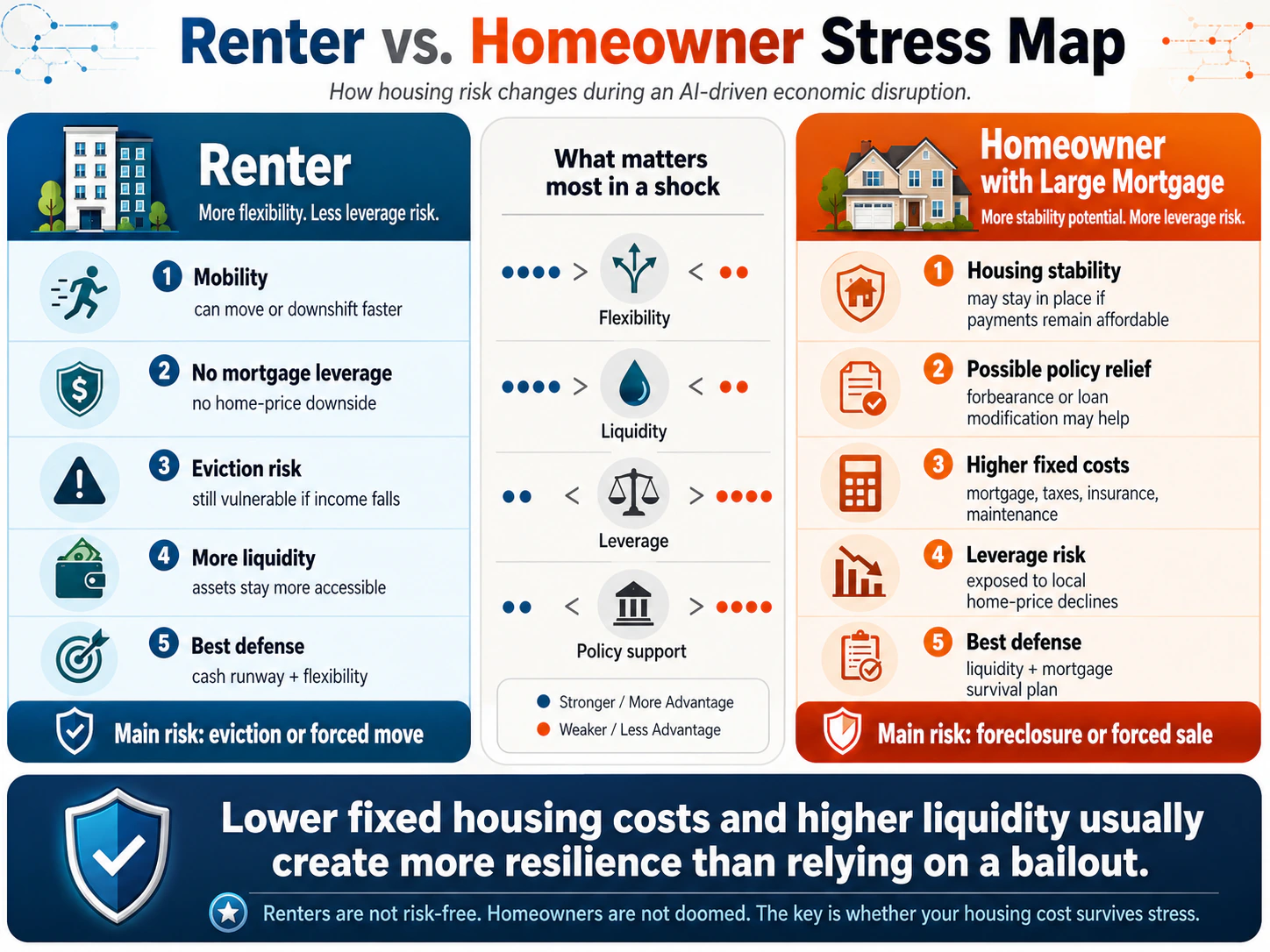
Renters still face rent increases, lease non-renewal, eviction risk, school disruption, and limited cheaper housing in high-cost areas. Flexibility does not mean immunity.
But renters often have more liquidity, no mortgage leverage, easier relocation, no local home-price exposure, and no maintenance, property-tax, or homeowners-insurance burden. In a labor-market shock, those advantages can matter.
Homeowners may get relief, but should not rely on it
Homeowners may receive forbearance, foreclosure moratoriums, loan modifications, refinancing programs, payment subsidies, or other relief in a systemic crisis. The COVID period proved that large-scale homeowner protections can happen. GAO found that pandemic foreclosure moratoriums and forbearance programs significantly reduced foreclosure risk, and foreclosures entering the process fell sharply during the period covered by federal protections.
But mortgage relief is not the same as mortgage forgiveness. CFPB explains that forbearance can temporarily pause or reduce payments, but the borrower still owes the missed amount. HUD’s FHA loss-mitigation options include repayment plans, forbearance, partial claims, and loan modifications, but those options depend on loan type, servicer process, eligibility, timing, and documentation.
Relief may preserve the home. It may not preserve the lifestyle, the equity, or the optionality.
The high-mortgage household
Consider a household with a $900,000 mortgage at 6% over 30 years. Principal and interest alone is about $5,396 per month. After property taxes, insurance, maintenance, utilities, and repairs, the full housing cost can plausibly land in the $7,000-$8,500/month range in many high-cost areas.
That payment is not just a housing decision. It is a bet on future income stability.
Decision rule: own the home because the payment survives stress. Do not own because you expect a bailout.
Case Study: A Family of Four With $1.5M
Assume a family of four with $1.5 million in financial assets, living in a high-cost suburb similar to Seattle or San Diego. One adult works in basic science research. The other works in project management. Both are concerned about AI-driven disruption.
The family is not broke. It is not financially careless. But the household still has to decide whether its structure can survive a messy transition.
Scenario A: The family rents
Strengths:
- High liquidity
- No mortgage leverage
- Relocation flexibility
- Ability to downshift housing faster
- Less exposure to local home-price decline
Weaknesses:
- Rent still has to be paid
- High-cost suburbs limit cheap options
- Children and school ties reduce mobility
- Landlord decisions create policy and renewal risk
Recommended posture: keep 18-36 months of core expenses liquid, avoid buying unless the mortgage survives a severe stress test, use AI aggressively in both careers, diversify the portfolio, and preserve relocation options. The upper end of that range is most relevant for households with children, high housing costs, one main earner, AI-exposed income, variable income, or large mortgage obligations.
Scenario B: The family owns with a $900k mortgage
Strengths:
- Housing stability if payments remain affordable
- Possible homeowner relief in a systemic crisis
- Inflation protection if fixed-rate debt becomes cheaper in real terms
- Emotional stability for children if the home is retained
Weaknesses:
- Large fixed payment
- Taxes, insurance, maintenance, and repairs
- Local home-price exposure
- Lower flexibility
- Possible forced sale if income falls and markets decline together
Recommended posture: hold 18-24 months of full housing cost liquid, avoid new HELOC, car, or renovation debt, understand loan-modification and forbearance options before distress, set sell/downsize/rent-out triggers in writing, and consider mortgage paydown only after liquidity is already secure.
| Factor | Renter with $1.5M | Homeowner with $900k mortgage |
|---|---|---|
| Liquidity | Strong | Depends on down payment and reserves |
| Housing flexibility | High | Low |
| Leverage | Low | High |
| Policy relief option | Lower | Higher |
| Forced-sale risk | Lower | Higher |
| Failure mode | Eviction or relocation | Foreclosure or forced sale |
| Best defense | Mobility + cash | Cash + mortgage survival plan |
Career Resilience: Become the Human in the Accountability Loop
The safest work is not simply work that AI cannot touch. The safer position is work that combines AI with accountability, regulation, liability, domain judgment, physical-world constraints, human trust, or ownership.
The OECD’s work on AI and skills points toward a practical conclusion: workers need more than tool familiarity. They need adaptable digital, managerial, social, and judgment skills that help them use AI inside real organizations.
Basic science research
Risks include AI-generated literature reviews, hypothesis generation, grant-writing support, lab automation, pressure on junior roles, and funding volatility.
Defensive moves:
- Become excellent at validating AI-generated hypotheses.
- Learn lab automation, statistics, and data pipelines.
- Move toward regulated, clinical, translational, or safety-critical research.
- Build grant, IP, compliance, and experimental-design fluency.
- Become the bridge between AI outputs and experimental reality.
Project management
Risks include automated scheduling, automated status reporting, AI-generated risk logs, automated meeting summaries, and fewer coordinator roles.
Defensive moves:
- Move toward technical program management.
- Manage regulated, physical, infrastructure, clinical, cybersecurity, or hardware programs.
- Own escalation, tradeoffs, stakeholder trust, and accountability.
- Use AI to automate low-value coordination before someone else does.
- Become the person who turns messy inputs into decisions.
The goal is not to avoid AI. The goal is to become the person trusted to use it, verify it, and make decisions around it.
Portfolio Strategy: Own the Upside, Survive the Drawdown
A household should not respond to AGI risk by going all cash. It also should not respond by going all AI stocks.
The resilience model is simple: own enough broad productive assets to participate in upside, while holding enough safe assets to avoid selling equities after a 30-50% drawdown during an income shock.
| Bucket | Purpose |
|---|---|
| Cash / money market / T-bills | Emergency runway and decision time |
| Short-term high-quality bonds | Recession and job-loss buffer |
| Global equities | Productivity and ownership upside |
| Value / international exposure | Reduce U.S. mega-cap AI concentration |
| Real assets / inflation hedges | Policy, infrastructure, and inflation resilience |
| Speculative AI bets | Optional, capped, not the foundation |
BlackRock frames AI as a major investment force, but also notes that productivity gains require infrastructure buildout and broad adoption. Acemoglu’s macroeconomic work provides a useful counterweight: AI may be important while aggregate productivity gains arrive more slowly or unevenly than optimistic forecasts imply.
That is the portfolio lesson. AI can be transformative and still disappoint investors if expectations, valuations, concentration, or timing get too stretched.
Actionable rules:
- Hold enough safe assets to avoid selling equities after a major drawdown.
- Cap single-stock and employer-stock exposure.
- Do not let employer income, local housing, and index funds all become the same AI-cycle bet.
- Use tax-advantaged accounts, but keep taxable liquidity.
- Rebalance at least annually.
This is a resilience model, not individualized investment advice.
What Not to Do
A resilience plan should reduce fragility. It should not turn fear into a new form of concentration risk.
- Do not go all cash. Cash buys time, but a household still needs productive assets if AI creates real economic upside.
- Do not go all AI stocks. A transformative technology can still become an overpriced investment theme.
- Do not buy the maximum house the bank allows. The bank qualifies the loan. It does not guarantee your future income.
- Do not assume UBI will preserve your lifestyle. Policy support may cover basics while leaving high fixed costs exposed.
- Do not assume an AI-resistant job is safe. Customer demand, employer budgets, and local spending can still weaken.
- Do not count home equity as emergency liquidity. Equity is useful, but it can be slow, costly, or unavailable when credit tightens.
- Do not wait for your employer to train you on AI. Build your own working fluency before the labor market forces the issue.
Government Policy Is the Swing Factor
Whether AGI becomes a transition or a crisis will depend heavily on policy.
| Policy | Household effect |
|---|---|
| UBI / AI dividend | Supports basic consumption |
| Expanded unemployment | Bridges job loss |
| Wage insurance | Helps people take lower-paying work |
| Mortgage forbearance | Delays foreclosure, but does not erase debt |
| Rent assistance | Reduces eviction risk |
| AI-profit or capital taxation | Funds redistribution, may lower after-tax returns |
| Public AI infrastructure | Broadens access to productivity tools |
| Healthcare decoupled from employment | Reduces job-loss shock |
The optimistic version is that policy helps households bridge disruption until productivity gains and lower costs spread. The harsher version is that support arrives late, unevenly, or with tradeoffs that change taxes and asset returns.
Policy can also help one part of the household while hurting another. UBI or an AI dividend may support consumption. AI, corporate, capital-gains, or wealth taxes may reduce after-tax investment returns. Mortgage relief may help homeowners while rent assistance helps renters. Fiscal support may stabilize demand in the short run while creating future inflation risk, tax pressure, or political tradeoffs.
A family should prepare for policy support, but not depend on policy support arriving in the right amount, at the right time, for their exact situation.
One blunt example: UBI may cover basics. It probably does not cover a high mortgage in a high-cost suburb.
The AGI Household Checklist
This is where the article becomes useful. You do not need to solve AGI. You need to reduce household fragility.
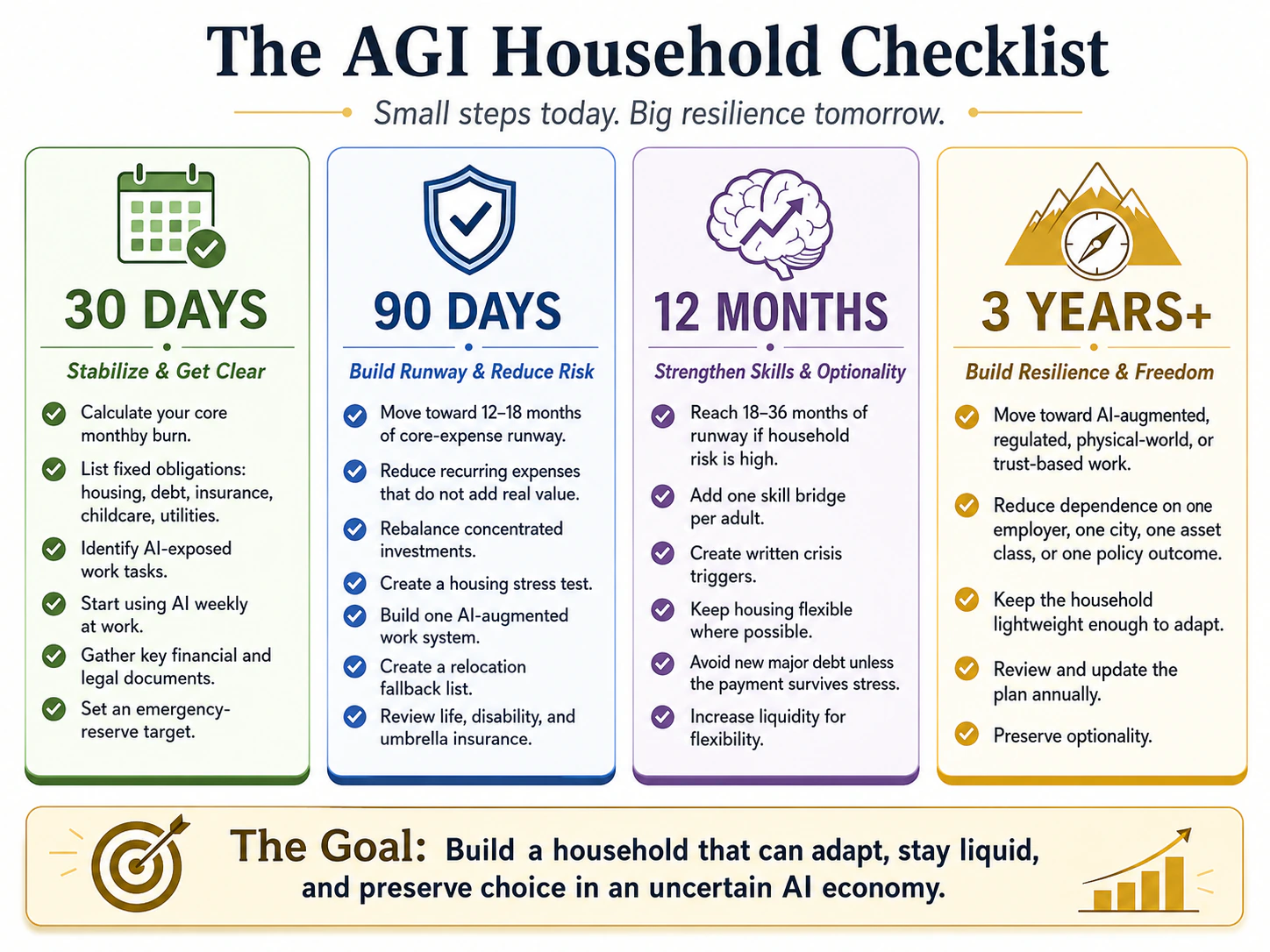
30-day actions
- Calculate core monthly burn.
- List fixed obligations: rent/mortgage, debt, insurance, childcare, school, utilities, subscriptions.
- Identify AI-exposed work tasks, not just AI-exposed job titles.
- Start using AI weekly at work.
- Freeze credit if you do not need new borrowing soon.
- Review insurance: health, life, disability, umbrella, homeowners or renters.
- Gather estate, tax, mortgage/rent, and account documents.
- Set a realistic emergency-reserve target.
90-day actions
- Move toward 12-18 months of core-expense runway if your income is concentrated or AI-exposed.
- Reduce recurring expenses that do not create real value.
- Rebalance concentrated investments.
- Create a housing stress test.
- Build one AI-augmented work system that saves time or improves output.
- Create a relocation fallback list.
- Review life, disability, and umbrella insurance.
12-month actions
- Reach 18-36 months of runway if household risk is high. The upper end is most relevant for families with children, high housing costs, one main earner, variable income, AI-exposed income, or large mortgage obligations.
- Add one skill bridge per adult.
- Create written crisis triggers: when to cut spending, sell assets, move, modify a mortgage, or shift career path.
- Keep housing flexible where possible.
- Avoid new major debt unless the payment survives a stress test.
3-year actions
- Move income toward AI-augmented, regulated, physical-world, trust-based, or ownership-linked work.
- Reduce dependence on one employer, one city, one asset class, or one policy outcome.
- Keep the household lightweight enough to adapt.
Final Takeaway: Build Optionality Before You Need It
AGI may eventually make life materially easier. It may lower costs, improve services, expand productivity, and make traditional work less central to survival.
It may also create a painful transition before those benefits are broadly distributed.
A household does not need to predict the exact outcome. It needs to avoid fragility. That means enough liquidity to wait, low enough fixed costs to adapt, enough assets to participate in upside, enough career flexibility to remain useful, and enough housing flexibility to preserve choices.
The best AGI plan is not a prediction. It is a household system that keeps working when the prediction is wrong.
Where to go next
If this post made your FI plan feel too dependent on one set of assumptions, start by making the model more visible.
- The Real Work in FI Is Not the Number. It Is the Control Loop.
- The 4% Rule Revisited: Safe Withdrawal Rates for Modern FI
- How to Do an Expense Audit
- What It Really Costs to Raise a Child in the US
When you are ready to compare scenarios, explore FI Architect for iOS. The goal is not to guess the future perfectly. The goal is to understand which assumptions matter before they break.
Sources and further reading
- IMF: AI Will Transform the Global Economy
- OECD: AI and Skills
- Financial Stability Board: The Financial Stability Implications of Artificial Intelligence
- Epoch AI: Trends in Artificial Intelligence
- Yale Budget Lab: Tracking the Impact of AI on the Labor Market
- NBER: Generative AI at Work
- Daron Acemoglu: The Simple Macroeconomics of AI
- McKinsey: The Economic Potential of Generative AI
- BlackRock Investment Institute: Digital Disruption and AI
- CFPB: An Essential Guide to Building an Emergency Fund
- Vanguard: Emergency Savings, Financial Well-Being, and Financial Stress
- CFPB: What Is Mortgage Forbearance?
- HUD: FHA Loss Mitigation
- GAO: COVID-19 Housing Protections
Educational content only. This article does not provide individualized financial, investment, tax, legal, housing, or career advice. AGI timelines and economic outcomes are uncertain, so any household plan should be stress-tested against multiple scenarios and current local data.